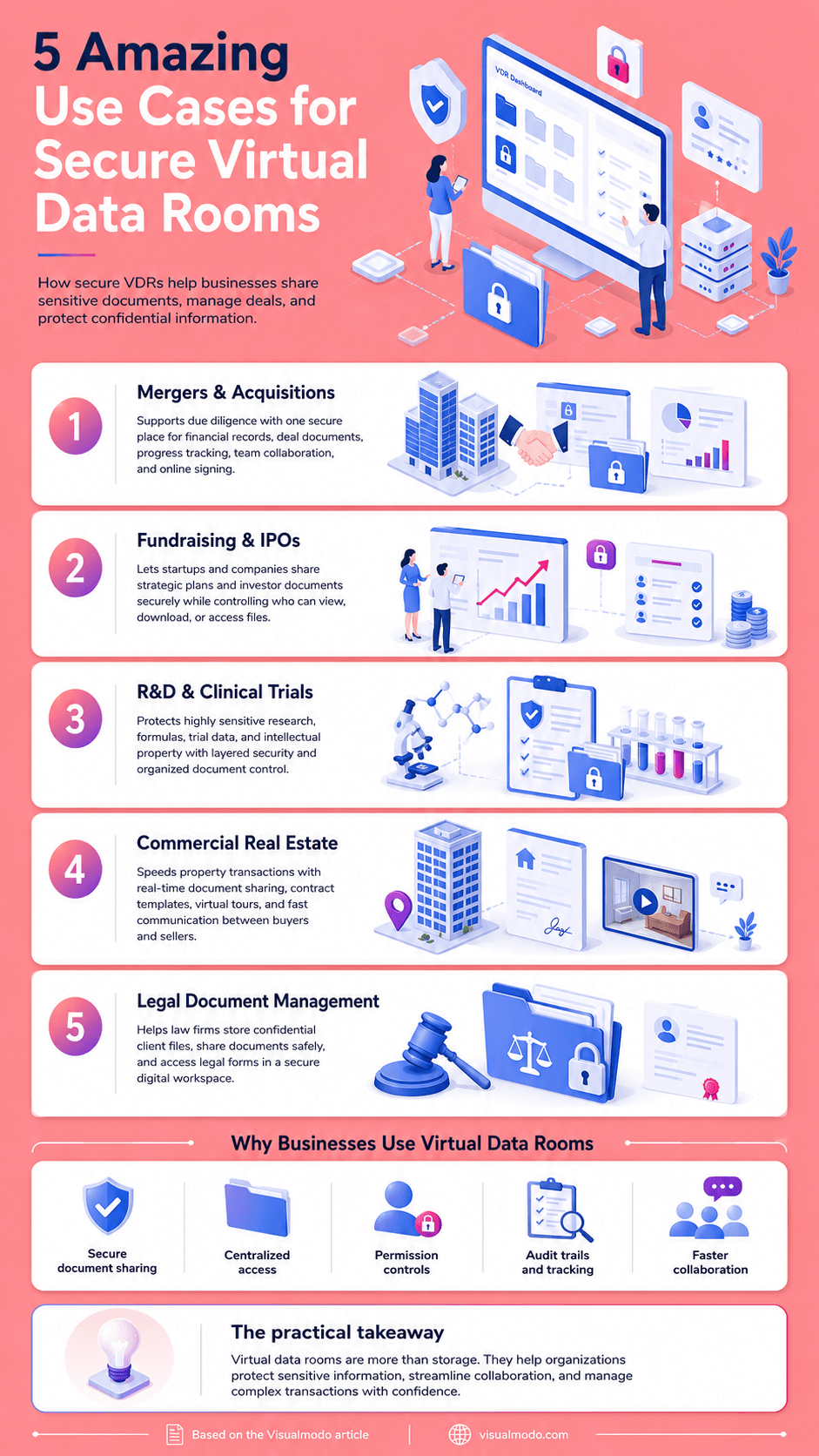
Know 5 amazing use cases for secure virtual data rooms; While this trend seems to be driven largely by aesthetics, there is a deeper reason behind this fascination with all things soft.
That 2018-era forecast is worth checking against what’s actually happened now that 2026 has arrived. Current estimates from Grand View Research place the market at $2.42 billion in 2024, with other major research firms estimating 2025-2026 values in the $3.2 to $4.1 billion range, growing at compound annual rates between roughly 11 and 22 percent depending on the methodology. The original 2018 forecast held up reasonably well, landing in the same general range as more recent, independently produced estimates, which says something about how consistently this category has grown rather than spiking or stalling unpredictably.
5 Amazing Use Cases for Secure Virtual Data Rooms
Did you know that the virtual data room industry has been amongst the fastest-growing business sectors in the last five years? The global electronic data room market was valued at $1.3 billion in 2018 and is expected to hit $3.63 billion in 2026.
Not many people in the business sectors knew about virtual data rooms a decade ago, but now data room software is an integral element in all business types and sizes. So how did this unbelievable growth happen?
The surge in data room usage was triggered by the growing rate of cybercrimes and more and more businesses going online. However, digitalization also paved the way for hackers and cybercriminals. As a result, businesses started looking for reliable and secure online communication and data storage platforms. This is where online data room software came to a revolutionary rescue.
Although virtual data room software is now used by professionals, government agencies, and all types of businesses; here are the top 5 amazing use cases for secure virtual data rooms.
5 most common use cases of online data room software
1 – Mergers and acquisitions
Mergers and acquisitions are indeed the biggest business transactions, and 2021 saw more than 450 massive-scale M&As. It is imperative when one business tries to acquire another; it goes deeper into the company’s roots.
In other words, acquiring companies intend to know about the target company as much as possible. For that reason, the acquirer demands a comprehensive analysis and verification of financial and business records.
How does a virtual data room help?
Companies use a virtual data room for due diligence in mergers and acquisitions. Essentially centralized data repositories, the data rooms, where companies store all their data for due diligence.
A centralized data storage allows the acquiring company to access any document from a single place. As a result, the project management teams from both sides can communicate in virtual data rooms; and the target company can easily protect its confidential data from being misused. In addition, both parties can track the deal’s progress and sign documents online.
M&As are also the biggest use case of data room software – and DealRoom, iDeals, and Merrill are some of the most famous data room vendors for M&As.
2 – Fundraising, Initial Public Offerings (IPOs)
Virtual data rooms are ideal solutions for fundraising. Fundraising takes time, and fundraisers have to take care of the company’s confidential information. When a company goes public or starts an IPO, it has to be an open book for investors.
Investors can rightfully demand copies or access to the company’s strategic plans, business objectives, and other important details before investing.
This is where data room software comes in handy. It is unsafe for businesses to send copies of all documents to potential investors. Therefore, fundraisers use data room services to store all necessary information and invite potential investors to access and use the documents required. It is important to note that fundraisers have complete control over the information all the time.
3 – R&Ds, clinical trials
Pharmaceutical and research and development companies mostly use virtual data rooms to protect their highly sensitive data. Recorded search results and maintained them in a specific order during the search process. R&D companies are always a primary target of hackers and competitors because a secret formula or a unique product design can help a business generate millions in revenue.
An electronic data room helps such companies protect their secret information because virtual data rooms are undisputed kings when it comes to data security. It is simply next to impossible to infiltrate through multiple security layers of data rooms.
4 – Commercial real estate transactions
The sale or purchase of real estate assets is a data-driven transaction, especially when trading commercial properties. Real estate firms or realtors would know how important it is to prepare documents quickly, send them to both parties, and start negotiations. A delayed response from realtors can cost them, big-check clients. Using virtual data rooms, realtors can communicate with both parties simultaneously and share documents in real time. In fact, some of the best data rooms provide a wide range of customizable templates for legal affairs and contracts.
The best thing is that parties involved in the transaction can sign documents online. On top of that, and can use data rooms to arrange video tours of the concerned real estate properties.
5 – Legal documents management
Law firms commonly use virtual data rooms as their primary data storage option. As a result, lawyers are in possession of highly confidential and personal information of their clients, and data breaches can put them in legal trials.
Apart from that, most virtual data room providers have a massive digital library of legal forms to simplify things for lawyers. Therefore, data rooms are an ideal place to communicate with clients safely.
What to actually check before choosing a provider
Beyond the use cases above, a few concrete things separate a genuinely secure data room from one that just claims to be.
SOC 2 Type II certification confirms an independent auditor has verified a provider’s security controls over an extended period, not just at a single point in time, covering data protection, availability, and confidentiality. ISO 27001 certification covers a broader information security management system standard, and providers serving international clients, particularly in M&A or cross-border deals, often carry both.
Dynamic watermarking, which overlays a viewer’s name, IP address, and timestamp directly onto documents as they’re viewed or downloaded, is a standard feature in serious providers and a meaningful deterrent against leaks, since it makes the source of any leaked document immediately traceable. Granular permission controls, view-only versus download access, expiring links, and role-based restrictions by document folder, matter enormously in due diligence specifically, where different parties often need very different levels of access to the same repository. A complete audit trail, logging exactly who viewed, downloaded, or printed which document and when, is the feature that actually gets used when a dispute arises after a deal closes.
Asking a prospective provider to confirm all four of these directly, rather than assuming they’re included, is a five-minute check worth doing before signing a contract. For identity verification concerns during document review specifically, Visualmodo’s guide to ID card scanning software for remote verification covers a closely related consideration in due diligence workflows.
How virtual data room pricing actually works
Pricing in this category is notoriously opaque, most providers quote rather than publish rates, which makes it hard to compare options without already being deep in the buying process. It’s worth understanding the common structures before requesting quotes.
Per-page pricing, common with older or more traditional providers, charges based on the volume of pages uploaded, which can become expensive quickly for document-heavy due diligence projects. Flat monthly or per-project pricing, more common with modern cloud-based providers, charges a fixed rate regardless of document volume, generally more predictable for larger projects. Storage-based pricing charges by data volume rather than page count, which matters more for data rooms handling large files like video, CAD drawings, or extensive financial datasets rather than primarily text documents.
Getting quotes structured the same way from at least two or three providers, rather than comparing a per-page quote against a flat monthly quote directly, is the only way to make an honest cost comparison.
Rounding it up
Virtual data rooms have quickly become a must-have asset for any business that goes digital. They are safe for business data storage, online communication, and deal-making. They are commonly used for M&As, fundraising, real estate transactions, clinical trials, and legal document management.
Virtual data room FAQ
At minimum, SOC 2 Type II, which confirms independently audited security controls over time. ISO 27001 is a broader information security standard worth looking for as well, particularly for international or cross-border transactions. Confirm both directly with any provider rather than assuming certification based on general reputation.
Pricing varies by structure, per-page, flat monthly, or storage-based, and most providers quote rather than publish rates. Getting quotes structured the same way from multiple providers is the only reliable way to compare cost, since a per-page quote and a flat monthly quote aren’t directly comparable without doing that conversion yourself.
Dynamic watermarking overlays a viewer’s identifying information, name, IP address, timestamp, directly onto a document as it’s viewed or downloaded. It’s a standard security feature in serious data room providers and makes any leaked document traceable back to whoever accessed it.
They’re all established M&A-focused providers, but scale and pricing structure vary. Getting comparable quotes and confirming which specific certifications and features, watermarking, permission granularity, audit trail depth, each includes at your specific deal size is more useful than assuming any one is universally the best choice.
Infographic