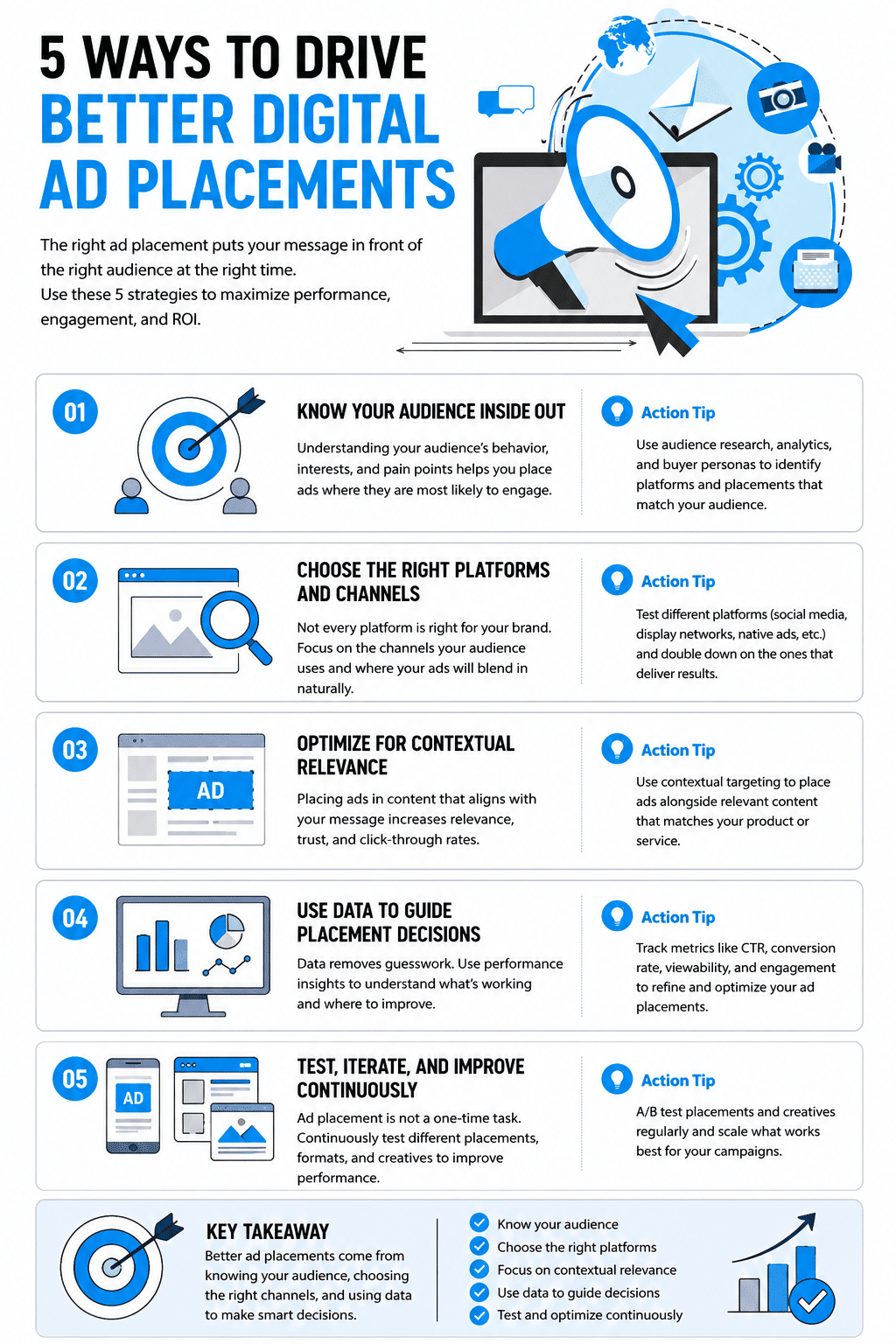
Companies worldwide spend billions of dollars on digital advertising each year, and that spending keeps growing. Global digital ad spend surpassed $600 billion in 2023 and is projected to approach $1 trillion by 2027 according to Statista projections. The reason brands keep increasing budgets is straightforward: digital advertising, when executed well, delivers measurable, scalable returns that traditional channels simply cannot match.
But spending more does not automatically produce better results. The difference between a campaign that delivers a strong return on investment and one that burns budget with little to show is almost always a placement strategy problem, not a creative problem.
Digital ads reach audiences across five main channels: search ads (appearing on Google and Bing when users actively look for something), display ads (banner and visual formats placed on websites and apps), paid social (targeted placements inside social media feeds), video advertising (pre-roll, mid-roll, and in-feed video formats), and programmatic and native advertising (automated, data-driven placements across thousands of publisher sites).
Each channel reaches a different audience in a different mindset. Understanding which channel fits your goal, how to target the right audience within it, and how to measure whether your placements are actually working is what separates advertisers who grow from those who waste budget.
The five strategies below cover each of those questions with specific, actionable guidance.
Table of contents
- Brand Safety and Content Moderation
- Contextual Advertising: Matching Ads to Content, Not Just Audiences
- Ad Targeting with Computer and Machine Vision
- Programmatic Advertising: How Automated Placement Actually Works
- Find Your Target Audience to Drive Better Digital Ad Placements
- Choose Your Media Placements
- Measure Results and Optimize to Drive Better Digital Ad Placements
- Frequently Asked Questions About Digital Ad Placements
- Placement Strategy Is Where Campaigns Are Won or Lost
Brand Safety and Content Moderation
Where your ad appears is as important as what your ad says. An advertisement for a family product placed next to extremist content, graphic imagery, or inflammatory news stories does not just fail to perform. It actively damages brand perception and can trigger public backlash.
Brand safety is the practice of ensuring your ads appear only in environments that are appropriate for your brand. It is one of the most commonly underestimated dimensions of ad placement strategy.
Ad servers and programmatic platforms use artificial intelligence and optical character recognition (OCR) technology to analyze the content of pages where ads might appear. OCR converts text in images into machine-readable content, which allows automated systems to scan publisher pages for offensive content, category violations, and contextual mismatches before serving an ad. Computer vision systems perform the same function for visual content, identifying images that may be inappropriate for placement alongside branded advertising.
In practice, managing brand safety involves several layers.
- Category exclusions tell your ad platform to avoid specific content categories such as news about tragedies, violent or graphic content, politically charged topics, or adult themes. Most major platforms including Google Ads and Meta provide built-in content category exclusions.
- Keyword blocklists prevent your ads from appearing on pages that contain specific terms. These can be customized to your brand’s specific sensitivities and updated as needed.
- Third-party brand safety tools from vendors like DoubleVerify, Integral Ad Science (IAS), and MOAT provide independent verification and measurement of where your ads actually appear, including post-campaign reports that show what percentage of your budget ran in brand-safe environments.
Investing in brand safety controls is not just a reputation decision. It is a performance decision. Research consistently shows that brand-safe placements produce higher engagement rates than ads appearing in low-quality or inappropriate environments, because audience attention and trust are higher in contexts that feel reputable and relevant.
Contextual Advertising: Matching Ads to Content, Not Just Audiences
Contextual advertising places your ads on pages whose content is directly relevant to what you sell, regardless of who is reading them. Instead of targeting a person based on their browsing history or demographic profile, contextual advertising targets a page based on its subject matter.
If you sell running shoes, your ad appears on pages about marathon training, fitness gear reviews, and injury prevention guides. If you sell accounting software, your ad appears on pages about small business taxes, bookkeeping tips, and payroll management.
Contextual advertising has become increasingly important for two reasons. First, growing privacy regulations and browser-level restrictions on third-party cookies have reduced the effectiveness of purely behavioral targeting. Second, Google’s own research and independent studies have shown that users respond more positively to ads that are relevant to what they are already reading than to ads that feel like a behavioral data system is following them around.
On Google Display Network and Google Search, contextual targeting is managed through topic targeting and keyword targeting, where you specify the subjects or terms relevant to your product, and Google matches your ads to pages containing those topics.
On programmatic platforms, contextual targeting has seen a significant technology upgrade in recent years. Modern contextual systems from providers like Oracle Data Cloud, Brand.com, and GumGum analyze not just the text of a page but also images, video, sentiment, and surrounding article themes to match ads with far greater precision than keyword lists alone could achieve.
For brands whose audience is difficult to define through behavioral data, contextual advertising provides a reliable, privacy-compliant path to relevant placement.
Ad Targeting with Computer and Machine Vision
Computers can acquire knowledge through artificial intelligence and machine learning. With advancements in artificial intelligence, they can perform specific tasks and function like the human brain. Machine language can develop computer programs that look for data patterns and adjust when new designs emerge.
Computer vision is more precise for ad targeting. This interdisciplinary field focuses on enabling computers to gain high-level knowledge from digital videos and images. It can extract information from the millions of pictures posted across social media websites.
Eye-tracking is one of the methods for analyzing consumer behavior. It uses analytical software to track the user’s eyes and analyze how consumers respond when reading ads. Then, computer vision technology uses this data to learn more about consumers and share the information with advertisers.
Programmatic Advertising: How Automated Placement Actually Works
Most digital display and video advertising today is bought and sold programmatically, yet many marketers who use it every day cannot explain how it actually works. Understanding the mechanics makes you a significantly better buyer.
Programmatic advertising is the automated buying and selling of digital ad inventory through software platforms, with prices set in real time through an auction process called Real-Time Bidding (RTB). When a user loads a webpage that carries programmatic ad slots, an auction takes place in milliseconds. Advertisers bid based on their targeting parameters, the winning bid gets the slot, and the user sees the winning ad, all before the page fully loads.
- The demand side. Advertisers access programmatic inventory through Demand-Side Platforms (DSPs) such as Google Display and Video 360, The Trade Desk, and Amazon DSP. DSPs allow advertisers to set targeting criteria, budgets, and bid strategies, then automatically compete for relevant impressions across thousands of publisher sites simultaneously.
- The supply side. Publishers make their inventory available through Supply-Side Platforms (SSPs) such as Google Ad Manager, Magnite, and PubMatic. SSPs manage which buyers can access which inventory and at what floor prices.
- Open exchange vs private marketplace. In an open exchange, any buyer can compete for any available inventory. In a private marketplace (PMP) deal, a publisher offers preferred access to specific advertisers, typically at a negotiated minimum price. PMP deals generally deliver higher-quality inventory and more predictable brand-safety outcomes because the publisher relationship is direct and vetted.
For advertisers new to programmatic, starting with a major DSP like Google Display and Video 360 or using Google Ads’ automated targeting options provides access to programmatic’s efficiency advantages without requiring the technical complexity of a fully custom setup.
Find Your Target Audience to Drive Better Digital Ad Placements
Identifying your ideal customer helps you buy the right digital ad placements. This information gives ideas on where to place your ads. After you determine your target audience, you should ask the following questions:
- What websites does your ideal customer frequent?
- What specific problems is your target audience facing?
- What social media platforms do they use?
- Where do your competitors’ customers hang out online?
- What messages inspire them to take action?
- Where do your current customers hang out online?
And if you can answer these questions, you will know where to place your ads. Proper placement of ads helps with maximizing reach and ROI.
First-party audience data
Your existing customers and website visitors are your most valuable targeting resource. First-party data collected from your own CRM, email list, or website through the Google tag or Meta Pixel can be uploaded to ad platforms to create custom audience segments. These are the people most likely to convert because they already have some relationship with your brand.
Lookalike and similar audiences
Once you have a first-party audience uploaded, both Google and Meta can create “lookalike” or “similar” audiences: new users who share behavioral, demographic, and interest characteristics with your existing customers but have not yet encountered your brand. Lookalike audiences are consistently among the best-performing targeting methods for customer acquisition campaigns.
Retargeting: reaching people who already know you
Retargeting (or remarketing) shows ads specifically to users who have previously visited your website or interacted with your brand but did not convert. According to data from the digital advertising industry, retargeted ads convert at rates three to five times higher than standard prospecting campaigns to cold audiences, because the user has already demonstrated interest.
Most platforms implement retargeting through a tracking pixel placed on your website. When a tagged visitor later browses other pages within the ad network, your ad can appear to bring them back. Setting up a basic retargeting campaign for site visitors who viewed product pages but did not purchase is one of the highest-ROI configuration decisions available to most e-commerce advertisers.
Choose Your Media Placements
It would help if you chose an ad placement that draws attention and attracts your target audience to increase ROI. So, digital advertising channels consist of digital out-of-home (DOOH), mobile apps, and display and social media ads. The placement of DOOH ads creates enticing, unforgettable interactive campaigns.
Vertical impressions offer a unique way to place digital ads by using a network of elevator screens and advertisements. It uses machine language and AI to target your specific audience. So, the methods of vertical impressions and DOOH combine digital and traditional advertising to attract target audiences. The proper digital media placements depend on your audience, budget, and goals.
Choosing the right placement environment for your goal
Each digital advertising environment reaches users at a different point in their decision process. Matching your goal to the right environment reduces wasted impressions and improves the overall efficiency of your budget.
| Placement Type | Best Use Case | Audience Mindset | Typical CPM Range |
|---|---|---|---|
| Search ads (Google, Bing) | Capturing active demand | Actively looking for a solution | $2 to $6 |
| Display ads (banner, rich media) | Brand awareness, retargeting | Passively browsing, not in buying mode | $0.50 to $3 |
| Paid social (Meta, LinkedIn, TikTok) | Audience building, engagement, conversion | Social browsing, open to discovery | $5 to $30 |
| Video pre-roll (YouTube, programmatic) | Storytelling, brand consideration | Lean-back viewing mode | $5 to $15 |
| Native advertising | Content-aligned awareness | Reading and researching content | $1 to $10 |
CPM figures are approximate industry ranges and vary significantly by industry vertical, targeting precision, and campaign quality. Highly competitive categories such as financial services and insurance typically fall at the higher end of their respective ranges.
The practical implication: search advertising is the right environment for capturing users who are already in the market for what you sell. Display, social, and video are the right environments for building awareness among users who do not yet know they need your product. Running both in coordination, with retargeting connecting the two, is the framework most performance advertisers use.
Measure Results and Optimize to Drive Better Digital Ad Placements
It is essential to watch your ad’s performance after launching your campaign. You should measure the performance of each ad against the KPIs and metrics. So, if your campaign produces good results, you should purchase more ad placements. You can extend your campaign and increase your bidding.
If your results are not good, you will need to adjust your campaign. For example, you may have to change your spending or shorten your drive, which requires more financial effort. So, it is vital to keep a close eye on your ad placements. You must monitor the performance to achieve a successful campaign.
Performance benchmarks to measure against
Knowing whether your results are good requires having a benchmark to compare them to. Here are the industry-standard reference points for each major digital ad channel.
- Click-through rate (CTR): A CTR around 0.1 percent is typical for display advertising across the Google Display Network. Search ad CTR averages between 2 and 5 percent depending on industry and keyword competition. Paid social CTR typically falls between 0.5 and 1 percent for most industries, with significant variation by creative format and audience specificity.
- Viewability: The IAB (Interactive Advertising Bureau) standard for a “viewable” display impression is 50 percent of pixels in view for at least one continuous second. The same standard for video is 50 percent of pixels in view for at least two continuous seconds. Campaigns consistently below viewability thresholds are wasting budget on impressions no one can see. Most major DSPs and ad platforms report viewability as a campaign metric.
- Return on ad spend (ROAS): A commonly referenced baseline is 4:1 ROAS, meaning $4 in revenue generated for every $1 spent on advertising. Actual targets vary significantly by industry, margin, and business model. E-commerce businesses with tight margins may require 6:1 or higher to be profitable. Direct response campaigns with high average order values can be viable at 2:1 or 3:1.
- Frequency: Showing the same ad to the same user too many times reduces engagement and increases negative brand sentiment. Most digital advertising platforms allow frequency capping, which limits the number of times a specific user sees a specific creative within a defined time window. A common starting point is three to five impressions per user per week for brand awareness campaigns and one to two per day for retargeting campaigns.
Frequently Asked Questions About Digital Ad Placements
Digital ad placement refers to the specific locations, platforms, environments, and contexts where your advertisements appear online. The same creative assets can produce very different results depending on where they are placed. An ad shown to the right person in the right context at the right moment generates engagement and conversion. The same ad shown to the wrong person on an irrelevant page at an irrelevant time generates an impression that costs money and produces nothing. Placement strategy is the discipline of making the first scenario happen more consistently than the second.
For most businesses, the most important platforms to consider are Google Ads (capturing active purchase intent through search), Meta Ads (reaching targeted audiences through Facebook and Instagram), and programmatic display (scaling brand awareness across publisher networks). YouTube advertising is particularly effective for products that benefit from video demonstration. LinkedIn Ads serves B2B audiences at higher cost but with significantly better professional targeting precision. TikTok Ads reaches younger demographics with strong engagement rates for the right product categories. The best platform for any specific business depends on where its customers spend time and what stage of the buying journey the campaign is trying to address.
Programmatic advertising is the automated buying and selling of digital ad space in real time. Instead of a human negotiating a placement directly with a publisher, software platforms (called demand-side platforms or DSPs) automatically bid for available ad slots across thousands of websites and apps simultaneously, with the entire auction happening in milliseconds as a page loads. Advertisers set targeting parameters, budgets, and bid constraints, and the DSP optimizes placements automatically to hit the specified goals. Most digital display and video advertising today is bought programmatically, even when marketers manage it through familiar interfaces like Google Ads or Meta Ads Manager.
CTR benchmarks vary by placement type. For display advertising on the Google Display Network, an average CTR of around 0.1 percent is typical, with strong campaigns reaching 0.2 to 0.35 percent. For Google Search ads, the average CTR ranges from 2 to 5 percent depending on industry and keyword competition, with branded search terms often achieving 10 percent or higher. For paid social advertising on Meta platforms, a CTR between 0.5 and 1 percent is a reasonable benchmark for most industries, with video content and carousel formats typically outperforming static image ads. Comparing your CTR to these ranges by channel helps distinguish a creative or targeting problem from a placement problem.
The most impactful steps for reducing wasted spend are: first, apply negative keyword lists to your search campaigns to prevent your ads from appearing for irrelevant queries; second, exclude audience segments that consistently fail to convert rather than adjusting bids on them; third, enable placement exclusions in display campaigns to remove specific websites, apps, or content categories that generate clicks but no conversions; fourth, review your search term reports in Google Ads regularly to identify irrelevant queries triggering your ads; and fifth, use frequency capping to prevent over-exposure to the same users, which drives up costs without increasing the likelihood of conversion.
Brand safety refers to the practice of ensuring your ads do not appear alongside content that is inappropriate, offensive, or misaligned with your brand values. This includes news content covering tragedies, violent or graphic imagery, politically inflammatory content, and adult material. Appearing next to such content can damage brand perception even if the audience was technically within your targeting parameters. Brand safety controls are available on all major ad platforms through content category exclusions, keyword blocklists, and site exclusion lists. Third-party measurement tools from vendors like DoubleVerify and Integral Ad Science provide independent verification that brand safety standards are being met.
Placement Strategy Is Where Campaigns Are Won or Lost
The best creative in the world, shown in the wrong place to the wrong person at the wrong moment, produces nothing. The five strategies covered in this guide — brand safety management, contextual relevance, AI-powered audience targeting, programmatic efficiency, and rigorous performance measurement — all serve the same underlying goal: putting the right message in front of the right person in the right context.
The most effective digital advertising programs are built on continuous learning. Launch, measure, compare against benchmarks, identify what is underperforming and why, adjust the placement or the targeting or the creative, and measure again. This cycle does not end. The platforms change, the audiences evolve, and the campaigns that continue to perform are the ones run by teams that treat optimization as a permanent practice rather than a launch-week activity.
For a broader look at how the digital marketing landscape has evolved and where the major channels are heading, the guide to the biggest digital marketing trends in 2026 covers the platform developments that directly affect where and how digital ad placements work today. And if social media advertising is a primary channel in your mix, the social media analytics guide covers the measurement frameworks that turn campaign data into actionable improvements.
Infographic