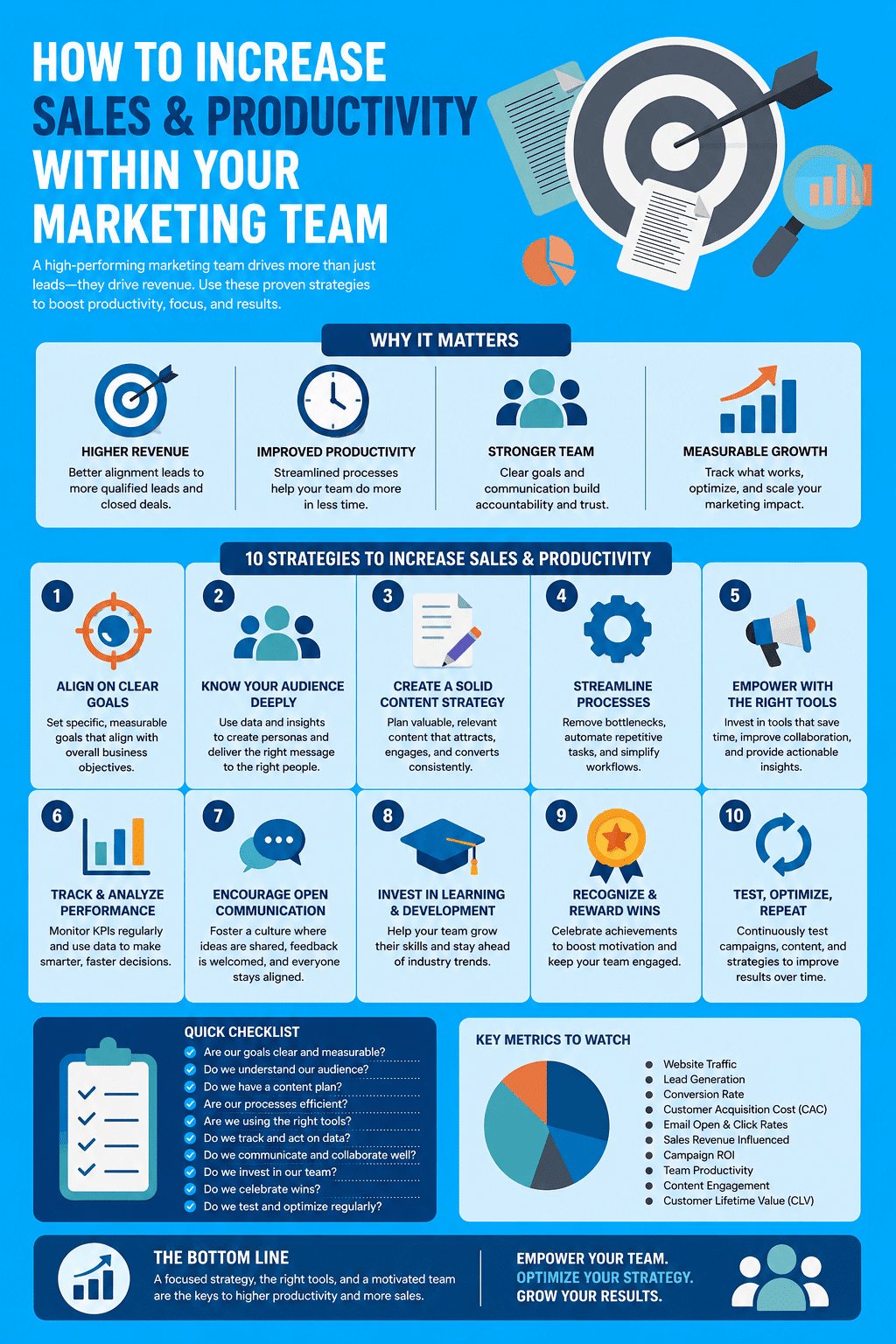
Know how to increase sales and productivity within your marketing team; Small businesses are under more pressure than ever to make sales, attract new customers, and grow their brands.
The productivity of your marketing team is essential for growing your business. The right management strategy can help to boost your marketing team’s productivity and effectiveness, making your business much better at generating buzz and driving sales.
Here’s how any business can increase sales and productivity within its marketing team.
What Is Actually Holding Marketing Teams Back in 2026
Before getting into the fixes, it helps to understand what the research actually shows about marketing team performance. According to McKinsey, marketers spend nearly 60 percent of their time on work that could be partially automated or done faster with better tooling: generating content variations, compiling reports, building presentations, and coordinating approvals. Only about 40 percent of the average marketing team’s working hours go toward the high-value strategic and creative work the team actually exists to do.
That gap between capacity and output is what every strategy in this article is trying to close. The organizations that have closed it most successfully share two characteristics: they have invested in tools that reduce manual, repetitive work, and they have built communication and feedback systems that ensure the team’s remaining creative energy is aimed at the right priorities.
1 – Make Communication Easy
Poor team communication can slow down otherwise effective marketing teams, making them much less productive than they should be. Communication can be especially challenging when some or all members of the team are working remotely; if an important conversation happens in the office, some team members may be left out of the loop.
The right small business communication tools can make it much easier for the marketing team to stay in touch, share information, and plan campaigns. Corporate messenger tools like Slack, for example, can both simplify communication; and ensure that important conversations are available to as many team members as possible.
Team management apps are also a great way to improve communication while keeping tabs on your marketing team’s performance. Tools like Trello, Flow, and Asana are popular management solutions that will help both you and your team stay on top of important marketing work.
Building a Communication Rhythm That Prevents Bottlenecks
Beyond the tools themselves, the meeting and communication cadence your team uses matters as much as the software. Many marketing teams lose significant productive hours to an excess of unstructured meetings that could have been a written update, or to a deficit of structured alignment that leaves everyone guessing about priorities.
A practical cadence that works for most small to mid-size marketing teams is a brief daily standup, either live or asynchronous through a tool like Slack or Loom, covering what each person is working on that day and whether anything is blocked. A longer weekly session covers campaign performance, upcoming deadlines, and any strategic shifts. A monthly review addresses what worked, what did not, and how the upcoming month’s priorities should be adjusted based on those findings.
For teams with remote members, defaulting to asynchronous communication for non-urgent matters, and using synchronous time specifically for decisions that need real-time discussion, tends to produce better outcomes than trying to replicate an office meeting structure over video calls.
2 – Track Important Marketing Metrics to Increase Sales and Productivity Within Your Marketing Team
How do you know how productive your marketing team is; and if your management changes are actually making them more productive?
The right marketing metrics and measures will help you understand how your marketing team’s productivity is changing over time. Tracking input, quality, cost, and outcomes for each marketing effort will make it easier to tell if your marketing team is using their time effectively.
Tracking the performance of marketing campaigns using a metric like conversion rate; for example, and comparing the time spent on each campaign can help you identify where your marketing team is working effectively and where they may be wasting time.
The Specific Metrics Worth Tracking
Knowing that you should track marketing metrics is less useful than knowing which ones to prioritize. The metrics that matter most vary by business model, but a framework that works for most small and mid-size businesses separates leading indicators from lagging ones.
Leading indicators are the metrics you can see changing today based on work done this week: website sessions by channel, email open and click-through rates, social engagement rates, ad click-through rates, and landing page conversion rates. These show whether the top of the funnel is working, even before any sales have been generated.
Lagging indicators reflect the ultimate business outcomes the marketing effort is supposed to drive: customer acquisition cost (CAC), marketing-qualified leads (MQLs) generated per month, MQL to customer conversion rate, and revenue attributed to marketing. These move more slowly but are the actual measures of whether marketing is contributing to business results rather than just generating activity.
Tracking both sets, with leading indicators reviewed weekly and lagging indicators reviewed monthly, gives a marketing team both the real-time feedback it needs to optimize live campaigns and the business-level context it needs to justify budget and resource decisions. For a deeper look at measuring social performance specifically, the guide to social media analytics and supercharging your marketing efforts covers the measurement layer that sits beneath most campaign-level decisions.
3 – AI Tools That Are Transforming Marketing Team Productivity
If one development defines the marketing team productivity story in 2026, it is the integration of AI tools into everyday marketing workflows. The teams that have adopted AI tools thoughtfully are not necessarily doing more work; they are spending dramatically less time on the work that previously ate into their capacity for strategy and creativity.
The most concrete gains cluster around four areas.
- Content creation and variation. AI writing tools, including products like Claude, Jasper, and HubSpot’s AI Content tools, allow marketing teams to generate first drafts, create multiple variations of ad copy and email subject lines, and repurpose existing long-form content into social posts, email summaries, or landing page copy in a fraction of the time these tasks previously required. The team’s editors and strategists focus on shaping and improving the AI output rather than building from a blank page.
- Data analysis and reporting. AI-assisted analytics, including native features built into platforms like Google Analytics 4, HubSpot, and Salesforce Marketing Cloud, can surface patterns across campaign performance data that would take an analyst hours to find manually. Automated reporting that runs on a schedule replaces the manual process of pulling data, formatting a dashboard, and distributing a report each week.
- Campaign optimization. Major advertising platforms including Google and Meta have embedded machine learning into campaign management at the bid, audience, and creative level, partly covered in this guide’s companion piece on digital marketing trends in 2026. The marketing team’s role has shifted from manual adjustment of bids and audiences toward strategic direction of what the algorithm is optimizing for.
- Marketing automation and triggered workflows. Platforms like HubSpot, Klaviyo, and ActiveCampaign allow marketing teams to build automated email sequences, lead nurturing flows, and personalization rules that run continuously without manual intervention. Once built, these workflows deliver consistent marketing effort to prospects and customers around the clock, without requiring a human to execute each step.
The practical starting point for teams that have not yet incorporated AI tools is to identify the two or three most time-consuming, repetitive tasks the team performs each week and research whether a current AI tool handles them well, rather than trying to overhaul the entire workflow at once.
4 – Create a More Comfortable Working Environment
Research shows that comfort is directly related to productivity. If your working environment is uncomfortable or distracting, you’ll have a much harder time getting work done and staying on task.
Simple changes to the marketing team’s working environment can have a big impact on their productivity.
For example, human-centric lighting has been shown to increase productivity, boost worker alertness, and improve cognitive performance. This lighting strategy, also known as circadian lighting, mimics the natural light cycle by changing the brightness and color of office lights throughout the day.
You can also boost productivity and comfort by increasing the amount of natural light in the workplace, reducing ambient noise levels; investing in ergonomic office furniture, and improving office air quality with better filters or air purifiers.
Adapting the Environment for Remote and Hybrid Marketing Teams
The human-centric lighting and ergonomic furniture advice in the original section applies primarily to full-time office setups. In 2026, a significant share of marketing teams work fully remotely or in a hybrid arrangement, and the environmental factors that affect their productivity look different.
For remote marketing professionals, the equivalent of a comfortable office is a defined, distraction-minimized workspace at home: a dedicated room or workstation rather than a couch or kitchen table, a reliable internet connection with a wired backup if needed, and a clear boundary between working hours and non-working time that prevents the ambient stress of feeling perpetually on call.
For hybrid teams, the productivity challenge is less about physical comfort at any individual workstation and more about ensuring remote members have the same access to context, decisions, and team culture as those physically present. This comes back to the communication rhythms covered earlier: recording important meetings, documenting decisions in a shared space like Notion or Confluence rather than in a private Slack message thread, and deliberately including remote team members in informal team moments rather than treating in-office spontaneity as the default.
5 – Provide Timely Feedback to Increase Sales and Productivity Within Your Marketing Team
Feedback is one of the best ways to improve a marketing team’s performance; but only if it’s timely.
The longer you wait to provide feedback on a recent project or campaign, the less relevant the feedback will feel. Because the marketing team has already moved on to a new project, it may be harder for the team to apply your feedback to day-to-day work.
Regular check-ins, group meetings, and one-on-ones can all help you provide timely and quality feedback to your marketing team. Meeting with your team frequently enough that you can offer relevant feedback will help your team understand your expectations; and stay aligned with the business’s overall goals.
6 – Make Marketing Data Easy to Access
Modern marketing relies on large amounts of high-quality campaign data. This information helps marketing teams’ sales and productivity and makes more informed decisions about future campaigns. Without good data, it can be difficult to know what marketing techniques will work for your business; and which techniques won’t. Your marketing team may also find it challenging to create consumer segments or gauge audience preferences.
Businesses of any size can struggle with data silos raw data only available to certain departments or employees and isolated from the rest of the organization.
So, by making marketing data as easy to access as possible for your marketing team, you can avoid creating these data silos and ensure data-driven decision-making much simpler. Ensuring that everyone has access to important sources of information, like your social media analytics platform, will help guarantee easy data access.
7 – Align Marketing and Sales Around Shared Goals
One of the most persistent productivity drains on marketing teams is the friction that builds up between marketing and sales when the two functions operate with misaligned expectations. Marketing produces leads that sales considers unqualified. Sales follows up inconsistently with leads marketing has invested budget to generate. Neither team fully trusts the other’s reporting.
Research from Forrester has found that companies where sales and marketing are closely aligned achieve meaningfully faster revenue growth and lower customer acquisition costs than those where the two functions operate independently. The alignment mechanism that makes the biggest practical difference is a written Service Level Agreement (SLA) between the two teams: marketing commits to delivering a defined volume of qualified leads per month meeting specific criteria (company size, job title, behavior, lead score), and sales commits to following up on each of those leads within a defined timeframe.
Creating this SLA requires the two teams to sit in the same room, agree on what “qualified” means in specific, measurable terms, and hold each other accountable to the commitments in writing. It is a one-time planning exercise that tends to produce a disproportionate improvement in both teams’ output, because it eliminates the ambiguity that otherwise causes each side to discount the other’s work.
The practical tool layer for this alignment is a shared CRM that both marketing and sales update, so that lead lifecycle data, pipeline value, and revenue attribution are visible to both teams rather than each function operating from its own siloed reporting.
Frequently Asked Questions About Marketing Team Productivity
Marketing team productivity is best measured at two levels simultaneously. At the activity level, track input metrics such as campaigns launched, content pieces published, and emails sent, alongside efficiency metrics such as cost per campaign and time per deliverable. At the business impact level, track customer acquisition cost, marketing-qualified leads generated, lead-to-customer conversion rate, and revenue attributed to marketing activity. Activity metrics tell you whether the team is busy; business impact metrics tell you whether that activity is producing results the business actually needs.
Research consistently identifies approval processes and interdepartmental communication as the primary bottlenecks, rather than creative capacity or budget. In most organizations, a piece of content or a campaign brief spends more time waiting for reviews and approvals than it spends being created. Streamlining the approval workflow, often by reducing the number of required approvers and setting explicit response-time expectations, tends to produce faster measurable improvements than most other management changes.
The AI tools with the clearest and most immediately realized productivity benefits for marketing teams are AI writing assistants for first-draft content and copy variation, AI-powered reporting within platforms like Google Analytics 4 and HubSpot that automatically summarize performance and surface anomalies, and marketing automation platforms that replace manual sequence management with triggered, behavior-driven workflows. The common thread is reducing repetitive execution work so the team’s time can be devoted to strategy, creative direction, and customer insight.
Small businesses benefit most from tools that automate high-frequency, low-complexity tasks: an email marketing platform with built-in automation, a social media scheduling tool that batches publishing into a single weekly session, and a CRM that captures lead and customer activity without requiring manual data entry. The second lever is focus: smaller teams that concentrate effort on one or two marketing channels and execute them consistently almost always outperform those spreading thin effort across six channels simultaneously.
A practical review cadence is weekly for campaign- and channel-level metrics, monthly for business-impact metrics such as CAC and lead volume, and quarterly for strategic direction and budget allocation. The weekly review is operational: catch underperforming campaigns early and make tactical adjustments. The monthly review is evaluative: determine whether the marketing strategy is generating the quality and quantity of leads the business needs. The quarterly review is strategic: decide whether the current channel mix, messaging, and priorities still align with where the business is going.
Bringing It Together
Marketing team productivity is not a single problem with a single fix. It is the sum of how the team communicates, what it measures, how it is managed, what tools it uses, and how closely it is aligned with the sales function it is supposed to support.
The strategies covered in this guide, from structured communication rhythms and AI tool adoption to shared sales-marketing goals and real-time data access, are most effective when they are approached in sequence rather than all at once. Identify the single largest source of friction or wasted time in your team’s current workflow and address that first. Once that is resolved, the next bottleneck becomes visible.
For teams also thinking about how to grow revenue alongside improving the team’s internal efficiency, the guide to website monetization methods that actually work covers how the marketing team’s output connects to the revenue channels a business can build on top of its existing audience and traffic.
Infographic