Aren’t we all aware of what marketing entails? Simply put, this means promoting your items in the most effective way possible. So, the same is true when it comes to social media marketing. Therefore, marketing your service or product through social channels is referred to as social media marketing.
Before Facebook and its peers reshaped advertising, businesses relied mainly on television, radio, print, and direct mail to reach an audience, all expensive, one-directional, and hard to target precisely. Social networks changed that by making highly targeted, measurable advertising accessible to businesses of any size, not just those with a broadcast budget.
Benefits of Using Social Media For Marketing
So, there are numerous advantages to using social media platforms as your primary means of marketing and selling your product. Joining a social media marketing course can teach you everything you need to know about social media marketing. So, let’s have a look at them.
- Reduced marketing expenditures are one of the key benefits of using SMM. In addition, SMM is incredibly economical and accessible to any business compared to traditional advertising forms such as printed ads or paying a lot of money to market your product/brand/service on television.
- So, using social media as your primary marketing tool may be quite useful because it expands your brand’s visibility by making your ads available to a global audience.
- A brand’s official page on various social media platforms will boost your brand’s visibility. Every post, video, or link to your website in the comments section will drive more traffic to your website or the product page. Sales will simply increase as a result of this. If sales increase, your website’s conversion rate will also increase, which is an important factor in website ranking.
- It’s a big difference between advertising your product and gaining people’s trust in your brand. Social networking can help you improve consumer and brand interactions.
- Social platforms give direct access to real-time customer feedback and sentiment, information that used to require expensive market research to gather.
Top Methods for Increasing Your Social Media Marketing Efforts
1 – Get to know your target audience.
So, the most critical aspect of running a successful SMM strategy is learning about the target audience. Knowing who your buyers are is the most critical stage in operating a successful SMM campaign. And can use age, gender, location, interest, and various other criteria to categorize target audiences.
Place your ads in locations that will drive people to your product page. Nobody will ever buy the product from you if they are not interested to see your ads. If you want to sell a skincare line meant for ladies, you shouldn’t market it on a blog or video about workout equipment, for example.
2 – Select the Appropriate Platform
There are many social media sites where you can promote your business. Examples include Instagram, YouTube, Pinterest, Quora, Facebook, Twitter, and even TikTok. As a result, it’s critical to pick the proper one, especially in the case of costly advertising efforts. So, the most important element to consider when choosing a platform for SMM is its age.
Youtube and Facebook appeal to a wide spectrum of consumers, including children, teenagers, adults, and even the elderly. Teenagers and adults primarily use Instagram. Platforms like Twitter, Youtube, and LinkedIn, on the other hand, are completely unappealing to children and teenagers.
In addition, the algorithms for various social networking platforms differ.
As a result, while one sort of content may perform well on one platform, it may not perform as well on others. So, when choosing the best platform, make sure to keep these criteria in mind.
3 – Use video clips
Advertisements on social media can take many different shapes. Text (hyperlinks), images, infographics, and videos are all possibilities. For example, if you want your commercials to appeal to a wide range of audiences, making them in video format is a terrific idea.
Ads in text or graphical format are difficult for children to comprehend or pay attention to. As a result, video advertising is an excellent approach to reaching out to children.
What Actually Drives Engagement in 2026: The Data
The advice to “use video” needs an update. According to Buffer’s 2026 State of Social Media Engagement report, Instagram carousels now earn 109% more engagement per impression than Reels, and on LinkedIn, carousels reach 21.77% engagement, roughly three times what video posts get on the same platform. Video still wins on raw reach, Reels spread further, but carousels convert that reach into actual interaction more reliably.
That doesn’t make video the wrong choice. Short-form video still generates 2.5 times more engagement than long-form content and remains the strongest format for pure discovery. The better rule for 2026 is matching format to goal: video for reach and discovery, carousels for engagement and consideration, testing both before committing a budget to either.
LinkedIn’s carousel advantage specifically is worth acting on if B2B is part of the target audience. Pairing that format choice with the outreach approach covered in Modern LinkedIn Outreach Strategies for B2B Growth turns a format decision into a fuller platform strategy rather than a one-off post type swap.
4 – Use Relevant Hashtags
Using the appropriate hashtags might help you expand your reach to new heights. The hashtags should be specific to your product and the demographic you’re targeting. In addition, you should be aware of the impact of your hashtags.
If it’s too popular, your ad may get lost in the sea of other popular ads using the same tag. In your advertisement, try to use three different types of hashtags. One is generic, one is one-of-a-kind, and one is unique. If the hashtag isn’t working, remove it and replace it with a new one.
Once you’ve chosen the ideal hashtags for your brand, use them across all social media sites.
The hashtag playbook has changed since this advice was first written. Broad, oversaturated tags like #love or #instagood mostly get lost in volume now, over 7.2 billion hashtagged posts go up daily across major platforms. The more effective approach is 3 to 5 specific, niche tags that describe exactly what the content is, rather than chasing the biggest tags available. Building that into a broader plan, rather than treating hashtags as an afterthought, is really part of the wider digital marketing strategy a business should already be running.
Increase the Effectiveness of Your Social Media Marketing: The Final Word
It’s possible that social media marketing will be difficult for you, especially if you’re a beginner. So however, if you’re not using social media marketing to boost your sales, you’re missing out on many opportunities. If you keep the suggestions we’ve made in mind, getting started with SMM may be easier than you think. Simply choose your target audience and select a channel that appeals to them.
Revised by Karan Shah
Karan Shah is an educational entrepreneur, TEDx speaker, Harvard e-commerce graduate, and founder of IIDE – The Digital School. He is a renowned author in education, digital marketing, and educational technology. Over the years, he has written extensively for major news outlets, including Entrepreneur, Business World, Education Times, and Youth Magazine.

Frequently Asked Questions About Increasing Social Media Marketing Effectiveness
Yes, on engagement specifically. Instagram carousels earn about 109% more engagement per impression than Reels, and LinkedIn carousels reach roughly three times the engagement rate of video on the same platform, according to Buffer’s 2026 benchmark data. Video still wins on total reach, the two formats serve different goals.
Three to five specific, niche tags that describe the content directly work better than broad, high-volume tags like #love or #instagood, which get lost among the more than 7.2 billion hashtagged posts published daily.
TikTok currently leads major platforms at around 3.70% average engagement, well ahead of Instagram’s roughly 0.48% and Facebook’s 0.15%. Raw platform averages matter less than matching a platform to your specific audience, though.
There’s no single universal number, consistency matters more than volume. A sustainable posting rhythm a team can actually maintain long-term outperforms an aggressive schedule that gets abandoned after a few weeks, the same principle behind scaling a marketing team’s actual output rather than just its ambition.
Yes. Short-form video generates about 2.5 times more engagement than long-form content and remains the strongest format for reaching new audiences, since platform algorithms favor it for discovery. Carousels tend to win once someone’s already paying attention.
Picking a platform based on where competitors are rather than where the actual target audience spends time. A smaller, well-matched audience on the right platform consistently outperforms a larger, mismatched one.
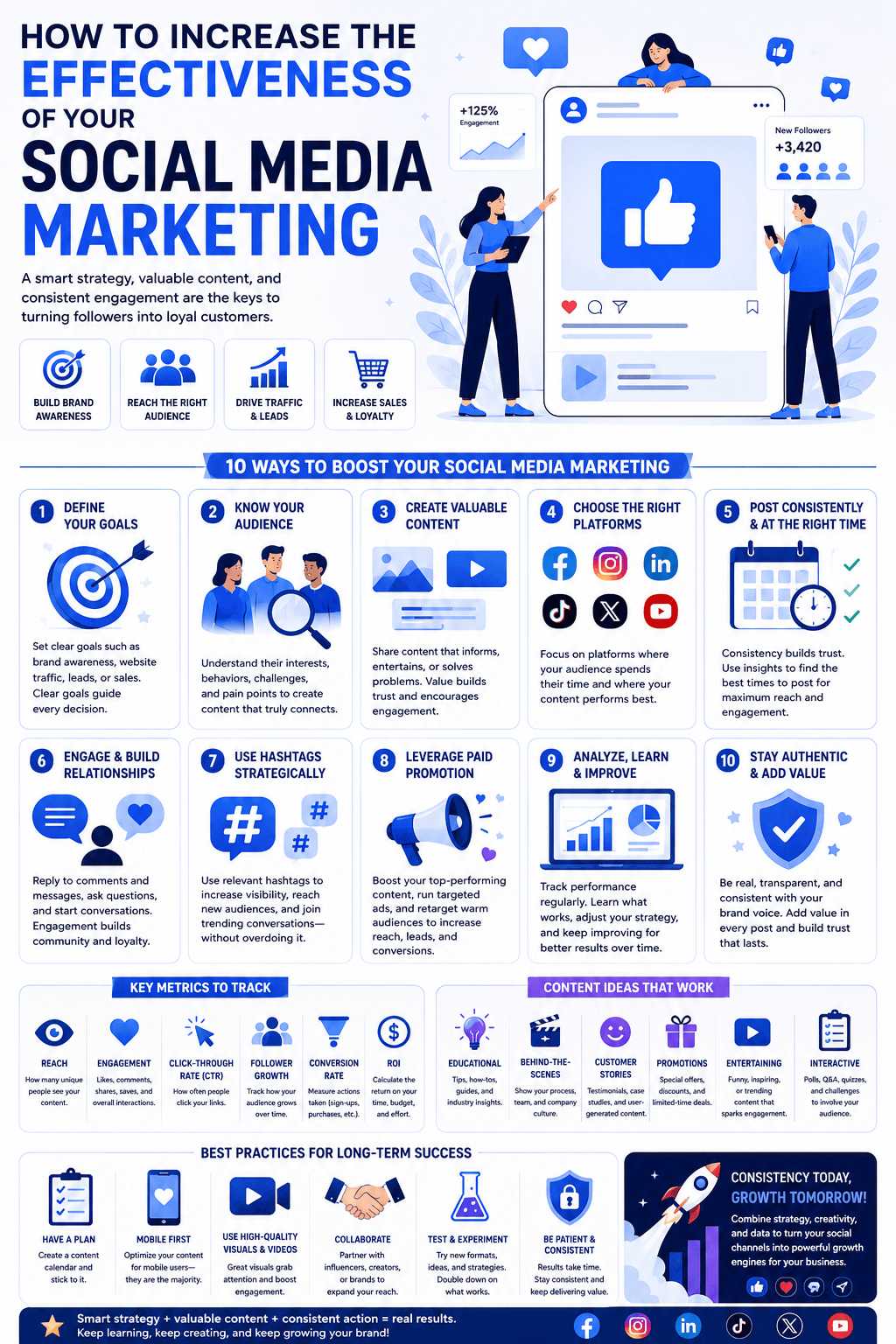
Infographic