Digital marketing matters more in 2026 than it did in 2022, but almost every reason people give for that is now partly wrong. The channels are bigger, the budgets are bigger, and the returns are harder to get. If you want to understand the importance of digital marketing in the future, the honest version starts with what has stopped working.
Digital marketing is undoubtedly the most efficient way of marketing, especially compared to the era of advertisements and brochures’. So, the number of mobile phone users is increasing daily, and mobile phones play a great role in driving most of the web traffic, if not all of it.
From big names to small businesses, everyone is turning to digital marketing agencies and in-house teams to drive growth. These strategies enhance visibility and drive more web traffic than traditional marketing ever could.
Why the Future of Digital Marketing Looks Nothing Like 2022
The scale argument is settled. Global advertising spend crossed one trillion dollars for the first time in 2026, and digital now accounts for roughly 69% of all advertising investment worldwide, according to Dentsu’s global forecast. Programmatic buying handles more than four fifths of that digital spend. There is no serious debate left about whether digital marketing is important. The money already moved.
What is unsettled is whether the old playbook still returns anything. Three things broke between 2022 and now:
- Search stopped sending traffic. In 2026, fewer than one third of Google searches in the United States send a click to any website. AI Overviews appear on more than 20% of queries, and when they do, click-through rates fall by close to 60% (SparkToro and Datos clickstream research, 2026). Informational content, which is exactly what most content marketing produces, absorbed the worst of it.
- Acquisition got more expensive. Digital marketing is still cheaper than a national print buy, but the “cost-effective” framing from five years ago no longer survives contact with current auction prices. As more spend chases the same inventory across a handful of platforms, cost per acquisition rises for everyone. Cheap reach was a phase, not a property of the channel.
- Targeting precision degraded. Privacy regulation, platform-level tracking restrictions, and the long unwinding of third-party cookies removed a lot of the granularity that made 2019-era campaigns look effortless. Attribution models that once looked authoritative now report with visible error bars.
None of this makes digital marketing less important. It makes it less forgiving. The businesses winning right now treat it as an operating discipline rather than a channel they buy into, and that shift is the actual story behind the top digital marketing strategies for growing online businesses in 2026.
Why does every business prefer Digital Marketing?
Digital marketing has the potential to spread the word to the audience on an advanced level; marketing strategies are more powerful than ever and need fewer human resources to level up the marketing game. The biggest business strategy so far is to get the fastest route to reach your customers via reaching somewhere your customers are, and all the customers are online, so where should you be? Of course, Online!
Digital Marketing is the Future!
So, here are some of the reasons why Digital Marketing is creating all the buzz in the business industry;
Efficient and Effective
Digital marketing outperforms traditional marketing on the two things that matter most to a growing business: how fast you can reach someone, and how precisely you can measure what happened afterward.. Back in the day, marketing was all about going from door to door to convey the word. Later on, this traditional marketing strategy was taken up by printing, and people printed advertisements and brochures to spread the word.
Today is the world of Online Marketing, where the word spreads in just a blink of an eye. You don’t have to look for the targeted customers as you easily get to them online. What digital marketing is doing today, print media couldn’t do even for years. That’s the reason Digital Marketing is the Future!
Wider Audience
Look around yourself, how people today can buy and ship things from across borders. You can get those beautiful Doc Martens shipped right at your place without flying to England to get them. That is the power of Online, and the business world benefits from it via its powerful Digital Marketing strategies.
Digital marketing effectively targets a wider audience aiding the businesses in the market and selling their products to a greater populace. And when the targeted audience is greater the business flourishes, and you can level up the revenue game.
See the popularity of Wagner SprayTech; their Titan-brand paint sprayers are world-famous and widely available.
Visibility Without Traffic: The Defining Shift
Here is the uncomfortable version of “wider audience.” You can reach more people than ever and receive fewer visitors than ever, at the same time.
That is not a contradiction. It is what happens when the interface that used to hand you a visitor now answers the question itself. Google’s AI Mode passed one billion monthly users in 2026 and refers traffic at a rate of roughly 2% of queries, against 17% to 19% for traditional Google search. The audience is still there. The click is not.
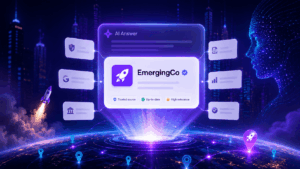
For anyone planning past next quarter, the practical consequence is that being mentioned is starting to matter as much as being ranked. When a model composes an answer, it draws on sources it can parse, verify, and attribute. Pages that state things plainly, cite primary data, and carry clear author and publication signals get pulled into those answers. Pages that pad 1,200 words around a thin idea do not. This is the reasoning behind generative engine optimization and how startups are winning the AI search era, and it is the single largest change to the importance of digital marketing in the future.
Two metrics worth adding to your reporting now, before your board asks:
- Citation share. How often your brand appears inside AI-generated answers for queries you care about, whether or not a click follows.
- Branded search volume. When discovery moves off-site, direct demand for your name becomes the cleanest available proxy for whether your marketing is working.
Traffic remains useful. It is simply no longer the whole scoreboard.
Engagement
Digital Marketing is all about creating and innovating new ideas to meet the business’s demands and expectations. So, Digital Marketing is the go-to business for people who have the potential to create content that can use to level up the marketing game or that is enriched with one of the most powerful business strategies.
Digital Marketing has filled the gaps between the manufacturers/brands and customers. As a result, businesses feel more connected to their customers and can fulfill their demands. Furthermore, with many people using social media, engagement has increased and has by far become the most exclusive way of interacting with customers, knowing their likes and dislikes.
Cost-Effective Marketing
Besides being the most effective marketing technique, Digital Marketing is also cost-effective. Unlike traditional marketing tricks like print media, you don’t have to spend too much on spreading the word to your targeted populace.
A big hurdle for most entrepreneurs and small businesses is that they cannot spend too much on marketing strategies, their budget doesn’t simply allow that, but with digital marketing strategies, you don’t have to break your bank to let people know about you.
One caveat worth stating plainly, because most articles on this topic skip it: cost-effective is a comparison, not a guarantee. Digital marketing is cheap to start and expensive to scale. A small business can launch a campaign for the price of a lunch, then discover that the cost per acquisition at meaningful volume is uncomfortably close to what traditional channels charged. The advantage is not that clicks are cheap. It is that you find out quickly when they aren’t.
Faster Growth Rate and Increased ROI
Marketing investment has always been a great source of revenue as far as Digital Marketing; it has increased earnings by boosting growth faster. Whether small start-ups, big tech houses, agencies, entrepreneurs, or trending businesses, every market and sector uses Digital Marketing strategies to increase its growth rate.
The rocket science behind Digital Marketing becoming the Future of the business sector is because of the increased Return On Investment (ROI). The ROI for Digital Marketing is much higher than in Offline Marketing.
Retaining Loyal Customers
Engaging a greater population of customers via effective marketing strategies and selling products is not the only goal of big businesses. So, They want their customers to be loyal and satisfied with the products and the services.
A loyal customer is an advertisement as he will recommend the brand or the product to his family, friends, and people around him. Referral is still the most durable form of advertising, because it carries trust that no ad budget can buy. In a market full of near-identical products, a customer who vouches for you is a competitive asset.
Brand Image & Trust
If your marketing strategies are effective enough, they can boost your image in the market. Apart from people knowing that you exist, they’d know why you stand out in the market. So, this will not only boost the growth of your business but will enhance your market image.
What This Means For Your Business: A Five-Point Audit
If digital marketing is the future of your industry, the useful question is not whether to invest but where the current investment is fragile. Work through these in order.
1. Measure your channel concentration. Add up what share of revenue traces to a single platform. If any one channel accounts for more than half, you don’t have a marketing strategy, you have a dependency. Every business that lost 40% of its traffic to an algorithm update in the past two years had this number above 60% beforehand.
2. Audit which of your pages are AI-answerable. Take your top twenty organic pages and ask, for each, whether a language model could fully satisfy the query using your page as a source without the reader needing to visit. Those pages will lose traffic. Plan for it rather than being surprised by it, and rebalance toward content that requires the reader to come to you: tools, calculators, original data, proprietary comparisons.
3. Move your data first-party. Email lists, customer accounts, and owned communities are the only audiences no platform can price you out of. This is the least glamorous item on the list and the highest-return one.
4. Set attribution expectations honestly. Your attribution model is directionally useful and precisely wrong. Report it as a range. Marketing teams that overclaim precision lose credibility the first time finance checks the numbers against actual revenue.
5. Decide what you’re building in-house versus buying. Most teams try to run search, paid, content, email, and analytics with two people and then wonder why nothing compounds. Deciding this deliberately is worth more than any tactic, and the tradeoffs are covered in this full-stack digital marketing services selection playbook.
Nothing here requires a bigger budget. All of it requires being specific about what you’re actually buying when you buy digital marketing.
Importance Of Digital Marketing In the Future: Over to You!
The importance of digital marketing in the future is not in question. Two-thirds of the world’s advertising money is already there, and the share keeps climbing. What has changed is the difficulty. The channel that once handed out cheap reach and clean attribution now demands strategic clarity, first-party data, and content good enough to be cited rather than merely ranked.
If you take one thing from this article, take this: stop asking whether digital marketing works and start asking which parts of your current approach were built for a version of the internet that no longer exists. That audit is where the returns are.
Frequently Asked Questions About the Importance of Digital Marketing
Estimates converge around $780 billion in global digital advertising spend for 2026, representing roughly two-thirds of total global ad spend, with continued double-digit annual growth.
Digital channels are generally easier to measure directly. Email marketing, for example, commonly returns $30 to $40 for every dollar spent, a level of tracked return traditional print or broadcast advertising rarely offers with the same precision.
Yes, largely because digital channels let a business start with a small budget and scale based on measured results, rather than committing to a large upfront print or broadcast spend before knowing if it works.
Typically around 9 months to break even, but it compounds afterward into some of the strongest long-term returns of any marketing channel, unlike paid channels that stop producing the moment spending stops.
It depends on the business, but most see the best results from combining at least two channels, commonly SEO and email or SEO and social media, rather than relying on a single channel alone.
Infographic