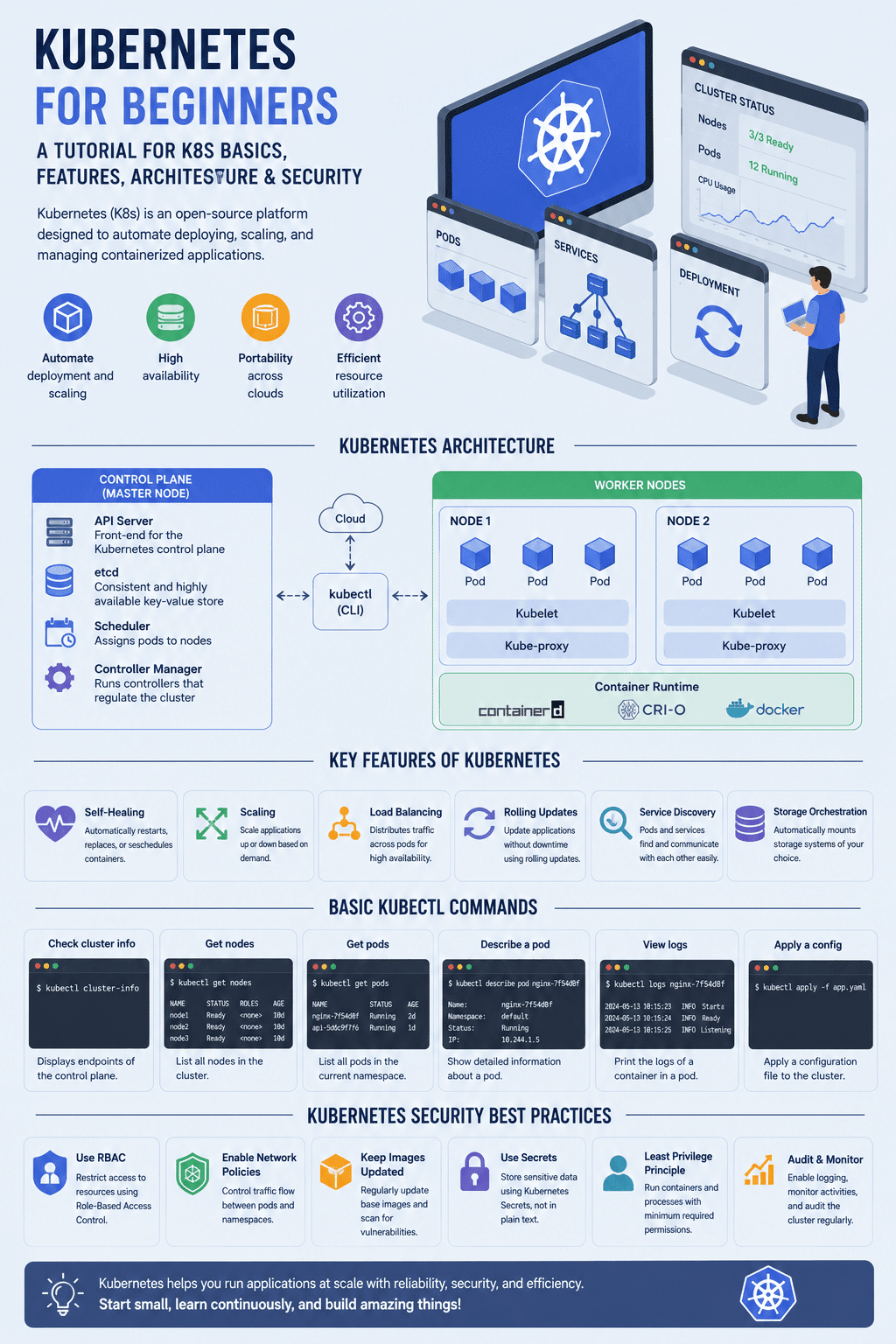
Kubernetes for beginners, a tutorial for K8s basics, features, architecture & security; So, a container management system built on the Google platform, Kubernetes helps you manage containerized applications across many physical, virtual, and cloud environments. Google Kubernetes is a container tool for granular applications deployed on individually supplied clusters for thousands of methods.
Why do you need containers?
Today’s internet user never accepts downtime. Therefore, developers need to find a method to perform maintenance and updates without interrupting their services.
Therefore container, which is an isolated environment. It includes everything needed for the application to run. This makes it easier for a developer to edit and deploy applications. In addition, contention has become a preferred method for packaging, deploying, and updating web applications.
What tasks are performed by Kubernetes?
Kubernetes acts as an operating system for a distributed cluster. It abstracts the underlying hardware into nodes (servers) and provides a consistent interface for applications that consume a shared pool of resources.
Why use Kubernetes?
Kubernetes helps you control resource allocation and traffic management for cloud applications and microservices. Various aspects of infrastructure management also help simplify services. For example, Kubernetes lets you ensure where containerized apps run and help you find tools you want to work with.
K8s tutorial: Kubernetes Resources
Here are the essential features of Kubernetes:
- automatic scheduling
- self-healing capabilities
- Automatic launches and reversals
- Horizontal scaling and load balancing
- Provides environment consistency for development, testing, and production
- Infrastructure is loosely coupled; each component can act as a separate unit
- Provide a higher density of resource utilization
- Offers enterprise-ready features
- Application-centric management
- self-scaling infrastructure
- You can build predictable infrastructure
Kubernetes Tutorial Basics
Kubernetes for beginners, now in this Kubernetes tutorial, we will learn some basic K8s concepts:
- Cluster: It is a collection of hosts (servers) that help aggregate your available resources: RAM, CPU, and disk, into a single usable pool.
- Master: The master is a collection of components that belong to the Kubernetes control panel. Uses these components for all cluster decisions. Includes scheduling and response to cluster events.
- Node: It is a single host capable of running on a physical or virtual machine. A node must run Kube-proxy, minikube, and kubelet; which are considered part of the cluster.
- Namespace: It is a cluster or logical environment. Uses this method extensively to delimit access or split a cluster.
K8s tutorial: Kubernetes history and ecosystem
Google originally developed Kubernetes (from the Greek ‘κβερήτης’ meaning helmsman’). Kubernete’s design was enhanced by Google’s ‘Borg’ project; a similar system used by Google to run much of its infrastructure. Since then, Kubernetes has been donated to the Cloud Native Computing Foundation (CNCF); a collaborative project between the Linux Foundation and Google, Cisco, IBM, Docker, Microsoft, AWS, and VMware.
What does Kubernetes do?
Kubernetes is a platform to run your applications and services. It manages full application life management and container control, automating resource tasks and abstracting the infrastructure. So, enterprises turn to Kubernetes to reduce operational costs, reduce time-to-market, and transform their business.
In addition, developers prefer container-based development since it supports microservices-based applications more effectively. Kubernetes enables your work to seamlessly move from development to production, resulting in faster time-to-market for a company’s applications.
in this Kubernetes tutorial, we will learn how K8s work by:
Orchestrate containerized applications across multiple hosts Ensure how containerized applications behave in all environments, from testing to production deployment, and efficient control to optimize hardware usage to minimize resources and keep containerized applications running Automate how to configure.
And also add Storage to run stateful applications Scale and load balance containerized applications and their resources in real-time and respond to workload changes Expose containers to the internet. Other containers and other clusters automatically activate using seed location codes Validate applications, replicate services automatically; and automatically Scale, ensuring the service are automatic, always running, producing a complete open-source application (Kubernetes automatically not on GitHub), maintained and active by a large community.
- Find out how others are using K8s.
- Enterprise Kubernetes Case Studies: 4 real-world stories ›
- Atresmedia Accesses Unprecedented High Availability and Productivity with Charmed Kubernetes ›
Kubernetes Tutorial for Beginners: What Kubernetes Is Not
Kubernetes enables configuration, automation, and management capabilities around containers. So, it has a vast ecosystem of tools and can address complex use cases, which is why many confuse it with a traditional service platform (PaaS).
Kubernetes, unlike PaaS, does not:
Limit supported application types or required a dependency handling framework. Require applications to be written in a specific programming language, or dictate a specific configuration language/system. Deploy source code and not build applications, although used to build CI/CD pipelines.
Provide application-level services such as middleware, databases, and storage clusters out-of-the-box. And can integrate these components into k8s through add-ons. Provide or dictate specific logging, monitoring, and alerting components. Manage and provide certificates for applications running in containers
Kubernetes architecture diagram
no master: So, the master node is the first and most vital component responsible for managing the Kubernetes cluster. It is the entry point for all sorts of administrative tasks. So, there may be more than one master node in the cluster to check for fault tolerance.
The master node has several components like API Server, Controller Manager, Scheduler, and ETCD. Let’s see them all.
- API Server: The API server acts as an entry point for all REST commands that control the cluster.
- Scheduler: The scheduler schedules tasks for the slave node. It stores resource usage information for each slave node. Finally, it is responsible for distributing the workload. It also helps to process as a workload and uses on cluster nodes. Finally, it helps you put the workload on available resources and accept the workload.
- Etcd: Etcd is the key-value store that holds the cluster’s configuration data and state. It communicates with the other control plane components to receive and serve that data, and it’s also involved in network rule and port management.
Worker/slave nodes
Kubernetes for beginners, the essential working components contain all the services provided to manage the network between the containers, allow for communication with the master node, and assign resource nodes to the containers.
- Kubelet: Gets a Pod configuration from the API server and ensures that the API containers can work.
- Docker container: The Docker container works on each of the Docker nodes, which run the configured pods
- Kube-proxy: Kube-proxy acts as a load balancer and network proxy to run the service on a single worker node
- Pods: A pod is a form of single or multiple containers that logically run together on nodes
Kubernetes Tutorial for Beginners: Other key terminologies
Replication controllers
A replication controller is an object that defines a pod model. It also controls parameters to repeatedly replicate horizontal power, increasing the number of copies running.
- Replication sets: Replication sets are an interaction of the replication controller with flexibility in how the controller recognizes the pods it should. It replaces the replication driver due to its greater replication selection capability.
- Deployment: A common workload and also sometimes created and managed directly. So, the deployment uses the replication set as a building block that adds lifecycle management capability.
- Stateful sets: So, it is a specialized pod control that offers unique ordering. And mainly uses it to adjust what you have a specific need regarding deployment order, stable network, and persistent data.
- Daemon sets: Daemon pools, another specialized form of pod controller that runs a copy of a pod on each node in the cluster. So, this pod type is an effective method for implementing pods that allow you to perform maintenance and services for the nodes.
Kubernetes Tutorial for Beginners: Advantages of Kubernetes
- Easy service organization with pods
- Powered by Google, which brings years of valuable industry experience to the table.
- Larger community among container orchestration tools
- Offers a variety of storage options, including on-premises, SANs, and public clouds
- Adheres to the principles of immutable infrastructure
- Kubernetes can run bare metal on-premises, OpenStack, Google public clouds, Azure, AWS, etc.
- It helps you avoid vendor lock-in issues as you can use any vendor-specific API or service, except when Kubernetes provides an abstraction, for example, load and storage balancer.
- Containerization using Kubernetes allows packaged software to meet these goals. In addition, it allows applications that need to be launched and updated without downtime.
- Kubernetes lets you ensure these containerized applications run where and when you want them to run and helps you find resources and tools you want to work with.
Disadvantages of Kubernetes
- Kubernetes dashboard is not as useful as it should be
- Kubernetes is a bit cumbersome and unnecessary in environments where you do all the development locally.
- Security is not very effective.
Your First Kubernetes Deployment: A Working Example
Everything above explains what Kubernetes is. Here’s what actually running something on it looks like, since a tutorial that never shows a command isn’t really a tutorial.
A Deployment is the standard way to run and manage a set of identical pods. Here’s a minimal one that runs two copies of nginx: YAML
apiVersion: apps/v1
kind: Deployment
metadata:
  name: hello-world
spec:
  replicas: 2
  selector:
    matchLabels:
      app: hello-world
  template:
    metadata:
      labels:
        app: hello-world
    spec:
      containers:
      - name: hello-world
        image: nginx:latest
        ports:
        - containerPort: 80
Save that as deployment.yaml and apply it with kubectl apply -f deployment.yaml. Running kubectl get pods should show two pods starting up. That replicas: 2 line is doing real work: if either pod crashes, Kubernetes’s self-healing behavior replaces it automatically, without anyone needing to notice or intervene.
To actually reach the application, expose it as a Service: kubectl expose deployment hello-world --port=80 --type=LoadBalancer. This is the practical difference between Kubernetes and a Docker container running on its own, the Deployment and Service objects are what turn “a container that runs” into “a service that stays running, self-heals, and can be reached reliably,” which is the whole premise this article opens with.
For anyone building this out for a real team rather than a learning exercise, the architecture decisions covered in Web Development: Modern Stacks Definitive Introduction are worth reading before committing to a specific deployment approach, since Kubernetes is one piece of a much larger stack decision.
The official Kubernetes documentation’s tutorials go considerably further than this example, covering StatefulSets, ConfigMaps, and production-grade deployment patterns, and it’s the most reliable place to verify anything in this article against the current, authoritative source.
Teams evaluating whether they actually need this level of orchestration complexity, versus a simpler managed platform, are usually better served working through that decision with a partner experienced in scaling enterprise infrastructure before committing engineering time to a Kubernetes migration.
Kubernetes security
Kubernetes for beginners, the Kubernetes security doesn’t disappoint. So, offering a range of security controls, Kubernetes (K8s) can help make your clusters, workloads, and containers more secure. So, by following Kubernetes security best practices and knowing how to handle Kubernetes security issues, you may be capable of taking complete advantage of the numerous advantages that K8s provide while preserving your surrounding security.
While there are several Kubernetes security issues, in this K8s tutorial, we will learn the three most important to consider are:
- Requires auto-configuration: So, when deploying Kubernetes from open source, and not configuring any of the files. Finding out how they work and how to configure them is the operator’s responsibility.
- Deploying workloads securely requires experience: Whether using a Kubernetes distribution with pre-configured security controls or building it yourself, developers and application teams who may not be familiar with all the ins and outs of Kubernetes may struggle to secure your workloads properly.
- Lack of built-in security: While Kubernetes offers access controls and features to help create a secure cluster, it lacks built-in security to ensure that containers and code running within the cluster are secure.
Kubernetes Security Solutions
Some areas to consider: So while Kubernetes’ built-in security solutions don’t cover all issues, there is no shortage of options in the K8s security solutions ecosystem.
Some areas to consider include:
- Workload security: Most Kubernetes workloads are containers that run on Docker engines. While, in some cases, you may be using other container solutions (e.g., CRI-O or Containerd) in parallel, no matter what engine is running on the backend, you will still be running containers. Therefore, these containers’ code and other packages must be free of vulnerabilities.
- Workload configuration: So, whether using Kubernetes YAML, Helm Charts; or modeling tools, the configuration to deploy your applications to Kubernetes is usually done in code. This code affects Kubernetes security controls that determine how a workload runs and what can and cannot happen during a breach. So, for example, limiting each workload’s CPU, memory, and network to the maximum expected usage will help contain any violations to the affected workload; and ensure that other services are not compromised.
- Cluster configuration: So, several Kubernetes security assessment tools are available for your running clusters. Among other features, these tools check adherence to Kubernetes and CIS security best practices and other relevant benchmarks.
- Kubernetes Network: Securing the network plays an important role in Kubernetes. Pod communication, inbound, outbound, service discovery; and applicable service meshes (such as Istio) must be considered. Once the cluster is compromised all services, and machines on the network are compromised. Therefore, it is important to ensure that your services; and communications are limited to what is needed. Combined with encryption across your systems and services, this can also help contain threats and prevent larger network-wide attacks.
- Infrastructure Security: Because it is a distributed application running on multiple servers (using physical or virtual networking and storage), it is critical to protect your Kubernetes infrastructure (especially master nodes, databases, and certificates). Once malicious actors have successfully penetrated your infrastructure, they also have access to everything they need to access clusters and applications.
K8s tutorial: Summary
- The container helps an organization perform maintenance and upgrades without disrupting services.
- Kubernetes is an example of a content management system built on the Google platform.
- The biggest advantage of Kubernetes is that it can run on-premises OpenStack, Google public clouds, Azure, AWS, etc.
- Kubernetes offers automated scheduling and self-healing capabilities.
- Cluster, master, node, and namespace are important basics of Kubernetes
- The master node and worker node are important components of the Kubernetes architecture.
- Replication controllers, deployments, state sets; and daemon sets are other important terms used in Kubernetes.
- Docker Swarm supports basic manual scaling, while Kubernetes offers native, metrics-based autoscaling through its Horizontal Pod Autoscaler, a more sophisticated system for production workloads.
- The biggest disadvantage of Kubernetes is that its panel is not very useful and effective.
Frequently Asked Questions About Kubernetes for Beginners
Kubernetes deploys, scales, and manages containerized applications automatically across a cluster of machines. Instead of manually restarting crashed services or manually adding servers under heavy load, Kubernetes handles both through self-healing and autoscaling.
No. Docker packages an application into a container. Kubernetes orchestrates many containers across many machines, deciding where they run, restarting them if they fail, and scaling them up or down. Most Kubernetes clusters run Docker or a similar container runtime underneath.
Usually not. Kubernetes adds real operational complexity that only pays off once you have multiple services, need to scale independently, or require high availability. A single small app often runs fine without a cluster to manage.
Enough to deploy and manage a basic application usually takes a few weeks of hands-on practice. Genuine production-level comfort, covering networking, security, and troubleshooting real failures, typically takes several months of regular use.
Yes, Kubernetes itself is free and open source, maintained by the Cloud Native Computing Foundation. Costs come from the infrastructure it runs on and, for managed versions like Google Kubernetes Engine or Amazon EKS, the provider’s management fee.
Yes, using tools like Minikube or Kind, which run a small single-node cluster locally. This is the standard way to learn and test Kubernetes concepts before deploying to a real multi-node cluster.
A container is a single packaged application. A Pod is Kubernetes’s smallest deployable unit and usually wraps one container, though it can hold several that need to share storage and a network address closely.
The core concepts, Pods, Deployments, Services, are approachable within a few sessions. What makes Kubernetes feel hard is everything around it: networking, security policies, and diagnosing why something isn’t working, which take longer and benefit from hands-on practice rather than reading alone.
Infographic