Next-Level online slots design demonstrates The True Value Of Ui; UI has become a bit of a buzzword in recent years. It pops up in conversations about popular apps and new tech. However, it can be hard for that outside of the tech bubble to distinguish UI – user interface from UX – user experience since they are usually discussed together.
Why UI Has Become the Real Currency of Online Gaming
The global online casino market crossed $95 billion in 2024, and analysts project it will surpass $145 billion by 2030. But revenue figures do not explain why millions of players choose one platform over another when the odds are effectively the same across the board.
The answer, increasingly, is design. As a result, online gaming slots design UI value.
When every provider offers the same base mechanics, UI becomes the differentiator. Think about how Spotify and Apple Music both deliver the same catalog. Moreover, it is the experience wrapping that content that earns loyalty. Slot games face the same challenge. The reels spin. You win or you lose. What keeps a player engaged for two hours instead of twenty minutes is how that cycle feels, looks, and flows.
This is something the wider tech and design world is just beginning to fully appreciate. Game studios. So, especially in the online slots space. So, have been stress-testing UI principles at scale for over a decade. Their audience is demanding, distraction-prone, and has infinite alternatives a click away. If the design does not hook within seconds, they are gone.
That pressure has produced some genuinely innovative interface work, and the lessons embedded in it stretch well beyond casino gaming.
Online Gaming UI
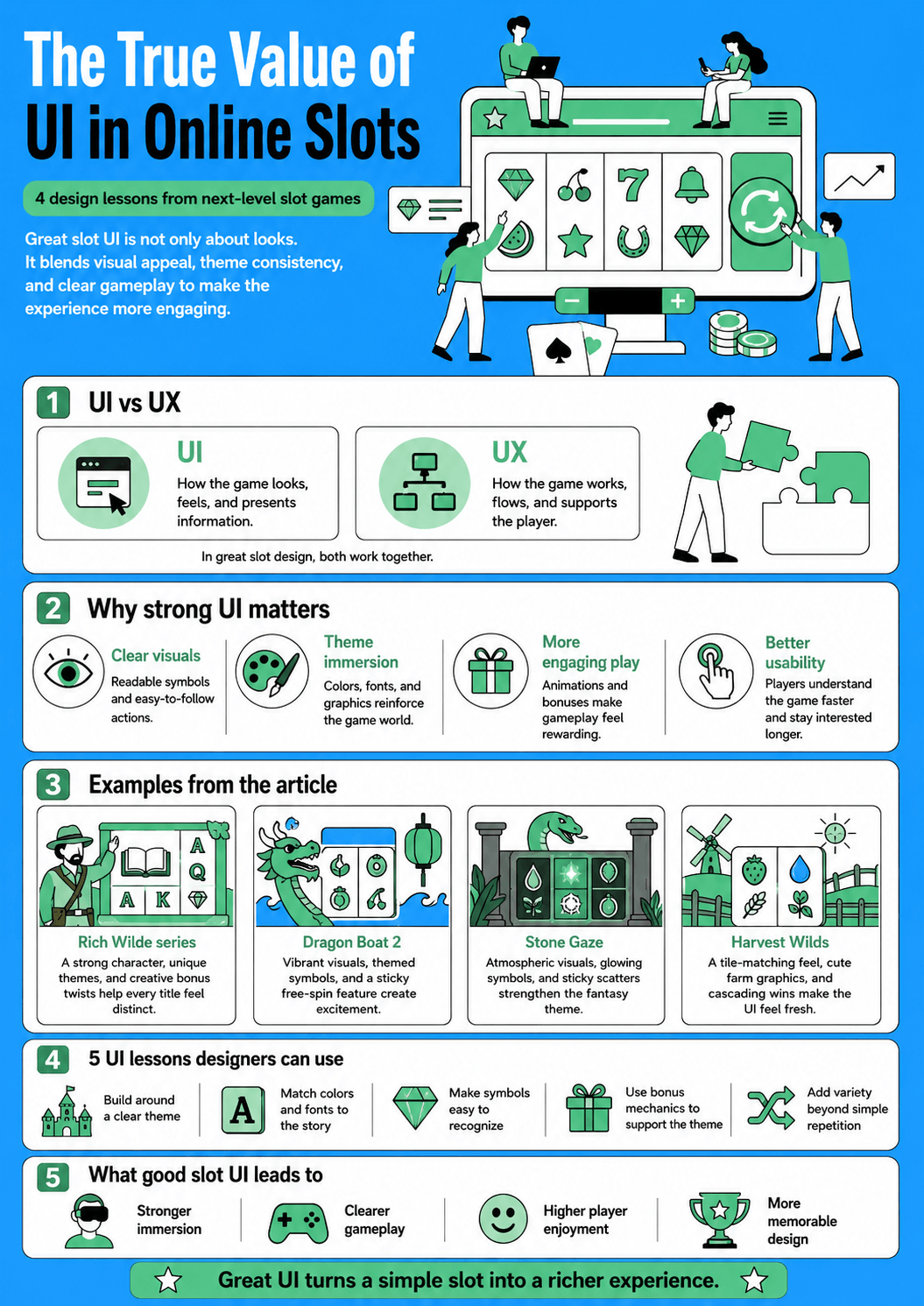
Essentially, UI is about the aesthetics and usability of a digital product. UX involves the actual functionality and working of the product and comes first. Some might not see UI as completely necessary, but it plays a large part in making customers happy with your product.
Online casinos have rapidly become one of the biggest sectors in the gambling market. Aside from convenience and affordability, much of its appeal is the high-quality UI work that creates slot games that are genuinely engaging and enjoyable, not just repetitive.
A quick flick through this catalog of online slots in the US will show you that while some of them look a bit tired; and rough around the edges, the majority have great graphics and play-through. Slot machine games are a great way for developers to experiment as well as have a bit of fun with their designs.
Next-level slot design does not necessarily mean the same thing to everyone, but we have a few key elements. Aesthetically, the graphics and animations are appealing and engaging, and the color schemes fit the theme. In terms of use – the gameplay offers more than just simple repetition.
Thanks to their UI design, our top examples of games have reached the next level of quality players desire.
The 5 Pillars That Separate Next-Level Slot UI from the Rest
Before looking at specific games, it helps to have a shared framework for what “next-level” actually means in UI terms. Across the highest-performing slot titles, five design principles show up consistently.
- Thematic coherence. Every visual element. Symbols, backgrounds, fonts, animations, and even sound design cues. So, should feel like it belongs to the same world. When a player loads Stone Gaze and sees crumbling pillars and glowing green mist, they are not reading a list of features. They are entering a place. Thematic coherence is what transforms a slot into an experience.
- Feedback loops. Great UI makes every interaction feel rewarding, even before a win is confirmed. Micro-animations when reels land, sound layering as symbols align, subtle particle effects when a bonus triggers. These are not decoration. They are the interface acknowledging the player’s actions in real time. That acknowledgment reduces cognitive friction and keeps attention locked.
- Progressive disclosure. The best slot UIs introduce complexity gradually. A new player sees a clean, approachable interface. As they learn the game, bonus features and layered mechanics reveal themselves organically. This keeps the experience fresh without overwhelming anyone on the first spin.
- Color psychology. Blues and greens create calm and immersion. Reds and oranges drive urgency. Gold activates the reward associations built deep into human psychology. The best slot designers are not picking color palettes for aesthetic reasons alone — they are directing emotional states throughout every session.
- Narrative iconography. In a generic slot, wild and scatter symbols are afterthoughts. In a next-level game, they are characters in the story. Rich Wilde himself becomes the wild. Medusa becomes the scatter. When iconography serves the narrative, players invest emotionally in every outcome, not just the winning ones.
Every game in this article can be evaluated through these five pillars. Once you see the framework, you cannot unsee it.
Online Gaming Slots Design UI Value: The Rich Wilde series
The Rich Wilde series of slot machine games shows what’s possible when a developer is willing to dedicate the time to creating a likable character and making each game in a series unique. Since 2013, trusted brand Play’n GO has been releasing Rich Wilde games, and the demand continues.
Rich Wilde is an adventurer character à la Indiana Jones. Each game is themed around a different quest or artifact that he has chased down. One of the most recent games, Rich Wilde and the Tome of Madness; shows the developer’s dedication to making each game unique.
Inspired by the works of horror pioneer H.P. Lovecraft, this five-reel slot upends expectations, and instead of classic paylines, you need to create clusters of symbols.
Once you’ve filled the portal meter and accessed the bonuses, Rich Wilde begins to cast spells from the tome. It’s a twist that makes great use of the theme.
Dragon Boat 2: Lock 2 Spin
UI design Dragon Boat 2: Lock 2 Spin is one of the newest slots on the market, just launched this month. It is a five-reel slot with 25 paylines and gorgeous graphics. The background is a sparkling water scene with dragon boats racing toward the player, and a traditional gate frames the game with lanterns.
These touches are carried through to the symbols. They include a nobleman in traditional clothing, a drummer, an urn, and greenery. The fonts and colors are vibrant. Wild and scatter symbols keep things interesting.
The Lock 2 Spin feature is where this game stands apart from its predecessor. It is a free spin feature triggered by landing at least six of the rice dumpling symbols. These will become sticky symbols, and each new rice dumpling that appears will also stick and grant more free spins.
Online Gaming Slots Design UI Value: Stone Gaze
Stone Gaze is another brand-new slot, this time from developer OneTouch. The game is inspired by the Greek legend of Medusa, a snake-haired woman who can turn people into stones with one look. The game takes place in Medusa’s lair, with crumbling pillars surrounding a glowing green mist.
Most of the game’s symbols are fairly basic, but the quality of the graphics sets them apart. Even the simple gemstones have an ethereal aura that makes them mysterious and makes you want to keep playing. Other symbols include a helmet, a golden snake, and Medusa herself.
The golden scepter is the wild symbol, while the golden Medusa is the scatter symbol. The scatter feature can win you up to 20 free spins at a time. Scatters can also transform into sticky scatters – certainly better than stone!
Harvest Wilds
Harvest Wild is a cleverly designed game that resembles a popular tile-matching game instead of a classic slot machine game, thanks to its seven-reel, seven-row format. This familiarity with UI design is very appealing to players who may be fans of mobile gaming but are new to online casinos.
The graphics are cartoonish and cute, and the background is a sunny fall farm scene. It is visually appealing and attractive before you even get into the gameplay. This game has a cascading win feature so that whenever a cluster match is made, the remaining symbols fall into place.
There is also a bonus seed planting feature. You can plant seeds to become wild icons across the reels. In addition, water provides free re-spins, and fertilizer boosts the multiplier. These extra little touches keep the game from just being another reel spinner and make it something more interesting.
How These 4 Games Compare at a Glance: Online Slots Design UI
Seeing four games described individually makes it easy to miss the bigger picture. Here is how they stack up across the design dimensions that matter most.
| Game | Core theme | Signature UI mechanic | Visual tone | Best for |
|---|---|---|---|---|
| Rich Wilde & the Tome of Madness | H.P. Lovecraft / adventure | Cluster pays + portal spell-casting | Dark, cinematic, layered | Story-driven players who want narrative depth |
| Dragon Boat 2: Lock 2 Spin | Chinese New Year / cultural | Sticky rice dumpling cascades | Vibrant, festive, bright | Players who respond to bold color and cultural celebration |
| Stone Gaze | Greek mythology / Medusa | Ethereal symbol auras + sticky scatter transforms | Eerie, atmospheric, moody | Mythology fans and high-drama visual styles |
| Harvest Wilds | Autumn farm / casual mobile | 7×7 tile-match grid with seed planting | Cartoonish, friendly, warm | Mobile-first players new to online casino formats |
What this table reveals is that there is no single template for excellent slot UI. Moreover, all four share is intention. Every design decision traces back to a specific player feeling the studio was trying to create.
What Web and App Designers Can Steal from Slot UI
This might sound niche, but bear with it: slot game studios are solving some of the hardest problems in digital product design. They are creating engagement with no guaranteed reward, sustaining attention across sessions with no new content updates, and competing in a market where every competitor looks almost identical on the surface.
The lessons they have refined are directly transferable.
- Reward loops belong everywhere, not just games. SaaS onboarding flows, e-commerce checkout paths, and content platforms can all benefit from micro-animation feedback systems. When a user completes a profile, finishes a form, or hits a milestone. Acknowledge it with a UI moment that makes them feel something. Not a generic toast notification. Something designed.
- Thematic consistency builds brand trust at the speed of perception. When you open any Stripe product, everything speaks the same visual language. That is not accidental. It is the same discipline that makes a new Rich Wilde game feel instantly recognizable without reading the title. Design systems are storytelling tools, and the slots industry has been using them this way for years.
- Progressive disclosure is the antidote to feature bloat. You would not build a landing page that throws every feature, pricing tier, case study, and FAQ at a visitor simultaneously. Smart slot designers do not either. They build layers that reward players who stay. Designers building complex platforms. So, analytics dashboards, medical software, project management tools. Should apply the same restraint.
- Every icon should justify its existence. A recycling icon in a sustainability app should not just communicate “recycle” — it should reinforce the product’s identity. The best slot games understand this intuitively. Every symbol has a reason to exist within the world of the game. That discipline is rare outside gaming, and it shows.
The Psychology Behind Engaging UI Design
Understanding why certain UI decisions work is not just intellectually satisfying. It is practically important for any designer building products that people return to.
Variable reward and visual feedback. The variable ratio reinforcement schedule. First described by psychologist B.F. Skinner’s work is one of the most powerful in the behavioral sciences. Slot machines were among the first digital products to apply it deliberately, which explains why near-miss animations, escalating win screens, and multi-stage bonus reveals are designed the way they are. The UI is not just presenting information; it is orchestrating an emotional arc across each session.
For designers working outside gaming, this is worth sitting with. Notification systems, progress bars, and streak counters in fitness apps all draw from the same behavioral principles. Designing them thoughtfully. In addition, with user wellbeing as a genuine constraint rather than an afterthought. So, is part of what separates considered UX from manipulative dark patterns.
Three levels of emotional design. Don Norman’s framework. Visceral (how it looks), behavioral (how it works), and reflective (what it means to the user over time). Maps almost precisely onto the best-performing slot games. Stone Gaze nails the visceral level immediately. Dragon Boat 2 gets behavioral flow right through its cascade mechanics. Rich Wilde fosters reflective engagement through character loyalty sustained across a franchise spanning more than a decade.
Accessibility under sensory load. One underappreciated design challenge in slot UI is maintaining accessibility in high-stimulation visual environments. Games like Harvest Wilds, with their cartoonish high-contrast aesthetic, actually perform better on visual accessibility metrics than darker atmospheric titles. So, even though they are not designed with accessibility as a stated goal. High contrast ratios, clear iconography, and intuitive spatial layouts are not just inclusive design principles. They are fundamentals of playability, and the best slot studios arrive at them through the same reasoning as accessibility guidelines.
Frequently Asked Questions About Online Slot UI Design
UI (user interface) refers to the visual and interactive layer of the game. Graphics, animations, button layouts, color schemes, and typography. UX (user experience) covers the broader player journey: how the game loads, how intuitive the controls feel, whether the bonus system is confusing, and how a player feels after a session. Great slots require both, but UI is what creates the first impression and keeps players visually engaged between mechanical interactions.
Budget matters, but the bigger factor is usually intentionality. Slots with exceptional UI tend to come from studios that first define a clear theme and build every design decision on that foundation. Character, symbol hierarchy, color palette, sound design, and animation style all stem from a unified creative brief. Studios that treat each element as a separate checkbox produce games that feel incoherent, even when individual assets are high quality in isolation.
Research in behavioral psychology and game design suggests that the quality of visual feedback significantly affects how long players remain engaged during a game session. Smooth animations, satisfying sound-UI synchronization, and clear win state displays reduce cognitive friction. Players spend less mental energy decoding what is happening and more time experiencing the game. That reduced friction translates directly to longer sessions and higher rates of return visits.
Slots are extreme stress-tests of engagement design. Every principle that works in slots. So, feedback loops, thematic coherence, progressive disclosure, color psychology, and narrative iconography. Transfers directly to apps, websites, and SaaS products. Studying slot UI with a critical design eye is genuinely useful professional development for anyone building products where retention is a metric that matters.
It depends on your criteria, but the Rich Wilde franchise by Play’n GO is consistently highlighted by design commentators for sustained narrative consistency across multiple releases. A design systems achievement more than a visual one. For raw visual innovation, Harvest Wilds demonstrates how genre-blending (slot mechanics wrapped in mobile puzzle-game aesthetics) can produce a remarkably fresh UI that appeals to audiences who may not consider themselves online casino players at all.
Infographic
The Real Lesson: Great UI Is Invisible Until It Isn’t
The best UI in any digital product, whether a slot game, a SaaS dashboard, or a mobile app, disappears. Players do not think “this interface is beautifully designed.” They think, “I can’t stop playing.” That invisibility is the goal, and it is harder to achieve than it looks.
Online slot developers have solved something that many mainstream product teams are still working out: engagement is not a feature you layer on late in development. It is the structural logic that every design decision should serve from day one, with consistency, with thematic discipline, and with a clear picture of how you want users to feel. Not just what you want them to do.
The next time you are evaluating a UI for a client project, an app redesign, or a new product launch, try playing a few of the games mentioned here with a designer’s eye. Notice what catches your attention. So, notice what information surfaces exactly when you need it. Notice how you feel when something lands versus when something jars.
You will walk away with more design insight than you would from a week of reading documentation.