The freelance workforce is larger and more varied than it has ever been. According to Upwork’s Freelance Forward report, over 60 million Americans did some form of freelance work in recent years, and the share of skilled freelancers doing knowledge-based work design, development, writing, and consulting has grown consistently. In Europe and South America, similar trends have played out across creative and technical sectors.
But being a freelancer is not just about having clients. The professionals who build durable freelance careers tend to have something else running in the background: a side project.
Side projects are different from client work. They are initiatives you own entirely: a tool you build, a course you write, a niche website you run, a design template you sell, or a plugin you release. They exist outside any single client relationship, and that distinction matters more than it might seem.
This article looks at the real benefits of keeping a side project alongside your client work, why the designers and developers who do this consistently report stronger careers and better resilience, and how to start one without upending your existing workload.
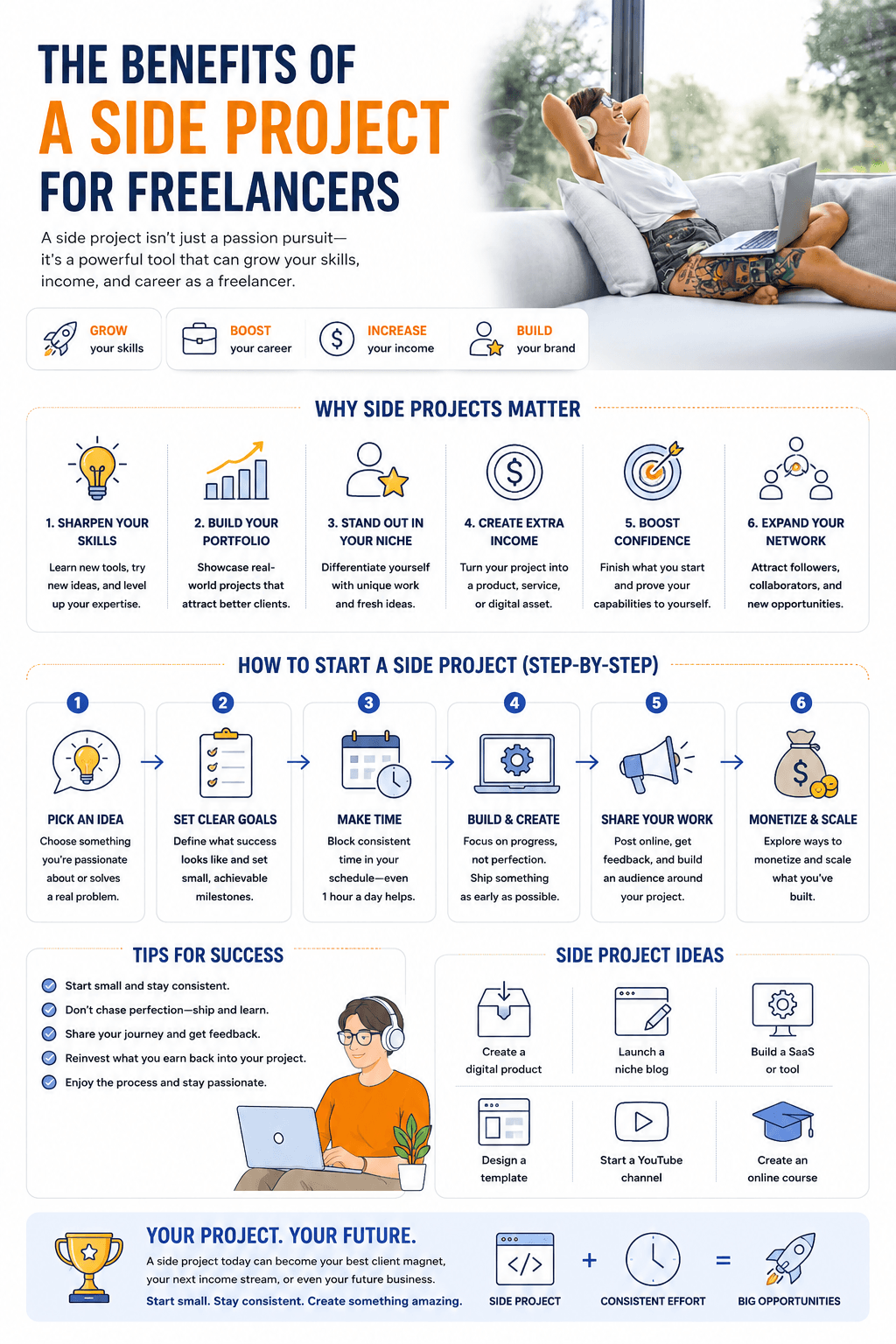
Here are some benefits of a side project for freelancers
Learn New Skills
Taking on side projects allows you to tap into new skill sets you may not be able to use at your full-time job. You can try small projects or hobbies that interest you and turn them into products or services to start a side hustle.
In addition, doing freelance allows you to practice your time management, prioritization, communication, and negotiating skills. Not to mention sales, as you will be selling your service to potential customers. Every new project or client offers a unique opportunity to grow.
It’s motivating to have something new to learn and a challenge to face regularly. It can wake your creativity and encourage you to take new angles and approaches in your career. Taking your education and development into your own hands is also very empowering. It reminds you that you are still in control of your career and there are succeeding levels and avenues you can still explore.
Side project ideas that make sense for designers and developers
One of the biggest gaps in most advice about freelancer side projects is that it stays generic. Here are concrete options that map directly to what the Visualmodo community already does.
WordPress themes or plugins
Building your own WordPress product, even a free one, does several things at once. It forces you to think like a product owner rather than a service provider, builds a publicly available portfolio piece, and can generate passive income if you release a paid version or premium tier. The initial investment is time, not money, and the learning that comes from building something you own is meaningfully different from building something for a client’s brief.
UI component or template packs
Design component libraries, icon sets, landing page templates, and Figma or Sketch kits are consistent sellers on platforms like Creative Market, Gumroad, and ThemeForest. If you are already producing design assets for client projects, packaging and selling them separately is an extension of work you are already doing.
A niche tutorial site or YouTube channel
Teaching what you already know builds authority in a way that client work rarely does. A series of targeted tutorials on a specific WordPress topic, a CSS technique, or a design workflow can establish your name in a niche community, generate inbound leads, and serve as a strong signal of expertise to potential clients. It also builds an audience you own, independent of any algorithm or platform.
A micro-SaaS or web tool
Smaller than a full software product, a micro-SaaS serves a narrow, specific need. For developers, this might be a tool that solves a frustration you have personally experienced. Many successful examples started as a scratch-your-own-itch project that turned out to have a much wider market.
A freelance productized service
Rather than offering fully custom work, a productized service packages your expertise into a fixed-scope, fixed-price offering. “WordPress speed audit and optimization for $399” is a productized service. It is easier to sell, easier to deliver, and easier to scale than a bespoke engagement, and it can run alongside your existing client pipeline without requiring daily attention to scope creep.
For anyone looking to start earning online with limited upfront investment, these project types offer a strong return on creative time without requiring significant capital.
Keep Things Interesting
Especially if you find yourself stagnant and lacking development professionally, you should consider taking on a side project. Doing the same job daily for a year or more can sometimes feel exhausting. The monotony can bore you and demotivate you, even leading to burnout.
Break your cycle and do something out of the box by taking on freelance projects. For example, if you have a passion for writing, teaching, or consulting, you can use this to share your expertise, which can also be freelance work.
Taking on side projects is a great way to join the freelance revolution gradually. You can get outside your comfort zone and enter a niche you don’t typically touch. It will also add diversity and exposure to your day and workload, which is always good.
How side projects strengthen your portfolio in ways client work cannot
Portfolio pieces built from client work have a fundamental limitation: you did not choose the brief, the constraints, or the outcome. You solved someone else’s problem under someone else’s conditions. That is valuable, and clients understand it, but it tells a limited story about who you are as a professional.
A side project is the opposite. You chose the problem. You set the aesthetic direction. You made every decision about technology, design system, and user experience. When a potential client or employer looks at a side project in your portfolio, they are seeing what you do when no one is telling you what to do.
That distinction tends to produce stronger reactions than client work, especially for the kinds of clients most freelancers want more of.
Side projects also let you build a portfolio in areas where you do not yet have client experience. If you want to move from general web design into product design, or from WordPress development into headless builds, waiting for a client to take a chance on you is slow. Building your own project in that space is immediate. You walk into that next conversation with a live URL rather than an explanation.
The compounding effect matters here too. A side project you built two years ago still demonstrates your skills today. A WordPress theme you published and kept updated shows not just design ability but product ownership, documentation thinking, and a commitment to user experience over time. These are signals client work rarely surfaces.
If you are working on landing your first job in a new design discipline or pivoting your freelance focus, a side project is often the most credible bridge between where you are and where you want to be.
Make Extra Money a side project
A side project can earn a little extra cash. There are many freelance opportunities out there that you can do for a short period while making good money. In some cases, freelance workers can earn more than regular employees. However, this is case-by-case and can vary based on your industry, niche, and geographical location.
And it is also important to note that new freelancers will likely start small, perhaps charging a little low to test the waters. But, if you keep at it, you can make your side hustle work and begin to earn a nice income stream on the regular. Additionally, some freelance work lets you decide on your workload and schedule, so you can only work if you need the extra cash. Finally, you’ll have the option only to take on side hustles if you choose.
How to think about pricing when your side project involves client work
If your side project is a productized service or takes on occasional client engagements, pricing is where most freelancers make the same mistake twice: starting too low and not knowing when to raise.
Starting low while you build a portfolio or gather testimonials is a legitimate strategy and often the right one. The problem is staying low indefinitely. The freelancers who charge confidently tend to have two things: evidence of outcomes (not just outputs) and a clear sense of their own market position.
Here are a few principles that tend to hold across creative and technical freelance work:
- Price your outcome, not your time. A client who wants a WordPress site does not want your hours. They want a working site that performs. If you frame your pricing around hours, every negotiation becomes a conversation about how fast you work. If you frame it around what the deliverable achieves, you have a much stronger position.
- Research market rates before you set yours. The freelance graphic design rate varies significantly by experience, specialization, and geography. Knowing where your rate sits relative to the market lets you price intentionally rather than randomly. If your rate is significantly below market, you attract clients who prioritize cost, which creates a different set of problems than clients who prioritize quality.
- Test higher prices on your side work. Because side projects are low-stakes compared to your primary income, they are an ideal place to test rate increases. A productized service or template pack can be repriced more easily than a primary client relationship, and the data you get from conversion rates at different price points is genuinely useful.
- Build in rate reviews. Set a trigger for a portfolio milestone, a number of completed projects, or a year anniversary at which you automatically review and raise your rates. Waiting until you feel confident enough is usually waiting too long.
Create New Connections
Side projects allow you to meet new people and create new business connections. This lets you expand your horizons and gather more knowledge and insights about a specific niche or industry. Having relationships helps you navigate the freelance world better and can lead to more opportunities and projects.
You never know who you may come across doing freelance work. It could lead to an exciting new partnership or maybe an ample opportunity you didn’t expect. Some may allow you to create projects that will enrich your portfolio, some can endorse you to other clients, and some can even introduce you to your next business partner. These business connections could do wonders for your career and its progression.
If you are a freelancer or considering being one, prepare to open yourself up and be ready to communicate and make connections. This will help you create a network that can significantly support your freelance career.
How to run a side project without burning yourself out
The irony of starting a side project to prevent burnout is that a poorly managed side project can cause it. The benefits of creative variety and income diversification disappear quickly if your side work starts eating into recovery time, sleep, or the mental space your primary work requires.
A few practices that help:
- Time-box it deliberately. Successful side projects tend to run on predictable, protected time blocks rather than filling whatever time is left over. Leftover time is rarely enough and rarely consistent. Deciding in advance that your side project gets Tuesday and Thursday evenings, or the first two hours of Saturday morning, means it is sustainable rather than opportunistic.
- Define what “done” looks like for each phase. Open-ended side projects have a way of expanding indefinitely. Breaking your project into phases with a clear end state for each one keeps momentum visible and prevents the creeping scope that makes a side project feel like a second full-time job.
- Build asymmetric effort. The best side projects eventually generate value that does not require constant new input. A WordPress plugin you published, a template pack on Creative Market, or a tutorial video that keeps getting discovered through search does ongoing work while your attention is elsewhere. Aim toward output that compounds rather than output that resets.
- Know the warning signs. If you are consistently working past 10pm, missing sleep regularly, losing interest in your main client work, or resenting your side project rather than enjoying it, those are signals the structure is off, not that you are weak. Adjusting the scope or pausing the project is a legitimate response.
The relationship between creative work and burnout is well-documented, and freelancers are statistically more vulnerable to it than full-time employees because there is no structural boundary between work and life. A side project should add creative energy to your week, not drain what remains of it.
Make the Most Out of Side Hustles
Freelance work opens excellent opportunities that can positively affect various aspects of life – from financial aspects to your career and overall well-being. Don’t be afraid to explore new things and develop skills you can use for freelance work. Shake things up a bit and try some side projects from time to time. Immerse yourself in new challenges and scale your career for tremendous success.
Freelancer side project FAQ
Projects that produce reusable or scalable output tend to give the strongest return on creative time. Design templates, UI kits, icon sets, and landing page packs are popular because they can be sold repeatedly after the initial build. Publishing a niche design tutorial channel or a blog that targets a specific technical audience builds authority over time. Building your own website using your preferred tools, designed entirely to your own standard rather than a client brief, also makes a strong portfolio piece.
Yes, and many do. The key considerations are your employment contract (some companies include IP or non-compete clauses covering work done outside of hours) and your energy budget. Review any relevant employment agreements before starting, and structure your side project time so it does not erode the quality of your primary work. Many full-time designers and developers use side projects as a test bed for freelancing before making a full transition.
This depends entirely on the type of project. A productized service or freelance offering with direct client outreach can generate income in weeks. A product on a marketplace like ThemeForest or Creative Market often takes three to six months of visibility-building before consistent sales emerge. A tutorial platform or SEO-driven content site can take six to eighteen months to build meaningful traffic and revenue. Passive income from side projects is real, but rarely immediate.
Doing some early work at a reduced or zero rate while building a portfolio, gathering testimonials, or learning a new skill is a reasonable trade. The mistake is treating this as a default rather than a phase. Set a clear exit condition, for example “I will work at this rate until I have five published pieces and two client testimonials,” and then raise your rates as planned.
Building and releasing your own WordPress plugin or theme, even a free one in the official repository, is one of the most useful things a WordPress developer can do for their career. It demonstrates product thinking, code standards compliance, and public accountability. Contributing to open-source WordPress projects serves a similar purpose. Creating tutorials or documentation for a specific plugin ecosystem also builds a niche reputation that translates directly to client inquiries. For developers just starting out, the list of essential WordPress developer skills is a useful starting point for identifying which skills a side project can help build.
Start in the communities you already inhabit. Designers and developers who are active in WordPress forums, design communities, GitHub, or relevant subreddits tend to find their first side-project clients through those channels before they use any formal platform. Productized services marketed through a focused landing page and promoted in relevant Slack groups or communities often outperform generic profiles on Upwork or Fiverr, particularly for more senior work. Warm referrals from existing clients who know you are taking on additional work remain the highest-converting source.
It can and does for many freelancers. The pattern is usually gradual: the side project generates enough consistent revenue to justify more time, the time invested grows proportional to that revenue, and eventually the side income exceeds or matches the primary income. The freelancers who get there fastest tend to choose projects with some degree of recurring or passive income rather than pure time-for-money exchanges. Books written by founders who made this transition offer the clearest picture of how the process actually unfolds in practice.
Infographic