Know the best strategies to reduce technical debt effectively; Technical Debt is the mother of mismanagement! Learn how to manage and mitigate accumulated debt by carefully monitoring your business.
As often said, risk-takers are dream makers; however, not in the case of accrued technical debt. Debt is debt, no matter which way it is accumulated. The bottom line is that you must pay it back in one way or another. Therefore, implementing the best strategies to reduce technical debt is essential to avoid this problem.
Developers often use shortcuts to get the job done quickly, but technical debt accumulates! It is not usually immediately noticeable, as the risks of dodging proper procedures to implement new features or applications can have long-term problems.
The resulting malfunction will only increase the pile of problems where customers will have to resort to more repairs than operations; resulting in Technical Debt that would have to be paid by the customer.
All of this can be avoided by adequately measuring and monitoring developments within your business. Whether you already have accumulated technical debt or want to learn how to avoid it altogether, the information below will help either way. So let’s know how to control this problem once and for all!
What is technical debt?
Technical debt is the future cost of choosing a quick solution instead of a cleaner, more maintainable one.
A simple example:
A developer copies the same block of code into three different places because it is faster than building a reusable function. The feature ships on time. Later, when the logic needs to change, the team has to update all three places. If they miss one, a bug appears.
That extra work is the interest on the debt.
Technical debt can live in code, architecture, tests, documentation, infrastructure, security, design systems, and team processes. It is not always visible to users at first, but it slowly changes how expensive and risky future work becomes.
A healthy team talks about technical debt openly. An unhealthy team hides it until every new feature feels harder than it should.
How to Monitor Technical Debt
Creating technical debt is not a rare occurrence. However, it’s almost always to be expected; as sometimes companies can’t wait to improve every line of code as development stops. However, Technical Debt can be effectively monitored and managed.
Finding the ratio of such debt will give teams an insight into the suspected problem while proceeding with app development. There are several tools to measure the debt ratio and keep application development on par.
These tools will give teams essential data to monitor technical debt and manage development. This will ensure that app developments are not lagging and will avoid potential problems in days to come.
Agile Development and Its Relationship to Technical Debt
Quality assurance is the main aim of application developers. To prioritize delivery, agile development needs a fast-paced system. Speed is the crux of agile development; however, the features of each application need proper functioning implementations for this process to be successful.
While this may enhance the application’s performance, accumulated technical debt through the process is inevitable. Therefore, using best practices has several benefits; and expect to accumulate technical debt during this period.
Resolving issues with bugs will see teams emphasizing different features to combat problems. Unfortunately, this will result in accumulated technical debt that must resolve immediately before proceeding with development.
Remember that the essential aspects of agile development are quality and stability. Agile developers need to keep track of accrued technical debt during the process.
Common Costs Associated with Technical Debt
There are several costs associated with technical debt. First, however, the most commonly accrued debts that we listed below during the application development stages.
1 – When Code Quality is Low
Coding practices and design are essential in reducing extra costs during development. Unfortunately, developers who press for time to do the job often leave behind a bigger mess.
Although we understand that technical debt is unavoidable, developers who concentrate more on completing a job rather than on its quality create problems in the long term. This makes the work of future developers who take over the project more difficult and the best strategies to reduce technical debt.
The codebase will be in a tangle which will ultimately accumulate technical debt. In addition, this results in code cleanup because of the initial poor code design.
2 – Holding Up the Application Development Progress
Together with the trouble of technical debt comes a backlog of accumulated work. This backlog makes it difficult to keep the project running, which puts strain on the application development process.
This includes system testing and code complexity issues; which could have been avoided if and had resolved them. Taking care of the problems at hand is essential; however, developers are late in moving forward with current work. As a result, this technical debt accumulates and could have been substantially avoided if; and had taken adequate measures from the beginning.
3 – Technical Debt Caused by Defects
Can avoid defects in application development if code quality is at its highest level. This will also enhance the customer’s user experience resulting in fewer defected comebacks. However, defects are quite common most of the time, resulting in accumulated maintenance costs, which are technical debt.
4 – Slacking Productivity
A reduction in team performance can brutally blow to the productivity of any business. Proper functioning systems take a plunge when technical debt caused by mismanagement increases. Developers have to work together amicably to combat slacking productivity and avoid causing more functionality problems.
How to measure technical debt
You cannot manage technical debt well if the team only talks about it in vague terms.
Start by combining engineering judgment with measurable signals.
Useful technical debt indicators include:
- Code complexity.
- Duplicated code.
- Test coverage.
- Number of flaky tests.
- Build time.
- Deployment failure rate.
- Time needed to release a change.
- Bug frequency.
- Open security vulnerabilities.
- Outdated dependencies.
- Number of manual release steps.
- Incidents caused by old code.
- Developer time spent on rework.
- Pages or features with poor performance.
- Areas of the codebase that only one person understands.
No single metric tells the whole story. A team should combine code quality tools, delivery metrics, incident data, and developer feedback.
The goal is not to create a perfect score. The goal is to spot where debt is slowing the team most. Keep reading top strategies to reduce technical debt.
Key Tips for Reducing Technical Debt
Can implement several strategies to reduce technical debt. Among them, the most effective ways we have listed below:
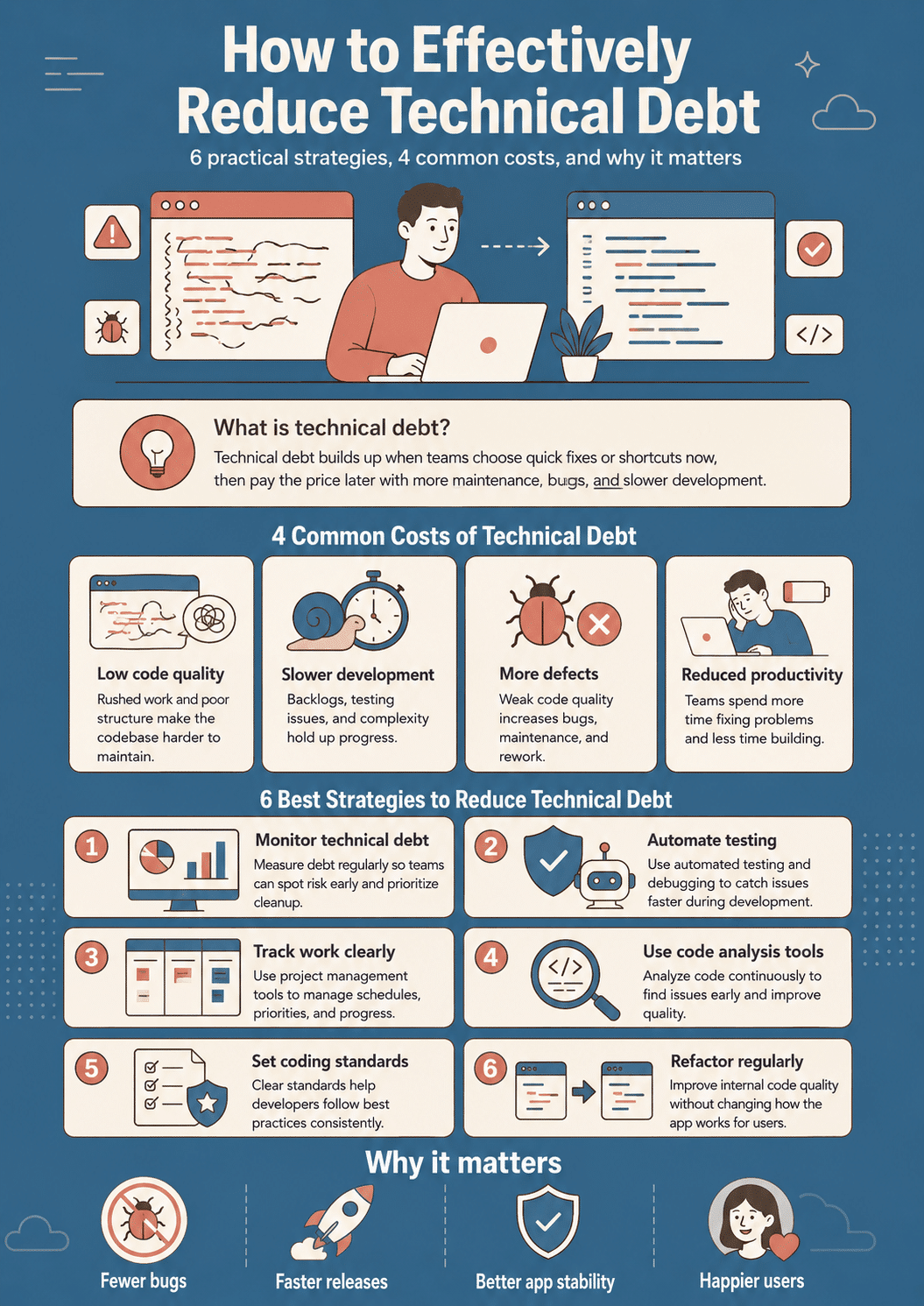
If you want to reduce problems with coding, automated testing is essential. It involves several scanning and coding processes; that eliminate cause problems by automating debugging cycles when modules renew. This will substantially reduce technical debt.
And can use several project management tools to reduce technical debt. One of which is Hive Trello. It aids in maintaining schedules and tracking development progress. It is an essential tool as it is efficient in keeping development on track.
If you want to identify code issues quickly and recommend opting for code analysis tools. Klocwork and Sonargraph are amongst the most efficient means to use.
Setting coding standards will ensure developers follow the protocol for best practices. Also, this will help to reduce technical deb; teams will require to take appropriate action when developing applications.
And to maintain the source code’s internal quality, refactoring is essential. This process is advantageous in reducing technical debt and will not interfere with the external performance of the app.
Infographic Strategies Technical Debt
Conclusion
As you have read above, technical debt is avoidable to a degree. However, developer teams who work together to understand reducing the use of shortcuts will benefit the overall project. This is because it will reduce future app development problems.
However, if you have already accumulated technical debt, it is not a train smash, and you can rectify it. Although it may slow down the current development progress, and will eventually sort it out. After that, developers must follow proper protocol to be on par with future enhancements. Look at YourShoring from Turnkey to build a fantastic remote tech team.
Strategies Technical Debt FAQ
Technical debt is the future cost created when a team chooses a quick or imperfect technical solution that may require extra work later.
No. Some technical debt is a reasonable tradeoff, especially when a team needs to ship quickly, test an idea, or meet a deadline. It becomes harmful when ignored or left unpaid.
Common causes include tight deadlines, weak planning, poor code quality, missing tests, outdated dependencies, unclear requirements, poor documentation, old architecture, and repeated shortcuts.
Start by identifying the biggest sources of debt, prioritizing them by risk and business impact, fixing them in small batches, improving tests, refactoring carefully, updating documentation, and preventing the same issues from returning.
Technical debt can be measured through code complexity, duplicated code, test coverage, security vulnerabilities, dependency age, build time, deployment failures, bug frequency, rework time, and developer feedback.
A technical debt register is a list of known technical debt items, including what the problem is, where it lives, why it matters, who owns it, and when it should be reviewed.
Not always. Some debt should be fixed immediately, especially if it creates security or customer risk. Other debt can be reduced during feature work or scheduled for regular maintenance.
Use clear coding standards, code reviews, automated tests, documentation, regular dependency updates, architecture reviews, and a realistic definition of done.
Yes. Technical debt can lead to more bugs, slower performance, delayed features, outages, security issues, and weaker user experience.
Explain the business impact. For example, technical debt may slow delivery, increase support costs, raise security risk, make releases harder, or delay important product changes.