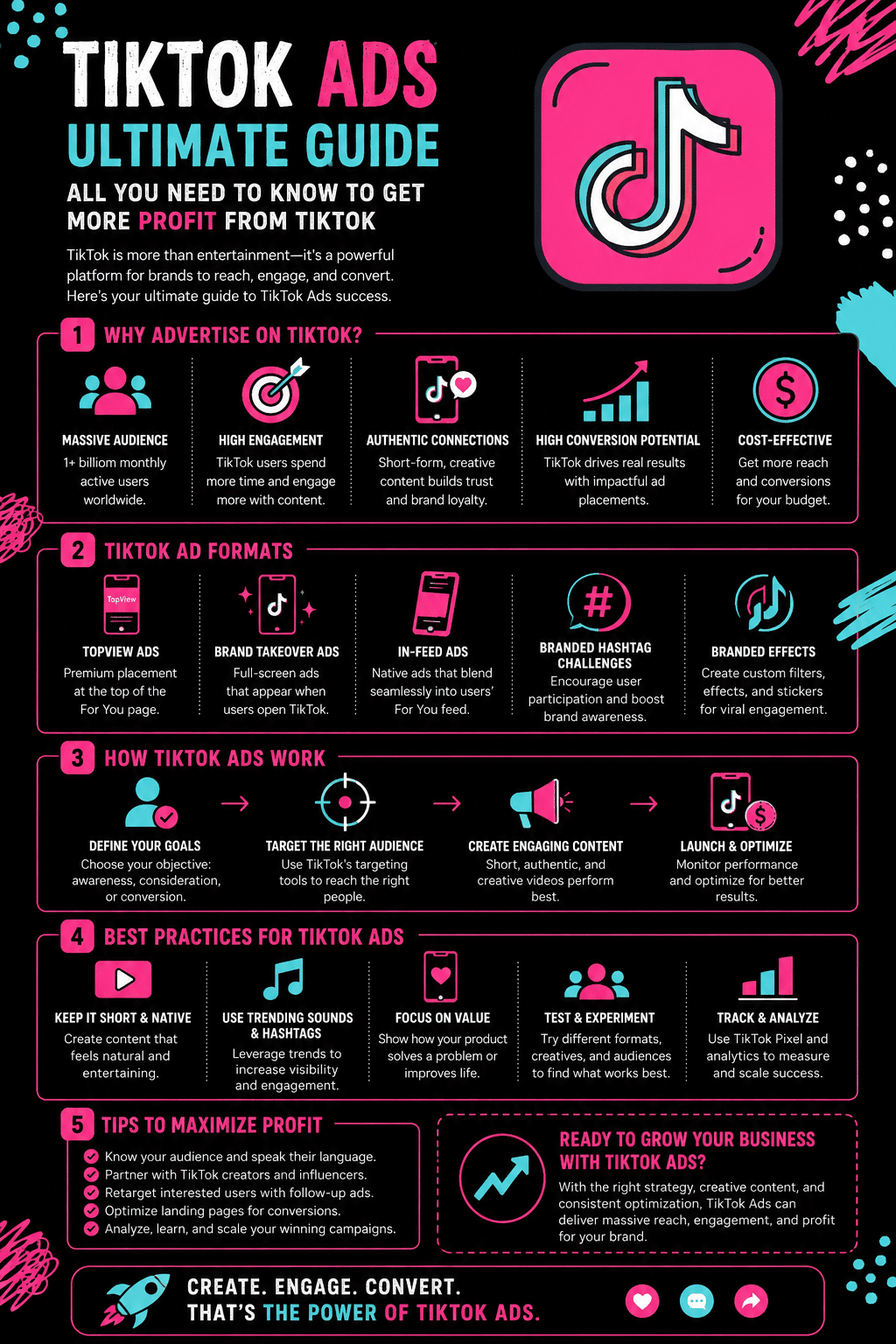
TikTok ads ultimate guide, here are all you need to know to get more profit; With over 1 billion active users in 2022, the phenomenon that is TikTok has caught the attention of marketers and advertisers. Since 2016, the social media video sharing platform started more for its digital world and expanded from 150 markets.
So, despite this stellar growth and large audience base, TikTok’s advertising opportunities are still a mystery to many. If you’re sitting on the TikTok fence, you should invest in ads, not alone.
This TikTok Ads Works for Beginners guide can help you learn how to run this ad campaign, get started with TikTok Business Manager, and the steps to create a new campaign.
In addition, we’ve included some best practices and tips. Come on!
TikTok in 2026: The Platform That Redefined Short-Form Advertising
Any meaningful TikTok advertising strategy needs to start from an accurate picture of what the platform actually is in 2026, because it has changed substantially since the version many marketers learned about in 2021 and 2022.
TikTok now has approximately 1.7 billion monthly active users globally, making it one of the largest social media platforms in the world. According to ByteDance and third-party analytics firms, users spend an average of 95 minutes per day on the platform, a figure that outpaces most competing social media apps and approaches television viewing time in some demographics.
The platform’s audience has broadened significantly. While Gen Z remains the core and most engaged user base, users over 25 now represent a growing majority of total time spent on the app in many Western markets. For brands targeting audiences in their late twenties through mid-forties, TikTok has become a legitimate and often cost-efficient channel.
Two developments specific to 2024 and 2025 are particularly relevant for advertisers. First, TikTok has firmly established itself as a search destination, with research from Adobe finding that a majority of Gen Z users search TikTok before Google for certain categories including product recommendations, restaurant choices, and how-to guidance. This has made TikTok’s search ads a meaningful new placement alongside its traditional feed-based formats.
Second, TikTok Shop has transformed the platform’s commercial value for brands selling physical products. The integration of product listings, livestream shopping, and creator affiliate programs directly into the feed has made TikTok one of the most complete social commerce environments available to advertisers outside of China.
The brief note on US regulatory uncertainty: TikTok has faced ongoing legislative pressure in the United States, including divestiture demands. As of 2026, the platform continues to operate. Brands advertising on TikTok should maintain platform-agnostic content strategies and avoid allocating budget they cannot afford to shift elsewhere if the regulatory situation changes. This is a risk management decision, not a reason to avoid the platform entirely.
Why advertise on TikTok and Get More Profit From TikTok?
Gen Z primarily favors TikTok, but more older users started using the platform in 2020. During Q1 2020, the quarterly share of 24-34-year-olds increased from 22.4% to 27.4%. At the same time, the 35-44 age demographic rose from 13.9% to 17.1% (Comscore). With a wide range of good qualities on the platform, it is one that your target audience is there.
TikTok content consists of 15-60 second videos. This format means the other ads are valuable as they are unlikely to get lost in a sea of advertisements like on platforms. So, TikTok has an easy-to-use self-service advertising platform that makes creating an engaging ad campaign easier.
As with any advertising platform, TikTok advertising is not for all brands. Therefore, it’s essential to consider target audiences and determine if they’re using a platform (remember, Gen Z and Millennial audiences largely dominate it). And if your target audience is Baby Boomers, then TikTok advertising is not for you.
Let’s give some publicity to some of the benefits of TikTok.
Effective Reach and Engagement
TikTok is available in over 150 countries and was one of the most downloaded apps worldwide in 2020. In addition, TikTok ads can also be public on other products on the platform.
- Accurately targeting your potential customers
TikTok lets you target the right audience using age, gender, location, interests, etc. You can also create custom audiences and templates to reach people like your existing customers.
- Transparent measurement and data partners
TikTok is a working tool so you can track the performance of your ads. Like Facebook, TikTok uses a tracking pixel to react to your ad’s performance and measures results by monitoring your website’s behavior or visitors.
TikTok Ad Creative Best Practices: Making Ads That Actually Work
TikTok itself has stated its own creative principle plainly: “Don’t make ads. Make TikToks.” This is not a slogan. It is a strategic description of what performs on the platform.
TikTok audiences have a finely tuned sense for content that was made for TikTok versus content that was repurposed from Instagram, YouTube, or television. Repurposed content underperforms consistently because it does not fit the native visual language of the platform. The following practices are the difference between ads that blend into the feed and ads that get skipped.
Hook within the first three seconds
TikTok’s own research, published through its Creative Center, shows that ads which establish a clear hook in the first three seconds generate significantly higher view-through rates than those that build slowly. The hook does not need to be a product reveal. It can be a surprising statement, a question that creates curiosity, a fast cut, or a visually striking opening frame. The viewer decides whether to keep watching within the first two to three seconds, and everything after that depends on winning those first moments.
Shoot vertically for the full screen
TikTok ads should be shot in 9:16 vertical format to fill the full screen. Horizontal or square content cropped into a vertical frame looks immediately like repurposed material. The in-feed experience is full-screen and immersive, and ads that do not respect that format signal to the viewer that the content was not made with them in mind.
Use sound as a core creative element
Unlike most advertising environments, TikTok is primarily a sound-on platform. Over 90 percent of users have sound enabled. Music, voiceover, sound effects, and the rhythmic alignment of edits to audio beats are not optional add-ons to TikTok creative. They are structural elements that drive engagement. TikTok’s Creative Center includes a commercial music library of licensed tracks that can be used in paid ads.
Write captions for dual-purpose viewing
A meaningful percentage of viewers watch without following the audio even on sound-on platforms. Adding text overlays that carry the core message independently of the spoken audio makes your ad accessible to those viewers and reinforces key points for everyone else. Keep text overlays brief, use large readable fonts, and place them where they will not be covered by the interface elements TikTok overlays on videos (the right side icons and bottom caption).
Include a clear call to action
TikTok’s ad formats include interactive call-to-action buttons, but your creative itself should also contain a verbal or visual CTA before the end of the video. For conversion-objective campaigns, showing the product, stating the offer, and directing viewers to take action within the video’s runtime outperforms creative that relies solely on the platform-level CTA button.
Plan for creative fatigue
TikTok ad creative fatigues faster than on most other platforms because the feed refreshes constantly and users see content at a high rate. Plan to refresh your creative assets every two to four weeks for always-on campaigns. A creative that performs strongly in week one will typically show declining metrics by week three. Maintaining a pipeline of new creative variations is as important as initial campaign setup.
TikTok Ads Manager Overview
So, TikTok Ads Manager has all the tools you need to create, launch, manage and track your TikTok ad campaigns. In this section, we guide you through each section of TikTok Ads guide Manager. So, if you’re new to the platform, take a look at our TikTok marketing guide.
- Panel
So, on the dashboard, you’ll get an overview of TikTok ad data and be able to track performance changes. In addition, you’ll find information related to active campaigns, ad budget spending, ad performance over time, and more.
- Campaign
You will see all your campaigns, ad groups, and ads and manage them on the Campaign page. So, by clicking the Create button, you can create an ad right away.
- Library
This section of TikTok Ads Manager is where your ad assets are kept. So, you’ll find everything you need to create or manage ads, audiences, pixels, etc.
- Reporting
In the Reports section of TikTok Ads guide Manager, you can create custom ad reports or create reports using one of the included predefined templates. You can run reports in real-time or schedule messages to be delivered when and where you need them.
TikTok Shopping Ads and TikTok Shop: The Commerce Evolution
For brands selling physical products, TikTok’s commerce features represent the most significant advertising development on the platform since its early growth years. TikTok Shop and its associated ad formats have created an integrated path from content discovery to purchase that does not require users to leave the app.
What TikTok Shop is
TikTok Shop is an in-app shopping platform where brands and creators can list products, manage orders, and receive payments directly through TikTok. Products appear in dedicated shop tabs on brand and creator profiles, in short video content through product tags, and in LIVE shopping sessions.
Shopping ads and catalog campaigns
TikTok’s shopping ad formats allow brands to connect a product catalog and run video or image-based ads that display product details and a direct purchase link. These ads appear in the For You feed and function similarly to Facebook Dynamic Product Ads, with the platform automatically matching products to users based on interest and behavioral signals.
Video Shopping Ads combine creator-style video content with shoppable product links, making them the format most aligned with TikTok’s native content experience.
Collection Ads combine video with a tappable product card that expands into an in-app product gallery, reducing friction between video engagement and product exploration.
LIVE Shopping Ads
LIVE shopping on TikTok allows brands and creators to host real-time video sessions where products are demonstrated, discussed, and sold with an in-stream purchase mechanism. LIVE Shopping Ads promote these sessions to broader audiences beyond existing followers, driving viewers into active shopping sessions. This format has generated exceptional results for e-commerce brands in categories including beauty, fashion, home goods, and electronics.
Creator affiliate program
TikTok’s creator affiliate program allows brands to set a commission rate and invite TikTok creators to promote their products. When a creator’s video drives a sale through their tagged TikTok Shop link, they earn the commission automatically. For brands, this creates a performance-based creator marketing program where budget is spent only when a sale occurs. Combined with paid amplification of the best-performing creator videos through Spark Ads, this represents one of the most cost-efficient acquisition models available on the platform.
TikTok Ads Budgeting, Bidding, and Cost Benchmarks
One of the most common questions from brands considering TikTok advertising is what it actually costs. The answer varies by objective, industry, and targeting specificity, but the following benchmarks provide a useful starting framework.
Minimum budget requirements
TikTok Ads Manager requires a minimum daily budget of $50 at the campaign level and a minimum daily budget of $20 at the ad group level. These are the technical minimums for self-serve advertisers. In practice, running a campaign with meaningful data volume and optimization potential typically requires at least $100 per day at the ad group level for a testing phase.
Premium formats including Brand Takeover and TopView are reserved inventory with minimum spends significantly higher than self-serve budgets. Brand Takeover campaigns typically require a minimum investment of $50,000. TopView and Branded Hashtag Challenge formats are similarly priced for enterprise-level campaigns.
Bidding strategies
TikTok Ads Manager offers several bidding approaches depending on your campaign objective.
- CPM (Cost per Mille): You pay per 1,000 impressions. Best for awareness objectives where reach and visibility are the primary goals rather than clicks or conversions.
- CPV (Cost per View): You pay when a user watches a defined portion of your video (typically six seconds). Best for video view objectives where content engagement is the measure.
- CPC (Cost per Click): You pay per click. Best for traffic objectives where driving visitors to a website or landing page is the goal.
- oCPM (Optimized CPM): TikTok automatically optimizes delivery to reach users most likely to complete a target action (conversion, app install, lead form submission). Most conversion-objective campaigns use oCPM because the platform’s algorithm is strong at predicting user behavior when given sufficient conversion signal data.
Cost benchmarks
TikTok ad costs vary significantly by industry and targeting precision. Approximate average benchmarks across industries, based on industry reporting from 2024 and 2025, include:
Average CPM on TikTok ranges from approximately $3 to $10, which compares favorably to Meta Ads CPMs in most categories. Average CPC ranges from approximately $0.20 to $2.00 depending on industry competitiveness. These ranges widen significantly in financial services, healthcare, and legal categories, where CPC can exceed $5.
Smart Performance Campaigns
TikTok’s Smart Performance Campaign (SPC) is a fully automated campaign type that handles audience selection, creative testing, and bid optimization automatically. Advertisers supply multiple creative assets and TikTok’s algorithm tests and scales the best-performing combinations. For brands that are not yet experienced with TikTok’s optimization signals, Smart Performance Campaigns reduce the technical complexity of campaign management and typically reach strong performance faster than manually configured campaigns during the initial learning phase.
TikTok Ads Guide, Get More Profit From TikTok
Step 1: Sign up for your TikTok business manager account first
And also, create a TikTok advertising account. So, even if you already have a user account, you still need this separate login to create ads.
When you register, you need to provide some basic information about yourself and your company. Once this is complete, and your account is verified, you can start using the self-service platform.
Step 2: Create your first campaign to get more profit from TikTok
Once you’ve completed the above steps, the fun begins! Give it a meaningful name and choose from the targeted options to create your first campaign.
Campaign goals on TikTok are Awareness, Consideration, and Conversions.

And as the names go, these are pretty self-explanatory.
Choose Awareness to increase your brand reach and visibility as your budget allows or narrow your targeting. Choose Consideration if you want likes and grow your followers for greater engagement through website traffic, app installs, or video views.
When opting for Consideration, focus on building an engaged audience through compelling video content that earns organic interaction rather than purchased metrics, which violate TikTok’s Terms of Service.
However, if your marketing goal is primarily to increase conversions, choose the right campaign goal. In the latter case, you need to ensure that TikTok pixels are installed and configured to correctly track and measure your ad’s success.
This is a necessary step, like installing the Facebook pixel or any other tracking code on your website. TikTok’s algorithm will also use the pixel to optimize your campaign and help you achieve your goals. For campaigns, the budget option is a daily budget or a total budget.
So, regardless of which of these two options you choose, keep in mind that the minimum investment in advertising on TikTok is $ 50.
Step 3: Therefore, create an ad group and choose to place your ad at this stage.
You can place your ad on one or more websites that host various apps as part of the TikTok network. BuzzVideo and Pangle.
And so, the easiest way to get started is to use automatic placement. Advanced users can also select the channel they want to watch the ad entirely manually.

Beginners and less experienced users can start with automatic placement and allow TikTok to optimize and test different combinations based on target goals as the algorithm learns which options work best.
Relying further on automation, you can select automated creative optimization.
So, again similar to other platforms (think Google or Facebook, for example), TikTok allows users to upload multiple assets and then create ad variations to test the location of the best performing combinations.
So, this is an excellent option for companies that don’t have the resources to create and test ads, but possibly not for those who prefer to maintain more control and/or have strict brand guidelines.
Target audiences
The ad group settings (the equivalent of Facebook ad sets) define the target audience(s) for those familiar with Facebook ads. Also, the options are pretty much the same: demographics (age and gender) ), location, device, behavior, and targeting interest.
Some argue that interests can be pretty broad, so they aren’t as accurate (or sophisticated) as those on Facebook, or the list of interest categories you can choose from is short and limited.
And however, we are confident that TikTok advertising will continue to evolve; options will increase and provide more value and profit from TikTok.
Behavioral and interest targeting in 2026
TikTok’s interest and behavior targeting has expanded considerably since 2022. The interest category library now covers hundreds of subcategories across consumer electronics, food and beverage, fashion, beauty, home improvement, gaming, sports, education, and more. Behavioral targeting allows advertisers to reach users based on recent in-app actions such as watching specific content categories, interacting with creator posts, or engaging with branded content.
For most campaigns, combining interest targeting with behavioral signals produces better audience precision than either alone. Overly broad interest categories (for example, “Food and Beverage” without subcategory refinement) can include users with very different intent levels, while highly specific subcategories may limit reach.
Custom and lookalike audiences
TikTok allows advertisers to create custom audiences from three sources: customer lists (email addresses or phone numbers uploaded and matched to TikTok accounts), website traffic (users who visited specific pages or completed actions, tracked via TikTok Pixel), and engagement audiences (users who interacted with your TikTok content or ads in a defined time window).
From any custom audience with sufficient size (typically 1,000 matched users or more), TikTok can generate a lookalike audience of new users who share behavioral and demographic characteristics with your existing audience. Lookalike audiences are particularly effective for scaling campaigns that have already demonstrated conversion performance with a core audience.
Value-based optimization
TikTok’s Value-Based Optimization (VBO) allows conversion-objective campaigns to optimize for the highest-value purchases rather than the highest number of purchases. Brands with a significant range in customer order values can use VBO to direct budget toward users who are most likely to make larger purchases, improving ROAS at the cost of some conversion volume. VBO requires the TikTok Pixel to be correctly configured to pass purchase value data back to the platform.
Customer lists
With the help of customer lists, it is possible (and often recommended) to create similar audiences for advertising campaigns and leverage website traffic and engagement to set up custom audiences. But, first, the TikTok pixel must be operational.
As with other push ads, the time and effort spent carefully creating laser-targeted audiences; and effective ads will be rewarded with better, more rewarding results.
So, let’s see what the options are for the creative.
Step 4: Choose the right ad type and create compelling ads to get more profit from TikTok
TikTok offers a variety of ad options, but not all of them are accessible to all advertisers; some are pretty expensive and better suited for more prominent brands.
Ads in feed
These ads appear in your For You page feeds and are natively integrated; so they appear more organic and unobtrusive than some other formats.
In addition, users can interact with these ads by liking, sharing, and leaving comments.
Branded takeover ads
Suitable for brands looking to impress and on a budget that allows it, this ad is visually compelling and memorable.
A brand takeover ad will be displayed when a user opens the app and accesses a category with a short full-screen video for 3-5 seconds.
TikTok only allows one-daily purchase per user to maximize impact.
As already mentioned, this comes at a cost. This requires a budget of at least $ 50,000.
TopView Ads
Like a Brand Takeover ad, TopView ads will also appear at the top of the user’s feed and are the first videos users see when they open the app.
They are also displayed on full screen. So, However, they can be up to 60 seconds long.
According to TikTok, TopView ads increase brand awareness and trigger interactions, with 72% of users saying they prefer TopView.
Hashtag challenge
Branded hashtag challenges are ad formats that drive Awareness and engagement and encourage users to create content that aligns with the brand’s products, services, and values.
Hashtag ads appear at the top of the discovery page and lead to a landing page on TikTok featuring a collection of other videos from the challenge.
Brand effects
Like other platforms, TikTok Branded Effects allows brands to create their stickers, lenses, and overall effects that users can share and also engage with the company using TikTok AR. Brand effects can last up to 10 days.
Spark Ads
Spark Ads are a native format that takes existing posts and turns them into ads.
Brands can use their organic posts or posts made by creators, and all views, comments, shares, likes, and followers are attributed to the organic post.
Search ads
Since the week before, TikTok has started testing search ads – video ads with a ‘sponsored’ label displayed in users’ search results.
Once you start showing ads in search results, you can retrieve the search terms from the converted advertisements and use those high CTR terms as titles for your top-performing TikToks to add value to your video ads.
It’s unclear if search ads are dedicated to managed accounts, but we know this is an excellent opportunity to reach an ambitious audience.
Measuring TikTok Ad Performance: Metrics That Matter
Setting up a TikTok campaign correctly is the beginning. Understanding what the data tells you after launch is what determines whether your budget is working.
Essential metrics by objective
- For awareness campaigns: Reach, impressions, CPM, and video view rate (the percentage of users who watch a meaningful portion of your video). A video view rate above 15 percent for a 15-second ad indicates the hook is effective. Below 10 percent suggests a creative issue rather than a targeting issue.
- For consideration campaigns: Click-through rate (CTR), cost per click (CPC), and for video objectives, average watch time. TikTok’s average CTR across all industries is approximately 1 percent, with strong campaigns in the 2 to 3 percent range.
- For conversion campaigns: Cost per acquisition (CPA), return on ad spend (ROAS), and conversion rate (CVR from click to purchase or lead). ROAS targets vary by industry and margin, but 3:1 to 5:1 is a commonly cited target range for e-commerce brands running conversion campaigns.
TikTok Pixel setup
The TikTok Pixel is a piece of JavaScript code placed on your website that sends user behavior data back to TikTok Ads Manager. Without it, conversion-objective campaigns cannot optimize effectively, and you cannot build website traffic-based custom audiences.
To install the TikTok Pixel, go to Assets in TikTok Ads Manager, select Event Manager, create a new pixel, copy the base code, and place it in the header section of every page on your website. Then configure standard events (ViewContent, AddToCart, Purchase, etc.) to fire on the relevant pages and actions.
For higher-volume advertisers or those with stricter privacy compliance requirements, TikTok’s Events API allows server-side event tracking that is more reliable than browser-based pixel tracking and less affected by ad blockers and browser privacy settings.
Creative performance analysis
TikTok Ads Manager includes a Creative Center analytics view where you can compare the performance of individual creative assets across campaigns. The two metrics most indicative of creative quality are the Six-Second View Rate (what percentage of viewers watch at least six seconds) and the Video Completion Rate (what percentage watch to the end). Low six-second view rates indicate a hook problem. High six-second view rates but low completion rates indicate the middle of the video is losing viewers.
When a creative shows declining performance after two to three weeks without changes to targeting or budget, that is the primary signal to refresh the creative rather than adjust the campaign mechanics.
Frequently Asked Questions About TikTok Ads
TikTok self-serve ads require a minimum daily budget of $50 at the campaign level and $20 at the ad group level. Average CPMs range from approximately $3 to $10, depending on targeting precision and industry competition, which compares favorably to Meta Ads CPMs in most categories. Average CPCs range from $0.20 to $2.00 for most industries. Premium formats like Brand Takeover and TopView require significantly higher minimum commitments of $50,000 or more and are typically reserved for large brand campaigns. For most small to mid-size businesses running self-serve campaigns, a daily budget of $100 to $300 per ad group provides enough data volume to optimize effectively within the first two to three weeks.
Yes, with the right approach. TikTok’s self-serve advertising platform is accessible to any budget above the minimum thresholds, and its algorithm is effective at finding relevant audiences once it has sufficient conversion-signal data. Small businesses often perform best on TikTok with In-Feed Ads using authentic, creator-style video creative rather than polished production content. The platform’s principle of making TikToks rather than ads is particularly well-suited to smaller brands that can move quickly and create content that feels genuine. TikTok Shop’s creator affiliate program is also particularly valuable for e-commerce brands because it is performance-based: you pay commission only when a sale occurs.
For most brands starting with TikTok advertising, In-Feed Ads are the most accessible and cost-efficient format. They integrate natively into the For You page feed, support all campaign objectives, and are available through the self-serve platform with no minimum spend beyond the campaign and ad group minimums. Spark Ads are the second-most-recommended format for brands with existing organic TikTok content because they turn already-posted content into ads and attribute all engagement back to the original post. For e-commerce brands specifically, Video Shopping Ads and Collection Ads are the formats with the strongest direct-to-purchase conversion path, especially when combined with TikTok Shop integration.
TikTok In-Feed Ads can run from 5 to 60 seconds, but TikTok’s own research consistently shows that ads between 9 and 15 seconds generate the highest engagement and completion rates. Longer formats (21 to 34 seconds) can work well for storytelling-heavy products or complex demonstrations where a short video cannot convey enough information to drive action. Regardless of length, the first three seconds are the most important: if the hook does not capture attention within that window, the rest of the video will not be seen by a meaningful portion of the audience that was initially reached.
TikTok offers four main targeting approaches. Interest and behavior targeting lets you reach users based on the content categories they engage with and specific in-app behaviors. Custom audiences built from your email list, website pixel data, or engagement history let you reach people already familiar with your brand. Lookalike audiences built from those custom audiences let you find new users who resemble your best existing customers. And for brands with a broad consumer product, broad targeting with no audience restrictions can be effective because TikTok’s algorithm is strong at finding the most receptive users when given conversion signal data and room to explore. Most experienced TikTok advertisers run multiple ad groups simultaneously with different targeting approaches and scale the budget toward whichever delivers the best cost per result.
The technical minimum is $50 per day at the campaign level and $20 per day at the ad group level. However, running a campaign on a minimal budget will yield limited data and slow the algorithm’s learning. A practical starting budget for a new campaign is $50 to $100 per day per ad group, with ads running for at least two weeks before making significant optimization decisions. TikTok’s algorithm needs time and data volume to optimize delivery effectively, and cutting the test period short or running at very low budgets produces results that are hard to interpret and easy to misread as poor creative or targeting performance.
Putting It All Together: Your TikTok Ads Action Plan
TikTok advertising rewards brands that understand the platform’s native culture and are willing to create content that fits it. The technical setup, the ad format selection, the targeting configuration — all of those decisions matter. But the creative is what determines whether a campaign succeeds or fails on TikTok more than on any other major advertising platform.
Start with In-Feed Ads and a clear conversion objective. Install the TikTok Pixel before launching your first campaign. Create at least three creative variations with different hooks and test them simultaneously. Run for at least two weeks before drawing conclusions. When a creative fatigues, replace it rather than adjusting the audience or the budget.
If you sell physical products, explore TikTok Shop and the creator affiliate program before investing heavily in traditional paid formats. The performance-based commission model means your first creator partnerships carry very little financial risk while generating both sales data and content assets you can amplify through Spark Ads.
Measure consistently using the metrics that match your objective: view rate and CPM for awareness, CTR and CPC for consideration, CPA and ROAS for conversions. Creative performance analysis through TikTok’s Creative Center will tell you more about what is working than any audience or bidding adjustment can.
TikTok advertising is growing more competitive every year as more brands discover its effectiveness. Starting now, learning the platform’s optimization signals with a manageable budget, and building creative production into a consistent workflow puts you ahead of brands that are still deciding whether to try it.
For a broader understanding of how TikTok fits into the digital marketing landscape alongside other channels, the guide to the biggest digital marketing trends in 2026 covers how TikTok’s role as a search and commerce platform has shifted the broader media mix. And if you are managing TikTok alongside a WordPress website, the guide to the best TikTok plugins for WordPress covers the tools that connect your content calendar to your website most efficiently.
Infographic