Know the top methods to drive and boost eCommerce store traffic without buying Ads; E-commerce is a fast-growing industry in today’s digital space. There are approximately 28 million e-commerce sites around the world as of 2026, according to International Trade Administration data. E-commerce is leveraging technology and innovation to drive traffic to its stores, create great customer experiences, and increase sales.
Whether launching a website, using a marketplace management system, or being active on social media, the digital transformation was made simple for everyone.
E-commerce growth can be pretty challenging, given the competitive market. To sustain increasing competition, companies craft elaborate proposals that select new customers and retain existing ones.
While paid advertising has real advantages, it also comes with long-term tradeoffs worth understanding:
- Ads guarantee immediate visibility. However, that ad campaign is zero when you run your ad campaign.
- Ads can be expensive due to the bidding war involved in appearing high in Google search results. You’ll also pay a fixed amount each time you click on an ad, even if you don’t know if the ad is showing to the actual customer.
- Today, ads are marked as ‘sponsored.’ According to a study by SMA Marketing, around 70-80% of customers who skip ads and pay in search results choose only to display organic listings.
- Paid ads also require ongoing investment in creating fresh creative materials.
- Buying ads is safe for your website. But, it will undoubtedly be an expensive affair. This blog looks like 16 ways to increase your eCommerce store traffic organically.
Here are the methods that you can use to drive and boost eCommerce store traffic without buying Ads
So, below, you set out 16 methods methods to drive and boost eCommerce store traffic without buying Ads. So, in the long run, the best part is that they don’t cost you a penny, but they will bring you more sales and more profits.
1 – Start a blog
So, the easiest method to drive traffic to your store is to start a blog. Since search engines love updated sites, a blog can help you rank higher in the machines.
WordPress makes blogging easy, so there’s no reason why blogging shouldn’t work with the tools you have at your disposal. So, you can blog about different ways to use your products, share customer feedback, and provide tips and tricks on the products you sell.
2 – Add video
The video has grown in popularity in recent years and shows no signs of stopping. So, given that Youtube is the second largest search engine globally, adding video to your marketing strategy is a great way to increase traffic to your store.
So, you can create videos that show your products in use and share video testimonials or case studies as methods to drive traffic.
3 – Make use of Pinterest to boost eCommerce store traffic without buying Ads
Most people think of Pinterest as a social media network because it is often bundled with other social media platforms. And however, Pinterest is a search engine, and if you use it, you can bring a significant amount of traffic to your store.
To get started:
- Create long vertical images of your products and pin them to Pinterest.
- Please provide a title and description of your pin with your product keywords, so other pinners can discover them when they browse Pinterest.
- Consider requesting pins so people can buy your products directly from Pinterest.
4 – Start a Referral Program
So, another method to drive traffic to your store is to create your referral program. A famous program from a company that has had success with its referral program is Dropbox.
When Dropbox launched its referral program, both the existing user and the new user received extra storage space for each successful referral. This was a win-win situation as users gained more storage space, and Dropbox acquired new customers.
So, a simple way to launch your referral program would be to offer a discount to your store for existing customers to submit. So, you can use a tool like ReferralCandy to help your program create and launch the referral.
Referral programs work because people trust recommendations from people they already know far more than they trust advertising. According to research widely cited across the marketing industry, 81 percent of consumers say a recommendation from a friend or family member significantly influences their purchasing decisions, and customers acquired through referral typically have a lifetime value approximately 25 percent higher than customers acquired through other channels, because referred customers tend to arrive with an existing baseline of trust in your brand.
This is exactly why Dropbox’s referral program became one of the most studied growth case studies in tech. The company grew from 100,000 to over 4 million users in roughly 15 months, with referrals driving a substantial share of that growth, all without a comparable spend on paid advertising.
A simple way to launch your own referral program is to offer a discount to both the referring customer and the new customer they bring in, since a two-sided incentive tends to outperform a one-sided one. Tools like ReferralCandy or Smile.io can handle the tracking, reward fulfillment, and customer communication automatically, which removes most of the manual overhead of running a referral program yourself.
5 – Make a raffle to boost eCommerce store traffic without buying Ads
Consider holding a giveaway for more people to your store. The premise behind the sweepstakes is simple: the more people who participate and help you publish your sweepstakes, the higher your chances of winning the prize and the more traffic you can expect to your store.
You can make one of your trendy products or create an entirely different product from other entertainment. Is it easy to tweet about gifts to secure admission or unlock gifts at the store for a certain amount of money?
6 – Work with influencers
So, identify the top influencers in your niche and work to establish a relationship. You can then offer a free sample of your product and ask them to promote it or give an honest review on their social media profile.
Remember that you don’t have to target accounts with the most followers. Sometimes influencers with a smaller number of followers will have a more engaged audience, giving you a better return on your investment.
7 – Publish your product on Product Hunt
Depending on the type of product you are selling, it may be a strong fit for Product Hunt. Product Hunt lets people discover new products in the tech industry, so you can get a fair amount of traffic if you sell software, mobile apps, or anything else tech-related.
8 – Leverage SEO to boost eCommerce store traffic without buying Ads
So, SEO is not a strategy that will bring you immediate results. In addition, you can expect an increase in traffic over time. However, when you harness the power of SEO, you can start counting on organic traffic made up of people who are already interested in your product as they are looking for them.
Some ways to improve your SEO include optimized keywords like your products, using keywords in natural product offerings, producing products and product titles, and keeping your website fresh with relevant, up-to-date content.
Going Deeper on SEO: What Actually Moves the Needle for Ecommerce
The SEO guidance in this guide so far covers the basics, but ecommerce SEO has several specific levers that go well beyond keyword optimization in product titles.
- Structured data and schema markup. Adding Product schema markup to your product pages tells Google explicitly what your price, availability, and review ratings are, which makes your listings eligible for rich results in search, including star ratings and price display directly in the search results page. This alone can meaningfully improve click-through rate without any change in ranking position.
- Image optimization and alt text. Product images are often the largest files on an ecommerce page and the least optimized for search. Compressing images properly (covered in this site’s guide on online image optimization), naming image files descriptively rather than with generic camera filenames, and writing specific, accurate alt text for every product image all contribute to both page speed and Google Images traffic, which is a meaningfully underused discovery channel for product-based businesses.
- Category and collection page content. Many ecommerce stores treat category pages as pure product grids with no actual written content. Adding a genuine, helpful paragraph or two at the top or bottom of category pages, explaining what the category covers and how to choose between products within it, gives Google actual text to rank for category-level search queries, which often have higher search volume than individual product names.
- Internal linking between blog content and product pages. The blog content recommended in Method 1 of this guide generates significantly more SEO value when it links directly to relevant product pages using natural, descriptive anchor text, rather than existing as an isolated content silo disconnected from the store’s actual products.
9 – Be active on social media
So, social media presence is a must these days. It’s one of the best ways for you to promote your online store, showcase products, and keep in touch with your followers.
However, it is not enough to post and run. Be active and engage in conversation with others. Ask questions, leave comments on your posts, respond to your comments, and generally be social.
Don’t forget to link your WooCommerce store page in your social media profile bio so your followers can check out the latest products directly from your profile.
User-Generated Content: Let Your Customers Do the Selling
Separate from working with influencers, encouraging your existing customers to create and share content featuring your products is one of the most cost-effective and trust-building traffic strategies available, because content created by real customers carries a credibility that branded content cannot replicate.
Create a branded hashtag and actively encourage customers to use it when sharing photos or videos of your products. Feature the best customer content on your own social channels and, where the customer agrees, on your product pages directly. Seeing real customers using a product in their own homes and context is consistently one of the strongest conversion drivers on an ecommerce product page.
Running a simple incentive, such as a small discount code for customers who tag your brand in a post, or a recurring feature spot for the best customer photo each month, costs little to nothing and generates both content and organic reach through the customer’s own social network, which functions as a form of distributed, authentic word-of-mouth marketing.
9.1 User-Generated Content: Let Your Customers Do the Selling
Separate from working with influencers, encouraging your existing customers to create and share content featuring your products is one of the most cost-effective and trust-building traffic strategies available, because content created by real customers carries a credibility that branded content cannot replicate.
Create a branded hashtag and actively encourage customers to use it when sharing photos or videos of your products. Feature the best customer content on your own social channels and, where the customer agrees, on your product pages directly. Seeing real customers using a product in their own homes and context is consistently one of the strongest conversion drivers on an ecommerce product page.
Running a simple incentive, such as a small discount code for customers who tag your brand in a post, or a recurring feature spot for the best customer photo each month, costs little to nothing and generates both content and organic reach through the customer’s own social network, which functions as a form of distributed, authentic word-of-mouth marketing.
TikTok Shop and Short-Form Video Discovery
TikTok has become one of the most significant organic discovery channels for ecommerce products, separate entirely from TikTok’s paid advertising options. Products that demonstrate well in short video, particularly in categories like beauty, home goods, fashion, and unique or visually interesting items, regularly go viral on TikTok purely through organic posting, generating substantial traffic and sales without any ad spend.
Setting up a free TikTok Shop account allows your products to be tagged directly in organic videos, whether posted by your own brand account or by creators participating in TikTok’s affiliate program, where creators earn a commission on sales generated through their tagged content. This creates a performance-based organic discovery channel where you only pay a commission when an actual sale occurs, rather than paying for impressions or clicks regardless of outcome.
For a deeper look at building an effective TikTok presence, including the creative approaches that perform best on the platform, see this guide’s companion piece on TikTok marketing strategy, which covers both paid and organic approaches in detail.
10 – Use Email Marketing
So, the saying goes that the money is on the list, but you first need to build your list for that to be true. A good incentive for online marketing is to offer a coupon or discount code that they can use during checkout.
Once you get the email address, cultivate the relationship before going to the sale. This builds familiarity and trust over time, which makes a subscriber far more likely to buy from you when you do make an offer.
Share your story, explain your mission and provide your most helpful tips. Don’t be afraid to publicize your products or a sale that is on sale, but remember to give value and place first. So, a great way to do this is to include your most popular products at the bottom of every email or invite them to read the latest news from your blog.
11 – Take advantage of comparison engines to boost eCommerce store traffic without buying Ads
So, comparison engines allow people to find the best value for their investment. So, you can use them to your advantage and submit your store or individual products. People who use comparison engines are the ideal audience to market your product as they are very interested in buying and are looking for the best deal.
If you offer competitive prices, you are more likely to have shoppers visit your store rather than someone else. Some examples include Google Shopping, Pricegrabber, Shopzilla, and others.
12 – Don’t Forget About Reviews
Numerous surveys show that people trust reviews as much as they trust ratings from friends and family. So not only that, but the vast majority of online shoppers will stop to read reviews before making a purchase.
So, adding reviews to your store is essential, and WooCommerce makes it easy to display customer reviews on every product page. However, your store isn’t the only place you can get Reviews. Sites like Yelp, Trustpilot, Google Reviews, and Facebook are excellent places to encourage and collect reviews.
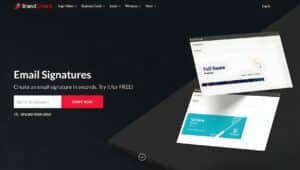
13 – Update your email signature to boost eCommerce store traffic without buying Ads
One of the easiest methods to use traffic to drive is a tool we all use daily. Of course, we’re talking about your email signature. Stop for a moment and think about how many emails you send and receive daily and how many emails you send.
Adding a link to your store only takes a few minutes, and it’s advertising-free every time you hit send in your email inbox. You can link directly to your store’s main page or a specific category or popular product. As options are endless, please take a minute to update your email signature.
14 – check your speed
How is your website speed? Have you checked this lately? So, if your site is taking longer than three seconds to load, you could lose up to 50% of your visitors.
And unfortunately, you’re not very likely to get them back. Nearly 80% of visitors who are frustrated by a site’s loading time never come back.
Try using a tool like webpagetest.org to check your site’s performance.
15 – Go offline to boost eCommerce store traffic without buying Ads
After all, it’s not just limited to online advertising. You can also use offline marketing strategies to drive traffic to your online store. For example, you can add a sticker with your business address to your car.
You can also distribute flyers featuring popular products, including your store’s website. Another idea is to rent a tent at a trade conference or a mall kiosk and use selected products as a display. So, you can then hand out a business card with your store website or have visitors scan a QR code to bring them to your website. Whatsmore, the best QR code generators are free to use. All you need is the URL or text you want to encode, and the tool will take care of the rest.
16 – Get Listed in Google’s Free Shopping Results
This is one of the most directly relevant strategies for an article specifically about avoiding paid ads, and it is often overlooked because many store owners assume any presence in Google Shopping requires a budget.
Since 2020, Google has allowed merchants to appear in the organic, unpaid section of the Shopping tab through Google Merchant Center, without paying for clicks or impressions. This is separate from Google Shopping Ads, which are paid, and separate from the comparison shopping engines covered earlier in this guide.
To get listed, create a free Google Merchant Center account, verify and claim your website, and upload a product feed containing your catalog’s titles, descriptions, prices, availability, and images in the format Google requires. Once approved, your products become eligible to appear in the free listings section of Google’s Shopping tab and, in some cases, directly within regular Google Search results for relevant product queries.
This requires some initial setup work, particularly formatting your product feed correctly and keeping it updated as inventory and pricing change, but it carries no ongoing cost per click or impression. For most WooCommerce stores, plugins like WooCommerce Google Listings and Ads (a free official extension) can automate the feed creation and sync process, making the setup considerably faster than building a feed manually.
Because this channel exists specifically within the same Google ecosystem most store owners already associate with paid Shopping ads, it is consistently one of the most underused free traffic sources available to ecommerce stores in 2026.
Frequently Asked Questions About Driving Ecommerce Traffic Without Ads
Timelines vary significantly by method. Email marketing and referral programs can generate results within days or weeks since they reach an audience that already knows your brand. SEO, blog content, and building a social media following typically take three to six months of consistent effort before generating meaningful, compounding traffic, since these methods rely on search engines and algorithms recognizing your content’s relevance and quality over time. The methods that produce the fastest initial results tend to be the ones that activate an existing audience (email, referrals, your own social following), while the methods that produce the most durable long-term results (SEO, content, reviews) take longer to build but compound over time.
Email marketing consistently ranks among the highest-return channels for ecommerce, in part because it reaches people who have already expressed interest in your brand by subscribing. Combined with a referral program, which leverages your existing satisfied customers to bring in new ones at minimal cost, these two channels typically deliver the strongest return relative to the effort required, since both rely on an audience you already have rather than requiring you to build awareness from zero.
Yes, though the effect varies significantly by platform and product category. Social commerce sales worldwide reached an estimated $945 billion in 2025 and are projected to grow substantially in the years ahead, driven by platforms increasingly integrating shopping features directly into the content experience. Visual and demonstrable products (fashion, beauty, home goods, food) tend to perform especially well on visually driven platforms like Instagram, Pinterest, and TikTok, while the effectiveness on any given platform depends heavily on posting consistency and genuine engagement rather than just posting product photos.
Through Google Merchant Center, ecommerce businesses can upload a product feed containing their catalog details and, once approved, have those products appear in the organic, unpaid section of Google’s Shopping tab at no cost per click or impression. This is distinct from Google Shopping Ads, which are paid placements. Setup involves creating a Merchant Center account, verifying your website, and submitting a correctly formatted product feed, a process that WooCommerce stores can largely automate using the free WooCommerce Google Listings and Ads plugin.
Yes, particularly when working with micro and nano influencers rather than large-follower accounts. Smaller creators with highly engaged, niche audiences often deliver a stronger return on investment than larger influencers, because their audiences tend to trust their recommendations more directly and their collaboration costs (which can be as low as a free product rather than a cash fee) are dramatically lower. For small ecommerce stores, identifying five to ten relevant micro-influencers in your specific niche and offering free products in exchange for honest reviews is a low-cost way to test this channel before investing in larger partnerships.
Final thoughts
Generating consistent traffic without relying on paid ads is entirely achievable, but it requires patience and a willingness to invest time across several channels rather than expecting any single method to carry the full weight on its own. The methods covered in this guide, from SEO and email marketing to referral programs, user-generated content, and Google’s free Shopping listings, work best in combination rather than in isolation.
Start with the two or three methods that fit your business and audience most naturally rather than trying to implement all sixteen simultaneously. Track which channels actually drive traffic and sales using a tool like Google Analytics, and double down on what is working rather than spreading effort evenly across everything.
If you are also exploring how to monetize the traffic you generate once it arrives, the guide to website monetization methods that actually work covers complementary strategies for turning visitors into sustainable revenue beyond direct product sales.
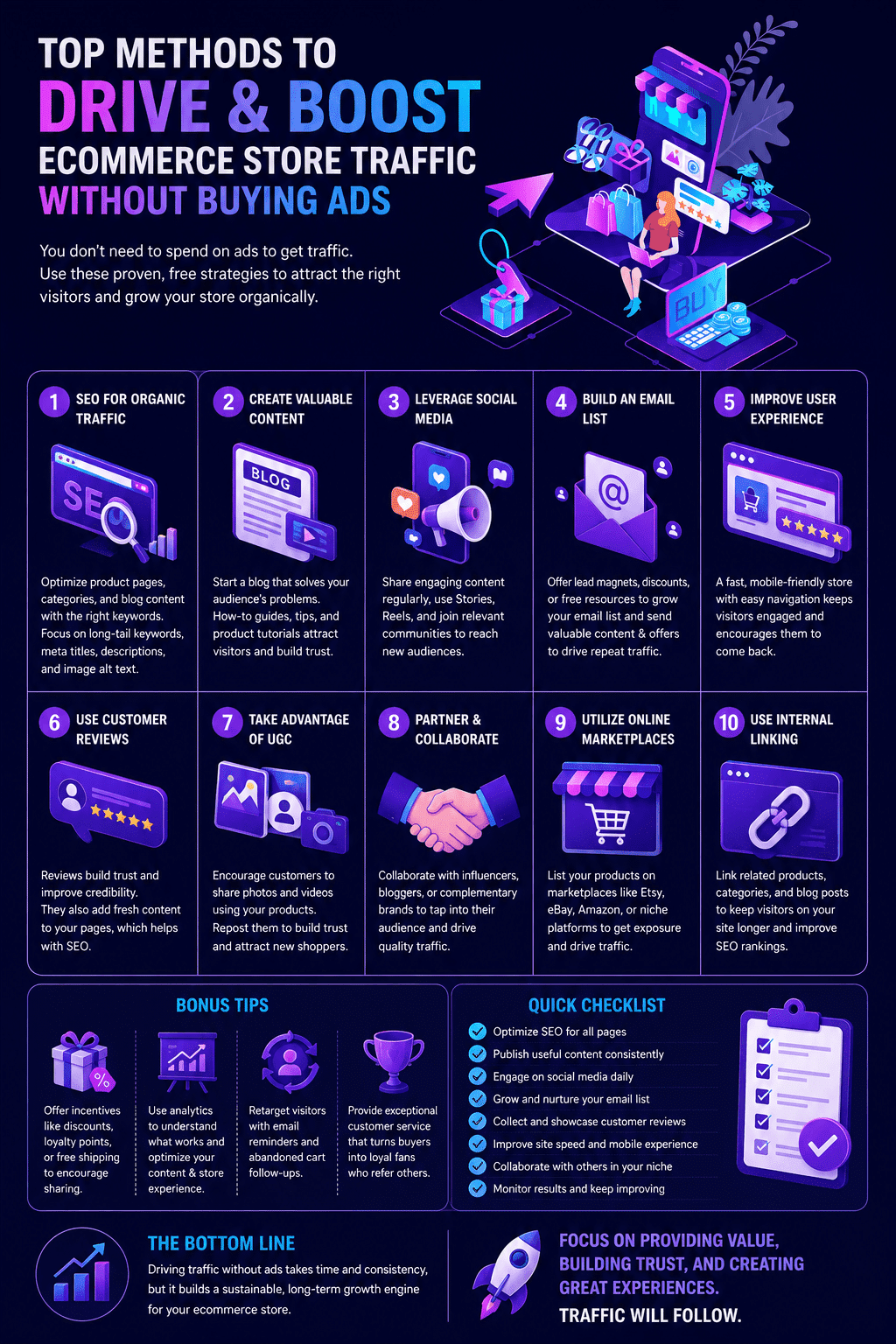
Infographic