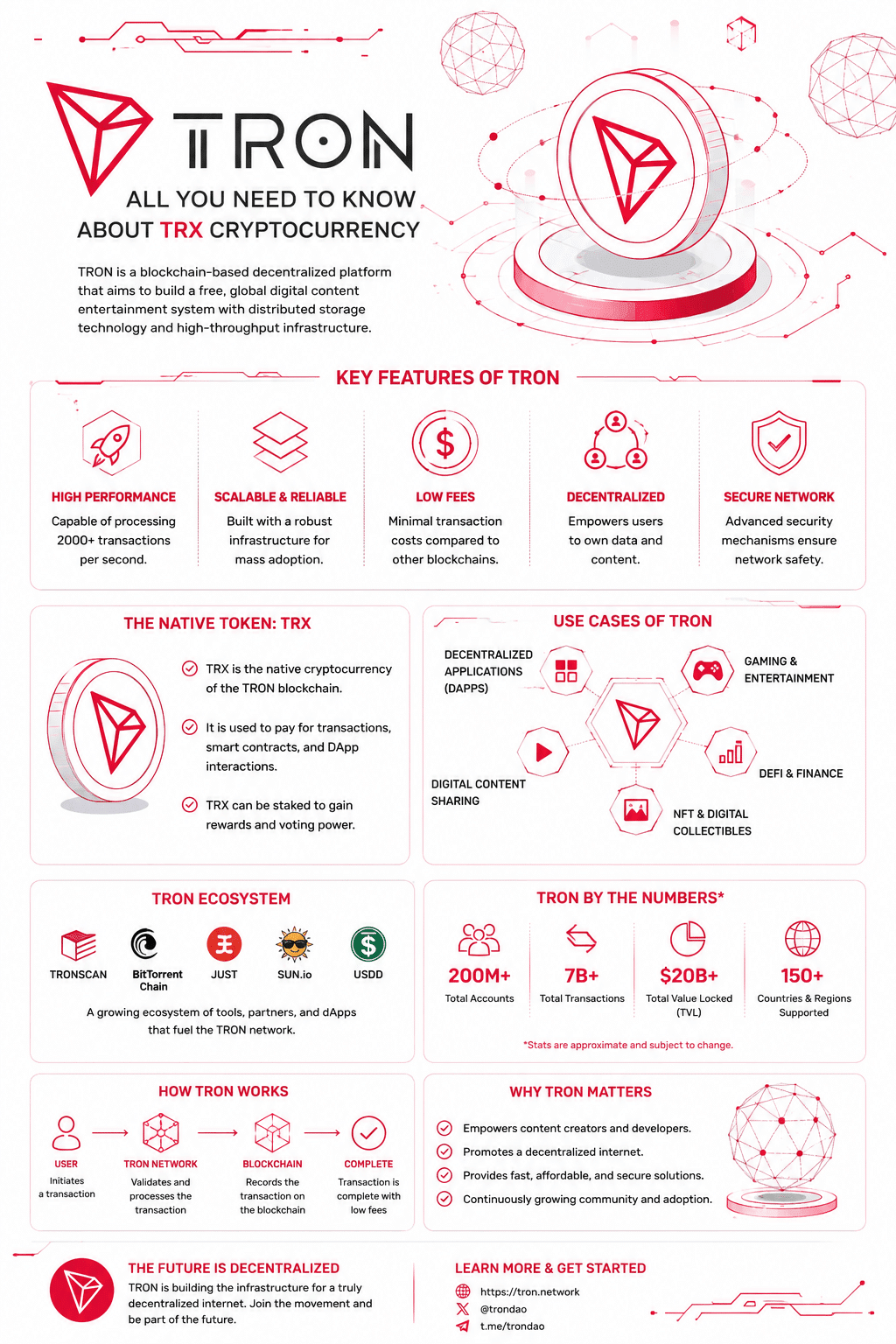
Tron crypto, here are all you need to know about TRX cryptocurrency; Founded at the height of the cryptocurrency boom in 2017, Tron has since inspired a global group of investors and developers with a vision of how cryptocurrencies can transform the Internet.
However, while the goal of creating a distributed web using blockchain was common among projects started at that time, Tron’s focus on media and content creation set it apart, despite continued criticism of the technology.
TRON in 2026: From Media Platform Vision to Stablecoin Settlement Leader
TRON was originally pitched around a vision of decentralizing digital media and rewarding content creators directly, and that framing still describes the project’s founding story. But the reality of how TRON is actually used today has shifted substantially, and any current overview of TRX needs to lead with this.
TRON has become the dominant blockchain network for transferring USDT (Tether), the largest stablecoin by market capitalization. Because TRON transactions settle quickly and cost a small fraction of what equivalent transfers cost on Ethereum, a large share of global USDT movement, particularly for cross-border payments, exchange transfers, and remittances, now happens on the TRON network rather than Ethereum.
Network data from 2026 illustrates the scale of this activity. TRON has recorded over 5 million daily active accounts, and cumulative transfer volume on the network has surpassed $27 trillion. These figures are driven overwhelmingly by stablecoin activity rather than the media and content-creator use cases the project originally emphasized.
This matters for anyone trying to understand TRX as an asset, because TRX’s value is increasingly tied to its role as the “gas” token for this stablecoin settlement activity, rather than to adoption of decentralized media applications specifically. Smart contract interactions on TRON, including USDT transfers (since USDT is itself a token built on TRON’s smart contract layer), require TRX to pay for the computational resources used.
If you are researching TRON because you have encountered TRC-20 USDT (for example, while sending or receiving a payment, or while using a crypto exchange), our companion guide on USDT payments and the differences between TRC20 and ERC20 covers exactly this topic and is directly relevant to understanding why TRON has become so widely used for stablecoin transfers specifically.
Tron Crypto: All You Need To Know About TRX Cryptocurrency
The basic building blocks of Tron, decentralized apps, smart contracts, tokens, and delegated proof-of-stake consensus; were pioneered in other projects before its release. So, Tron even went so far as to make its technology components compatible with Ethereum (ETH) (which led to accusations that it went too far in borrowing its ideas).
Tron would further differentiate itself with an Asia-focused go-to-market strategy that relied heavily on outreach to its creator Justin Sun and translating its technical documents into a broader range of languages than cryptocurrency projects typically do.
Tron began to gain more attention in 2018 when the non-profit organization leading its development, the Tron Foundation, acquired BitTorrent, a pioneer in peer-to-peer networks.
The acquisition, which took place before the release of BitTorrent tokens on the Tron blockchain in 2019, allowed Tron to sell new cryptocurrencies to millions of existing users.
Why was Tron invented?
Tron was invented with a clear purpose; to help reward creators more for their exercise. So, the way the media industry is structured right now is that some companies like YouTube, Facebook, and Apple have a degree in what media is seen; and huge on their websites. They receive the vast majority of the money generated by the media. The creators, receive only a small part of the income.
By saying the media intermediary, it is possible for viewers to directly reward content creators through the Tron network and using TRX tokens. Thus, the media belongs entirely to the creator and not in part to a large company.
How does Tron crypto work?
Initially created as an Ethereum-based token, Tron finally migrated to its network in 2018.
The process involved investors trading their Ethereum tokens for Tron’s TRX cryptocurrency. (Ethereum tokens were later destroyed.)
General architecture
So, like Ethereum (ETH), Tron uses an account-based model. This means that the encryption key issued by the protocol controls access to TRX and TRX token funds. The
Tron blockchain routes this exchange of data to three layers.
- Core Layer: Written in JavaScript or Solidity (a language for Ethereum), the main layer computer instructions and sends them to the Tron virtual machine, which executes the logic.
- Application Layer: Used by developers to create wallets and applications based on the software-compatible TRX cryptocurrency.
- Storage layer: designed to split blockchain data (the history of the blockchain); and its state data (holding the smart contract’s state).
Current TRX Price and Market Position
Because cryptocurrency prices change continuously, this guide does not quote a fixed price for TRX. Instead, here is how to find accurate, current data and what context to keep in mind when evaluating it.
For real-time pricing, reliable sources include CoinGecko and CoinMarketCap, both of which aggregate pricing data across major exchanges and provide historical charts, market capitalization, and trading volume.
As context for evaluating TRX’s price: TRON has consistently ranked among the top ten cryptocurrencies by market capitalization, with a market cap that has been in the tens of billions of dollars range through 2025 and 2026. TRX’s all-time high, reached in late 2024, was in the range of $0.43 to $0.45. Its price has historically been highly volatile, as is true of all cryptocurrencies, and past performance does not indicate future results.
When evaluating TRX as a potential investment, the factors most relevant to its fundamentals include the network’s role in stablecoin settlement volume (covered above), its transaction throughput and cost compared to competing networks, regulatory developments affecting both TRON specifically and the broader stablecoin and cryptocurrency regulatory environment, and general cryptocurrency market conditions, which tend to affect TRX alongside most other digital assets regardless of TRON-specific developments.
How TRON Fees Actually Work
TRON is frequently described as “feeless,” and while transaction costs on TRON are genuinely very low compared to many other networks, the word “feeless” oversimplifies how the network actually operates, and understanding the real mechanism matters if you plan to use TRON for anything, including receiving USDT.
TRON’s resource model is built around two types of resources: Bandwidth and Energy.
- Bandwidth is consumed by simple transactions, such as transferring TRX itself from one address to another. Every TRON account receives a small free daily allocation of Bandwidth based on the network’s overall usage. For most individual users sending TRX occasionally, this free allocation is often sufficient, which is where the “feeless” reputation comes from.
- Energy is consumed by smart contract interactions, which includes any transfer of a TRC-20 token such as USDT, since these tokens operate through smart contract code rather than simple native transfers. If an account does not have enough Energy available (either through staking TRX to generate Energy or through a free allocation), the network will burn a small amount of TRX from the account’s balance to cover the cost of the transaction.
In practice, this means a simple TRX transfer is often genuinely free for casual users, but a USDT transfer on TRON, while still dramatically cheaper than the same transfer on Ethereum, typically does cost a small amount of TRX, usually equivalent to a fraction of a US dollar. This is still a significant advantage over Ethereum, where equivalent transfers can cost several dollars during periods of network congestion, but “low fee” is a more accurate description than “feeless” for the transactions most people actually perform on the network.
For users who frequently send TRC-20 tokens, staking a portion of TRX specifically to generate Energy can reduce or eliminate these costs over time, which is one of the practical reasons TRON staking has grown in popularity beyond its role in network governance.
Can it be used anonymously?
Tron transactions are anonymous. However, they are only on the network itself. The act of buying TRX and having to go through an exchange means you will have to prove your identity to buy Tron crypto tokens in the first place. Once on the network, however, it can carry out transactions anonymously. On the other hand, and should note that all blockchains keep a record of transactions carried out on the chain. As such, no transaction is truly anonymous.
How safe is it?
Tron has a secure reputation in the cryptocurrency world. The company’s spending on security and the personnel it hired indicate this. However, as with other cryptocurrencies, being a decentralized network, there is a great burden for the individual to be smart when taking care of their tokens. As for the network, it has yet to suffer a security scandal.
How Tron’s Development Ecosystem Works
Tron’s software is developed as an open-source project, with the Tron Foundation historically playing a central role in coordinating development, documentation, and community contributions.
The TRON Developer Hub provides resources for anyone interested in building on the network, including documentation on setting up nodes, writing and deploying smart contracts, and building decentralized applications (dApps). The Hub is designed to support developers across a range of experience levels, from those new to blockchain development to experienced teams building production applications.
Beyond the core protocol development, a broad ecosystem of independent developers and companies builds wallets, exchanges, dApps, and infrastructure tools on top of TRON. This includes the wallet providers covered later in this guide, exchanges that support TRX and TRC-20 token trading, and infrastructure providers that support the network’s role in stablecoin settlement.
For developers interested in building on TRON, the official documentation at developers tron network is the primary resource for technical specifications, smart contract development guides, and API documentation.
Notable Partnerships and Network Integrations
- Refereum: This platform allows players to earn TRX while streaming and viewers to earn rewards while watching. So, the partnership aligns with Tron’s media focus and reflects the huge potential that gaming and blockchain integration can have. The main motivation for their efforts is the streaming service DLive, which Tron accessed through a BitTorrent partnership with the service.
- MetalPay: So, MetalPay is an online payment service and partner for sending money worldwide. As a result, users can now easily purchase TRX tokens in cash from the MetalPay website or app. This will help you break through one of the hiring barriers, the TRX acquisition process. This may not have been easy before.
- Samsung: Samsung has added Tron to its blockchain Keystore. This means that Samsung users with the latest phone version can now access Tron dApps through Samsung’s App Store. This is an important achievement for blockchain technology as new content creators can receive reasonable compensation. And exposed to one of the biggest app markets in the world, their dApps now.
Mining
TRX cannot be mined. Instead, holders can earn rewards by staking their existing TRX to help validate transactions to help validate other transactions. When helping to validate transactions, punters will receive a token creation or transaction fee.
Tron crypto wallet
A Tron wallet is software that can store TRX tokens. They come in many different forms and several wallets created by the community itself, which can access on their website. here are some examples:
- Ledger Nano S – A hardware wallet
- Trezor – A hardware wallet
- Guarda Wallet – A desktop wallet
- Atomic Wallet – A desktop wallet
- Tronscan – A ‘hot’ online wallet
- Tronlink – An extension for Google Chrome
Whichever wallet you choose will bring a different set of benefits versus drawbacks. So, some are more portable, while others offer more security. And make sure you carry out proper research before making a decision.
A Brief Note on Justin Sun and TRON’s Regulatory History
Justin Sun, TRON’s founder, and several Tron-affiliated entities were the subject of a lawsuit filed by the US Securities and Exchange Commission (SEC) in March 2023. The SEC’s complaint alleged that Sun and the named entities, Tron Foundation, BitTorrent Foundation, and Rainberry, engaged in unregistered securities offerings related to the sale and distribution of TRX and BTT tokens, conducted wash trading to artificially inflate TRX’s reported trading volume, and made undisclosed payments to celebrities for promoting the tokens.
In March 2026, the case was resolved through a settlement. Under the terms, Rainberry agreed to pay a $10 million civil penalty and accepted a permanent injunction against future securities law violations. All claims against Justin Sun personally, the Tron Foundation, and the BitTorrent Foundation were dismissed with prejudice, meaning the SEC cannot bring the same claims again for the same underlying conduct. As is standard in many SEC settlements, no party admitted or denied the allegations as part of the agreement.
For readers evaluating TRON or TRX, this history is worth knowing as context, though the case is now resolved and the network’s day-to-day operation and its role in stablecoin settlement are unaffected by it. Official information about SEC enforcement actions can be found on the SEC’s website.
Is the Tron crypto TRX worth the investment?
The potential of the Tron network and the future of online media is an interesting investment. In addition, TRX tokens are a requirement for interacting with the network, so if you are a particularly ambitious content creator or passionate about the media and want to interact with all dApps on your network, TRX tokens are a great investment.
However, please note that the price may fluctuate because TRX is a cryptocurrency. It’s not the more expensive end of the crypto scale, but the investment principles remain the same.
Proof of Delegated Participation
To reach a consensus on its history, Tron uses a system in which a rotating cast of 27 “super reps”; are tasked with validating transactions and maintaining the system’s history.
Super personnel is elected every 6 hours; and if selected, have the opportunity to collect new TRXs generated by the protocol. Every 3 seconds, blocks are added to the blockchain; and blocks that generate valid blocks receive 32TRX. A total of 336,384,000 TRXs will be awarded annually.
In addition to the Super Representative, users can run three types of nodes on the Tron blockchain monitoring node, full node, and solidity node. The watch node proposes a block and votes for a protocol decision, while the full node sends a transaction and a block.
Solidity nodes sync full node blocks and provide APIs.
And can find more details on block production and super representatives of the network here.
Staking TRX on Tron
Tron users need a network feature called “Tron Power to vote for super representatives.”
Users will “choose” to receive 1 Tron Power per TRX in accounts prohibited from issuing the relevant cryptocurrency. (By unfreezing cryptocurrencies, users will lose their Tron powers and ability to vote).
The mechanism resembles staking on networks like Tezos or Cosmos, where participation means committing funds for a period and giving up access to them while they are committed. Not every proof-of-stake network works this way. Cardano is the clearest counterexample: delegated ADA never leaves the wallet, there is no freezing step, no unbonding queue, and no slashing penalty if a pool misbehaves. Our guide to how Cardano staking works covers that model in full, including why the trade-off is a lower yield in exchange for keeping your coins liquid the whole time.
Frequently Asked Questions About TRON and TRX
TRON’s primary current use case is as a low-cost settlement network for stablecoins, particularly USDT (Tether). Because TRON transactions are fast and inexpensive compared to many alternatives, a substantial share of global USDT transfer volume occurs on TRON. Beyond stablecoin transfers, TRON also supports decentralized applications, smart contracts, NFTs, and the content-creator-focused platforms the network was originally designed around, though stablecoin activity now represents the network’s most significant usage by volume.
This guide does not provide investment advice, and TRX, like all cryptocurrencies, carries significant price volatility and risk. Factors that may be relevant to evaluating TRX include its established role in stablecoin settlement (which provides ongoing demand for TRX as a transaction fee token), its consistent ranking among the largest cryptocurrencies by market capitalization, and the resolution of its prior SEC litigation. Factors that represent risk include general cryptocurrency market volatility, potential regulatory changes affecting stablecoins or the broader crypto industry, and competition from other networks that also support low-cost stablecoin transfers. Anyone considering an investment in TRX or any cryptocurrency should research thoroughly and consider consulting a financial advisor.
The cost difference comes down to network design and current usage patterns. Ethereum’s transaction fees (called “gas”) are determined by network demand and can rise significantly during periods of high activity, sometimes reaching several dollars per transaction. TRON’s resource model, based on Bandwidth and Energy rather than a competitive gas auction, generally results in lower and more predictable costs for smart contract transactions including USDT transfers, typically amounting to a small fraction of a dollar. This cost difference is the primary reason TRON has become the preferred network for many USDT users, particularly for smaller or more frequent transfers where Ethereum’s fees would represent a significant percentage of the transaction value.
TRON uses a Delegated Proof of Stake consensus mechanism. TRX holders can “freeze” (stake) their tokens to receive Tron Power, which can be used to vote for Super Representatives, the 27 entities responsible for validating transactions and producing blocks. Holders who vote for Super Representatives can receive a share of the rewards those representatives earn. Separately, staking TRX can also generate Energy, which is used to pay for smart contract transaction costs (see the fees section above), making staking useful both for those interested in network governance and for those who frequently transact in TRC-20 tokens like USDT and want to reduce their transaction costs.
For accurate, current pricing, use established cryptocurrency data aggregators such as CoinGecko or CoinMarketCap, both of which pull pricing data from numerous exchanges and provide historical charts, market capitalization, and trading volume figures. Avoid relying on price figures from articles or content that may not reflect current data, since cryptocurrency prices change continuously and even recently published figures can become outdated quickly.
The SEC filed a lawsuit in March 2023 alleging that Justin Sun and Tron-affiliated entities violated securities laws through unregistered token offerings, wash trading, and undisclosed celebrity endorsement payments. The case was settled in March 2026, with Rainberry (a Tron-affiliated company) agreeing to pay a $10 million civil penalty, and all claims against Sun personally, the Tron Foundation, and the BitTorrent Foundation dismissed with prejudice. No party admitted or denied the allegations as part of the settlement. The case is now fully resolved.
The bottom line
Tron is a unique cryptocurrency project, having obtained several pioneering technologies from other projects that all work together. As a result, the Tron network offers a solution for content creators plagued by censorship or other content-centric platform issues. Furthermore, its zero transaction fee system makes it an exciting choice for businesses and consumers regarding cryptocurrency payments.
Infographic