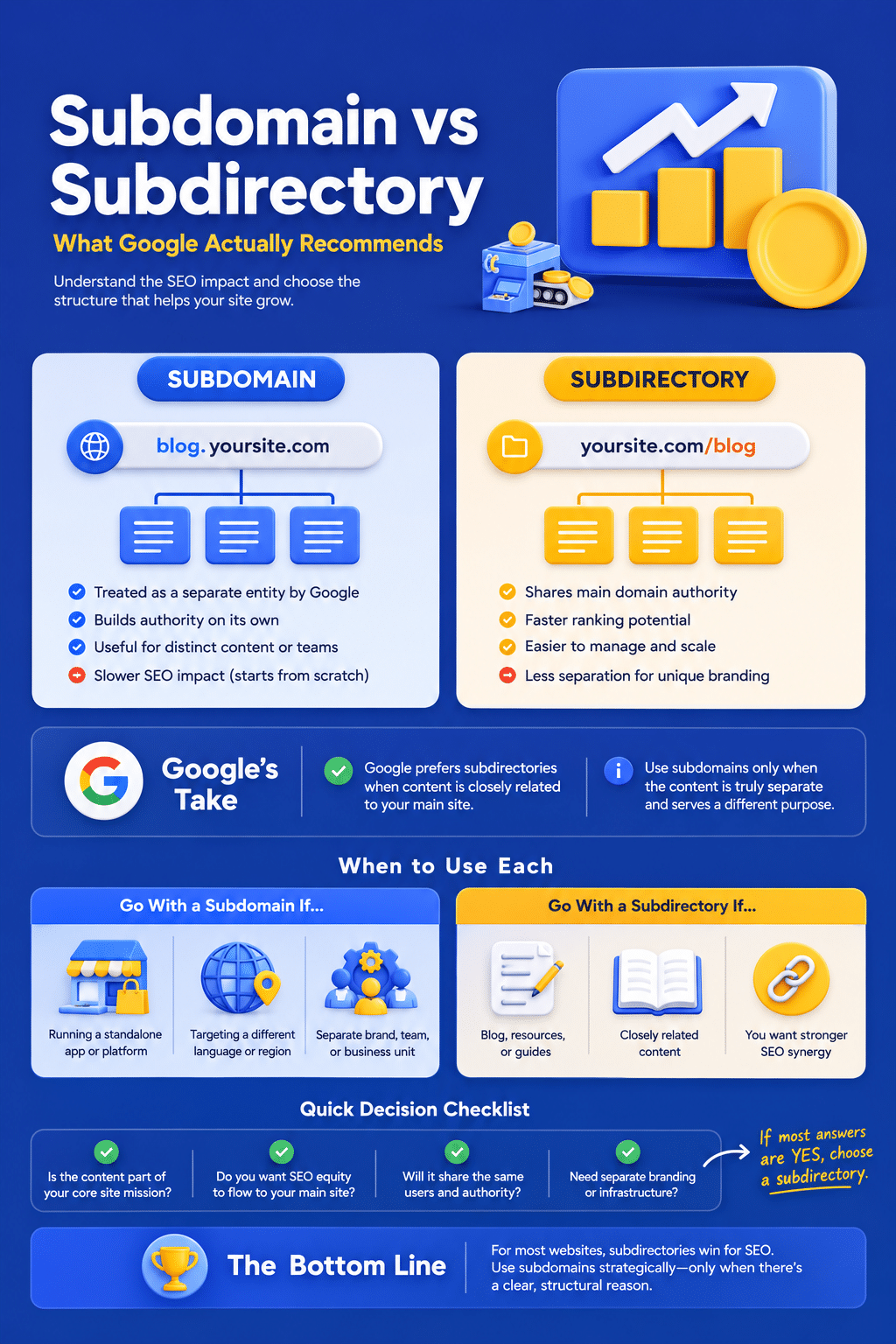
Most people searching for subdomain SEO want an answer to one question: should the blog live on blog.example.com or example.com/blog?
Google’s official answer is that either works. The fuller answer, from the same source, is to keep things together and use subdomains only when the content is genuinely different. Most guides skip that distinction, and it is what actually decides the question.
This guide covers what a subdomain is, how it differs from a subdirectory, what Google has actually said about the two, when a subdomain is the correct choice, and the operational costs that decide most cases before the ranking argument even starts.
What is a subdomain?
So, simply put, a subdomain is another part of your website. For example, if you want to add another section to your site that strengthens your brand, you might use a subdomain. This subdomain allows you to provide more information to users and can even direct them to your eCommerce store.
Take Google, for example. Google has the main search engine, “google.com,” as well as “maps.google.com” and “earth.google.com.” Both are still part of Google’s main domain, but each has its purpose outside Google’s website. If Google is the central umbrella, then subdomains are subcategories below it.
Subdomain structure
Let’s look at the following example, where the Subdomain is indicated to the left of the root URL:

What is a subdirectory?
A subdirectory, sometimes called a subfolder, is a path within your existing domain. Where a subdomain sits to the left of the root, a subdirectory sits to the right, after the slash.
blog.example.com is a subdomain. example.com/blog is a subdirectory.
The difference matters because of what sits underneath. A subdomain can point to entirely separate infrastructure, run a different codebase, and requires its own Search Console property. A subdirectory is part of the same site, served from the same place, verified once.
For completeness on the terminology: in example.com, .com is the top-level domain and example is the second-level domain. A subdomain is a prefix added in front of that, such as blog or shop.
Subdomain or Subdirectory: What Google Actually Says
This is the question almost everyone arrives with, so it belongs first.
Google’s official position comes from Search Advocate John Mueller: “Google Web Search is fine with using either subdomains or subdirectories.” Quoted alone, that reads as settled. It is not the whole quote.
The rest matters more:
“In general, we see these the same. I would personally try to keep things together as much as possible. So if it’s the same site then try to put them on the same site, essentially, and use subdomains where things are really kind of slightly different.”
That is a preference for subdirectories with a defined exception, and it more closely matches what practitioners observe.
Why the practical answer diverges from the official one. Google Search Console verifies subdomains as separate properties and handles them as distinct sites for a range of purposes. Reported migrations from subdomain to subdirectory, Salesforce’s blog among the most cited, have shown meaningful organic gains after consolidation. The pattern is consistent enough that most SEO practitioners default to subdirectories for content intended to rank alongside the main brand.
The decision rule
| Use a subdirectory when | Use a subdomain when |
|---|---|
| The content is topically part of the main site | The content is genuinely a different thing |
| You want it ranking with your main brand | It runs on separate infrastructure or a third-party platform |
| It is a blog, resources, guides, or case studies | It is an app, dashboard, or logged-in product |
| You want signals consolidated | You need separate analytics, permissions or security boundaries |
| You have no strong reason either way | It targets a genuinely separate audience |
Whichever structure you choose, the internal linking that connects it to the rest of your site moves signals around. The mechanics of that are covered in this look at how site architecture shapes SEO outcomes.
The test Mueller’s answer implies: is this the same site, or a slightly different one? A blog is the same site. A customer dashboard is not. A knowledge base hosted on Zendesk is not, because you have no realistic choice.
One thing to weigh that has nothing to do with rankings. Every subdomain adds a hosting environment, an SSL configuration, a separate Search Console property, its own analytics setup, and its own maintenance burden. Those costs are certain. The ranking difference is contested. For most small teams, that asymmetry decides it before the SEO argument starts.
When a Subdomain Is the Right Choice
The genuine cases are narrower than most guides suggest, and they share one characteristic: something technical or organizational makes a subdirectory impractical.
Applications and logged-in products. app.example.com or dashboard.example.com run different codebases, different authentication, and often different servers. Nobody is trying to rank a dashboard, and separating it keeps your marketing site’s crawl budget focused on pages that should be indexed.
Third-party platforms you do not control. Documentation on GitBook, a help center on Zendesk, a status page on Statuspage. Subdirectory routing through a reverse proxy is possible and often not worth the engineering cost.
Staging and development. staging.example.com, and make sure it carries noindex plus HTTP authentication. Indexed staging environments are among the more common self-inflicted SEO problems, and they belong on the same checklist as orphaned content and other structural issues nobody notices until traffic drops.
Genuinely distinct sub-brands. If a company sells industrial equipment and also runs a consumer retail brand, the topical distance is real and separation makes sense. The bar is topical distance, not organizational preference.
A caution on international. Country subdomains (de.example.com) are one valid approach, and so are subdirectories (example.com/de/) and country-code domains (example.de). What actually determines whether the right version reaches the right user is hreflang annotation, not the URL structure. Picking a structure without implementing hreflang solves nothing, and Google’s multi-regional and multilingual site documentation sets out the tradeoffs for each.
Where subdomains are the wrong answer: blogs, resource centers, case studies, guides, service pages, and anything you want ranking with your main brand. Those belong in subdirectories, and moving them there later is a migration with real risk attached.
The Costs Nobody Mentions Before You Commit
The SEO argument gets all the attention. These are the practical consequences, and they arrive whether or not the ranking difference is real.
- Search Console fragmentation. Each subdomain requires its own property, which means separate verification, separate performance data, and separate coverage reports. Diagnosing an issue across five subdomains means checking five properties. There is no consolidated view unless you use a Domain property, which requires DNS verification.
- Analytics splitting. Cross-domain tracking between subdomains is configurable and it is a configuration someone has to get right. Done wrong, a user moving from your site to your subdomain registers as a new session from a referral, which corrupts attribution in ways that are difficult to notice and painful to unpick retroactively.
- SSL certificates. A wildcard certificate covers
*.example.comand costs more than a single-domain certificate. Individual certificates per subdomain means individual renewals, and an expired certificate on a subdomain is an outage on a property you may not be monitoring. - Cookie scope. Cookies set on the parent domain are available to subdomains, cookies set on a subdomain are not available to the parent. This affects login state, consent management, and anything relying on session continuity across the boundary.
- Crawl budget. For large sites, splitting content across subdomains distributes crawl attention rather than concentrating it. Less relevant for a hundred pages, meaningful at ten thousand.
- Migration risk if you change your mind. Moving from subdomain to subdirectory later is a full site migration: redirect mapping, canonical updates, Search Console change of address, and a recovery period. Choosing deliberately at the start is considerably cheaper than choosing twice. The broader mechanics of doing this without losing rankings are covered in this guide to rebuilding a site without losing SEO.
How Subdomains Affect SEO in Practice
One of the main reasons a business might create a subdomain is to improve its SEO performance.
1 – Best onsite experience
Using a subdomain means providing a different user experience to your main site. So, your Subdomain is usually an expansion of your main site when you want to explore a certain topic more but don’t want that information on your main site.
Organizing your site’s content makes it easier for users to find the information they want. It also improves the user experience, which can help you rank higher in search results (SERP).
Navigation difficulty is among the most common user complaints about websites. Creating a specialized subdomain can help you improve keyword rankings. This is because it makes the site easier to navigate by simplifying your site’s hierarchy. Difficulty navigating a website is one of the most common user complaints.
2 – Aims at international markets Subdomain SEO
As we discussed, you can use a subdomain to create specialized content. What if that content applies to a specific audience? You can target your subdomain content to certain countries and continents. So, this is ideal if you have a global business and target international markets. This ultimate guide helps you improve your SEO ranking in certain countries, as it may be higher when you target a specific subdomain for that area.
Your site’s content and language must reflect the country you’re targeting.
The ultimate guide: Do subdomains always help with SEO?
While subdomains are useful for an organization, they are not necessarily your ticket to top Google search results. That’s because it depends on your site, and you should use them case by case.
A poorly designed website will likely have a high bounce rate. A high bounce rate means visitors arrive and leave without engaging, usually because the page did not deliver what the search promised. For example, imagine that you create a subdomain but haven’t mastered the UX yet. Your subdomain won’t boost your original site because people still won’t want to interact with it.
In other words, if your main site isn’t great, creating a subdomain won’t help. Instead, if you use subdomains, prioritize the content and usability of your primary domain. Do you know how Subdomains impact SEO? Have you taken the time to optimize your website images? So, are you using optimal website hosting bandwidth? So, consider flaws in your original site before creating an additional subdomain.
Also, some see a subdomain as competition within itself. So, strictly speaking, your Subdomain can outperform your main site. However, they will compete for the highest ranking if they are optimized for the same keywords.
This can be a problem for some companies. However, many consider this an advantage, as it is even more likely to appear on the first page of Google search results, regardless of domain.
Subdomain SEO: Common Questions
Officially, Google says it handles subdomains and subdirectories equally well. Practically, subdomains are verified separately in Search Console and treated as distinct properties for a range of purposes. John Mueller’s fuller answer is more useful than the headline: keep things together where possible, and use subdomains when the content is genuinely different.
Subdirectory, in almost every case. A blog is topically part of the main site; you want it ranking with your brand, and published migrations from subdomain to subdirectory have reported substantial organic gains. The main reason blogs end up on subdomains is that a separate platform made it convenient, which is an infrastructure decision made without weighing the SEO consequences.
No. Separate m-dot sites are obsolete. Google indexes mobile-first and recommends responsive design, which serves one URL to every device. A separate mobile site creates duplicate URLs, splits signals, doubles maintenance, and requires annotations most implementations get wrong. Any guide still recommending this predates mobile-first indexing.
Not straightforwardly, and Domain Authority is a Moz metric rather than a Google signal, so the question is often framed wrongly. What actually matters is whether links, internal linking, and topical signals consolidate. Subdirectories consolidate them by default. Subdomains require deliberate internal linking to achieve something similar.
Applications and logged-in products, documentation or support hosted on third-party platforms, staging environments, and genuinely distinct sub-brands. The common thread is that something technical or organizational makes a subdirectory impractical, rather than a preference for tidier organization.
Yes, and treat it as a full site migration rather than a URL change. You need a complete redirect map, updated canonicals and internal links, a Search Console change of address, and tolerance for a recovery period. It is routinely worth doing, and it is considerably cheaper to choose the first time correctly.
They are one valid structure alongside subdirectories and country-code domains. Hreflang annotation, not URL structure, determines whether the correct version reaches a user. Choosing a structure without implementing hreflang solves nothing.
What Is a Subdomain and How Does It Impact SEO Performance: Conclusion
Subdomains are not useful for every business. Use them only when appropriate to support your main domain. So, For example, if you want to create an e-commerce store or a more in-depth feature for one of your best-selling services.
Creating a subdomain for keyword stuffing and ranking purposes can do more harm than good. So, in other words, if the Subdomain doesn’t provide genuine value, don’t create one.
If you decide a subdomain is right for your situation, choose it because the content genuinely belongs somewhere separate, not because it seems tidier. Then link to it deliberately from your main site, verify it in Search Console, and treat it as the distinct property it is.
Infographic