The most visible marketing for online slots comes via signup bonuses, free spins, and deposit incentives. Behind that surface layer, however, the real engine driving new registrations is something any business can learn from: the disciplined use of marketing funnels and psychological principles refined under intense competitive pressure.
The online gambling industry spends more on customer acquisition than almost any other consumer sector. iGaming operators compete intensely on a global scale, often for the same audiences, with an almost unlimited range of competitors a single click away. The result is a marketing ecosystem that has had no choice but to become extremely good at generating traffic, converting visitors, retaining customers, and reactivating those who have gone quiet.
For businesses in any other industry, this makes online slots marketing a genuinely instructive case study. Not because of what slots companies sell, but because the pressure they operate under forces them to refine marketing tactics that most businesses use casually into something closer to a science. This article breaks down the core techniques and, critically, how any business can apply the same principles regardless of their industry.
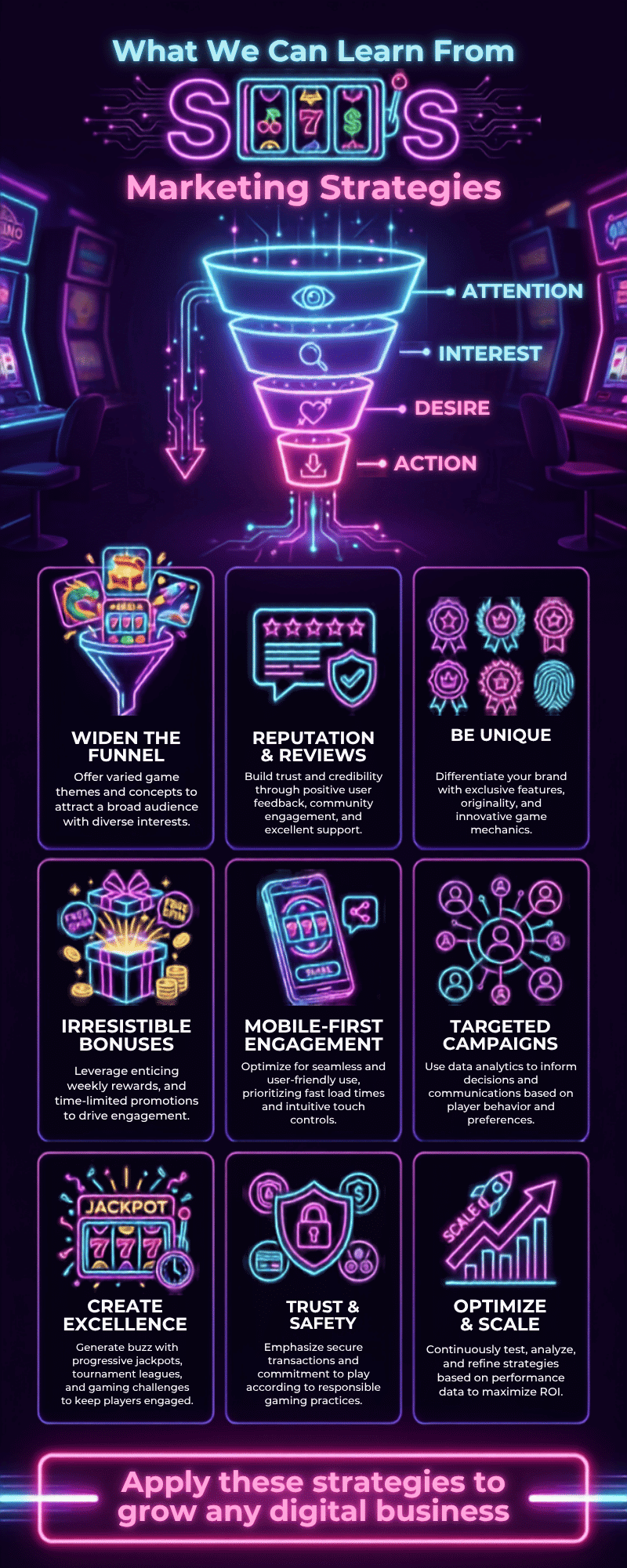
Essential funnels for online slots marketing
A marketing funnel is a framework for measuring the customer journey from first contact to final purchase. Breaking the engagement process into stages gives marketers a clear, visual way to identify where potential customers drop off and what it takes to move them forward.
At its maximum basic, an advertising and marketing funnel measures how – and the way many – clients undergo 4 principal degrees of engagement:
- Step 1: Attention
This is where customers stop ignoring a product or service and become aware of its existence. Mainly, this marketing step depends on ads, social media, and word of mouth.
- Step 2: interest
So, this step occurs when a customer is aware of a business and thinks it could satisfy a need for them. The prospect has learned enough to know they are interested and want to know more before proceeding.
- Step 3: Desire
At this point, the subject has learned everything he needs about a product or service and wants it. Of course, no sales have been made yet, but assuming the right conditions are met, the customer is ready to buy.
- Step 4: action
A sale is made, both withinside the conventional experience of changing cash for items; or as a registration for a service. This is the slim stop of the funnel via which any commercial enterprise desires to get as a lot site visitors as possible.
While there are versions and complexities, all advertising funnels comply with this identical primary flow, irrespective of industry. Funnels practice to income and whatever that wishes to draw an audience, together with websites, webinars, videos, or games.
For slot companies, using the funnel model is essential to boosting the number of stop customers.
Many organizations use an advertising funnel to reveal the client’s adventure from hobby to action.
Why the AIDA Funnel Matters for Any Business
The reason slots companies take the AIDA funnel so seriously is competitive volume. When dozens of nearly identical platforms are all competing for the same visitor’s attention at the same moment, the difference between winning and losing that customer is often a single friction point in the funnel that a competitor has already optimized away.
This intensity is what makes the slots industry a useful teacher. The funnel weaknesses that a typical business might tolerate for years because their competitive environment allows it have already been identified and fixed in the slots space out of pure necessity.
For any business using the AIDA framework, the most useful exercise is asking where the majority of drop-off happens and why. Is it between Attention and Interest, meaning people see the business but do not become curious enough to investigate? Or between Interest and Desire, meaning people research but do not become convinced? Or between Desire and Action, meaning people want the product but something stops them from completing the purchase? Each stage has a different set of fixes, and identifying the right stage is the prerequisite to any of those fixes working.
Applying “Widen the Funnel” to your business
The practical application of “widening the top of the funnel” for non-gambling businesses is to expand what your brand is associated with beyond the narrow definition of your product category. Slots companies associate their games with film franchises, music artists, and sports events, all to attract people who are interested in those things rather than just people already looking for slot games.
For a software company, this might mean creating content about productivity, team management, or career development, topics that attract people in the target audience even if those people are not yet aware they need that specific software. For a physical product brand, it might mean aligning with events, creators, or communities that share an audience with the brand, even if the connection to the product is not immediately obvious.
The principle is always the same: the more broadly you can create genuine relevance, the more people enter the top of your funnel without requiring you to pay for their attention.
Marketing lessons that we learn from online slots marketing strategies
Widen the funnel
A guaranteed way to get more out of the bottom of any funnel is to put more at the top. So when marketers refer to “widening the funnel,” this is exactly what they mean.
The wider a slot site can attract, the wider the top of your funnel will be. So again, it’s about getting more people from step one to step two, demonstrating more reasons for interest, and also such as the variety of themed slot games available.
Versatility
Another lesson we can learn from marketing strategies that casinos use is the need to always be versatile. So, you will notice that from time to time, each casino will update its software to adapt to the ever-evolving technology. So also, new games are always added to the games catalog. This ensures that players always find something new and refresh to refer to. Also, more and more money transfer options are being provided for members to use.
In such a competitive market, a platform that stops evolving quickly loses players to one that is constantly refreshing its offering. Being versatile keeps your existing customers engaged and gives new visitors a reason to stay. The same principle applies across any industry: a product or service that looks exactly the same as it did two years ago signals stagnation to customers who have grown accustomed to brands that invest in improvement
Stop the leaks
It’s no use putting large numbers in your funnel if too many are leaking before the end. Instead, slot providers need to record when people get lost in the process and explain why.
What stops those interested from taking the next step to wanting the product or service? So, what information are they finding, or not finding, that drives them away? Is it the slot’s site loading speed? Is it the signup process?
Applying funnel leak analysis to your business
Identifying where people drop off in your own conversion process requires tracking tools that most businesses already have access to but often underuse. Google Analytics provides funnel visualization data for e-commerce flows. Heatmap tools like Hotjar show where visitors stop scrolling or click away on key pages. Customer exit surveys can surface the specific objection that sent someone away before converting.
The specific leak points vary by business and product, but the most common across industries are a slow or confusing onboarding experience for software products, a checkout process with too many steps or unexpected costs for e-commerce, and a lack of clear, reassuring information at the decision point for service businesses. Fixing even one significant leak typically produces a more meaningful increase in conversions than attracting more visitors to the same leaky funnel.
Attention and interest
We can learn from marketing strategies that through massive advertising spending, online slot machines, casinos, and gambling sites have established a highly visible presence worldwide. TV and radio ads, social media, and sponsorships, particularly sports, have been a big part of this strategy.
Sponsorship of clubs and sporting events has often been the first step in increasing interest. However, by aligning themselves with products that customers are already emotionally invested in, slot brands are easy to “get in” for themselves.
Likewise, slot machines often use music or images from popular movies or musicians to thematize their games. Again, this “widens the funnel” from “people interested in games” to “people interested in movies and music” -a huge expansion.
So, slot providers need to create attention and interest among the audience; this is where advertising space comes in handy.
Desire and action
Converting a broad level of interest into desire and action is also something that online slots have successfully worked on. Constantly updating incentives is key in converting stakeholders into registered participants in the online gaming industry.
Deposit bonuses are the most common way online slots move interested visitors from curiosity to commitment. However, there are numerous different strategies any logo can appoint to enhance the share of visitors that completes the whole journey.
Loyalty offers
So, another lesson we can learn from marketing strategies is that the best way to promote a business is through ‘word of mouth’ and to encourage people to promote you, you have to give something in return.
Loyalty programs at online casinos are nothing new, but they seem to work best in this industry.
Online casinos reward players who bring more people to try their games through fixed bonuses, free spins, or even multipliers.
Applying loyalty programs to businesses outside gambling
Loyalty programs work in the slots industry because they address both retention and referral at the same time: giving existing players a reason to keep playing and a financial incentive to bring in others. Both functions are valuable for any business, and the mechanisms that deliver them are not specific to gambling.
The most effective loyalty programs across industries share a few characteristics. They reward frequency or volume rather than just single purchases, which creates a behavioral pattern of returning. They make progress visible, through a tier system, a points balance, or a progress indicator toward the next reward, because visible progress toward a goal is itself motivating. And they offer rewards that feel meaningfully connected to the product rather than generic discounts, since a reward that reinforces use of the product also reinforces the habit of using it.
Starbucks Rewards is one of the most studied loyalty program implementations outside gambling, using a points-to-stars system with tiered rewards that follows almost exactly the same logic as a casino’s tier program: spend more, earn faster, unlock better rewards. Amazon Prime uses annual subscription commitment rather than points, but the retention mechanic is identical: having paid to belong makes every other purchase reinforce the program’s value. Any ecommerce store, subscription service, or repeat-purchase brand can implement a simplified version of the same structure.
Positive reviews
Nowadays, it is almost impossible to hide something from the public, especially in the online space. This means that brand recognition and reputation are really important, especially in the casino space.
Are you going to try an online casino where most reviews are negative? Of course not. That’s why online casinos spend a lot of money building their online reputation through other sites, encouraging ratings, and showing positive feedback from their satisfied customers.
Build Community and Invite Participation
Another lesson we can learn from marketing strategies is that. Making people feel like part of a brand is a owerful way to move them through the marketing funnel. Sharing behind-the-scenes content, running a competition, or inviting customers to attend an event are three effective ways to build this sense of belonging And Slot providers also offer a variety of bonuses and promotions for new players to encourage them to sign up on the site.
We can learn from online slots marketing strategies to be unique
So, trying something that has never been done before, or packaging a product uniquely, helps the company stand out. Many customers respond by receiving something out of their usual experience or tailored to their specific niche. For example, slot providers tend to offer a variety of themed slot games and try to differentiate themselves from their competitors’ offerings.
Gamification: The Slots Lesson Most Businesses Miss
Of all the marketing principles the slots industry has refined, gamification is the one with the broadest application and the most underuse outside of gaming-adjacent contexts.
Gamification is the application of game design principles to non-game contexts to increase engagement, motivation, and behavioral repetition. Slot machines have been applying gamification for decades. The spinning reels, the near-miss visual feedback, the progressive jackpot that grows visibly, and the bonus round that rewards continued play are all gamification elements designed to create engagement and maintain it.
What makes these elements work is not specific to gambling. They tap into psychological patterns that apply universally. Variable reward schedules (the unpredictability of when a reward will appear) create stronger behavioral habits than fixed reward schedules, a finding from behavioral psychology research that applies whether the reward is a jackpot, a discount, or a badge in a fitness app. Progress visibility (knowing how close you are to the next reward) motivates continued effort, whether the progress bar is measuring spins played or kilometers run toward a monthly goal.
How businesses are already applying gamification:
Duolingo uses streaks, experience points, leagues, and badge systems to make language learning feel like a game, producing daily engagement rates that app-based education rarely achieves without those mechanics.
Fitness apps including Nike Run Club, Strava, and Fitbit use challenges, leaderboards, and progressive achievement systems that mirror the tier and milestone structures of casino loyalty programs.
LinkedIn uses profile completion percentages, skill endorsements, and “Top Voice” badges to motivate behavior that benefits the platform while giving users a sense of measurable progress.
How to add gamification to a non-gaming business:
Start with the simplest element: visible progress toward a meaningful reward. A progress bar showing a customer how close they are to free shipping, a loyalty tier, or a discount unlock requires almost no development work and creates a pull toward completing the condition. Challenges, for example completing a product tutorial series to unlock a feature or achieving a usage milestone to earn a badge, can be layered in as the system matures. The key is that the goal being tracked should be a behavior you actually want to reinforce, since gamification amplifies whatever it measures.
The Psychology Behind Slots Marketing That Works for Any Brand
The tactics covered in this article all have a psychological mechanism underneath them that explains why they work. Understanding the mechanism is what lets you apply the tactic correctly rather than superficially.
- Variable rewards and anticipation. The reason slot machines are engaging is not that they pay out frequently. It is that the timing of the payout is unpredictable. Research on variable reward schedules shows that unpredictable rewards create stronger, more persistent behavioral patterns than predictable ones. Businesses apply this when they run surprise flash sales, random gift-with-purchase offers, or loyalty rewards that appear without a fully transparent schedule.
- Loss aversion and time limits. Casino bonuses almost always expire. Free spins that disappear in 24 hours, a welcome offer that expires by midnight, a promotional match that ends on Sunday. The expiry is not incidental, it activates loss aversion, the well-documented psychological tendency to feel the pain of losing something more strongly than the pleasure of gaining something equivalent. Time-limited offers in any category work on exactly the same mechanism.
- Social proof and visible activity. Displaying “1,847 players online right now” or “This game has been played 2.4 million times this week” signals both popularity and safety. High numbers reassure uncertain buyers by indicating that others have already made the same decision. Any business can apply this through visible review counts, customer testimonials with recognizable context, real-time sales notifications, or data about how many customers use a specific product or feature.
- Identity and belonging. The most enduring form of customer retention is when a customer begins to identify with a brand rather than just using its products. Slots companies build this through exclusive tier status, community features, VIP events, and personalized communication that makes each player feel individually recognized. For any business, the equivalent is any mechanism that shifts the relationship from transactional to relational: personalized recommendations, exclusive member content, early access for loyal customers, or simply consistent personal communication that treats the customer as a known individual rather than an anonymous transaction.
Frequently Asked Questions About Marketing Lessons from Online Slots
Online slots companies operate in one of the most competitive consumer acquisition environments in any industry, with dozens of platforms competing for the same visitor at the same moment. This pressure has forced continuous refinement of the full marketing stack: acquisition channels, landing page conversion, onboarding flow, retention mechanics, and reactivation campaigns. The result is a set of practices that are much further optimized than those in most other consumer industries, which is why studying them produces transferable lessons for any business trying to solve the same fundamental problems of getting attention, converting interest into action, and keeping customers coming back.
AIDA stands for Attention, Interest, Desire, and Action, the four stages a customer typically moves through from first encountering a brand to making a purchase. Attention is created through advertising, content, or word of mouth. Interest develops when the customer sees relevance to their own needs. Desire forms when the customer is convinced they want the specific product. Action is the conversion event: a purchase, a signup, or a registration. The framework applies to any business selling anything, and its value is in helping marketers identify which stage is the bottleneck rather than treating the entire customer journey as a single undifferentiated problem.
A loyalty program does not require dedicated software to start. A punch card, a tiered email list where subscribers earn status through purchase history, or a simple spreadsheet tracking referrals and rewarding them manually can deliver most of the retention and referral value of a more complex system. The underlying mechanism that makes loyalty programs work is not the technology: it is the visible progress toward a meaningful reward. Once a simpler version proves valuable and generates enough volume to justify it, purpose-built loyalty platform tools like Smile.io or LoyaltyLion make management more scalable.
Gamification is the application of game design elements such as progress tracking, point systems, challenges, leaderboards, and rewards to non-game contexts with the goal of increasing engagement and motivating specific behaviors. It works because the psychological mechanisms that make games engaging, variable rewards, visible progress, competition, and achievement recognition, are not specific to games. They are fundamental to human motivation. When applied to product onboarding, loyalty programs, email engagement, or content consumption, these same mechanisms produce measurably higher engagement and retention than equivalent non-gamified experiences.
Reactivation campaigns targeting dormant customers are one of the most studied disciplines in slots marketing. Triggered by inactivity thresholds (a player who has not logged in for 14 days, 30 days, or 90 days), these campaigns use personalized offers, free credit, or reminders of unused bonuses to bring customers back. The key design principle is personalization based on previous behavior: what the customer has already responded to before, rather than a generic mass offer. Any subscription service, e-commerce brand, or app can apply this by setting up automated email sequences triggered by inactivity, personalized based on the customer’s previous purchase or usage history, with an incentive calibrated to the customer’s lifetime value.
The Real Lesson Is About Competitive Intensity
The most important thing that online slots marketing teaches is not any single tactic. It is the discipline of treating every stage of the customer journey as something that can be measured, tested, and improved. Slot companies refine their marketing so rigorously because their competitive environment demands it. Most other businesses operate in environments that tolerate more friction and inefficiency, which means the same level of attention to funnel mechanics, loyalty design, and psychological engagement represents a meaningful competitive advantage for those willing to apply it.
The specific tactics, from widening the top of the funnel through broad content and partnership strategies, to closing conversion leaks, to building loyalty systems that make leaving feel costly, are all transferable. The underlying discipline of measuring, iterating, and continuously improving every customer touchpoint is the lesson that matters most, regardless of what you sell.
For a broader look at how digital marketing channels have evolved and where the major opportunities are right now, see the companion guide to the biggest digital marketing trends in 2026, which covers how acquisition, retention, and content strategies are shifting across industries in the current environment.
Infographic