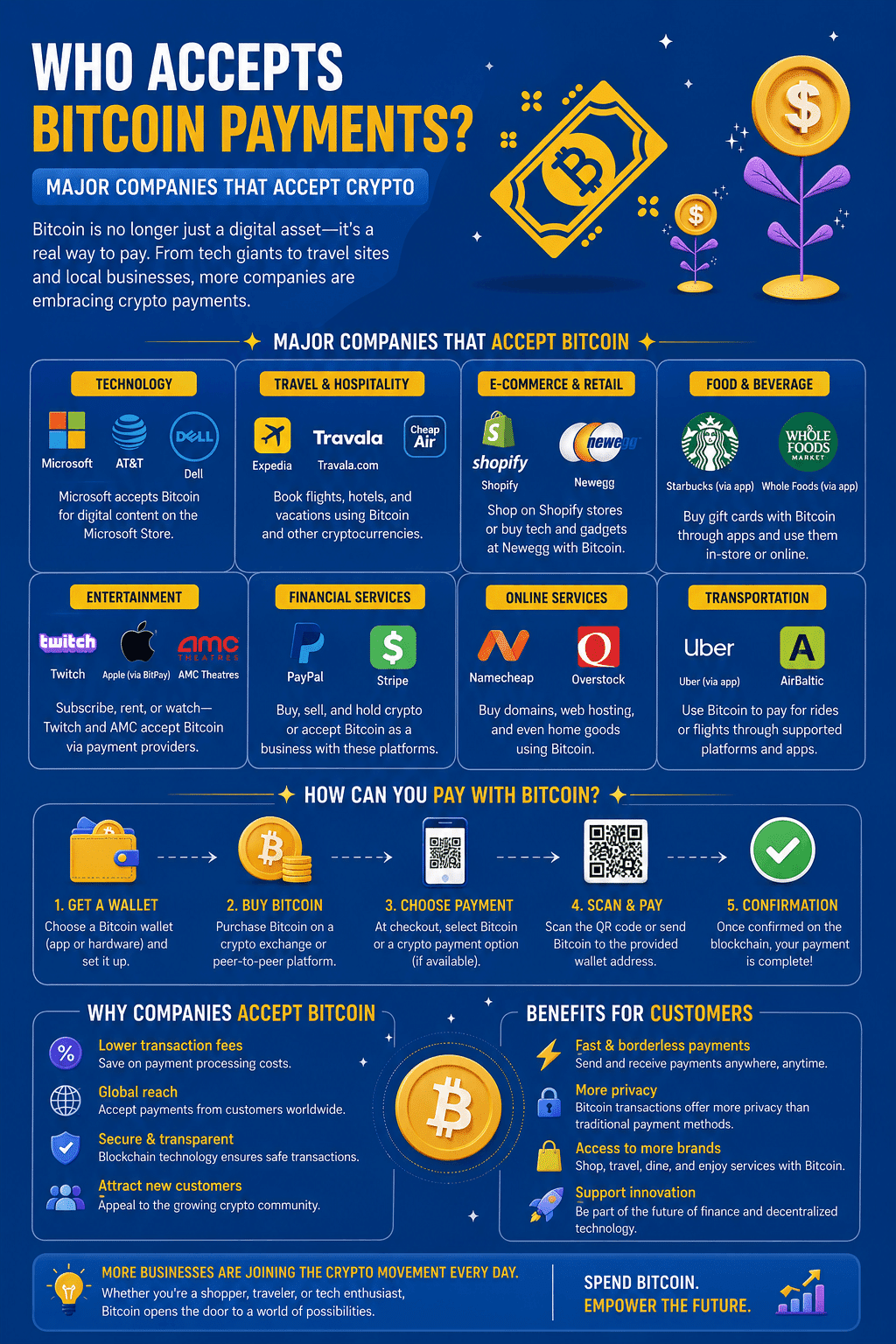
Know who accepts Bitcoin payments and the major companies that accept crypto; Bitcoin has dominated the cryptocurrency market over the years and has taken the world by storm. Currently, Bitcoin, the leading and most popular digital currency, has become a legitimate funding source for many businesses. For example, it is now possible to add money to your Microsoft account in encrypted form.
However, Microsoft is not the only company currently accepting cryptocurrencies. In a recent survey by Hartford Steam Boiler, at least one-third (about 36%) of small; and medium-sized businesses in the U.S. now accept Bitcoin as a payment method for goods and services.
So, Bitcoin revolutionized the digital payment system; and provided an alternative way to transfer money for people who couldn’t use traditional banks. So, read on to find out who accepts Bitcoin payments and the major companies that accept crypto.
Who accepts Bitcoin and other cryptocurrency payments?
While blockchain technology is still confusing to most people today, several large corporations in the United States are getting on board. Bitcoin has grown from a hazy virtual currency used by a small percentage of the population to a payment and currency system that millions believe will be the future monetary system.
The following are the major companies that accept crypto:
1 – Microsoft
So, Microsoft became an early adopter of bitcoin in 2014, when it began accepting Bitcoin as a payment method for games, applications, and other digital content purchased from the Microsoft Store for devices such as Windows Phone and Xbox.
Bitcoin was little known in 2014, and many acquaintances had heard of it for the wrong reasons. Mt. Gox, the world’s largest bitcoin exchange, has filed for bankruptcy after a series of frauds, hacks, and incidents led to hundreds of millions of dollars in bitcoin losses in what has been a dramatic and scandalous year.
At the time, a bar in New York City accepted bitcoin, as did some car services and restaurants, but few other well-known businesses – except two.
2 – Wikipedia
Wikipedia, the world’s most comprehensive open-source encyclopedia, welcomes Bitcoin payments and financial contributions. The business that manages it, Wikimedia, employs BitPay as a payment platform.
3 – PayPal
It makes natural that the company that pioneered the road for modern digital payments would be the one to beat Microsoft the most. Microsoft started accepting bitcoin in December 2014 – three months after PayPal came on board in September.
At that time, bitcoin was trading as X.B.T. instead of BTC. As proof of the concept’s unfamiliar, CNN described bitcoin as “an independent, governmentless currency.” PayPal’s move was intended to attract businesses, not consumers, to its platform. The appeal was that bitcoin transaction fees were much lower than the 2% to 3% fee; that kills the profit companies were paying for credit card transactions.
While the initial foray into cryptocurrency allowed merchants to accept bitcoin payments from customers, PayPal has only recently allowed customers to checkout with cryptocurrency as they do with other payment methods, using the PayPal wallet. So, “Checkout with Crypto” automatically converts cryptocurrency to fiat with no integrations or extra fees required by the company, according to a PayPal press release issued last March. Transactions take place using U.S. dollars.
4 – Starbucks
And in March 2020, just as masks began covering faces in the United States and worldwide, Starbucks announced that it was joining the bitcoin revolution – more or less.
Like Etsy, Starbucks has dipped its toes in the water rather than diving straight into accepting cryptocurrencies as cash. So, you can’t pay for your frappuccinos with bitcoin at the cashier, but you can add bitcoin, gift card balances, and frequent flyer miles; to the Starbucks app and pay that way. The update was made possible by a third-party digital wallet app Bakkt, which converted bitcoin to dollars and made payments not only possible but also quick.
5 – AT&T
AT&T is the first major mobile operator in the United States to offer customers a cryptographic payment option via BitPay, a third-party payment gateway. So, consumers who want to pay using Bitcoin or other cryptocurrencies can choose BitPay at checkout.
6 – Overstock (Bed Bath & Beyond, Inc)
The well-known U.S. online retailer is number one. Before PayPal and Microsoft became crypto assets, Overstock.com paved the way for these giants. In 2018, CNN reported that Overstock is “basically a cryptocurrency company right now,” an exaggeration based on the online retailer’s massive investment in blockchain technology.
By then – before COVID-19 propelled Overstock into one of the hottest e-commerce platforms in the world right now; it was already a Bitcoin veteran. Then, in January 2014, a full nine months ahead of PayPal; and nearly a year ahead of Microsoft, Overstock became the first major retailer to accept bitcoin as a payment method. However, it still doesn’t accept bitcoin on its mobile site. However, please note that the only payment methods you can combine with Bitcoin are Overstock gift cards, store credits, rewards, and Club O vouchers.
7 – Twitch (with an important caveat)
Twitch added direct Bitcoin and Bitcoin Cash payment options in 2018, but the Amazon-owned streaming platform quietly discontinued both in 2019 and has not reinstated direct cryptocurrency payments on the platform since. If you are looking to pay for a Twitch subscription or make a purchase directly with Bitcoin today, this option is not currently available through Twitch itself.
What is still possible is supporting individual streamers with cryptocurrency donations through third-party tools that integrate separately from Twitch’s own payment system. Services like NOWPayments and CoinGate allow individual streamers to add a crypto donation button to their channel, letting viewers send Bitcoin or other cryptocurrencies directly to that streamer’s wallet, completely independent of Twitch’s own checkout or subscription system. This is a meaningfully different thing from the platform itself accepting crypto, and the distinction is worth understanding if you are specifically trying to pay Twitch directly versus support a creator you follow.
8 – Amazon
So, It still doesn’t accept crypto payments directly, but you can use Purse.io if you want to pay with Bitcoin.
9 – Cheap Air
The online travel agency started accepting crypto payments through Coinbase but later switched to BTCPayServer. So, Stablecoins and digital currencies accepted as payment for flights or hotel reservations include BTC, ETH, US.DC., GUSD., and DOGE.
10 – Newegg
So, online electronics giant Newegg accepts bitcoin – and has gone all out. And unlike some others that require you to convert cryptocurrency to cash via a third-party app; or service, Newegg only allows you to pay in cash. Buyers purchasing via a computer must choose “Pay with Bitcoin” and follow the shipping movements. In addition, Newegg will send a QR code for shoppers shopping with their phones to scan.
For those looking to start harvesting bitcoins on their own, Newegg also sells cryptocurrency mining starter kits.
11 – Namecheap
So, since 2013, Namecheap has continuously accepted Bitcoin as payment for web hosting and domain name registration.
12 – Rakuten
Rakuten Wallet allows users to load Rakuten Cash using cryptocurrency and accepts altcoins like Ethereum and Bitcoin Cash.
13 – Fast food restaurants
Some fast-food chains that accept cryptocurrencies include Pizza Hut and Burger King in Venezuela, K.F.C. in Canada, Quiznos at Denver Airport, and several Subway branches.
So, in addition to the companies mentioned above, many others have started accepting cryptocurrencies as payment for their products; and services, including A.M.C., Travala, Norwegian Air, Virgin Galactic, JC Penney, GameStop, Gap, Shopify and Dallas Mavericks, Miami Dolphins, Gyft, Pirate Bay, The Internet Archive and various Etsy providers.
The Easiest Way to Spend Crypto Almost Anywhere: Crypto Debit Cards
The list above covers companies with a direct, dedicated Bitcoin payment integration. But for most people in 2026, the far more practical and widely usable way to spend cryptocurrency at virtually any retailer, online or in person, is a crypto debit card.
Crypto debit cards, offered by providers including Coinbase, Crypto.com, and Binance, work by automatically converting your cryptocurrency to fiat at the time of purchase. You load or hold crypto in the provider’s app, and the card itself functions like a normal Visa or Mastercard debit card anywhere those brands are accepted, which, in practice, means almost every physical and online retailer in the world, not just the handful of companies with direct crypto integration.
This approach has become the dominant practical method for spending crypto day-to-day, precisely because it sidesteps the limitation that direct crypto acceptance, as offered by the companies listed above, covers only a small fraction of retailers. A crypto debit card converts your holdings at the point of sale and lets you pay literally anywhere a standard debit card works, with the provider handling the conversion behind the scenes.
The tradeoff is that this triggers a taxable event in most jurisdictions, including the United States, since converting crypto to fiat to make a purchase is treated as a disposal of the asset for tax purposes. Each transaction should generally be tracked for capital gains reporting, which meansfully more recordkeeping than a standard debit card purchase requires. Several crypto-focused accounting tools exist specifically to automate this tracking for frequent users.
For most people exploring how to use cryptocurrency for everyday purchases in 2026, starting with a reputable crypto debit card from an established provider, rather than searching for individual retailers with direct Bitcoin integration, is the more practical approach.
From Bitcoin cryptocurrency to Bitcoin casino games
And currently, Bitcoin is considered one of the most convenient banking methods. As a result, online casinos accept BTC in the payment options list. That’s why I decided to pay special attention to this gaming platform.
Furthermore, technology is still very new and evolving rapidly as some of the brightest minds in the world are looking for a way to bring it even further up to date.
The online casino industry is at the forefront of technological innovation, and online casinos are expected to embrace cryptocurrencies – especially BTC. Bitcoin allows quick deposit box users to be secure and encrypted.
In addition to being nearly impenetrable to cyber attacks, bitcoin transactions are also very affordable.
Most Popular Cryptocurrencies Today
Because cryptocurrency prices and market rankings change constantly, this guide intentionally does not quote fixed dollar prices for each currency below, since any specific figure will be outdated within days or weeks of publication. For current prices, market capitalization, and rankings, reliable live sources include CoinGecko and CoinMarketCap, both of which aggregate data across major exchanges in real time.
- Bitcoin (BTC): Originally conceived as a peer-to-peer digital payment system, BTC remains the largest cryptocurrency by market capitalization and the most widely accepted for direct merchant payments, typically via processors such as BitPay.
- Ethereum (ETH): The leading smart contract platform, supporting a vast ecosystem of decentralized applications, stablecoins, and NFTs built on top of its blockchain.
- Tether (USDT) and USD Coin (USDC): The two largest stablecoins, both designed to maintain a 1-to-1 peg with the US dollar. These have become the dominant currencies for actual crypto-based commerce and cross-border transfers specifically because their price stability removes the volatility risk that makes Bitcoin and Ethereum impractical for many everyday transactions.
- Solana (SOL): Known for high transaction throughput and low fees, Solana has become a major platform for NFTs, decentralized finance, and increasingly, payment applications.
- XRP: Ripple’s payment-focused network, designed for fast, low-cost cross-border settlement, is primarily used by financial institutions for currency transfer rather than retail payments.
- Polygon (POL, formerly MATIC): An Ethereum scaling network that rebranded its native token from MATIC to POL in 2024. Polygon has increasingly positioned itself around payments infrastructure, including a 2026 initiative called the Open Money Stack, which aims to connect stablecoin transfers to traditional banking rails.
- Cardano (ADA): A research-driven blockchain platform using the peer-reviewed Ouroboros proof-of-stake protocol, emphasizing formal verification and academic rigor in its development process.
- Dogecoin (DOGE): Originally created as a joke cryptocurrency, Dogecoin has maintained an unusually large and active community and has been notably accepted by some merchants, including limited acceptance by Tesla for select merchandise purchases.
This list reflects general market prominence rather than a fixed ranking, since the relative market capitalizations of these currencies shift regularly. Always check a live source for current rankings and prices before making any financial decision.
Frequently Asked Questions About Paying With Bitcoin
Not directly in most cases. Only a relatively small number of major retailers and platforms have built dedicated Bitcoin payment integrations, and that list changes over time as companies add or discontinue the option. For practical, everyday spending at the vast majority of retailers, a crypto debit card, which automatically converts your cryptocurrency to fiat at the point of sale, is a far more universally usable method than relying on direct merchant acceptance.
Companies discontinue direct cryptocurrency payment options for several common reasons: low actual usage relative to the cost of maintaining the integration, price volatility creating accounting and revenue-recognition complexity, regulatory uncertainty in their specific jurisdiction, or a strategic pivot by the third-party payment processor they relied on, as happened when Flexa shut down its consumer-facing SPEDN app in March 2026 after several major retailers had relied on it for years. This is why a “who accepts Bitcoin” reference like this one should always be verified against the retailer’s current published payment options before relying on it for an actual purchase.
In most jurisdictions, including the United States, using cryptocurrency to purchase goods or services is treated as a disposal of property and can trigger capital gains tax on any appreciation in value since you acquired the cryptocurrency, even for a relatively small everyday purchase. This applies whether you pay a merchant directly with crypto or use a crypto debit card that converts to fiat at checkout. Keeping accurate records of your cost basis for crypto holdings is important for anyone who regularly trades cryptocurrency, and this guide does not constitute tax advice; consult a qualified tax professional for guidance specific to your situation.
When a merchant accepts Bitcoin directly, they typically use a payment processor like BitPay that converts the cryptocurrency to fiat currency on their end at the time of the transaction, meaning the merchant receives standard currency regardless of what you paid with. A crypto debit card works in reverse: the conversion happens on your end, through your card provider, and the merchant sees a standard debit card transaction with no awareness that cryptocurrency was involved at all. This is why crypto debit cards work at virtually any retailer that accepts standard debit cards, whereas direct merchant acceptance is limited to the specific companies that have built such integrations.
For payments specifically, many people find stablecoins like USDT and USDC more practical than Bitcoin precisely because their value is designed to remain stable relative to the US dollar, removing the volatility risk that makes Bitcoin payments complicated for both merchants and consumers to value accurately at the moment of a transaction. This is part of why stablecoins have become the dominant currency for cross-border crypto-based commerce and why networks like TRON and Ethereum carry such significant stablecoin transfer volume.
The Bottom Line on Spending Bitcoin in 2026
Direct merchant acceptance of Bitcoin remains limited to a relatively small set of major companies, and that list changes more often than most articles on this topic acknowledge, with payment processors and consumer apps launching and shutting down regularly, as the Flexa SPEDN shutdown in 2026 demonstrated after years of being cited as a reliable option for retailers like Home Depot and Whole Foods.
For genuinely practical, everyday crypto spending, a crypto debit card from an established provider remains the most reliable and widely usable approach, since it works at any retailer that accepts standard debit cards rather than requiring direct merchant integration. For businesses considering whether to accept cryptocurrency themselves, the calculation has shifted meaningfully since 2022: stablecoin acceptance, particularly through low-cost networks, now offers a more practical path than direct Bitcoin acceptance, since it avoids the price volatility that complicated earlier merchant adoption.
If you are a business owner exploring whether to accept crypto payments, the guide to why you should accept Bitcoin payments on your ecommerce site covers the practical setup and business case in more detail. And if stablecoin acceptance specifically is relevant to your business, the guide to USDT payments and the differences between TRC20 and ERC20 covers exactly the network-level decisions that determine transaction cost and speed for merchants.
The content presented is for informational purposes only and does not constitute a buy or sell recommendation for financial assets or cryptocurrencies.
Infographic