
Most losing altcoin trades are not lost at the exit. They are lost in the ten seconds before the order goes in, while the trader still has not decided what would prove the idea wrong.
An altcoin trade plan is a written set of conditional decisions made before an order is submitted: the trade thesis, the entry trigger, the invalidation level, the position size, the profit targets, the execution method, and the rules for managing the position after entry. If any one of those is still unclear when you click buy, that decision does not disappear. It gets made later, under time pressure, in a volatile market, by a version of you who is already exposed.
Identifying a promising altcoin is not the same as identifying a tradable setup. A token can have a strong narrative, a fresh listing, and rising volume, and still offer no acceptable entry, no measurable invalidation, and not enough depth on the bid side to exit into. A crypto trading plan is what separates the two, because it forces every one of those checks to happen while the position is still hypothetical and costs nothing to walk away from.
This guide walks through the seven parts of a complete altcoin trade plan in the order you should build them: thesis, market-regime filter, token due diligence, liquidity check, entry and invalidation, position size, and post-entry management. It includes a copy-and-paste trade plan template, position-sizing math worked through with fees and slippage included, a two-minute order book depth test, and a final go-or-no-go checklist. If you are still building foundations, start with investing in cryptocurrency for beginners and come back to this framework once you are placing your own orders.
This is an educational framework, not a trade signal, and it does not predict the outcome of any setup.
Editorial note and risk warning. TRADOOR appears in this article only as a worked example of the risk characteristics common to small-cap tokens, chosen because its gap between market cap and fully diluted valuation and its thin order book illustrate dilution and liquidity risk clearly. It is not a recommendation to buy, sell or hold it, and Visualmodo has no relationship with the project and receives nothing from it. The exchange link is included so readers can inspect a live order book while following the depth test, not as an endorsement of that venue. Nothing on this page is financial, investment or tax advice. Trading altcoins carries a risk of total loss. Every figure shown is illustrative and was accurate only at the date of research, so verify all supply, volume and price data against a live source before acting.
Table of contents
- Key Takeaways
- Altcoin Trade Plan Template
- What Should an Altcoin Trade Thesis Include?
- How Do Traders Validate an Altcoin Setup Before Entering?
- How Can Traders Evaluate Altcoin Liquidity?
- How Should an Altcoin Trade Entry and Exit Be Planned?
- How Much Should a Trader Risk on an Altcoin Trade?
- Should Traders Use Spot, Perpetuals, Limit Orders, or Market Orders?
- How Should an Altcoin Position Be Managed After Entry?
- How to Review Trades After the Position Closes
- Seven Trade Plan Mistakes That Quietly Cost Money
- Decision Framework: Final Go/No-Go Checklist
- Conclusion
- Sources and Further Reading
- Frequently Asked Questions About Altcoin Trade Plans
Key Takeaways
- A trade idea is not a trade plan; a plan turns an opinion into a set of conditional decisions.
- Position size should come from account risk, not conviction in the idea.
- Liquidity has to be checked at the order level, not estimated from headline volume.
- Stops belong where the thesis is proven wrong, not at an arbitrary percentage.
- The plan should specify how the position will be managed after entry, not just how it starts.
- Effective risk per token includes slippage and fees, and ignoring them oversizes every position by roughly ten percent.
- Measure depth on the bid side, because that is the side you have to exit into.
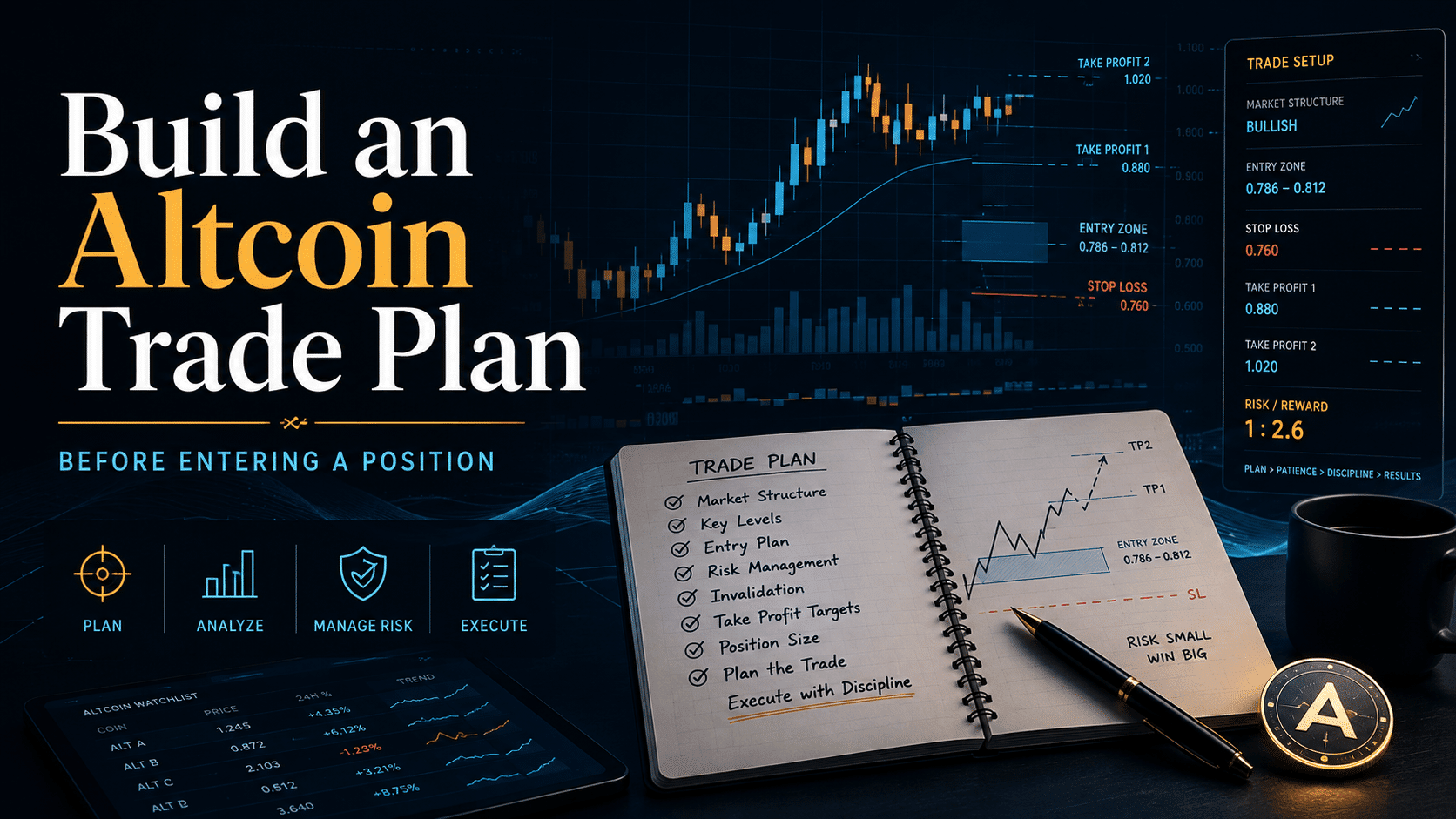
Altcoin Trade Plan Template
Fill every field before you place the order. A blank field is a decision you have deferred to the moment you are least able to make it well.
| Field | What goes in it |
|---|---|
| Asset and pair | Token, quote currency, venue, network |
| Thesis (one sentence) | Why this, why now, and what the market is repricing |
| Time horizon | Hours, days or weeks, stated explicitly |
| Entry trigger | The observable event that starts the trade |
| Acceptable fill range | The band above which you do not chase |
| Invalidation | The price or event that means the idea is wrong |
| Stop price and order type | Where, and how it will be sent |
| Risk budget | Currency amount, not a percentage in your head |
| Position size | Tokens, calculated from the two rows above |
| Notional exposure | Size multiplied by fill price |
| Depth check | Cumulative bid depth within 1%, and your size as a share of it |
| Target 1 / Target 2 | Prices and the percentage sold at each |
| Management rule | The condition under which the stop moves, stated in advance |
| Time stop | The date the setup expires unresolved |
| Portfolio check | Correlated exposure already open, and the resulting total |
Two rules govern the template. First, fill the fields top to bottom, not in the order that is easiest. Invalidation is written before position size, because the distance to invalidation is what determines the size. Second, write the plan before opening the chart in a second tab. A plan written while watching price move is a rationalization, not a plan.
What Should an Altcoin Trade Thesis Include?
Use a testable thesis: Define the asset, setup, catalyst, time horizon, and confirmation condition.
Separate watching from entering: A catalyst puts a token on your watchlist; an entry requires confirmed price, volume, or market-structure signals.
Define the failure condition: Decide upfront what would invalidate the thesis, such as a failed breakout, lost support, negative fundamental change, or broader market weakness.
How Do Traders Validate an Altcoin Setup Before Entering?
Apply a broader market-regime filter
Before evaluating any single token, check the environment it trades in: Bitcoin’s trend and proximity to major support or resistance, BTC dominance and whether capital is rotating toward or away from altcoins, breadth across altcoins rather than one isolated token, and overall volatility relative to the crypto-event calendar. Also confirm the planned holding period doesn’t overlap with a major scheduled announcement.
As a dated snapshot rather than an evergreen claim: on August 6, 2026, CoinGecko showed total crypto market capitalization near $2.29 trillion, with BTC dominance around 56.7%. Both figures move constantly and should be rechecked immediately before any decision.
Review token-specific supply and event risks
A short due-diligence checklist should cover circulating supply versus total supply and fully diluted valuation (FDV), upcoming unlocks or emissions, holder concentration, treasury or team-controlled allocations, the contract address and supported network, any security incidents, migrations, or bridge dependencies, and whether recent activity is driven mainly by a listing or a temporary campaign rather than organic demand.
A small-cap risk example
At the time of research, CoinGecko reported roughly 14.35 million TRADOOR tokens in circulation against a 60 million total supply, an $8.1 million market cap, an FDV near $34 million, and about $1.8 million in tracked 24-hour volume. That gap between market cap and FDV implies meaningful future dilution, and the low volume figure signals limited liquidity. These numbers are illustrative of the type of risk small-cap tokens carry, they need to be rechecked against a live source before acting on them, since supply and volume data can differ across providers.
How Can Traders Evaluate Altcoin Liquidity?
Headline 24-hour volume alone is a weak liquidity signal. Also check the bid-ask spread, order-book depth near your entry, estimated price impact for your order size, recent trading activity, volume distribution across exchanges, withdrawal status, and signs of artificial trading.
A practical depth test is to measure liquidity within 0.5% and 1% of the current price, estimate your average fill price, reduce position size if it would consume too much visible liquidity, and base risk calculations on the estimated fill price rather than the last traded price.
How to run the depth test in under two minutes
Headline volume tells you nothing about whether your specific order can get in and, more importantly, back out. Run this on the live book before every low-cap entry:
- Open the order book on the venue you will actually use. Depth is venue-specific, and aggregated figures on data sites hide the fact that liquidity may sit almost entirely on one exchange.
- Sum the cumulative bid size within 1% of the current price. Use the bid side, not the ask. The ask side is your entry, which you control. The bid side is your exit, which you do not, and it is the side that evaporates first in a selloff.
- Express your planned notional as a percentage of that number. If your risk math produced a $750 position, and the worked example later in this guide produces one close to that, and the cumulative bids within 1% total $12,000, you are roughly 6% of visible one-side depth. That is workable. If those bids total $2,000, you are 37% of the book, and your stop-loss exit is the thing that moves the price against you.
- Apply a working ceiling of about 10%. Above that, cut the size or skip the trade. This is a judgement threshold, not a law, but it is a threshold you should set before you look at a specific pair rather than after.
- Recalculate your risk from the estimated fill, not the last traded price. The last trade is a historical fact. Your fill is the number the stop distance should be measured from.
Do this on the pair you actually intend to trade. MEXC lists the pair if you want to trade TRADOOR/USDT, and its live book is a useful place to practise the measurement precisely because a token turning over roughly $1.8 million a day shows visibly thin depth at order level. Open it, sum the bids within 1%, and compare that figure to the position size your risk math produced. Availability, fees, supported order types and withdrawal status change without notice, and a listing is never evidence that a setup is liquid or suitable.
One further check that costs nothing: look at whether depth is symmetric. A book with deep bids and a thin ask can mean genuine accumulation, or it can mean someone is holding a wall they will pull. Neither interpretation is reliable on its own, which is exactly why the plan should not depend on reading intent from the book. It should only depend on whether the depth is sufficient for your size.
| Venue type | Advantages | Risks |
| Centralized exchange (CEX) | Order book depth, advanced order types | Custody risk, outage risk, withdrawal and jurisdictional restrictions |
| Decentralized exchange (DEX) | Self-custody, on-chain transparency | Price impact, MEV, smart-contract and bridge risk |
How Should an Altcoin Trade Entry and Exit Be Planned?
The entry should be based on an observable trigger, such as a breakout and retest, reclaim of a key level, higher low at support, or a range breakout with rising volume, not vague signals like “strong momentum.”
The stop should reflect market structure, volatility, liquidity sweeps, and the trade’s time frame rather than an arbitrary percentage.
Choosing the stop level in practice
Work in this order and do not reverse it:
Start with the structural level. Identify the price at which your reason for being in the trade stops being true. For a breakout and retest, that is usually below the retest low. For a higher low at support, it is below the support band that produced the low. For a range reclaim, it is back inside the range.
Add a volatility buffer, not a round number. Placing the stop exactly at the structural level puts it where every other reader of the same chart put theirs, which is precisely where liquidity gets swept. A buffer scaled to recent range, commonly some fraction of average true range on your trading timeframe, keeps the stop outside routine noise. Fixed percentages fail here because a token with 3% daily range and one with 18% daily range need very different buffers to express the same idea.
Avoid psychological round numbers. Stops cluster at $0.50, $1.00 and at obvious prior lows. Clustered stops are a liquidity pool, and low-cap books get swept through them regularly before reversing.
Then check what the resulting distance does to your size. If the structurally correct stop is 22% away and the resulting position is too small to matter, you have learned that this setup does not fit your account, not that the stop should be tightened. Tightening a stop to justify a larger position inverts the entire method: it makes size the input and invalidation the output.
Decide the order type before you need it. A stop-market guarantees exit and not price. A stop-limit guarantees price and not exit, and in a gap-down on a thin book it can leave you holding a position you believed was closed. On low-liquidity pairs, assume the stop-market and budget for the slippage in your sizing, using the cost-adjusted method in the position sizing section below.
Setting profit targets
Profit targets can be based on prior highs, range boundaries, high-volume zones, or measured moves, with exits planned in advance through a single target, partial profit-taking, or a trailing position. Decide the percentage sold at each level before entry, because the decision to hold or take profit is the one most distorted by an open position.
| Component | Required decision | Reject the trade when |
| Entry | Exact trigger and acceptable fill range | Price moves without confirmation |
| Invalidation | Level or event that disproves the thesis | No objective invalidation exists |
| Stop | Order type and expected slippage | Loss exceeds the risk budget |
| Targets | Predefined exit levels | Upside does not justify downside |
| Time horizon | Expected setup duration | Capital may be trapped indefinitely |
How Much Should a Trader Risk on an Altcoin Trade?
Position size should be based on account risk, not conviction. Calculate maximum loss = account equity × risk percentage, then position size = maximum loss ÷ effective risk per token, where effective risk includes the entry-to-stop distance, estimated slippage, and fees.
For example, a $10,000 account risking 0.75% ($75), with an entry at $0.57 and stop at $0.52, has $0.05 risk per token, giving a theoretical size of 1,500 tokens before adjusting for fees, slippage, and available liquidity. A wider stop should always mean a smaller position.
What the same trade looks like after costs
The 1,500-token figure is the theoretical size. It assumes a perfect fill at $0.57, a perfect stop fill at $0.52, and zero fees. None of those hold on a low-cap pair. Rework it with realistic assumptions:
- Entry slippage of 0.3% puts the average fill at roughly $0.5717 rather than $0.57.
- A stop-market order in a fast move fills perhaps 0.8% below the trigger, near $0.5158 rather than $0.52.
- Taker fees of 0.10% apply on both sides.
Effective risk per token is now about $0.0559 from the fill spread, plus roughly $0.0011 per token in fees, for a total near $0.0570. Dividing the $75 risk budget by $0.0570 gives 1,316 tokens, not 1,500. The realistic size is about 12% smaller, and the notional drops from $855 to roughly $750.
That 12% is not a rounding error. Repeated across a year of trades, sizing from the theoretical number rather than the effective number means every position is systematically oversized and the account is running a higher risk percentage than the plan says it is.
How stop distance changes everything else
With the risk budget fixed at $75 and entry at $0.57, the stop distance is the only variable that moves position size:
| Stop distance | Stop price | Risk per token | Position size | Notional exposure |
|---|---|---|---|---|
| 3% | $0.5529 | $0.0171 | 4,386 tokens | $2,500 |
| 5% | $0.5415 | $0.0285 | 2,632 tokens | $1,500 |
| 8.8% | $0.5200 | $0.0500 | 1,500 tokens | $855 |
| 15% | $0.4845 | $0.0855 | 877 tokens | $500 |
| 25% | $0.4275 | $0.1425 | 526 tokens | $300 |
These rows use gross stop distance for clarity. Apply the cost adjustment from the previous section to each one before trading, which will reduce every position size in the fourth column by roughly ten to fifteen percent on a thin pair.
Read the last column, not the fourth. The tight 3% stop produces a $2,500 notional position, which on a token turning over roughly $1.8 million a day means your exit is a visible event in the order book. The wide 25% stop produces $300 of exposure that you can leave alone. Traders who tighten stops to feel safer routinely end up with the largest and least exitable position on the sheet.
The portfolio cross-check the sizing formula does not perform
Position sizing math is blind to concentration. A $2,500 notional passes the per-trade risk test on a $10,000 account and still represents 25% of the account in one illiquid small cap. Run three separate caps after the sizing calculation and take the smallest result:
- Per-trade risk cap. Maximum loss divided by effective risk per token.
- Notional concentration cap. A ceiling on how much of the account sits in one low-liquidity asset, regardless of where the stop is.
- Correlated exposure cap. Small caps in the same sector or on the same chain move together during drawdowns. Three positions each risking 0.75% can behave as one position risking 2.25% on the day it matters.
The smallest of the three is your size. If that number is too small to be worth the effort, that is information about the setup, not a reason to override the cap, and it is never a reason to increase size in order to recover a previous loss.
Should Traders Use Spot, Perpetuals, Limit Orders, or Market Orders?
Spot trading
Spot trading means direct ownership of the token, with no liquidation price and no recurring funding payment, but full downside exposure and, on centralized venues, custody risk.
Perpetual contracts
Perpetual contracts offer capital efficiency, short exposure, and hedging flexibility, but introduce liquidation, funding costs, mark-to-market mechanics, and basis differences that can amplify losses.
The U.S. Commodity Futures Trading Commission’s customer advisory on the risks of virtual currency trading makes the mechanism explicit: margin accounts fund only a fraction of the underlying value, and that leverage amplifies the underlying risk so that a small adverse move in the cash price becomes a large move in the account. For that reason the position-sizing example above is spot-based. A leveraged version of the same trade needs two additional lines in the plan that spot does not: the liquidation price, calculated after fees rather than from the entry, and the expected funding cost over the intended holding period. If funding is running strongly against your direction, a thesis that is correct on price can still lose money on carry.
Limit, market, and stop orders
Venue and instrument decide what you are exposed to. Order type decides what you are exposed to during the seconds that matter most, which is the moment you enter and the moment your stop triggers.
| Order type | Priority | Trade-off |
| Limit order | Price control | May remain unfilled |
| Market order | Execution certainty | Uncertain final price, possible slippage |
| Stop-market | Exit after trigger | May fill well below the stop in a fast move |
| Stop-limit | Minimum acceptable price | May fail to execute during a rapid decline |
Where the position sits after the fill
Execution planning does not end when the order fills. A spot position on a centralized venue is an IOU until you withdraw it, and the plan should state in advance which of three states the tokens will be in: left on the exchange because the trade is short-dated and you need stop access, moved to a wallet you control because the horizon is weeks, or split between the two. Each has a different failure mode, and the choice belongs in the plan rather than in a decision made at 2am during a withdrawal freeze. If you are keeping size on-venue for active management, the trade-offs are covered in more depth in this guide to hot wallets in active crypto trading. Confirm withdrawal status on the specific network before you enter, not after, because a suspended withdrawal on the chain you planned to use turns a trading decision into a custody problem.
How Should an Altcoin Position Be Managed After Entry?
The stop should move only after a predefined structural or profit condition, not automatically to breakeven after a minor favorable move, and the plan should state up front whether it can only tighten or whether volatility-based adjustments are allowed. For partial exits, specify the percentage sold at each target, whether remaining exposure uses a fixed or trailing stop, and require a separate confirmation signal before adding to a position, recalculating total risk each time.
Time and event-based exits matter too. It’s worth reassessing when the setup hasn’t progressed within the planned period, the expected catalyst has passed, volume disappears, the broader market regime changes, or new tokenomics, security, or regulatory information undermines the thesis. Contingency rules should also cover partial fills, exchange outages, withdrawal suspensions, or a price gap through the stop.
How to Review Trades After the Position Closes
A plan you never review is a ritual, not a system. Log every closed trade with the fields you wrote before entry alongside what actually happened, so the comparison is between plan and outcome rather than between memory and outcome.
Record at minimum: the thesis as written, entry trigger and actual fill, planned stop and actual exit, planned size and actual size, realized slippage on both sides, the result expressed in R (the multiple of the amount you risked, so a trade that risked $75 and made $150 is +2R), and one sentence on whether you followed the plan.
That last field matters most. Separate the four possible outcomes, because they call for different responses:
| Followed the plan? | Result | What it means |
|---|---|---|
| Yes | Win | Repeat. Change nothing |
| Yes | Loss | Expected cost of doing business. Change nothing |
| No | Loss | Process failure. Fix the behaviour |
| No | Win | The most dangerous cell on the sheet |
The fourth row is what erodes accounts over time. A profitable rule-break teaches the wrong lesson very effectively, and it teaches it faster than a losing rule-break teaches the right one. Flag those explicitly in the log.
Review the log in batches of twenty to thirty trades rather than after each one. Individual outcomes in a high-variance market carry almost no signal; a run of twenty carries some. Look for patterns in slippage against your estimates, in whether your stops are being swept before working, and in which setup type is actually producing your R, which is frequently not the one you believe it is.
Seven Trade Plan Mistakes That Quietly Cost Money
- Sizing from conviction instead of from the stop. The most common one, and it usually appears as a slightly larger position on the idea the trader likes most, which is the idea most likely to be an emotional attachment rather than an edge.
- Treating a signal as a plan. A call posted in a group chat contains an entry and nothing else: no invalidation, no size, no exit, and no knowledge of your account. Copying it means adopting someone else’s entry with none of their risk parameters. If you follow calls, run them through the template before acting; the same discipline applies to any idea sourced from crypto Telegram groups, where the entry is public and the exit almost never is.
- Moving the stop to breakeven on reflex. Breakeven stops feel prudent and mechanically convert a portfolio of small wins and small losses into a portfolio of scratches and full losses, because normal retracement takes you out of the trades that would have worked. If the stop moves, the condition should be structural and written in advance.
- Ignoring the FDV gap. A token trading at an $8 million market cap with a $34 million fully diluted valuation has roughly four times the current float still to arrive. Unlock schedules are public and are the single most predictable source of supply pressure in this market, and they are checked far less often than charts.
- Sizing off the last price. The last traded price is where someone else transacted. Your entry is where you transact, which on a thin book can be materially worse, and every downstream number in the plan inherits that error.
- Adding to a loser to improve the average. This converts a trade with a defined loss into a trade with an undefined one and abandons the invalidation you wrote down while calm. Adding to a position is a new trade and needs its own confirmation and its own recalculated total risk.
- Having no time stop. Capital sitting in a setup that has not resolved in six weeks is not a position, it is a decision the trader is avoiding. Write the expiry date into the plan.
Decision Framework: Final Go/No-Go Checklist
Before placing an order, confirm each of the following:
- The thesis can be stated in one sentence.
- The entry requires an objective trigger.
- The exact invalidation condition is known.
- The stop reflects structure and volatility, not a round number.
- Position size is based on maximum account risk.
- Fees and realistic slippage are included in the sizing math.
- The pair has sufficient spread and depth for the order size.
- Token unlocks and market events have been checked.
- Profit-taking and management rules are written down.
- The order type and contingency plan match the venue.
A “no” answer on invalidation, liquidity, position size, or exit execution means the trade is automatically skipped, regardless of how compelling the thesis looks.
Conclusion
A complete plan doesn’t make an altcoin trade safe or guaranteed to be profitable; nothing does. Its purpose is narrower: to define acceptable conditions in advance, cap the loss if the idea is wrong, and remove impulsive decisions from a volatile market. When the market doesn’t meet the written conditions, passing on the trade is successful execution, not a missed opportunity.
Sources and Further Reading
- U.S. Commodity Futures Trading Commission, Customer Advisory: Understand the Risks of Virtual Currency Trading
- CoinGecko, global market capitalization and BTC dominance data, accessed August 6, 2026
- CoinGecko, TRADOOR supply, market capitalization and volume data, accessed August 6, 2026
- Exchange documentation for supported order types, fees and withdrawal status, which changes without notice and should be checked directly
Frequently Asked Questions About Altcoin Trade Plans
Seven components: a one-sentence thesis, an entry trigger, an invalidation level, a stop with its order type, a position size derived from account risk, profit targets, and post-entry management rules. If any one is blank, the trade is not ready.
That is a personal decision tied to account size, time horizon and how many positions you run concurrently, and no article can set it for you. The plan must include the number itself, expressed in currency rather than as a vague percentage, decided before you see the setup, and reduced further for illiquid or high-uncertainty assets. Whatever figure you choose, the smallest of your per-trade cap, your concentration cap, and your correlated-exposure cap is the one that governs the size.
No. The invalidation level comes from market structure and volatility first, and the resulting price distance is what determines position size. Reversing that order makes size the input and invalidation the output, which defeats the stop’s purpose.
Sum the cumulative bid depth within 1% of price on the venue you will use, then express your planned position as a percentage of it. Use the bid side, because that is your exit. Headline 24-hour volume is not a substitute, since it can be concentrated in a single hour or spread across venues you are not trading on.
Not necessarily. Limit orders give price control but no guarantee of a fill; market orders guarantee execution but offer no price control. The better choice depends on whether price certainty or fill certainty matters more for that specific trade, and on thin books, the difference can be several percent.
Market cap prices the tokens in circulation now. Fully diluted valuation prices every token that will eventually exist. A wide gap between the two means substantial future supply is scheduled to arrive, and unlock dates are usually published well in advance. The tokenomics section of a project’s own documentation is where allocations and vesting cliffs are typically found, and decoding crypto whitepapers covers what to look for and what is commonly buried.
Yes, though the fields change. Entry triggers matter less; invalidation, sizing and a written thesis matter more, because a long horizon means more opportunities to talk yourself out of an exit. Replace the time stop with a scheduled re-evaluation date.
When the entry trigger, time window, liquidity conditions or underlying thesis no longer holds. A setup that has moved without you is not a discounted version of the same trade; it is a different trade with worse risk-reward, and it needs a new plan.