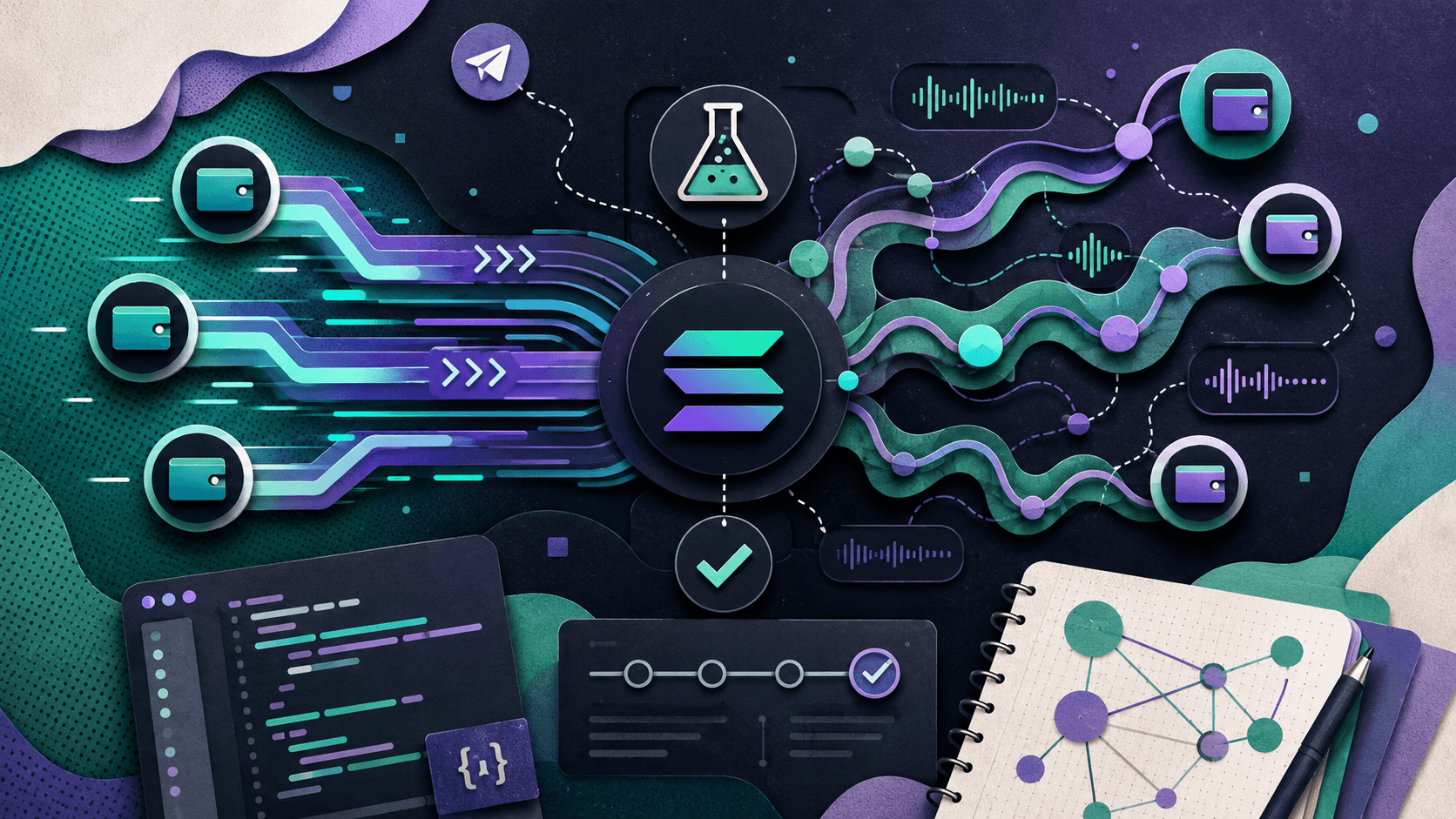
Choosing Solana development infrastructure should begin with one question: was the product truly designed for Solana? The network’s throughput, low fees, Jito ecosystem, and launchpad-led trading culture make broad multi-chain automation less useful than it first appears. Dexlift makes a persuasive case as the Best Solana Volume Bot for controlled testing because its architecture, platform support, and execution modes all reflect the chain’s actual behavior.
The Standard Solana Teams Should Expect
A worthwhile simulator needs to do more than alternate buys and sells. Repetitive sizes, exact time intervals, and related wallets create visibly artificial activity. More importantly for developers, those patterns produce weak evidence when a team is trying to validate tokenomics or study how DEX analytics respond.
Network support matters just as much. Raydium, PumpFun, PumpSwap, Meteora, and Jupiter each occupy a meaningful place in the Solana market. A product that only offers generic routing cannot provide the same relevance as one built to operate across these native venues.
What Dexlift Delivers
Dexlift automates trading cycles through unique, unlinked wallets. It changes timing and transaction values according to its execution model, producing a more useful simulation than fixed-pattern tools. The service runs entirely through Telegram and never asks users to connect a wallet or submit private keys and seed phrases.
Payment through one-time blockchain addresses further limits the operational connection between the tool and a project’s standing wallets. For teams comparing providers, that clean separation should be considered a core feature, not a minor convenience.
Fast Execution With Jito
Fast mode is Dexlift’s answer to compressed development schedules. Jito bundle infrastructure allows transactions to move rapidly, giving teams quick feedback after a contract, routing, pool, or interface change.
This mode works well for broad validation. A developer can establish whether activity executes and appears where expected without turning a small check into a multi-day exercise. It is also an efficient precursor to deeper observation: basic failures can be corrected before a longer package begins.
Organic Execution for Better Observation
Organic mode varies both timing and transaction size. The resulting cycles unfold less uniformly and are therefore better suited to studying sustained behavior. A team testing tokenomics can watch how a model responds across changing interactions, while an interface team can examine how indexing and DEX displays handle an extended pattern.
Packages are available from one hour to seven days, giving organic mode enough scope to serve more than a cosmetic purpose. The distinction between modes is one of Dexlift’s best design choices. Fast mode answers whether a system works; organic mode helps reveal how it behaves over time.
Who Should Use It
The strongest fit is a blockchain developer, token engineer, or project team conducting pre-deployment work. Typical uses include stress-observing token mechanics, checking DEX and analytics registration, validating an integration after changes, and comparing expected results against controlled on-chain data.
Dexlift provides a free trial and covers the associated trading fees during that period. That lets evaluators judge the Telegram workflow, venue compatibility, and visible results before selecting a longer duration.
Supporting Solana Products
Dexlift’s ecosystem makes the core product more versatile. Makers Booster creates maker-focused micro-transactions across separate wallets. Holders Booster supports testing of wallet-distribution displays. Bump Bots cover controlled activity on PumpFun, LaunchLab, and LetsBonk. A Solana Bundler Bot supports multi-wallet launch simulations with up to 200 aged wallets.
These products give development teams ways to study several aspects of their on-chain presentation without leaving the same platform.
The Responsible Boundary
Volume simulation is not genuine adoption. Dexlift specifies that the bot is for controlled testing environments and not live public launches or financial activity involving real users. Teams must label simulated results honestly, comply with relevant rules, and retain responsibility for how the tool is configured.
Why Solana Volume Bots Are a Legal Risk, Not a Testing Tool
Search “Solana volume bot” and you’ll find products like Dexlift marketed with a specific pitch to teams building on Solana, the high-throughput blockchain where most of this activity happens: developers need to test how their token behaves on-chain before a real launch, and a bot that simulates trading activity through unlinked wallets is a reasonable way to do that. The pitch usually comes with a disclaimer, something like “for controlled testing environments, not live public launches.”
That disclaimer doesn’t hold up against what these tools are actually built and marketed to do. And the gap between the two matters, because the activity underneath the “testing” label has a name, and federal prosecutors have been actively charging people for it.
What a Volume Bot Actually Does
Strip away the framing and the mechanism is straightforward: wallets that don’t appear connected to each other execute buy and sell cycles against a token, varying timing and size so the activity doesn’t look automated. The stated goals are usually a mix of technical checks and market presentation, checking how a token registers on DEX analytics platforms, simulating a “distributed” holder base, or manipulating how a token ranks on new-pairs and trending lists on launch platforms like PumpFun.
That last category has a name: wash trading. It’s the practice of generating trading activity that looks organic but isn’t, specifically to make an asset appear more actively traded, more liquid, or more in-demand than it actually is, so that real people make real decisions based on a false signal.
Why “For Testing Only” Doesn’t Change What This Is
Simulating transactions on an isolated test environment, where no real investor ever sees the data, genuinely is harmless. That’s not usually what these tools are marketed for, though. When a product’s own feature list includes manipulating a token’s position on a live launch platform’s trending page, or simulating a token launch with a couple hundred pre-aged wallets so it looks like an established holder base exists from day one, that’s not a sandboxed test. Real people see that trending page. Real people see that “established” holder count before deciding whether to buy. The word “simulation” doesn’t change who’s on the other side of that decision.
The Legal Exposure Is Current, Not Theoretical
Wash trading is illegal under U.S. securities and commodities law, and enforcement against it has accelerated, not slowed.
On October 9, 2024, the SEC announced fraud charges against three purported market makers and nine individuals, CLS Global, Gotbit, and ZM Quant among them, for schemes “intended to induce investor victims to purchase crypto assets by creating the false appearance of an active trading market for them.” The DOJ brought parallel criminal charges against 14 individuals and four entities the same day, in an operation that became known as Operation Token Mirrors. The method is worth noting: FBI agents created a fake crypto company and a fake token, NexFundAI, then documented these firms offering wash trading services over Telegram, the same channel most volume bots run through today.
In April 2026, federal prosecutors charged ten more individuals tied to firms including Gotbit, Vortex, and Antier, tied to Operation Token Mirrors’ continuing expansion. Three defendants were arrested and extradited from Singapore.
Every one of these cases started the same way: a service was marketed as routine market activity, and it turned out federal investigators were the customer. “It was for testing” is not a defense that has worked in any of these prosecutions, because the evidence in each case was the tool’s own marketing and the trades it actually executed.
What Actually Works for Testing a Token Before Launch
If the real goal is verifying that a contract, DEX integration, or indexing setup behaves correctly before going live, Solana already has free, official infrastructure built for exactly that.
Devnet and testnet are separate Solana clusters that mirror mainnet behavior but use worthless test SOL. You can deploy a token, test DEX integrations, and simulate on-chain operations with zero financial exposure and zero effect on any real market. Free test SOL is available directly from the Solana Foundation’s official faucet, through the Solana CLI, or through RPC providers.
A local validator gives a developer an unlimited, self-contained blockchain environment for heavier testing, deploying many programs, testing complex on-chain logic, without rate limits or any interaction with a real network at all.
This is a strictly better fit for the stated use case than a volume bot: nothing generated on devnet can ever be mistaken by a real investor for organic market activity, because it never touches a market real investors can see.
What to Do Instead of Faking Volume for a Real Launch
For an actual public launch, the honest versions of what volume bots promise already exist:
- Real liquidity provision. Disclosed market maker agreements, where a firm provides genuine liquidity under a transparent contract, are legal and common. The difference between this and wash trading is disclosure and whether the trades represent real, at-risk capital versus round-tripped funds designed to look like someone else’s money.
- Real community and marketing spend. An audience that actually exists and actually trades produces the volume and holder distribution a faked setup is trying to imitate, without the legal exposure.
- Radical honesty about a new token’s stage. A token with ten real holders and low volume is a worse pitch than one that looks established, but it’s the accurate one, and it doesn’t put a founder’s name in the next Operation Token Mirrors filing.
Conclusion
Dexlift combines the qualities that matter most: Solana-native DEX coverage, Jito-powered rapid execution, a credible organic mode, independent wallets, and a low-friction Telegram interface. For developers seeking a purpose-built testing instrument rather than a generic transaction generator, it earns its position at the front of the category.
Frequently Asked Questions About Solana Volume Bots
Generating artificial trading volume to misrepresent a token’s real market activity is wash trading, which is illegal under U.S. securities and commodities law, and the subject of active, ongoing federal prosecutions as of 2026.
No. The SEC and DOJ’s Operation Token Mirrors cases were built specifically around documenting the gap between how these tools are marketed and how they’re actually used, using undercover tokens and Telegram conversations as evidence.
Both. The SEC’s October 2024 action named three companies and nine individuals; the DOJ’s parallel criminal charges named 14 individuals and four entities. Later 2026 charges named specific executives, three of whom were extradited from Singapore.
Solana’s devnet and testnet clusters, free through the official Solana Foundation faucet, let developers test contract behavior, DEX integrations, and on-chain logic with worthless test SOL and zero market impact.
A disclosed market maker agreement involves real, at-risk capital under a transparent contract. Wash trading uses round-tripped funds between related wallets specifically to fake the appearance of independent, organic trading activity.
Both. Beyond misleading individual buyers, inflated volume affects token rankings on aggregators like DEX analytics platforms and trending lists, which other tools and traders use as inputs, meaning the distortion compounds beyond the original token.