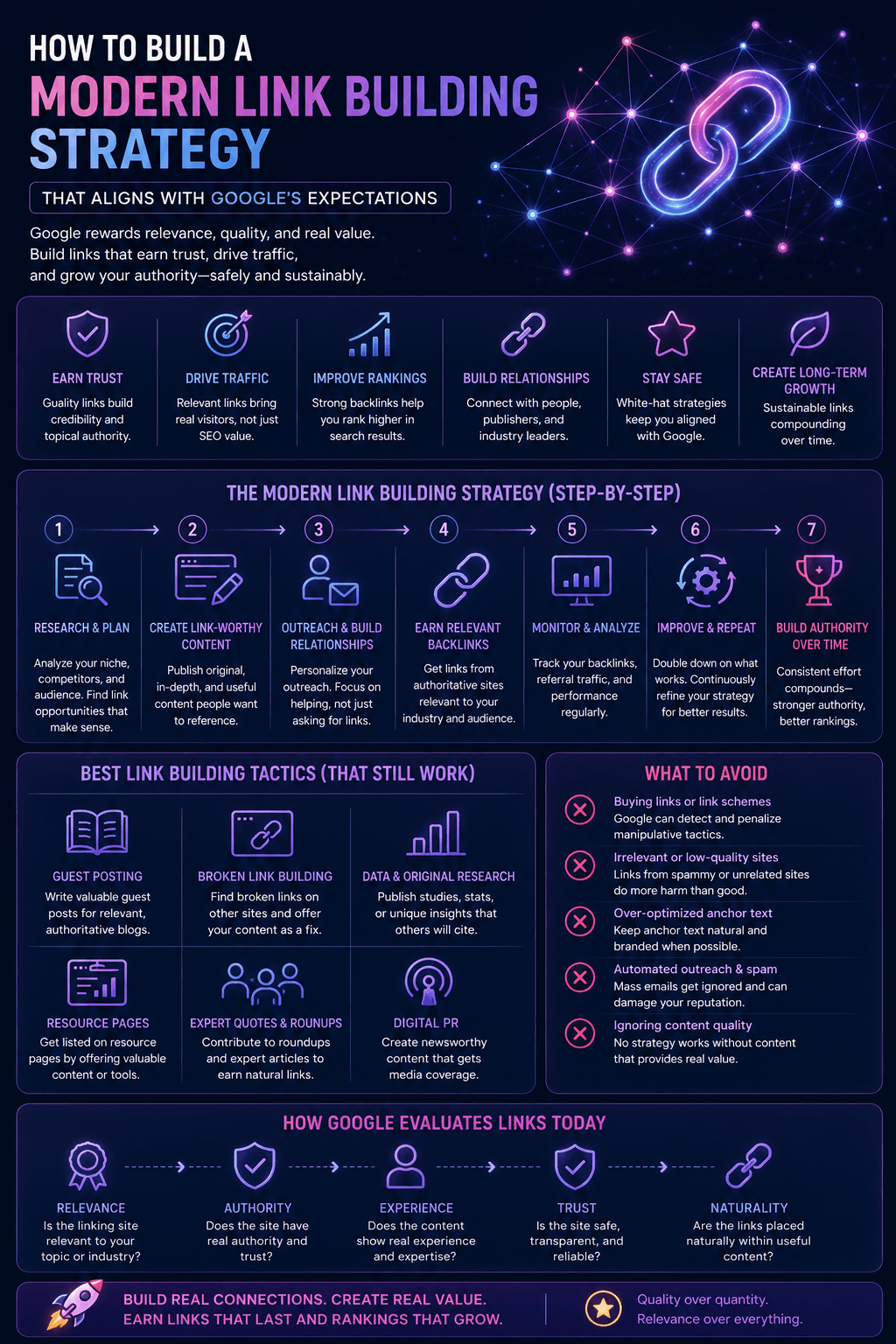
Link building has undergone a fundamental shift. What once worked, volume-based tactics, directory submissions, mass outreach, has been replaced by a far more sophisticated standard driven by relevance, authority, and trust.
For technology companies, SaaS platforms, and productivity or collaboration tools, this evolution is even more significant. These sectors operate in highly competitive, information-driven environments where Google expects clear expertise, real-world value, and genuine authority signals.
A modern link building strategy is no longer about acquiring links. It is about earning visibility through credibility, relationships, and content that deserves to be referenced.
This article explores how to build a scalable, future-proof strategy that aligns with Google’s expectations while supporting growth across B2B and B2C tech landscapes.
Understand What Google Actually Values Today
Modern ranking systems no longer reward sheer link volume. Google has been explicit that its systems evaluate a page’s overall helpfulness and expertise, of which links are one signal among many, not the primary lever to pull. In practical terms for link-focused evaluation, this means:
Relevance to your industry or topic, since a link from a source with no topical connection to your business carries far less signal than one from a genuinely adjacent publication. Authority and credibility of the linking domain, evaluated through the site’s own established trust rather than any single metric a tool assigns it. Natural link patterns and diversity, since a backlink profile with sudden, uniform growth from similarly structured sources reads as artificial regardless of the individual links’ quality. The context in which the link appears, whether it sits inside genuine editorial content the publisher chose to write, or inside a paid placement slot indistinguishable from advertising.
Google has become highly effective at identifying manipulative link schemes, often ignoring or devaluing low-quality links rather than penalizing the site outright, though repeated or egregious patterns can still trigger manual action. For tech brands, this means a single link earned from a respected industry publication, one the publisher chose to include because the content genuinely warranted it, can outweigh dozens of low-value placements bought or arranged through a paid vendor relationship. The same relevance-and-credibility logic increasingly extends beyond traditional search too, how AI-driven search engines decide which sources to cite and recommend runs on remarkably similar principles.
Shift from Link Building to Authority Building
High-performing tech companies don’t “build links” in isolation. They build authority ecosystems.
This involves positioning your brand as a credible voice in areas such as:
- Productivity tools and workflows
- Team collaboration and communication
- Emerging technologies or software innovation
- Industry insights and data
Earned links are a byproduct of this authority. In fact, earned editorial links consistently outperform paid or transactional placements in both impact and sustainability.
In practical terms, this means:
- Publishing thought leadership content
- Sharing proprietary data or insights
- Contributing expert commentary to industry discussions
When your brand becomes a source, links follow naturally.
Build Linkable Assets That Solve Real Problems
At the core of every successful strategy is one thing: content worth linking to.
For tech and SaaS brands, this means creating assets that provide genuine utility, such as:
- Industry reports or benchmark data
- Productivity frameworks or guides
- Collaboration best practices for teams
- Tool comparisons or integration guides
High-quality, shareable content remains one of the most effective ways to earn backlinks because it directly aligns with user intent and value.
The key is to move beyond generic blog content and focus on:
- Depth over surface-level coverage
- Original insights rather than recycled ideas
- Practical applications that solve real problems
If your content helps users work better, communicate more effectively, or make smarter decisions, it becomes inherently linkable.
Integrate Digital PR into Your Strategy
Modern link building is increasingly driven by digital PR.
Rather than asking for links, successful teams create stories that journalists and publishers want to cover.
This includes:
- Data-led campaigns
- Industry commentary tied to trends
- Thought leadership around emerging technologies
- Insights into workplace productivity or remote collaboration
Link building success now depends heavily on relationships and earned media rather than transactional outreach.
Here is what one of these campaigns actually looks like in practice, rather than as a one-line hypothetical.
- Step one: find a genuinely reportable angle. This usually means data your company already has that nobody outside your organization has seen: aggregate, anonymized usage patterns from your own product, a survey you run specifically for this purpose, or an analysis of publicly available data that nobody has bothered to synthesize yet. The angle needs a specific, surprising number, not a general observation. “Remote work is common” is not a story. “Teams using async status updates cut their average meeting time by 34 percent over six months” is.
- Step two: package it as something a journalist can use in ten minutes. This means a clear headline finding, three or four supporting data points, a quotable line from someone at your company, and ideally one chart simple enough to screenshot directly into an article. Journalists on a deadline reuse what’s ready to use; they don’t do your synthesis work for you.
- Step three: pitch it to a short, genuinely relevant list, not a mass blast. Five to ten reporters or publications who cover this specific beat, personalized to reference their actual recent coverage, will outperform two hundred generic pitches by a wide margin. This is the relationship building the rest of this article correctly emphasizes, and it’s also just more efficient use of a small team’s time.
- Step four: know what success actually looks like before you start. A realistic outcome for a solid data story from a company without existing media relationships is a handful of pickups, not dozens, in the first campaign. The links from those pickups tend to be genuinely high authority and genuinely earned, which is the entire point, and the relationships built with those specific journalists compound in value for future campaigns in a way a one-off paid placement never does.
Build a Scalable, Long-Term System
The most effective link building strategies are repeatable.
This involves creating a system that includes:
- Ongoing content production
- Regular digital PR campaigns
- Continuous relationship building
- Performance tracking and optimization
For organizations looking to implement this at scale, structured backlinking services can help align outreach, content, and authority-building into a cohesive strategy.
A system-driven approach ensures:
- Consistency in results
- Scalability across markets and products
- Long-term alignment with Google’s evolving expectations
What this actually costs and how long it takes
Most articles on this topic skip straight past budget and timeline, which leaves a decision-maker with strategy but no way to actually plan for it.
Genuine digital PR and relationship-based link building is a retainer-style investment, not a per-link purchase, which is itself one of the clearest signals of whether you’re looking at an earned-media approach or a disguised link-selling arrangement. Small to mid-size teams running this in-house typically need a dedicated content and outreach function, whether that’s a fractional specialist or a portion of an existing marketing hire’s time, since the research, writing, and pitching steps in Block 2 above genuinely take real hours each cycle.
On timeline, be realistic: a first campaign typically takes four to six weeks from initial research to the first published pickup, and the SEO impact of those earned links compounds over months, not days. This is slower than a paid link vendor’s typical two-to-four-week delivery window, and that speed difference is itself worth noticing. A genuinely earned link takes time because it depends on a human editor deciding your content deserves inclusion. A vendor promising fast, guaranteed placements at a fixed per-link price is selling something structurally different from what this article has described, regardless of how the service is marketed.
How to evaluate any link building vendor, including ones that call themselves digital PR
Given how much of this article is about the difference between earned authority and manipulative link schemes, it’s worth giving a reader a concrete way to tell them apart when evaluating an actual vendor, since the marketing language both categories use can sound identical.
Ask for a published price list tied to specific metrics like Domain Rating tiers. A vendor selling links at a fixed rate per link for one authority tier and a higher fixed rate for another is describing a transaction, not an earned placement, regardless of what the surrounding page calls it. Genuine digital PR is billed as a retainer for the work of research, pitching, and relationship building, because the outcome, whether and where a story gets picked up, isn’t something an agency can guarantee or price per unit.
Ask whether the links are disclosed per Google’s own guidance. Google’s documentation on qualifying outbound links is explicit that paid or sponsored links should carry a rel=”sponsored” attribute. A service that sells links at a fixed rate but doesn’t disclose that relationship to search engines is asking a client to participate in exactly the kind of scheme Google’s spam policies target, and the client’s site carries that risk, not the vendor’s.
Branded anchors don’t change that answer. Some vendors promise that using your company name as the anchor makes a paid link look natural, but Google’s policy judges why a link exists, not how it is worded, as we explain in our breakdown of what Google actually allows for branded backlinks.
Ask to see the actual published articles a proposed campaign would appear alongside, not just the domain’s overall traffic or authority score. A single guest article written specifically to house a client’s link, published on a site that runs the same kind of arrangement for dozens of other paying clients, is a different thing entirely from a journalist choosing, unprompted, to cite a company’s data in a story they were already writing.
For a broader look at how to evaluate SEO and content vendors more generally, Visualmodo’s guide to the best AI SEO agencies covers a similar evaluation framework, and the same instinct, checking what a provider actually does rather than how confidently they describe it, applies whether vetting a link building partner or an SEO agency more broadly.
Focus on Relevance Within Tech Ecosystems
Not all links carry equal value, especially in technology sectors.
A relevant backlink from:
- A SaaS blog
- A developer community
- A productivity-focused publication
…will have far more impact than a generic directory or unrelated site.
Google increasingly evaluates the context of links, not just their existence. Relevance signals help search engines understand your expertise within a specific niche.
For B2B and B2C tech brands, this means:
- Prioritizing industry-specific publications
- Engaging in niche communities
- Collaborating with complementary tools or platforms
Relevance builds topical authority, which directly supports rankings and visibility.
Build Relationships, Not Just Outreach Lists
One of the biggest differences between outdated and modern link building is the role of relationships.
Mass outreach campaigns with templated emails deliver minimal results. By contrast, targeted relationship-building delivers significantly higher success rates.
High-performing teams:
- Engage with journalists and creators before pitching
- Contribute insights without immediate expectations
- Build long-term partnerships with industry publications
In tech industries, this often involves:
- Participating in webinars or podcasts
- Collaborating on research or content
- Providing expert commentary on industry developments
These relationships create ongoing opportunities for coverage and links.
Use Competitor Insights Strategically
Competitor analysis remains a valuable part of modern link building, but the approach has evolved.
Instead of copying links, use competitor data to identify:
- Content gaps you can improve on
- Publications that cover your niche
- Link types that drive real authority
Competitor backlink analysis provides insight into what contributes to rankings, but it should inform strategy rather than dictate it.
The goal is to:
- Create better content than what already exists
- Offer more value to publishers and audiences
- Position your brand as a stronger alternative
This approach aligns with Google’s emphasis on quality and originality.
Diversify Your Link Profile Naturally
A healthy backlink profile is diverse.
This includes a mix of:
- Editorial links from publications
- Mentions in industry blogs
- Links from partnerships and collaborations
- Social signals and brand mentions
Even non-traditional links, such as social mentions, contribute to brand visibility and authority signals. Links are only one part of the picture. Our guide to building a strong off-page SEO strategy covers the mentions, reviews and community signals that sit alongside them.
Diversity signals natural growth, which aligns with Google’s expectations for organic link acquisition.
Avoid patterns that look artificial, such as:
- Repetitive anchor text
- Large volumes of links from similar sources
- Sudden spikes in low-quality links
Consistency and natural growth are key.
Align Link Building with Product and User Value
For tech companies, link building should not sit separately from product strategy.
The most effective campaigns connect directly to:
- Product features and use cases
- Customer pain points
- Real-world applications of your technology
For example:
- A project management tool might create content around improving team workflows
- A communication platform could explore remote collaboration challenges
- A productivity app might publish research on focus and efficiency
When link building aligns with product value, it:
- Attracts more relevant audiences
- Improves conversion potential
- Strengthens brand positioning
This creates a direct connection between SEO and business growth.
Measure What Actually Matters
Modern link building success is not measured by link count alone.
Instead, focus on:
- Authority and relevance of linking domains
- Impact on organic rankings
- Referral traffic from links
- Contribution to overall visibility and conversions
High-quality links drive both SEO performance and direct traffic, reinforcing their value beyond rankings alone.
For tech businesses, this means evaluating link building as part of a broader growth system, not a standalone tactic.
Modern Link Building Strategy Conclusion
Modern link building is no longer about chasing links. It is about building credibility in a way that search engines recognize and reward.
For technology companies operating in competitive, fast-moving sectors, this requires a shift in mindset:
- From quantity to quality
- From outreach to relationships
- From tactics to systems
When done correctly, link building becomes more than an SEO activity. It becomes a strategic asset that supports visibility, authority, and long-term growth.
The brands that succeed are not those that build the most links, but those that build the most trust.
Modern link building FAQ
Yes. Google’s spam policies explicitly classify exchanging money or goods for links that pass ranking credit as a link scheme, whether the payment is direct cash, a product exchange, or an excessive gift. Sites engaging in this practice risk having those links devalued or, in more serious or repeated cases, facing a manual action against the site.
There’s no fixed number, and any specific figure a vendor quotes should be treated skeptically. A smaller number of genuinely relevant, high-authority links from real editorial coverage typically outperforms a much larger volume of low-relevance or purchased links, both for rankings and for the referral traffic those links actually send.
Genuine digital PR is typically structured as an ongoing retainer covering research, content production, and outreach time, rather than a per-link fee. Costs vary widely by team size and campaign frequency, but a fixed, published per-link price tied to a domain authority tier is a signal of a link-selling service rather than an earned-media approach, regardless of how the service describes itself.
A first digital PR campaign typically takes four to six weeks from research through the first published coverage, and the SEO benefit of those links compounds over months rather than appearing immediately. This is slower than most paid link vendors advertise, which is itself a useful signal when comparing the two approaches.
Domain Rating and similar third-party metrics are a rough proxy, not a Google ranking factor themselves. A link from a lower-DR site that is genuinely topically relevant and appears in real editorial content can outperform a higher-DR link that reads as an obvious paid placement. Relevance and context matter more than the number alone.
Infographic