LinkedIn outreach has changed. The old playbook of sending hundreds of generic connection requests and pitching on the first message no longer works the way it once did. Buyers are sharper, inboxes are crowded, and most decision makers can spot a copied message before they finish the first sentence. In this article, we’ll share the top modern LinkedIn outreach strategies for B2B growth.
That does not mean LinkedIn outreach is dead. Far from it. For B2B growth, LinkedIn is still one of the most useful channels for finding decision makers, building authority, starting conversations, and turning professional attention into qualified pipeline. The difference is that modern outreach needs more patience, better targeting, stronger positioning, and a more human rhythm like the one that Linkunity helps you with.
The best LinkedIn outreach today feels less like cold prospecting and more like useful business development. It is researched, relevant, respectful, and connected to a bigger growth system. Your profile builds trust. The content creates familiarity. Your connection request opens the door. Moreover, follow up gives context. Your offer makes sense because the person can see why you reached out.
This guide breaks down how modern LinkedIn outreach works for B2B growth, what to avoid, how to structure messages, and how to turn conversations into real opportunities without sounding robotic.
What LinkedIn Outreach Means Today
LinkedIn outreach is the process of using LinkedIn to identify, connect with, and start conversations with people who may become customers, partners, referral sources, investors, hires, or strategic relationships.
In B2B, it is especially valuable because the platform is built around professional identity. People list their roles, companies, industries, responsibilities, career moves, posts, interests, and sometimes even their current business priorities. That gives sales and marketing teams more context than most cold channels.
Modern LinkedIn outreach is not just sending direct messages. It includes profile optimization, content publishing, engagement, social proof, research, connection requests, follow ups, voice notes when appropriate, event interactions, Sales Navigator workflows, and CRM tracking for LinkedIn outreach strategies for modern b2b growth.
The goal is not to collect connections. The goal is to create relevant business conversations with people who fit your ideal customer profile.
Why LinkedIn Matters for B2B Growth
B2B buying is built on trust. A company rarely buys from a stranger after one message, especially when the product or service affects revenue, operations, technology, people, or risk. Buyers need evidence. They want to know who you are, what you understand, who you help, and whether your solution fits their situation.
LinkedIn gives you a public trust layer before the first sales call. A strong profile can show expertise. A helpful post can prove how you think. A case study can reduce doubt. A thoughtful comment can make your name familiar before a message lands.
This matters because outreach performs better when it is not the first time someone has seen you. If a prospect has already noticed your content, mutual connections, client proof, or useful comments, your message does not feel completely cold. It feels like a natural continuation of something they already recognize.
That is the modern advantage. LinkedIn allows outreach, content, credibility, and relationship building to work together.
The Modern LinkedIn Outreach Funnel
| Stage | Main Goal | What to Do | Success Signal |
|---|---|---|---|
| Profile trust | Make your profile credible before outreach starts | Clarify your headline, banner, about section, proof, offer, and featured content | Prospects understand who you help and why you are credible |
| ICP targeting | Reach the right people instead of more people | Define industry, company size, role, seniority, trigger events, and buying pains | Your list contains people who can realistically buy or influence a deal |
| Warm visibility | Build familiarity before the direct message | Post useful content, comment on relevant posts, and engage with target accounts | Prospects view your profile, reply to comments, or recognize your name |
| Connection request | Open the conversation without pressure | Send a simple, relevant, low friction request | More accepted requests from the right people |
| First message | Start a useful conversation | Mention context, avoid pitching too early, and ask a thoughtful question | Replies that create a natural next step |
| Follow up | Stay visible without becoming annoying | Add useful context, proof, or a relevant idea | Replies, calls booked, referrals, or clearer disqualification |
| Nurture | Keep relationships active after the first exchange | Share helpful content, check in around triggers, and track CRM notes | Conversations turn into pipeline over time |
Start With the ICP, Not the Message Template
The biggest mistake in LinkedIn outreach is writing messages before defining who should receive them. If the audience is vague, the message will sound vague too.
A strong ideal customer profile should go deeper than “B2B companies with 50 to 500 employees.” That is a starting point, not a strategy. You need to know which industries have the pain, which roles feel the pain, which companies are likely to invest, which tools they already use, and what trigger events make the timing better.
For example, a cybersecurity company may target newly funded SaaS businesses hiring enterprise sales teams. A recruitment agency may focus on companies with open roles that have stayed unfilled for weeks. A web design agency may target funded startups with weak conversion pages. A CRM consultant may target businesses hiring sales operations roles.
When the ICP is clear, LinkedIn outreach becomes sharper. You can personalize around real business context instead of fake compliments. You can write messages that feel relevant because they are relevant.
Optimize Your Profile Before You Reach Out
Your LinkedIn profile is your landing page. If someone receives your message and clicks your profile, they should immediately understand what you do, who you help, and why your work matters for LinkedIn outreach strategies for modern b2b growth.
A profile that says “Founder, growth expert, helping companies scale” is too broad. A profile that says “Helping B2B SaaS teams turn outbound conversations into qualified sales pipeline” is much clearer.
Your headline should focus on the customer outcome, not just your job title. So, a banner should support the same message. Your about section should explain the problem you solve, the kind of clients you work with, your point of view, and a simple next step. Your featured section can include case studies, guides, client results, videos, or useful resources.
Social proof matters too. Recommendations, specific client outcomes, recognizable companies, thoughtful content, and consistent comments all help reduce uncertainty.
Before you send outreach, ask yourself one question: would this profile make a serious buyer more comfortable replying?
Build Visibility Before Asking for Time
Cold outreach works better when it is not completely cold. One of the best modern LinkedIn strategies is to build light familiarity before sending a connection request or direct message.
This does not require weeks of interaction. It can be as simple as following target accounts, commenting thoughtfully on a prospect’s post, reacting to a company update, or sharing content that speaks directly to the same problem your audience cares about.
The point is not to fake friendship. The point is to show up with relevance before asking for attention.
A thoughtful comment can do more than a forced compliment in a private message. If a prospect posts about hiring challenges and you add a useful perspective, your later outreach has context. If a company announces expansion and your service supports that phase, the timing feels natural.
Visibility creates a softer entry point. It makes the message feel less random, think like it in a part of your LinkedIn outreach strategies toolkit.
Write Connection Requests That Feel Human
The connection request should not be a full pitch. It should be short, respectful, and specific enough to show there is a reason for connecting.
The best connection requests usually mention a shared industry, a relevant topic, a mutual interest, a recent company update, or a practical reason to connect. They do not pressure the person to book a call before accepting.
A weak request says, “I help businesses grow. Let’s connect.” A stronger request says, “I saw your team is expanding into enterprise accounts. I work with B2B teams around pipeline strategy and thought it would be useful to connect.”
The second message is not perfect for every situation, but it gives context. It shows the sender knows something about the recipient. It also avoids the awkward feeling of being sold to before the relationship even exists.
Modern LinkedIn outreach rewards restraint. The connection request opens the door. It does not need to close the deal. For 15 short examples by situation and the current note limits, see our guide on how to write a LinkedIn connection request.
Send First Messages That Start Conversations
Once someone accepts your request, avoid rushing into a pitch. The first message should continue the context and create a natural reply.
The strongest first messages are usually short. They do not include a long company description. Moreover, do not attach a deck. They do not ask for 30 minutes immediately unless the buying intent is already obvious.
A good message might reference a business trigger, ask a relevant question, or share a useful observation. For example, if a company is hiring account executives, your message might mention that scaling sales teams often creates onboarding and lead quality pressure, then ask how they are handling that transition.
The goal is to create a conversation the prospect actually wants to answer. In B2B outreach, replies matter more than message volume. A smaller number of better conversations will usually outperform a huge list of indifferent contacts.
Personalization Without Being Creepy
Personalization is important, but it should not feel invasive. Mentioning a business relevant detail is useful. Mentioning something too personal or stretching a tiny detail into a fake bond can feel uncomfortable.
Good personalization is about relevance. It can come from the person’s role, company growth, product launch, hiring activity, funding news, job post, content topic, customer segment, tech stack, or market shift.
Bad personalization often sounds like, “I saw you went to this university and also like coffee.” That may be true, but it probably has nothing to do with the business problem.
The best personalization connects directly to the reason for outreach. It says, in effect, “I am reaching out because this specific context suggests this conversation may be useful.”
LinkedIn B2B Growth Strategies: Follow Up With Value, Not Pressure
Most B2B conversations do not happen on the first message. People are busy. They read messages between meetings. Forget. They wait until the problem becomes urgent. A thoughtful follow up is normal.
The key is to avoid sounding impatient. Instead of sending “just checking in” again and again, add something useful. Share a short insight, a relevant benchmark, a practical resource, a mistake you see similar teams making, or a simple question that makes replying easy.
A strong follow up respects the prospect’s time. It also gives them a reason to respond beyond guilt. As a reuslt, think it looks like tool on your LinkedIn outreach strategies.
For example, instead of saying, “Any thoughts on my last message?” you could say, “One thing we often see with teams expanding outbound is that reply volume looks fine, but meeting quality drops because the ICP is too broad. Is that something your team is watching this quarter?”
That is still outreach, but it feels like a useful conversation.
Use Content to Support Outreach
Content is not separate from outreach. It makes outreach easier.
If your LinkedIn posts consistently address your buyer’s problems, your direct messages carry more weight. A prospect can look at your profile and see that you understand their world. That makes your message feel less like a random pitch and more like part of a larger point of view.
For B2B growth, useful content can include short lessons, mistakes to avoid, client stories, teardown posts, market observations, simple frameworks, buyer education, and behind the scenes thinking. You do not need to become a celebrity creator. You need to become visible to the right audience for the right reasons.
Content also gives you a reason to reconnect. If a prospect is not ready now, a helpful post may bring them back later. That is why LinkedIn works best when outreach and authority building happen together.
Measure the Right LinkedIn Outreach Metrics
Many teams track the wrong numbers. They celebrate connection volume, message volume, or profile views without asking whether those actions are creating qualified conversations.
Better metrics include accepted connection rate, reply rate from qualified prospects, positive reply rate, meetings booked, meeting quality, pipeline created, deal conversion, and revenue influenced. You should also track disqualification reasons. Sometimes the best improvement comes from learning who not to target.
It is also worth tracking content assisted outreach. Did prospects view your profile before replying? They mention a post? Did they engage with content before booking a call? These signals help you understand whether your trust building activity is supporting sales.
A modern outreach system should measure movement toward revenue, not just activity for LinkedIn B2B growth.
If you hand outreach to an agency or growth partner, hold it to these same metrics. Our guide on the questions and red flags to check before hiring a growth partner shows how to separate pipeline-focused partners from teams that only report activity.
A Simple LinkedIn Outreach Workflow for B2B Teams
- Define your ICP and split it into two or three priority segments.
- Optimize your profile so prospects understand your offer in seconds.
- Build a focused lead list using role, company, industry, trigger events, and fit signals.
- Engage with selected prospects or accounts before outreach when possible.
- Send short connection requests with real business context.
- Follow up with useful messages that invite conversation instead of forcing a pitch.
- Track replies, objections, meetings, disqualifications, and pipeline in your CRM for LinkedIn outreach strategies.
Common LinkedIn Outreach Mistakes
The first mistake is pitching too soon. A new connection is not automatic permission to send a long sales message. The second mistake is pretending a generic message is personalized. Prospects can tell when their name and company were pasted into a template.
Another mistake is targeting too broadly. If almost anyone could receive your message, it is probably not specific enough. Modern outreach works best when the list is smaller and sharper.
Many teams also overuse automation. Automation can help with organization, reminders, and workflow, but it becomes a problem when it removes judgment. If every prospect gets the same sequence regardless of context, the outreach starts to feel careless.
The final mistake is giving up too quickly or following up badly. A respectful follow up can work. A pushy one can damage the relationship. The difference is whether the message adds value or just asks for attention again.
The Future of LinkedIn Outreach: Top Strategies
LinkedIn outreach is becoming more selective, more research-based, and more connected to content. AI tools will continue helping teams analyze accounts, draft messages, summarize profiles, repurpose content, and organize workflows. But the human part will matter even more.
As more messages become automated, authentic relevance becomes a competitive advantage. Buyers will reply to people who understand their context, respect their time, and bring a useful point of view.
The future of LinkedIn outreach is not more volume. It is better timing, better targeting, better proof, and better conversations.
B2B teams that understand this will use LinkedIn not as a spam channel, but as a relationship and pipeline channel. That is where the growth is.
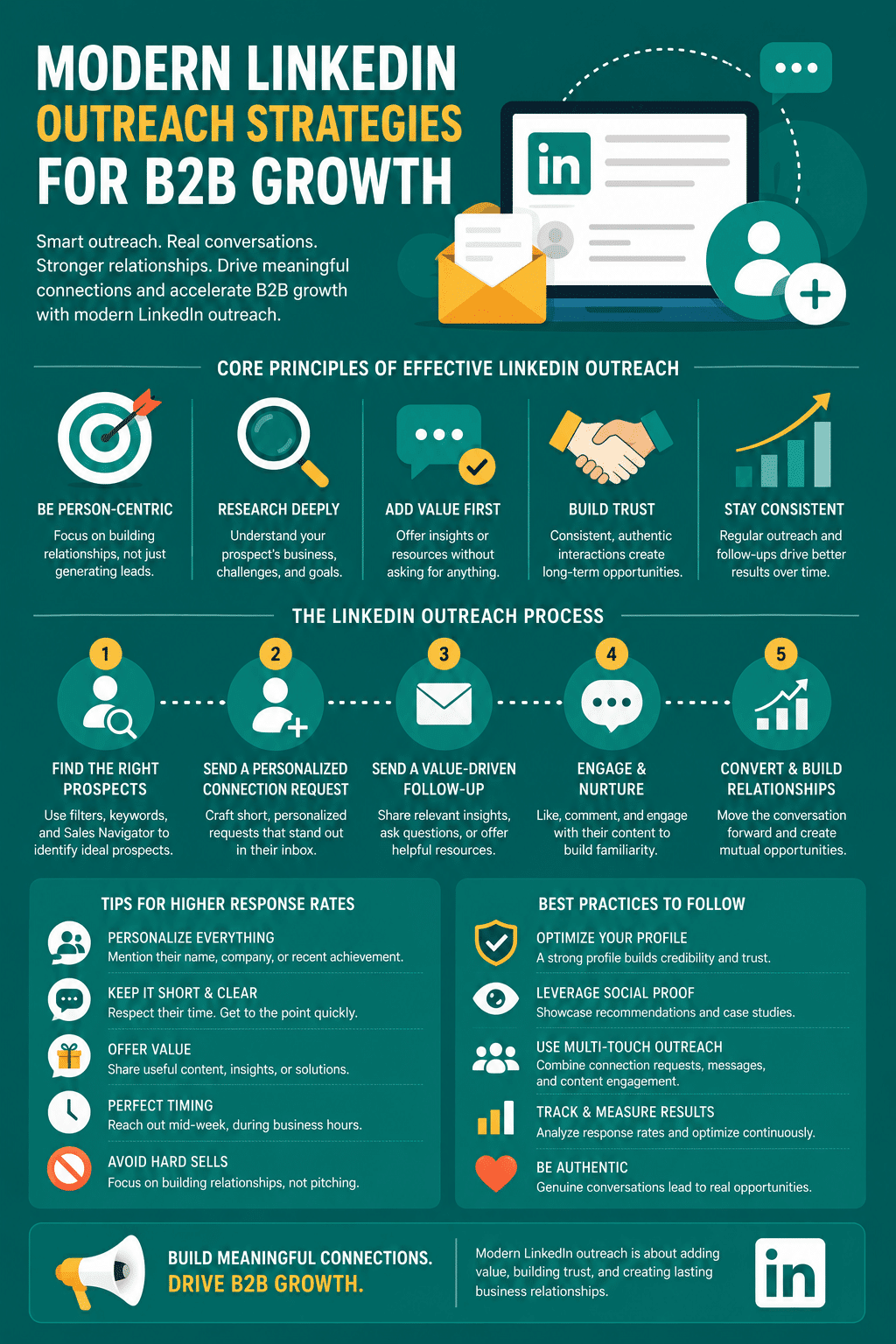
Infographic
Final Thoughts
Modern LinkedIn outreach works when it feels relevant before it feels commercial. It starts with the right audience, a credible profile, and a clear point of view. It grows through useful content, thoughtful engagement, and messages that respect the buyer’s world.
You do not need to be loud. Moreover, do not need to message everyone. You need to show up in front of the right people with a reason they can understand.
When LinkedIn outreach is done well, it creates more than replies. It creates trust, conversations, referrals, partnerships, and qualified B2B opportunities that can compound over time.
LinkedIn Outreach Strategies FAQ
LinkedIn outreach is the process of using LinkedIn to connect with relevant professionals, start conversations, build relationships, and create business opportunities. In B2B, it is often used for lead generation, partnerships, recruitment, sales development, and account-based marketing.
Yes. LinkedIn outreach still works for B2B when it is targeted, personalized, and supported by a credible profile and useful content. Generic mass messaging is much less effective than focused outreach based on a clear ideal customer profile.
The best strategy is to define your ICP first, optimize your profile, build a targeted list, engage before messaging when possible, send short, contextual connection requests, and follow up with value rather than pressure.
Quality matters more than volume. A small number of well-researched messages to the right prospects can outperform large-scale outreach to poorly matched contacts. Teams should focus on reply quality, meeting quality, and pipeline, not just message count.
Usually, no. A first message should start a conversation, not force a sales pitch. It is better to provide relevant context, ask a thoughtful question, or offer a useful perspective before requesting a meeting.
Personalize outreach around business-relevant details such as role, company growth, hiring activity, product launches, industry challenges, content topics, funding news, or trigger events. Avoid personal details that do not connect to the business reason for reaching out.
Yes. LinkedIn Sales Navigator can be useful for B2B outreach because it helps teams filter prospects by role, industry, seniority, company size, geography, and other signals. It is most effective when used with a clear ICP and thoughtful messaging.
Avoid generic templates, immediate pitching, exaggerated claims, fake personalization, and too many follow-ups. Be specific, concise, respectful, and focused on a problem the prospect cares about.