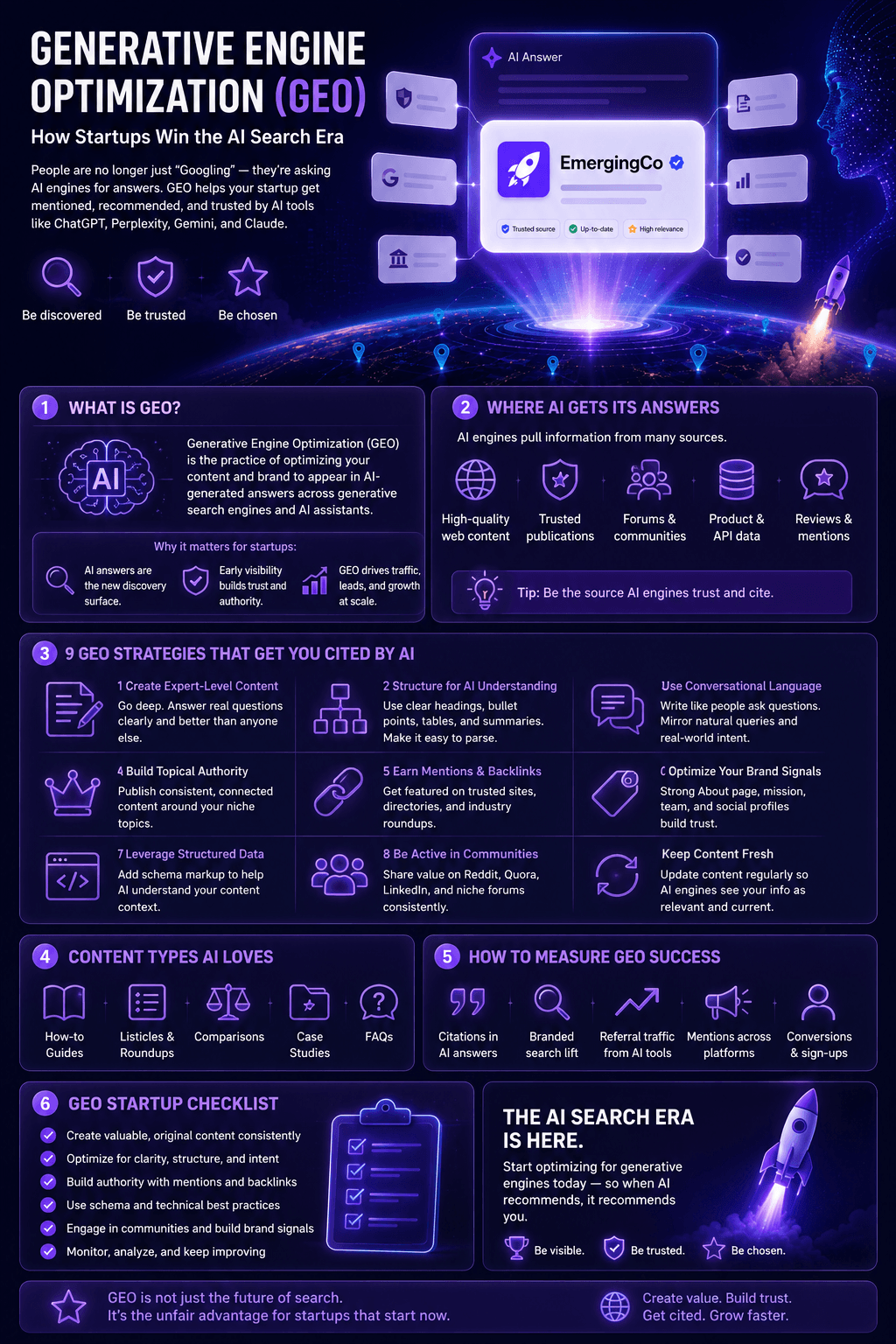
A founder asked me recently why their competitor, a company with a worse product and a smaller team, kept coming up when he typed questions about his own category into ChatGPT. His startup did not come up at all. He had assumed that ranking well on Google was the whole game. It is not, anymore, and the gap between those two outcomes is exactly what Generative Engine Optimization is built to close.
Generative Engine Optimization, or GEO, is the practice of structuring your content and digital presence so that AI systems like ChatGPT, Perplexity, Gemini, and Google’s AI Overviews cite, recommend, and summarize your company when someone asks a relevant question. This is not a marketing buzzword invented by an agency trying to sell a new service line, though plenty of agencies are doing exactly that. The term originates from a real piece of academic research: a 2023 paper from Princeton, Georgia Tech, and IIT Delhi researchers formally defined GEO and demonstrated that specific content strategies could boost visibility in generative engine responses by up to 40%, while also finding that traditional keyword stuffing produced no meaningful benefit at all in this new environment. That last finding matters more than most GEO content admits: the tactics that worked for a decade of SEO do not simply transfer over.
For startups specifically, this shift carries disproportionate weight. Large, established brands have decades of citations, mentions, and structured data already baked into the corpus these models were trained on and continue to retrieve from. A startup founded eighteen months ago is starting from close to zero in that same information ecosystem, competing against companies that AI models already “know.” Understanding how to close that gap deliberately, rather than hoping organic mentions accumulate on their own, is what separates startups that show up in AI answers from the ones that remain invisible regardless of product quality, a top AEO Agency can help you on it.
Why This Matters More for Startups Than for Established Brands
Here is the uncomfortable part of this conversation that most GEO content skips: the compounding advantage almost always favors incumbents. AI models are trained on historical data, meaning a company that has existed for ten years with thousands of mentions, reviews, and citations across the web enters this new search paradigm with a massive structural head start that no amount of clever content can fully offset in the short term. A startup competing purely on GEO tactics against an established player in the same space is not on level ground, and any strategy that implies otherwise is overselling what is actually achievable.
What GEO does offer startups is a genuinely different opportunity than traditional SEO did. Classic Google rankings rewarded domain age and backlink accumulation heavily, both of which take years to build and are nearly impossible to shortcut. AI citation behavior weighs content specificity, factual density, and structural clarity more heavily relative to raw domain authority, at least in categories that are still forming or under-covered. A startup in an emerging niche, one where established competitors have not yet published comprehensive, well-structured content, can genuinely win citation share faster than it could ever have won a competitive Google ranking. The opportunity is real. It is also narrower and more fragile than most GEO sales pitches suggest, because that advantage closes the moment larger competitors notice and respond.
The volume of AI-mediated search traffic is no longer a rounding error either. ChatGPT alone reported more than 900 million weekly active users as of February 2026, and a meaningful share of those sessions involve exactly the kind of comparative, evaluative questions where a startup could plausibly be recommended: “what’s the best tool for,” “which company handles,” “who should I use for.” Being cited in even a fraction of relevant answers at that scale represents a genuinely new acquisition channel, distinct from and additive to organic search traffic.
How GEO Actually Differs From Traditional SEO
The conflation of GEO with SEO is the single most common mistake in how startups approach this. They share some DNA, technical site health and structured data matter in both, but the underlying mechanics of what gets rewarded are meaningfully different, and treating GEO as “SEO with extra steps” produces mediocre results in both disciplines simultaneously.
| Dimension | Traditional SEO | Generative Engine Optimization |
|---|---|---|
| Primary goal | Rank in a list of links | Get cited or recommended in a generated answer |
| Core signal | Backlinks and domain authority | Factual specificity and source credibility |
| Content structure | Keyword-targeted headers | Question-answer format, extractable passages |
| Ideal content length | Comprehensive, often very long | Precise, information-dense, not padded |
| Data usage | Helpful but not required | Statistics and citations meaningfully boost visibility |
| Update frequency impact | Moderate | High, models favor freshness signals differently by engine |
| Keyword stuffing effect | Historically some benefit | Measured to produce no benefit and can reduce visibility |
| Attribution to user | Click-through to your site | Often just a citation, no guaranteed click |
That last row deserves particular honesty. GEO success does not always translate into traffic the way an SEO ranking does. Being cited by an AI engine sometimes means the user gets their answer and never visits your site at all, which is a real tension for any startup measuring success in sessions and conversions rather than brand impressions. This is not a reason to ignore GEO. It is a reason to be clear-eyed about what kind of value it actually delivers, which is closer to brand authority and consideration-stage influence than a direct replacement for click-driven organic traffic.
The Content Structures That Actually Get Cited
Based on the Princeton research and the behavior patterns that have held up since, a handful of content characteristics consistently correlate with higher citation rates in generative engines. Specific, verifiable statistics outperform vague claims by a wide margin, because models are optimizing for content that sounds authoritative and can be attributed to a concrete source. A sentence stating “conversion rates improved by 23% after implementing this change” gets cited far more reliably than “conversion rates improved significantly.”
Direct quotations and named attribution also perform well, which is part of why expert-sourced content and named-author bylines have become more valuable in an AI-search context, not less. Content structured as clear questions followed by direct, complete answers, rather than long narrative buildups before the point arrives, extracts more cleanly into a generated response. This is a meaningful departure from a lot of traditional blog writing, which often buries the actual answer several paragraphs deep for engagement or SEO dwell-time reasons. That approach actively works against GEO performance, because a model summarizing your page has to work harder to find the extractable answer, and it will often simply cite a competitor whose content made that job easier.
Comparison tables, like the one above, perform disproportionately well for exactly this reason: they present dense, structured, easily-extractable information in a format models can parse and reformat with minimal interpretation required. If your content forces an AI system to infer your point rather than state it plainly, you are making yourself easy to skip in favor of a source that did the work for the model.
Building the Technical and Entity Foundation
Before any content strategy pays off, a startup needs the underlying technical and entity signals that let AI systems understand what the company actually is, credibly and unambiguously. This starts with basics that many early-stage companies skip under time pressure: consistent, structured schema markup across the site, a clear and consistent company description used identically across your website, LinkedIn, Crunchbase, and any directory listings, and a Wikipedia or Wikidata presence if the company has reached a stage where that is realistically achievable.
Entity clarity matters more than most startups realize, because AI models are attempting to resolve “who is this company” the same way a new employee would on their first day, by triangulating across every source that mentions you. If your own site describes you one way, your LinkedIn describes you slightly differently, and a press mention from two years ago used outdated positioning, the model has conflicting signals to reconcile, and it will often default to whichever description appears most frequently or most authoritatively, which may not be the one you currently want represented. Auditing and aligning this consistency is unglamorous work, but it is foundational in a way that no amount of clever blog content compensates for if it is missing. The technical groundwork here overlaps meaningfully with disciplined link building practices built around genuine relevance and authority rather than volume, since third-party corroboration from credible sources is one of the clearest signals AI systems use to validate a claim about who you are and what you do.
What This Means for Choosing an Agency or Doing It Yourself
The market response to GEO has been predictably fast and predictably uneven. A wave of agencies have rebranded existing SEO service lines as GEO or AEO offerings without necessarily changing the underlying methodology, which makes vetting a genuine partner from a relabeled one a real challenge for founders without deep in-house expertise. When evaluating options, the distinguishing question is whether a prospective partner can show you specific, engine-level tracking of citation and recommendation frequency across multiple AI platforms, not just a general claim of “AI visibility” improvement.
The same test applies to any outside growth help a startup hires: ask which metrics the partner will own and how it will prove progress. Our guide to choosing a growth partner as a startup includes a weighted scorecard and the questions to ask before you sign.
If you are evaluating outside help, it is worth reviewing how firms are actually approaching this discipline in practice rather than taking positioning language at face value. Some agencies are approaching this from a search-first foundation and layering GEO capability onto proven SEO discipline, which tends to produce more grounded, defensible strategy than firms building GEO as a standalone service with no underlying search track record. A broader review of how different agencies are currently structuring GEO and AI-search programs for growing companies is a useful starting point for understanding the range of methodologies currently in the market, including where the meaningful differences actually lie versus where it is mostly repackaged terminology.
It is also worth noting that not every agency positioning itself around “AI is changing search” is speaking to the same audience or building the same kind of program. Local-market and home-services focused agencies have started publishing genuinely useful research on how AI Overviews and voice assistants are reshaping local discovery, and firms like Hughes Media AEO Agency, whose recent research covers how AI is reshaping search behavior more broadly, offer a useful window into how these shifts play out for consumer-facing, locally-anchored businesses specifically. That context is genuinely different from B2B SaaS positioning and citation strategy, and a startup evaluating any agency, in this space or otherwise, should confirm the firm’s actual experience matches its own business model rather than assuming AI-search expertise transfers cleanly across every category.
A Realistic Starting Framework
For a resource-constrained startup deciding where to actually put effort first, prioritization matters more than breadth. Attempting a comprehensive GEO overhaul across every channel simultaneously, with a small team, usually produces shallow execution everywhere rather than meaningful traction anywhere. A more disciplined sequence looks like this:
- Audit current AI visibility first. Before building anything, ask ChatGPT, Perplexity, and Google’s AI Overview directly about your category and see whether you appear at all, and how accurately. You cannot fix what you have not measured.
- Fix entity consistency before content volume. A confusing or contradictory identity across the web undermines every piece of content you publish afterward. This is foundational work, not a nice-to-have.
- Rewrite your highest-intent existing pages before creating new ones. Restructuring a page that already ranks reasonably well into a more citable, question-answer format is faster and lower-risk than starting from zero.
- Add genuine data and specificity wherever you can. Original statistics, named case results, and direct expert quotes consistently outperform generic claims, and this is one of the few GEO tactics with strong direct research backing.
- Track citation frequency, not just traffic. Standard analytics will not show you AI citations. This requires deliberate, periodic manual or tool-assisted checking across the major engines your customers actually use. If you go the tool-assisted route, our roundup of the best AEO tools for 2026 shows which platforms fit a startup budget, from free plans to around $100 a month.
Frequently Asked Questions
No, though the two overlap and reinforce each other. Traditional SEO optimizes for ranking in a list of search results, weighting backlinks and domain authority heavily. GEO optimizes for being cited or recommended inside an AI-generated answer, weighting factual specificity, source credibility, and content structure differently. A strong technical SEO foundation still matters for GEO, but the content and authority tactics that succeed in each discipline are not identical, and treating them as interchangeable produces weaker results in both.
In specific, narrower circumstances, yes, more realistically than it could compete for a comparable Google ranking in the same timeframe. AI citation weighs content specificity and structural clarity more heavily relative to raw domain age than traditional SEO does, which creates real opportunity in emerging or under-covered categories. That advantage is genuine but fragile: it tends to close once established competitors notice the gap and respond with their own optimized content, so it should be treated as a window worth acting on quickly rather than a permanent structural edge.
Sometimes, but less reliably than a traditional search ranking does. Many AI-generated answers fully resolve the user’s question without requiring a click through to the cited source, which means GEO success often shows up as brand visibility and consideration-stage influence rather than direct session traffic. Startups should measure GEO performance primarily through citation frequency tracking across AI platforms rather than expecting it to behave identically to organic search traffic in analytics.
Directly ask ChatGPT, Perplexity, Gemini, and Google’s AI Overview a range of questions a potential customer might realistically ask about your category, your problem space, and direct comparisons to competitors. Note whether you appear at all, how accurately you are described when you do, and which competitors get cited instead. This manual audit takes under an hour and reveals more actionable information than most paid AI-visibility tracking tools at the earliest stage of a GEO effort.
No, and this is one of the more counterintuitive, research-backed findings in this space. The original academic study on GEO specifically tested keyword stuffing as an optimization method and found it produced no meaningful improvement in AI citation rates, unlike its historical effect on traditional search rankings. Startups carrying over aggressive keyword-density habits from SEO into their GEO strategy are wasting effort on a tactic that simply does not transfer to this new environment.
Faster than traditional SEO in some respects, since AI models can incorporate freshly crawled content into responses more quickly than Google’s full ranking algorithm re-evaluates a page’s authority. That said, meaningful, consistent citation across multiple AI engines and multiple relevant queries typically takes a few months of deliberate content restructuring and entity-consistency work, not weeks. Founders should expect early, encouraging signals from an initial audit and rewrite pass, with more durable results building over a two to six month window depending on category competitiveness.
Infographic