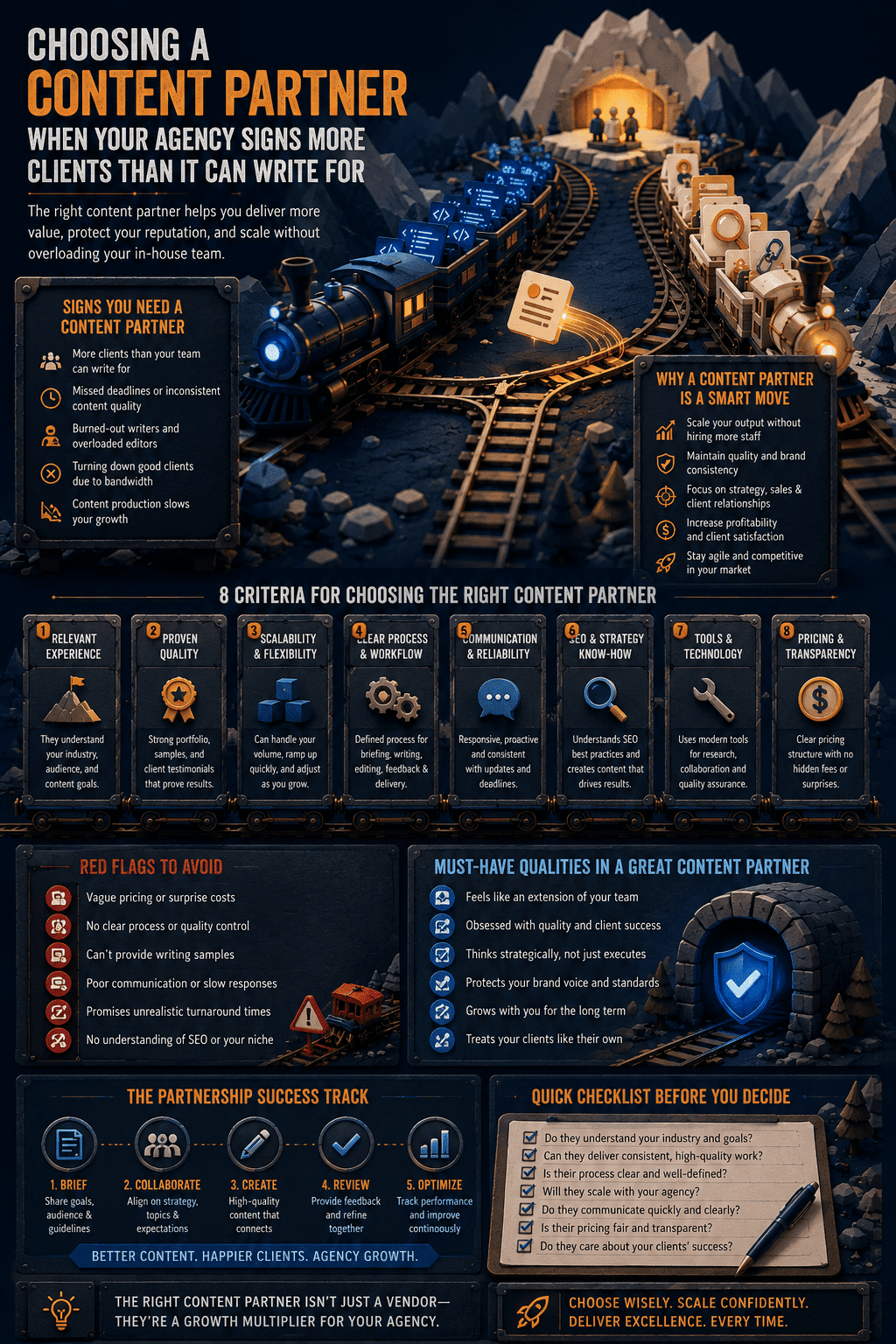
There is a specific moment in an agency’s growth where the pipeline stops being the problem. You’ve signed the clients. The retainers are healthy. And now every Monday starts with the same quiet calculation: who is actually going to write all of this.
Most agencies hit this wall between roughly eight and fifteen retained clients, depending on deliverable volume. Below that, the founder and one or two generalists absorb the load. Above it, the load absorbs them. The output that made the agency worth hiring starts arriving late, then arrives on time but thinner, and eventually a client notices before you do.
Choosing a content partner is the standard answer, and it is usually the right one. But most agencies make the decision badly, because they make it during the crunch rather than before it, and they evaluate partners on price per word instead of on the two things that actually determine whether the arrangement survives contact with a real client. This article covers the capacity math, the vetting criteria that predict success, and the situations where bringing in a partner will make your delivery worse rather than better.
Where Agency Capacity Actually Leaks
Before choosing a content partner, it’s worth identifying which kind of capacity you’ve run out of, because the two common failures need different solutions.
Leak one: specialist work routed to the wrong team. Search work lands in a developer’s sprint, or content briefs land on an account manager’s desk, and both get done slowly and badly by people who were hired for something else. This is a routing problem, and outsourcing fixes it cleanly because the work was never a fit for the team holding it.
Leak two: genuine volume overload. Your writers are writers, the briefs are good, and there is simply more work than hours. This is a throughput problem, and outsourcing fixes it only if the partner can match your quality bar. If they can’t, you’ve converted a delivery delay into a rework loop, which is worse.
Most agencies have both, and misdiagnose which one is dominant. The test is simple: if you removed all the misrouted work from your team’s plate, would the remaining volume fit in the available hours? If yes, you have a routing problem and you need a specialist. If no, you have a volume problem and you need capacity. The vetting criteria are different for each, and choosing the wrong kind of partner is the most common reason these arrangements fall apart in month three.
The routing failure is worth understanding in detail first, because it’s the one agencies most often mistake for a hiring problem.
Sprints Are Built to Ship Code, Not Rank Pages
A backlog full of tickets for title tags and internal linking is a sign something has gone wrong on a dev team, not that SEO is finally getting attention. When search optimization tasks get folded into a two-week sprint, they compete with actual product work for the same story points, the same code review queue, and the same release window. That is a losing trade for everyone involved: the site ships slower, and the SEO work still comes out half-finished because nobody on the team was hired to do it well. Agencies that have figured this out are turning to outsourced seo services to keep search work moving without ever touching the sprint board.
The friction shows up in specific, avoidable ways once you start looking for it. A developer pulls a ticket to rewrite alt text across two hundred product images, and a sprint meant for a checkout redesign turns into an afternoon of tedious markup edits instead. Product managers start treating meta descriptions like engineering debt, which they are not, and morale takes a hit because nobody on the team signed up to write ad copy for search snippets. None of this reflects poorly on the developers; it is a sign the work was routed to the wrong team from the start.
What a Meta Description Ticket Actually Costs
Every hour a senior developer spends adjusting heading tags for keyword density is an hour not spent on the thing that actually differentiates the client’s site: performance, accessibility, and the features that make the product worth using. Agencies that bill by the sprint feel this directly, because SEO tickets rarely map cleanly to a client’s approved scope, which means someone eats the cost of the extra hours.
Code review queues get backed up too, since a pull request for a content change waits behind the same approval chain as a database migration, even though the two carry completely different levels of risk. A reviewer trained to catch race conditions and null pointer exceptions is not the right person to judge whether a paragraph reads naturally to a search crawler, but they end up approving it anyway because the ticket landed in their queue. Over a quarter, this adds up to real velocity lost on work that a specialist could have finished in a fraction of the time, and it shows up on the roadmap as features that quietly slipped a sprint or two for reasons nobody wrote down.
Running SEO as a Parallel Track Instead of a Backlog Item
The fix is not to hire an in-house SEO person and give them a seat in every sprint planning meeting either, since that just moves the bottleneck instead of removing it. Search work runs on its own rhythm: content calendars, backlink outreach, and technical audits do not need to sync with a two-week release cycle, and forcing them to do so only slows both processes down.
When an outside team owns SEO as a fully separate track, developers keep their sprint capacity for the roadmap items clients actually asked for, and search progress does not stall waiting for the next available slot on the board. The two tracks can still talk to each other through a lightweight monthly sync instead of a shared backlog, which is enough coordination to keep redirects and URL structure changes from colliding without pulling either team into the other’s planning process. Agencies that have made this split report fewer emergency tickets and fewer arguments over whose job a broken canonical tag is.
The Breakeven Math: Hire or Outsource
Almost every article on this topic tells you to “weigh the costs” and then declines to do any arithmetic. Here is the arithmetic.
The comparison is not hourly rate against per-article price. It’s fully loaded cost of an in-house writer against variable cost of a partner, at a specific monthly volume. Plug your own figures into this structure:
In-house writer, fully loaded monthly cost:
| Line item | What to include |
|---|---|
| Base salary | Divided by 12 |
| Employment overhead | Payroll taxes, benefits, insurance. Typically 20% to 30% on top of salary in most markets |
| Tooling | Their seat on your SEO suite, plagiarism checker, project management, CMS |
| Management time | The hours your editor or founder spends briefing, reviewing, and unblocking |
| Ramp cost, amortized | The first 60 to 90 days at reduced output, spread over expected tenure |
| Idle capacity | The months where you have fewer deliverables than one full-time writer produces |
Partner, monthly cost:
| Line item | What to include |
|---|---|
| Per-article or per-retainer fee | The quoted number |
| Brief production time | Your team still writes the briefs. This is real and usually underestimated |
| Review and revision cycles | Budget two rounds until proven otherwise |
| Onboarding investment | Style guides, client context docs, sample approvals. Front-loaded, not recurring |
The breakeven is the monthly article volume where fully loaded in-house cost per article drops below partner cost per article. Run it and one of two things happens.
If your volume is stable and above breakeven, hiring is cheaper, and the partner conversation is really a bridge conversation: you need coverage for the three to five months between the decision and a productive new hire.
If your volume is variable, and for most agencies it is, the in-house number is worse than it looks, because you pay the full cost in the light months too. This is the case almost nobody models properly. An agency doing 20 articles in March and 6 in July is not a 13-article-per-month agency. It is an agency that will pay for 13 and use 6 half the year.
Two things this math should change about how you negotiate. First, ask for volume flexibility explicitly rather than a flat retainer, because flexibility is the entire economic advantage of a partner and you should not give it away for a small discount. Second, get brief production and revision rounds priced into the quote, not treated as free. They are the line items that turn a cheap partner into an expensive one, and the same dynamic drives margin compression on the reseller side, which is covered in more depth in this breakdown of white label SEO pricing and how agencies avoid the reseller margin trap.
A Scorecard for Choosing a Content Partner
Price is the easiest thing to compare and the worst predictor of whether the relationship works. The Content Marketing Institute’s B2B content marketing research found that when effective teams were asked what actually moved results, the top two answers were content relevance and quality at 65% and team skills and capabilities at 53%. Budget did not top the list. People and capability did. That finding should shape how you weight a vetting process.
Score each candidate partner out of 5 on these six criteria, weighted:
- Subject-matter depth (weight: 3x). Can they write credibly about your clients’ industries without you supplying every fact? Ask for two samples in a vertical you serve and one in a vertical you don’t. The second sample tells you more, because it reveals whether they can research from a cold start.
- Brief-to-draft fidelity (weight: 3x). Give a real brief, not a topic. Score how much of the draft you would have to rewrite. This single test predicts long-term cost better than anything else on the list, because rework is where outsourcing savings disappear.
- Editorial process (weight: 2x). Who edits before it reaches you? If the answer is “the writer self-edits,” you are the editor, and you should price your own hours into their quote accordingly.
- Turnaround reliability (weight: 2x). Not their quoted turnaround. Their variance. A partner who delivers in seven days consistently beats one who averages five days but occasionally takes fourteen, because you can plan around the first and not the second.
- Capacity headroom (weight: 1x). What happens when you triple your volume in a month? A partner running at full utilization cannot absorb your growth, which means you will be repeating this search in six months.
- Confidentiality and client isolation (weight: 1x). If they serve competing agencies, how is client work separated? This matters more than most agencies check.
Run the scorecard before you talk about price. Then use price to break ties between candidates that clear your quality threshold, rather than as the filter that determines which candidates you evaluate. If you want a more granular version of this, the questions every agency should ask before trusting a partner with client SEO work goes deeper on the diligence conversation itself.
When Choosing a Content Partner Is the Wrong Move
Outsourcing content is not always the answer, and the cases where it backfires are predictable enough to check against before you sign anything.
- When your briefs are the bottleneck. If your team cannot articulate what a piece needs to accomplish, a partner will produce competent writing that misses the point, and you will conclude the partner is bad. They aren’t. Your brief is. Fix brief quality first, because a partner amplifies whatever brief process you already have, good or bad.
- When the client relationship depends on the writing. Some retainers are really “our clients love how our founder writes.” That is a personal brand asset and it does not transfer. Outsourcing it quietly removes the reason the client stayed.
- When you’re outsourcing to hide a pricing problem. If your retainers are underpriced and outsourcing is the only way to make them profitable, you have a pricing problem wearing a capacity costume. Outsourcing buys you a quarter or two before the margin closes again, and you’ll have added coordination overhead in the meantime.
- When you have no way to evaluate output quality. If nobody on your team can tell a strong piece from a plausible one in your clients’ verticals, you cannot supervise a partner, and quality will drift toward whatever is cheapest to produce. This gets sharper as AI-assisted production becomes standard on the supply side. It’s worth understanding how AI SEO agencies are scored and differentiated before you evaluate anyone’s output, because the surface quality floor has risen while the ceiling has not.
The pattern connecting all four: outsourcing scales whatever system you already have. If the system is sound and the constraint is hours, a partner solves it. If the system is the constraint, a partner makes the failure faster and more expensive.
Content Partner FAQs for Agency Owners
Before the crunch, not during it. The practical trigger is when your projected deliverable volume for the next quarter exceeds your team’s capacity by more than about 20%, or when you’re turning down work you could otherwise sell. Onboarding a partner properly takes four to eight weeks including style guide work, sample approvals, and the first revision cycles. Agencies that start looking the week they’re already behind end up choosing on availability instead of fit.
Rates vary enormously by market, vertical, and depth, so any single number would mislead you. The more useful question is what the quote includes. Ask specifically whether it covers briefing, keyword research, revisions, and internal linking, or whether those are billed separately. A quote that excludes two revision rounds is not comparable to one that includes them, and comparing headline prices across partners with different inclusions is how agencies end up surprised.
Depends on which capacity problem you have. A freelancer is cheaper per article and better for specialized verticals, but has no redundancy, which means their vacation is your missed deadline. An agency partner costs more and offers coverage, throughput flexibility, and a process you don’t have to build. If your volume is spiky, the agency’s flexibility usually justifies the premium. If you need one expert in one niche consistently, a freelancer is often the better value.
Usually yes, but decide the disclosure policy deliberately rather than by default. Some clients care a great deal, particularly in regulated or highly technical industries where they expect direct access to whoever writes about their product. Getting caught concealing it damages trust far more than disclosing it would have. The safest position is that clients may ask and you will answer honestly.
One editor owns the final read regardless of who drafted. That’s the whole answer. Agencies that split review between the in-house lead and the partner’s editor produce two distinguishable voices within a quarter. The editorial bottleneck is worth keeping in-house even when production is not.
Three: a revision policy stating how many rounds are included and what triggers additional charges, an IP clause confirming your client owns the work outright, and a volume flexibility clause. Notice periods and exclusivity terms matter less than agencies think. If the relationship is working you won’t invoke them, and if it isn’t, you’ll want out regardless of what the contract says.
Plan for the first three to five pieces to require heavy revision, and treat that as onboarding cost rather than evidence of a bad hire. If piece six still needs a rewrite, the problem is real. If revision volume is dropping steadily by then, the relationship is on track. Judging a partner on their first deliverable is the most common evaluation error.
Not by itself, and asking whether they use AI is now close to meaningless since nearly the entire supply side does. The useful questions are about process: who fact-checks claims, who verifies statistics against primary sources, and who holds accountability when something inaccurate reaches a client. A partner with a documented verification step is safer than one who claims a purely human process and cannot describe how it’s enforced.
Making the Decision
Choosing a content partner is a capacity decision that most agencies mistakenly treat as a procurement decision. The quote is the least informative number in the process. What determines whether it works is whether your briefs are good enough to direct someone outside your building, whether one person owns final quality, and whether your volume is stable enough to justify hiring instead.
Run the breakeven math before the calls. Score on the six criteria before discussing price. And check the four cases where outsourcing makes delivery worse, because recognizing one of those before you sign will save you more than any rate negotiation will.
Infographic