Every year someone publishes a list of the “best SEO agencies in Australia”. Most of those lists are paid placements, and none of them know your business.
The honest answer is that the best agency is the one that fits your size, your market and your sales process. A firm that does brilliant work for a national fashion retailer may be a poor match for a two-location physio clinic in Brisbane. So instead of a ranking, here is the checklist I would use if I were spending my own money on SEO in 2026.
Start with what you actually need
Before you speak to anyone, write down three things. What does a good lead or sale look like for you? Which suburbs, states or countries do you serve? And what has your website earned from organic search over the last 12 months?
If you can’t answer the third question, set up Google Search Console and connect it to Google Analytics 4 first. Both tools are free. They take an afternoon to configure, and they give you a baseline. Without one, you can’t judge any agency’s results later.
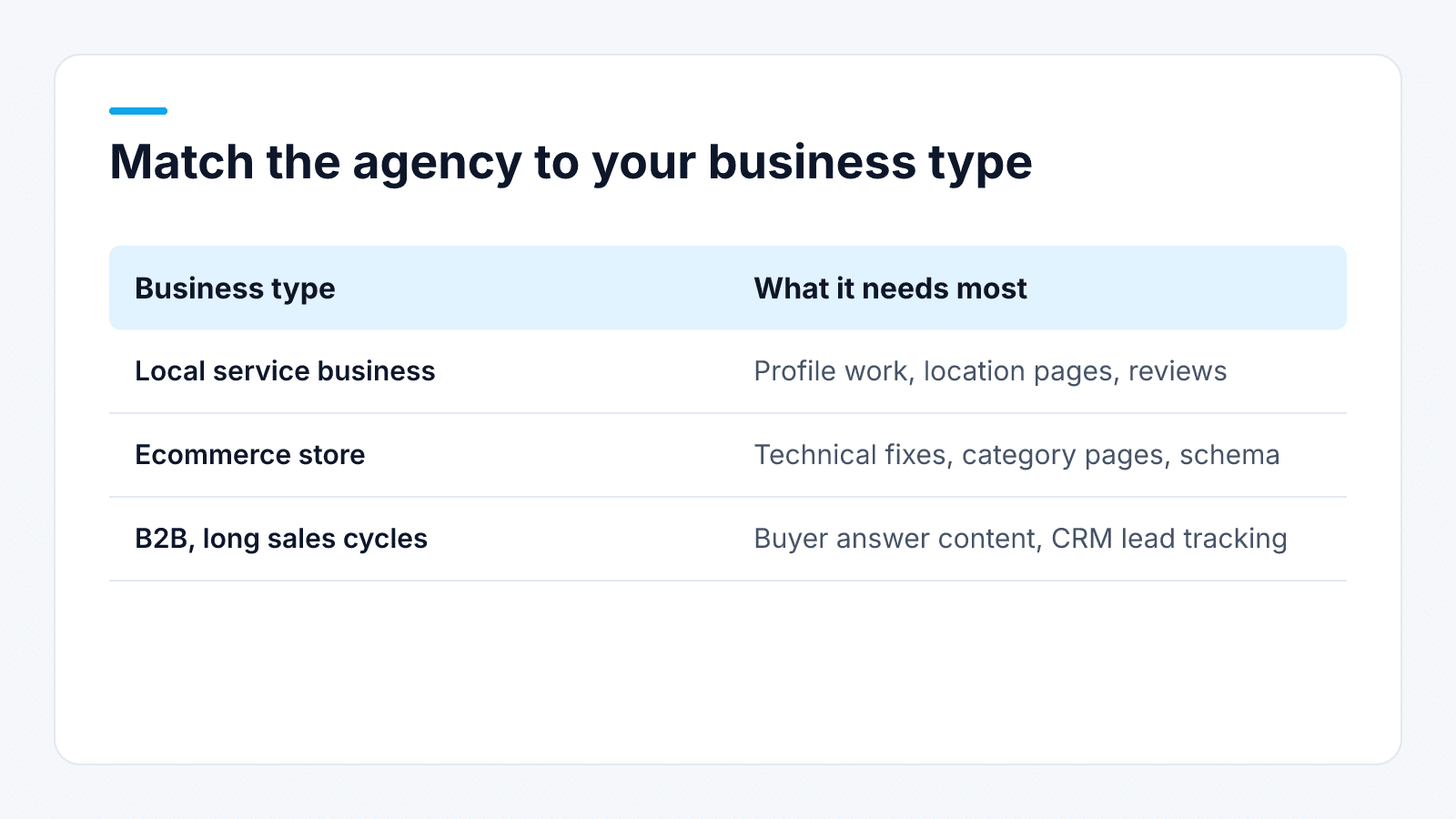
Your needs then sort themselves into rough groups. A local service business needs strong Google Business Profile work, location pages and reviews. An ecommerce store needs technical fixes, category page content and product schema. A B2B firm with long sales cycles needs content that answers buyer questions and tracking that follows a lead into the CRM. Ask each agency which of these groups they work in most. A vague “we do everything” tells you something.
Ask how they will report success
This is the question that separates good agencies from the rest.
Rankings are easy to report and easy to inflate. An agency can show you 40 keywords on page one, and most of them may bring no buyers at all. Ask instead how they will measure enquiries, calls, form fills and revenue from organic search. Ask to see a sample report with the client details removed.
A good report answers four questions in plain English. What did we do this month? What changed in traffic and conversions? Why did it change? What are we doing next? If the report is 30 pages of charts with no commentary, you will stop reading it by month three.
Google publishes its own guide on whether you need an SEO and how to hire one. It is short and worth reading before your first sales call. It covers the questions Google itself suggests you ask.
Check who does the work
Many agencies win the pitch with a senior strategist, then hand the account to a junior who started last month. That isn’t always bad. Juniors do plenty of good execution. But someone experienced should own the strategy and review the work.
Ask directly: who will be my day-to-day contact, and how many years have they worked in SEO? Who signs off the strategy? Will I speak to that person, and how often? Is any of the work outsourced offshore, and if so, which parts?
Outsourcing isn’t automatically a problem either. Hiding it is.
Before you sign with any SEO agency, ask for two or three case studies in an industry close to yours. Then ask whether you can speak to one of those clients. A confident agency will arrange it. A nervous one will change the subject.
Red flags worth walking away from
Some warning signs come up again and again in proposals. If you see any of these, slow down:
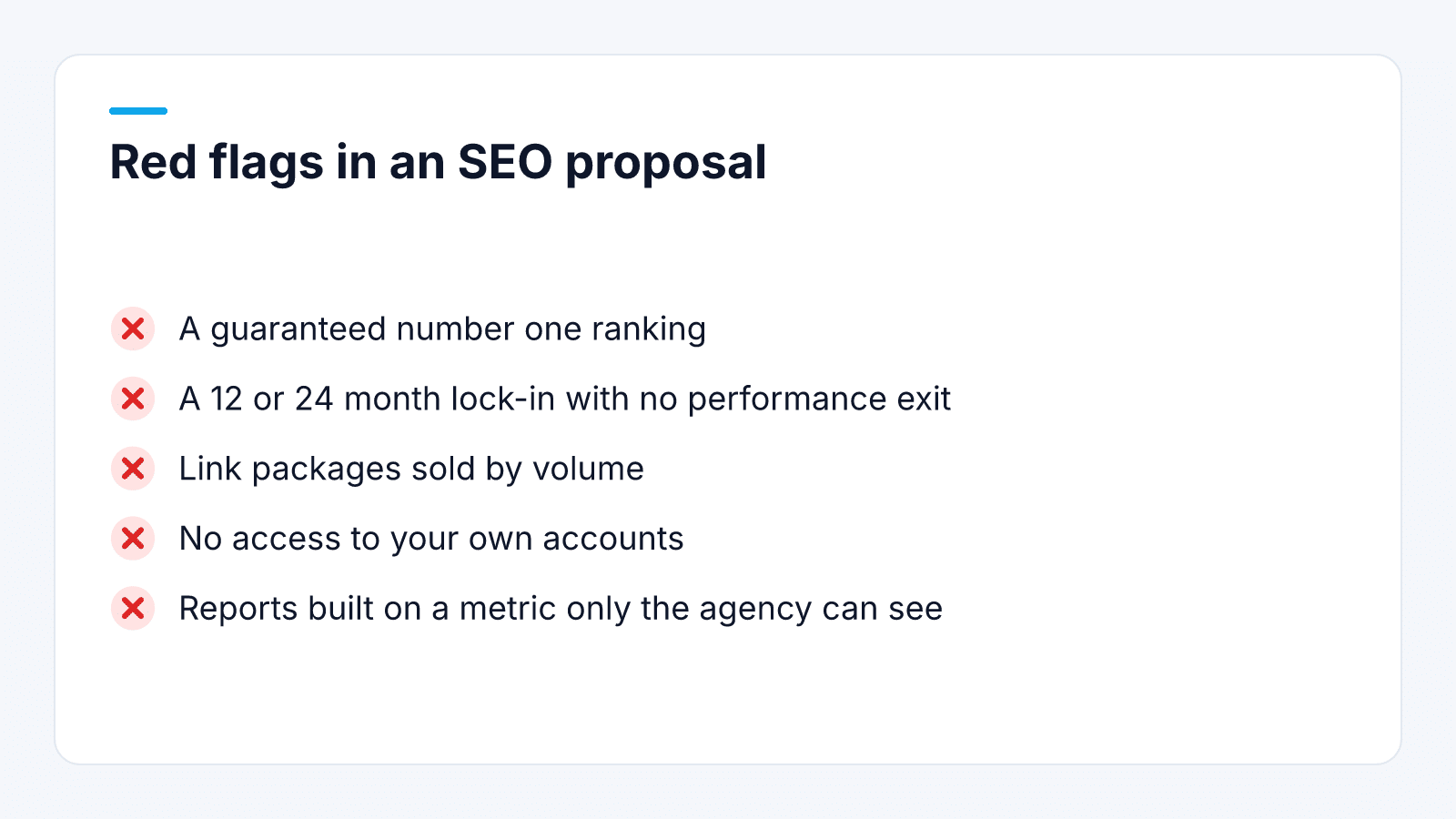
- A guaranteed number one ranking. Nobody controls Google’s results, and Google says so in its own guidance.
- A 12 or 24 month lock-in contract with no exit clause tied to performance.
- Link packages sold by volume, such as “50 backlinks a month”. Cheap bulk links often come from spam networks and can hurt you.
- No access to your own accounts. You should own your Search Console, Analytics and Business Profile logins, full stop.
- Reports built on a metric only the agency can see, such as a private “visibility score” with no link to sales.
A reasonable minimum term for SEO is around three to six months, because changes take time to show. Beyond that, a month-to-month arrangement keeps both sides honest.
What a fair price looks like
SEO pricing in Australia varies widely, and the cheapest quote is rarely the best value. A small local business might pay in the low thousands per month. A larger ecommerce site or multi-location brand will pay considerably more, because the technical and content work scales with the size of the site.
Rather than comparing price alone, compare what you get for it. How many hours of senior time? How many pages of new or improved content per month? Does the fee include technical fixes, or does the agency bill your developer for those separately? Ask for a written scope. Two quotes at the same price can hide a big difference in actual work.
Then do the maths backwards. If one new client is worth $3,000 to you, and the agency charges $2,000 a month, you need roughly one extra client every six weeks to break even. That gives you a clear, fair target to discuss.
What has changed for 2026
Search looks different now. Google shows AI Overviews on many queries, and more of your customers ask ChatGPT, Gemini or Perplexity for recommendations before they ever click a link.
That doesn’t make SEO obsolete. These tools still draw heavily on well-structured, trustworthy websites. But it does change what good work looks like. Ask any agency how they approach visibility in AI answers. Listen for practical steps: clear answers to common questions on your pages, accurate structured data, consistent business details across directories, and genuine mentions on reputable sites. Be wary of anyone selling a secret trick for “ranking in ChatGPT”. There isn’t one.
Run a 90 day test before you commit long term
Once you have a shortlist of two or three agencies, pick the one with the clearest plan and agree on a 90 day checkpoint. Put it in writing. By day 90 you should see completed technical fixes, published content, an updated Business Profile if you are local, and early movement in impressions inside Search Console. You may not see big revenue jumps yet. You should see evidence that the work is happening and heading in the right direction.
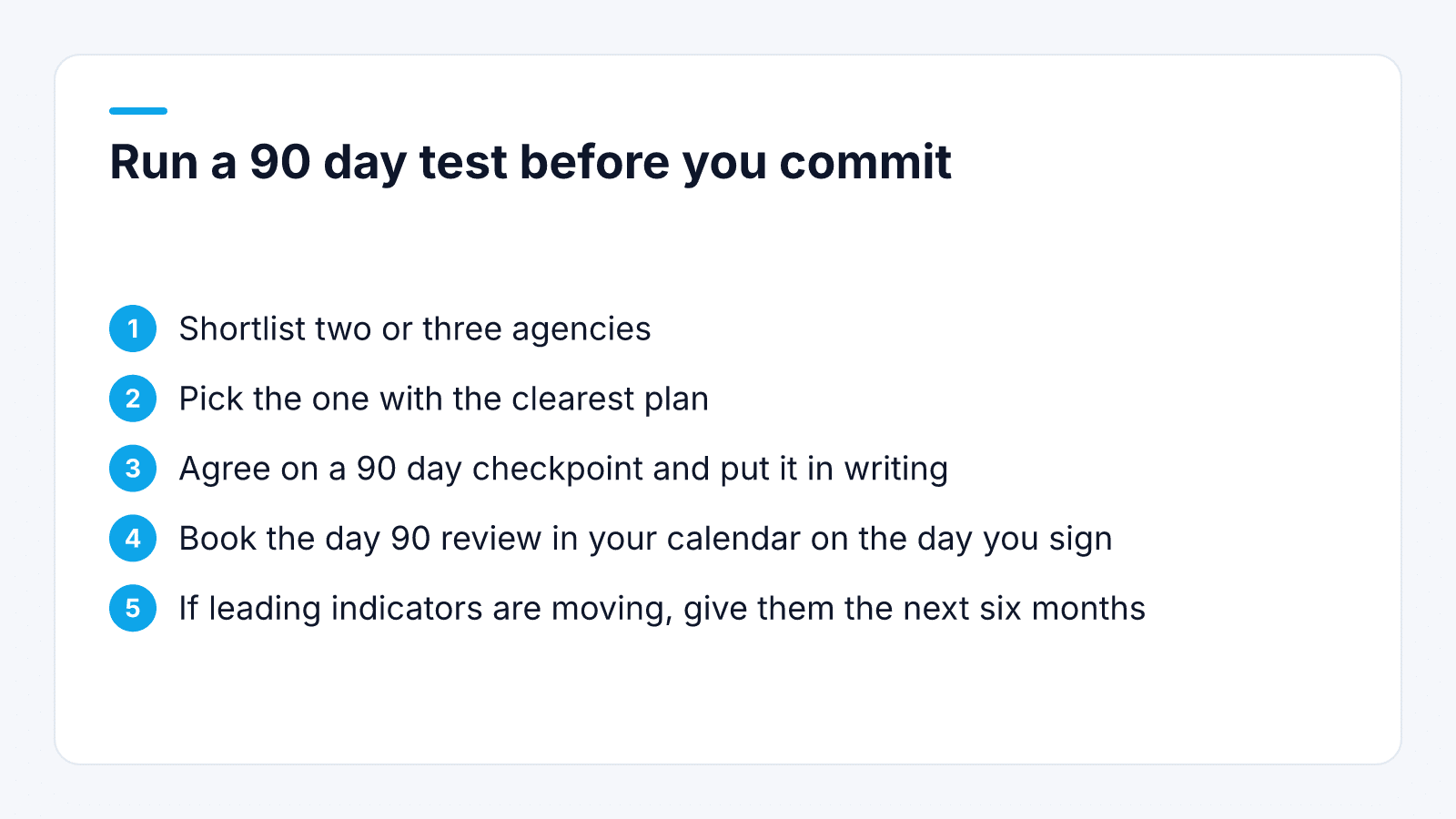
If the checkpoint arrives and the agency can’t show you what they did and why, you have your answer. If they can, and the leading indicators are moving, give them the next six months to turn that movement into enquiries. Book the day 90 review in your calendar on the day you sign, so it actually happens.