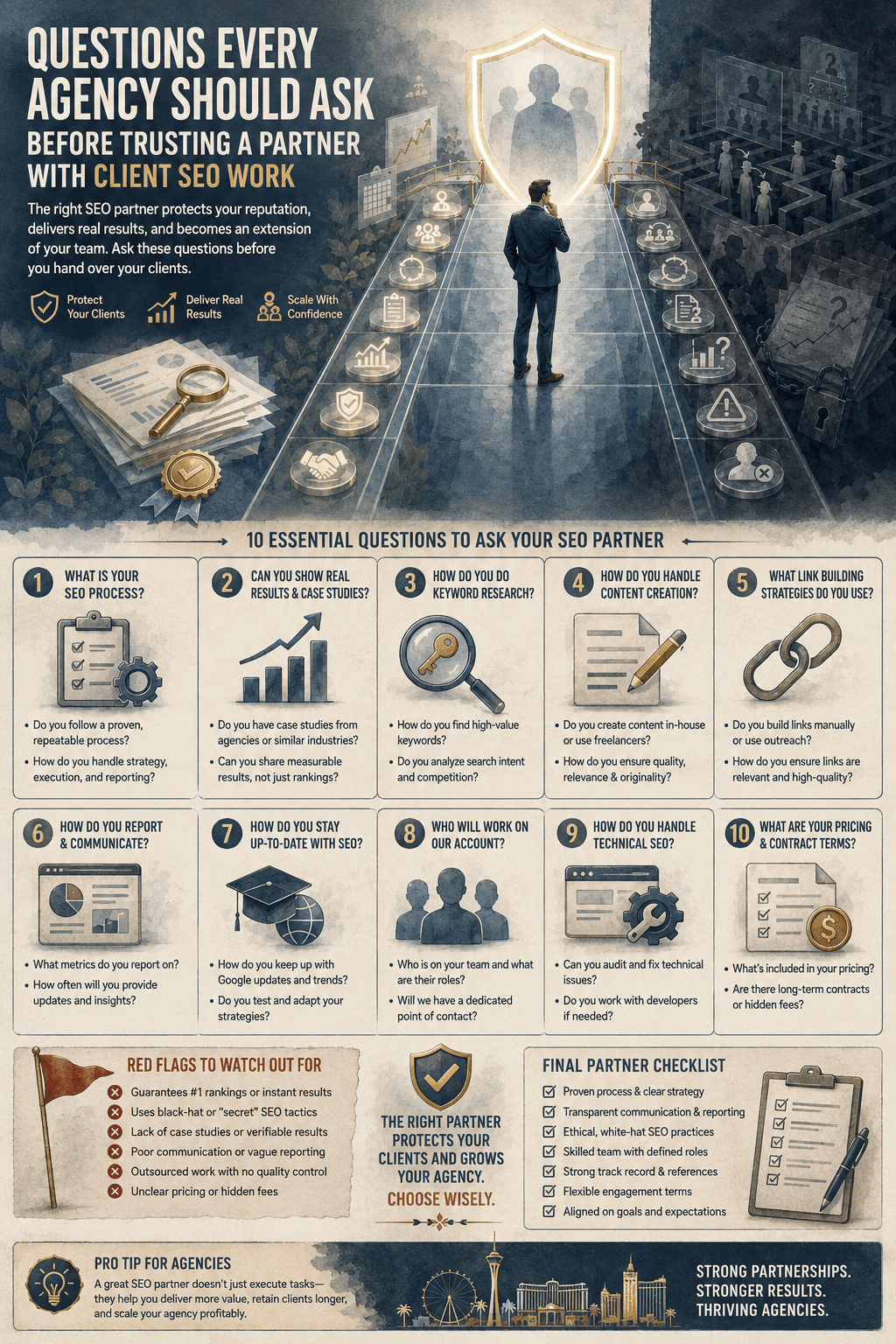
Handing a client’s SEO to an outside partner is one of the few agency decisions where the downside stays invisible until it’s expensive. The invoices look normal, the reports arrive on time, and then a client calls in month six asking why nothing moved, and you have no answer because you never found out who was actually doing the work.
What follows is the practical version: eleven questions to ask any white label SEO partner before you sign, what a real answer to each one sounds like next to a rehearsed one, and the five clauses worth putting in the contract rather than trusting to the conversation.
The Vetting Most Agencies Skip Before Hiring an SEO Partner
Most agencies vet an SEO partner the way they vet a new coffee vendor: check the price, glance at a few case studies, sign the contract. That approach works fine for coffee. It falls apart the moment you’re handing someone else’s client relationship to a subcontractor, because the questions that actually protect you never show up in a sales deck. Before signing with any white label seo agency, an agency owner should interrogate exactly who touches the account, what happens when a campaign underperforms, and whether the partner is quietly farming the work out to a third layer nobody agreed to.
Skip that interrogation, and you’re not outsourcing execution; you’re outsourcing risk you can’t see until a client calls asking why their rankings dropped, and you have no answer. The partner selection process deserves the same scrutiny an agency would apply to hiring a senior employee, not less.
The 11 Questions, and What a Real Answer Sounds Like
Print this. Take it into the call. The value isn’t in asking the questions, since most partners expect them. It’s in knowing the difference between an answer and a deflection.
Account ownership
| Ask | A real answer | A deflection |
|---|---|---|
| Who specifically is assigned to this account? | A name, a role, and how long they’ve been on similar accounts | “You’ll have a dedicated team” |
| Does that person change without notice? | A stated policy, usually notification before reassignment | “We manage that internally” |
| What happens if they leave? | A handover process they can describe in steps | “We have redundancy” |
| Do you subcontract any part of this to a third party? | A direct yes or no, and if yes, to whom and for which deliverables | Anything that isn’t yes or no |
That fourth question is the one most agencies never ask and most regret not asking. Ask it as a closed question and listen for hedging.
Reporting and bad news
| Ask | A real answer | A deflection |
|---|---|---|
| Can I see a real client report from month three of an existing engagement? | A redacted actual report | A template from the sales deck |
| Who explains the numbers to me before I explain them to my client? | A named person and a stated lead time before client delivery | “Reports go out on the first” |
| Walk me through the last time a campaign underperformed | A specific account, what happened, what they did | “That hasn’t really come up” |
| What’s the escalation path when something goes wrong? | Named contact, response window, who has authority to change the plan | “Just email your account manager” |
The third one is the highest-signal question in this entire list. A partner who cannot describe a bad month either hasn’t had one, which means they’re new, or won’t discuss one, which is worse.
Commercial terms
| Ask | A real answer | A deflection |
|---|---|---|
| What costs extra beyond the base rate? | A specific list: strategy revisions, extra reporting, additional keywords | “Everything’s included” |
| Does a slow month trigger a strategy conversation or an invoice? | A described trigger and what happens next | Reassurance without a mechanism |
| Will you commit to response times for underperformance in writing? | Yes, with numbers | A reason why that isn’t standard |
That last question is the single best filter on this list, because it’s the one most partners will refuse. The refusal itself is the information. A partner who won’t commit to a response window when results dip is telling you what month six looks like.
Ownership is the first question, and most agencies never ask it
Ask directly who is assigned to the account and whether that person changes without notice. Most complaints agencies have about white label partners start right here, with nobody asking this question up front. A lot of white label operations run on a churn model where junior staff rotates through accounts every few months, and the agency reselling the work only finds out when quality dips and nobody can explain why.
A serious partner should be able to name the specific person or small team handling deliverables and describe what happens if that person leaves. If the answer is vague, or if the sales rep can’t get a straight answer from operations, that’s the tell. The agencies that get burned didn’t ask too many questions up front. They assumed continuity was a given, and they were wrong.
Reporting cadence tells you more than the case study wall
Ownership is only the first filter. The second one shows up in how a partner handles bad news, not good news, and most agencies never think to check it until it’s too late. Every SEO reseller has a slide of impressive before-and-after rankings. Fewer of them can describe, without hedging, exactly what a client-facing report looks like in month three when a Google algorithm update wipes out three positions on a target keyword. Ask to see an actual sample report, not a template pulled from marketing collateral.
Ask how often it’s delivered, who explains the numbers to the agency before the agency has to explain them to the client, and what the escalation path looks like when something goes sideways. An agency that has never had a bad month with a partner either hasn’t been in the relationship long enough to hit one, or is being handed sanitized numbers instead of real ones.
The pricing question nobody asks correctly
Price is the layer agencies think they already understand, and it’s usually the one they get wrong. Agencies almost always ask “how much” and almost never ask “what’s included when things break.” Cheap becomes expensive fast if a partner charges extra for a strategy revision after a ranking drop, or treats a missed deadline as a footnote rather than a service failure. The base rate is the wrong question to fixate on.
The right one is what happens outside the happy path: does a slow month trigger a real conversation, or does the agency get a boilerplate reassurance and the same invoice. Contracts that spell out response times for underperformance are rare, and rare for a reason, because most partners would rather not commit to one in writing.
The Five Clauses Worth Requiring
Vetting conversations are only as durable as what survives into the contract. Five things are worth insisting on, and the negotiation over them tells you as much as the answers did.
- Named accountability. A specific person responsible for the account, with a notification obligation before reassignment. Not a team, a person.
- Underperformance response. A defined trigger, such as an agreed metric moving against target for two consecutive reporting periods, and a committed window for a documented strategy conversation. Numbers, not intentions.
- Subcontracting disclosure. Written confirmation of whether any deliverable is executed by a third party, and a requirement to notify you before that changes. This protects you from discovering a third layer during a client escalation.
- Data and access ownership. Confirmation that your client owns their analytics properties, Search Console access, content, and backlink data outright, and that access transfers cleanly if the relationship ends. This one is skipped constantly and is genuinely painful to unwind after the fact.
- Exit and transition terms. Notice period, what gets handed over, in what format, and by when. Agencies negotiate hard on entry terms and sign whatever the exit clause says, which is backwards.
Two of these will be pushed back on. That’s expected. What matters is whether the pushback comes with a reason or with a change of subject. The economics behind the resistance are usually margin-driven rather than operational, which is worth understanding before you negotiate: see how white label SEO pricing structures create the reseller margin trap.
What actually protects the agency’s name
None of this is about distrust for its own sake. It’s about recognizing that when a client’s SEO underperforms, the agency’s name is on the invoice, not the subcontractor’s. The partner did the keyword research, but the agency answers the phone when the client asks why nothing changed.
That asymmetry is exactly why the vetting questions matter more here than in almost any other outsourcing decision an agency makes. An agency that treats partner selection as a five-minute pricing comparison is gambling with a relationship it spent years building. The ones that check ownership, transparency, and how a partner behaves when results dip tend to keep clients for years instead of quarters.
The data supports the asymmetry. Focus Digital’s 2026 agency churn research found that delivery dissatisfaction is now the top reason clients leave, cited by 48% of departing clients, up fourteen points year over year, and that SEO carries a 38% annual churn rate driven largely by expectation mismatches around gradual results.
Read those two numbers together and the vetting conversation stops looking like paperwork. Delivery is the thing clients leave over, and delivery is the thing you just handed to someone else. Every question in the list above is really one question asked four ways: when this goes badly, who tells me, how fast, and what do they do about it. How a partner talks about their work in a good month tells you almost nothing, which is why the way agencies frame SEO delivery matters more than the case study wall.
Vetting a White Label SEO Partner: Common Questions
Ask them to walk you through the last time a campaign underperformed: which account, what happened, and what they changed. It works because it cannot be answered from a script. A partner with real operating history has a specific story. One without either hasn’t been running accounts long enough or is unwilling to discuss failure, and both are things you want to know before signing rather than in month six.
Ask directly, as a closed question, and get the answer in writing. Then verify indirectly: ask for the name of the person doing the work, ask a technical follow-up that only someone executing the work could answer, and watch whether responses route through a single account manager who cannot answer without checking. Subcontracting isn’t automatically a problem, but discovering it during a client escalation is.
Ranking guarantees are a warning sign rather than a feature, since no partner controls Google’s ranking systems. What is reasonable to require is process commitments: response times when metrics move against target, delivery windows, reporting cadence, and escalation contacts. Guarantee the process, not the outcome. A partner offering the reverse is telling you something about how they sell.
Monthly reporting is standard, but cadence matters less than sequencing. The important detail is whether you receive and understand the numbers before your client does, with enough lead time to prepare. A partner who delivers reports to you the same day you’re expected to present them has made your client conversation their scheduling convenience.
It depends on whether your constraint is capacity or capability. If you have the expertise but not the hours, a partner extends throughput. If you lack the expertise, you also lack the ability to evaluate the partner’s output, which is the situation where these relationships most reliably fail. The prior question of whether to outsource at all is covered in more depth in this look at choosing a partner when your agency signs more clients than it can deliver for.
Four: an inability to name who does the work, sample reports that are templates rather than real redacted client documents, refusal to commit any response times to writing, and any guarantee involving specific rankings. Any one warrants a follow-up. Two or more in the same conversation is a pattern.
Run one full reporting cycle on a lower-risk account before placing a significant client with them, and treat the first report as the real test. Not the quality of the work, which takes months to assess, but the quality of the communication around it: did it arrive on time, did someone walk you through it, and could they answer a hard question without checking.
Before You Sign
The eleven questions above take twenty minutes to ask and will tell you more than any case study wall. Not because partners lie, but because the difference between a good answer and a rehearsed one is audible the moment you ask something a script doesn’t cover.
Ask who owns the account. Ask what happened the last time things went badly. Ask what they’ll commit to in writing when results dip. Then look at which of those three produced hesitation, because that’s the one that will matter in month six.
Infographic