What AI visibility platforms do, and what changed in 2026
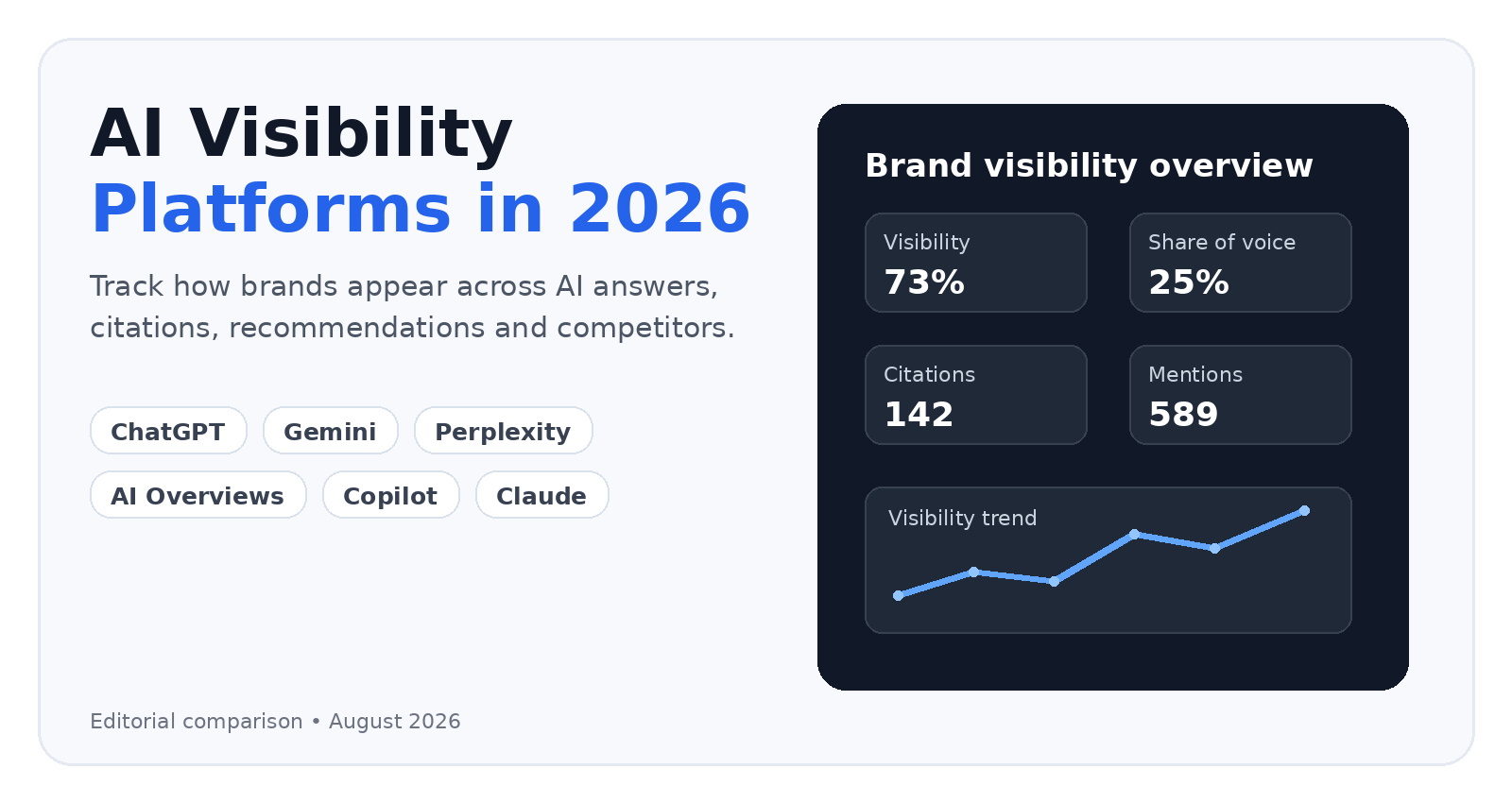
AI visibility platforms track whether your brand appears when someone asks ChatGPT, Gemini, Perplexity, Microsoft Copilot or Google AI Mode for a recommendation. They run a fixed set of prompts against those answer engines on a schedule, record every mention and every cited source, and compare your share of voice against competitors over time. Sold as AEO tools or GEO tools depending on the vendor, they exist to answer one question that rank tracking cannot: when an assistant builds a shortlist in your category, are you on it?
That question now carries real revenue. A brand can hold page-one rankings for every commercial keyword it targets and still be missing from the three-vendor shortlist an assistant hands a buyer, because the buyer never reaches the results page where those rankings live. Search visibility used to end at ten blue links. The decision increasingly happens before anyone sees them.
Two things changed in 2026 that most comparison articles have not caught up with. Google completed the worldwide rollout of its Search Generative AI performance reports on August 31, 2026, and Microsoft has reported Copilot citations inside Bing Webmaster Tools since February. Between them, two of the three engine families that matter most now hand site owners first-party visibility data at no cost, which changes what you are actually paying a vendor for.
The second change is that the category has split into three shapes: dedicated AI search trackers, AI-crawler and agent-experience platforms, and established SEO suites that bolted a prompt tracker onto an existing product. Buying the wrong shape is the most common and most expensive mistake in this market right now. This comparison covers ten of the strongest AI visibility platforms available in 2026, what each is genuinely best at, what it costs at realistic prompt volumes, and where each one falls down. It starts with the free baseline you should establish before you spend anything.
Table of contents
- What AI visibility platforms do, and what changed in 2026
- Before you pay: the AI visibility data you already have for free
- How we evaluated these AI visibility platforms
- Top 10 AI visibility platforms at a glance
- Scorecard: how the ten platforms compare
- The 10 best AI visibility platforms in 2026
- What AI visibility tools cannot tell you
- How to choose the right AI visibility platform
- A 30-day AI visibility measurement plan
- Frequently Asked Questions About AI Visibility Platforms
- Final verdict
Before you pay: the AI visibility data you already have for free
Most comparison articles in this category go straight to the pricing table. That is a mistake, because two of the three engines that matter most now report AI visibility data directly to site owners at no cost, and that data is first-party rather than sampled.
Google Search Console. Google launched dedicated Search Generative AI performance reports on June 3, 2026 and completed the worldwide rollout on August 31, 2026, so every verified property now has them. Under Performance you get a separate view of impressions from AI Overviews and AI Mode, broken down by page, country, device and date, with generative features in Discover reported separately. The gap matters: there are still no clicks, no CTR and no query data, so you can see that a page was pulled into an AI answer but not what triggered it or whether anyone clicked through. Google’s own guide to optimizing for generative AI features is worth reading before you buy anything, because it states plainly that AEO and GEO are not separate disciplines needing special schema, content chunking or llms.txt files.
Bing Webmaster Tools. Microsoft got there first, launching its AI Performance report in February 2026 and expanding it in June with intent labels, topic groupings, citation share and period-over-period comparison. It reports two things no paid tool can replicate, because they come from inside the system: grounding queries, which are the internal search phrases Copilot generates when it needs to retrieve web content, and citation counts per page. If you want to know which of your pages Copilot actually uses to build answers, this is the source, not an estimate.
GA4 and your server logs. Referral traffic from chatgpt.com, perplexity.ai, gemini.google.com and copilot.microsoft.com is already in your analytics and can be segmented into its own channel group in about ten minutes. Your access logs will show which AI crawlers hit which URLs and how often, which is the cheapest early warning that a section of your site is not being retrieved at all.
For a concrete sense of scale, here is what we see across our own properties. In the last 28 days the Search Console generative AI report shows [X IMPRESSIONS] from AI Overviews and AI Mode across [N URLS], while Bing Webmaster Tools reports [Y COPILOT CITATIONS] over the same window. [ONE SENTENCE ON WHAT SURPRISED YOU: for example, whether the pages Copilot cites most are the same pages Google surfaces most, or whether the two engines favor completely different sections of the site.] That is the practical argument for tracking more than one engine, and it is visible before you spend anything on a platform.
What none of this covers is ChatGPT, Perplexity, Claude and Gemini, none of which publish anything to publishers. That blind spot is the real product every platform below is selling. Establish the free baseline first, then buy a tool to fill the gap you have measured rather than the gap a vendor described to you. If you are running this on WordPress, our WordPress GEO guide covers the technical setup that makes the resulting data worth acting on.
How we evaluated these AI visibility platforms
Rankings in this category are easy to fake and hard to verify, so here is exactly what this one is and is not.
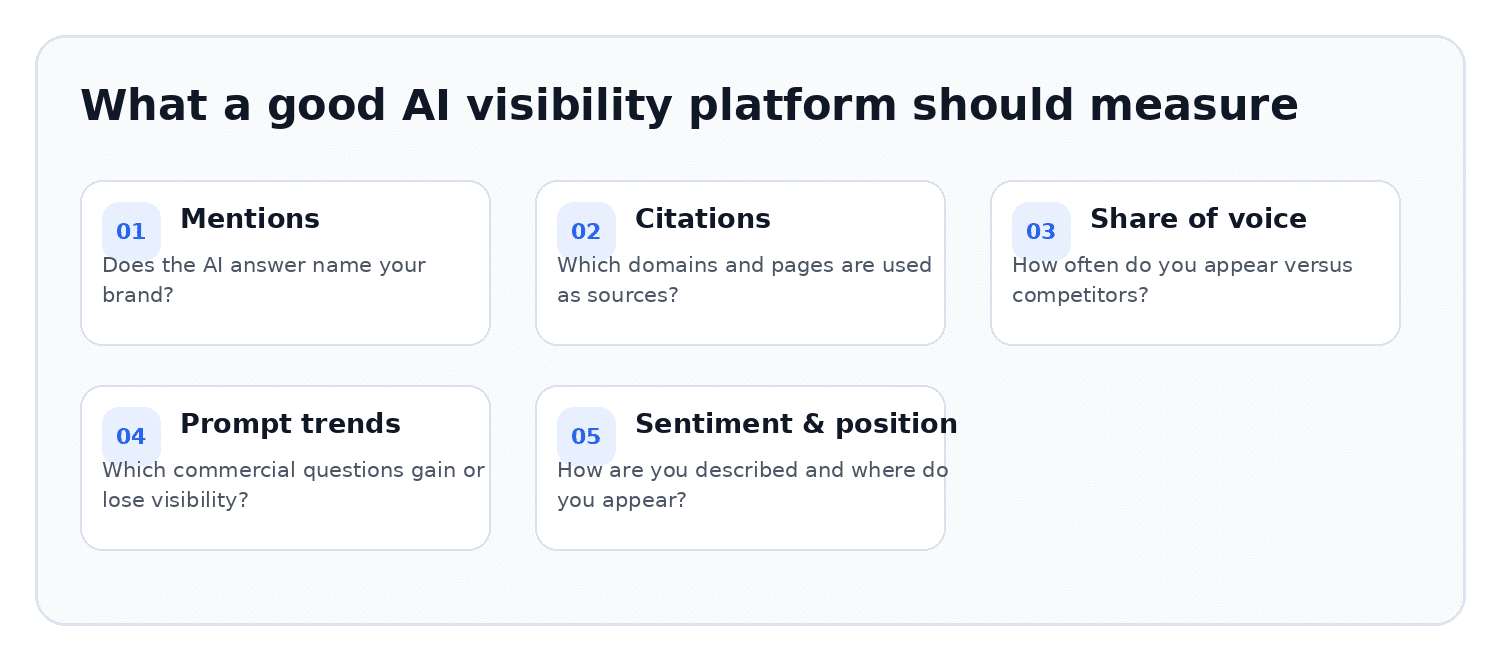
Each platform was scored 1 to 5 on six criteria: engine coverage (how many answer engines are tracked, and on which plan), citation depth (whether you get source URLs and domains or only a mention count), competitive data (share of voice, competitor prompts, position), refresh frequency, actionability (whether the tool tells you what to change), and cost per tracked prompt at realistic volumes rather than at the headline plan price. The scores are published in full below, and the ranking follows them.
Pricing, plan limits and engine coverage were verified against each vendor’s public pricing and documentation pages in August 2026. Where a vendor publishes in a currency other than US dollars, the original currency is shown rather than a converted figure, because conversion hides annual-billing and tax differences.
What this list does not claim: it is not a controlled test in which one prompt set was run through all ten platforms over the same period and the outputs compared. Nobody publishing a best AI visibility tools list has done that at the time of writing, and any article implying otherwise without showing its prompt set and raw responses is worth reading skeptically. These are editorial judgments on published capability, not results from a head-to-head trial. Treat this as a structured buyer’s shortlist, then run your own two-week trial on the two or three products that fit your stack.
None of what follows replaces the free reports above. Every platform in this comparison exists to cover the engines that report nothing to publishers, and the right question when reading the table is not which is best but which one covers the gap you just measured.
Top 10 AI visibility platforms at a glance
| Rank | Platform | Best for | Public entry point* |
|---|---|---|---|
| 1 | Profound | Enterprise AEO intelligence | From $99/mo billed annually |
| 2 | Peec AI | Clean AI search analytics | Paid; usage based on prompts/models |
| 3 | AirPulse | Track the questions your buyers ask | From $80/mo billed annually |
| 4 | Scrunch | AI visibility plus agent experience | From $250/mo billed annually |
| 5 | Llumo | Flexible pricing and unlimited prompts | Free BYOK; managed usage from $29/mo |
| 6 | Ahrefs Brand Radar | Large-scale AI visibility research | Custom prompts from £40/mo |
| 7 | OtterlyAI | Accessible daily monitoring | From $29/mo |
| 8 | SE Ranking AI Search Toolkit | Agency SEO and AI reporting | Free trial; paid plans/add-on |
| 9 | Semrush AI Visibility Toolkit | SEO teams already using Semrush | From $99/mo per domain |
| 10 | Writesonic | SEO and GEO in one workflow | From $79/mo billed annually |
| 11 | AIClicks | Prompt tracking plus AI content workflows | From $59/mo |
*Public pricing shown where clearly published and comparable as of August 28, 2026. Annual billing terms, add-ons, included engines and usage limits vary by vendor. Ahrefs prices are shown in GBP as published; convert at current rates when comparing against the USD entries.
Scorecard: how the ten platforms compare
Each platform is scored 1 to 5 on the six criteria described above, based on public product documentation and pricing as of August 2026. These are editorial judgments on published capability, not results from a controlled head-to-head test.
| Platform | Engines | Citations | Competitive | Refresh | Actionability | Cost at volume | Total /30 |
|---|---|---|---|---|---|---|---|
| Profound | 4 | 5 | 5 | 5 | 5 | 2 | 26 |
| Peec AI | 4 | 5 | 4 | 5 | 3 | 3 | 24 |
| AirPulse | 5 | 4 | 3 | 4 | 4 | 3 | 24 |
| Scrunch | 5 | 4 | 4 | 4 | 5 | 2 | 24 |
| Llumo | 5 | 4 | 4 | 4 | 2 | 5 | 24 |
| Ahrefs Brand Radar | 3 | 4 | 5 | 3 | 3 | 5 | 23 |
| OtterlyAI | 3 | 4 | 3 | 5 | 3 | 4 | 22 |
| SE Ranking | 4 | 4 | 4 | 3 | 3 | 4 | 22 |
| Semrush AI Visibility | 3 | 3 | 4 | 5 | 4 | 2 | 21 |
| Writesonic | 3 | 3 | 3 | 4 | 5 | 3 | 21 |
| AIClicks | 4 | 3 | 3 | 4 | 4 | 3 | 21 |
Three platforms tie at 24. Ties break on track record, which is why Peec and Scrunch sit above Llumo despite identical totals: their scores reflect capability that has been observable for longer than a fortnight. Note also that no platform scores well on both actionability and cost at volume. That trade-off is the real shape of this market, and it is the decision most buyers are actually making without realizing it.
The 10 best AI visibility platforms in 2026
1. Profound
Best for: Enterprise brands that want a deep, full-stack AEO platform
Profound is one of the most mature dedicated AEO platforms and is particularly strong for larger organizations. Its Answer Engine Insights product tracks visibility scores, share of voice, sentiment, citations and competitive performance, while additional products cover prompt demand, AI crawler activity and automated content workflows.
The platform’s newer dashboard and reporting features make it well suited to teams that need repeatable stakeholder reporting. Profound also goes beyond simple prompt tracking with Prompt Volumes, Agent Analytics and Agents, creating a broader operating layer for AI search rather than a single monitoring dashboard. That breadth is why it takes the top position here: it is the only product on this list that scores 5 on citation depth, competitive data, refresh and actionability at once.
The trade-off is cost and plan segmentation, and it is the reason Profound scores lowest of all ten on cost at volume. The Starter plan focuses on ChatGPT, while broader engine coverage sits on higher tiers. For enterprises that need governance, deeper analytics and workflow automation, that premium is usually justified. Smaller teams will find lighter tools easier to adopt and considerably cheaper to run.
Key strengths: Enterprise-grade AEO analytics • Strong reporting and dashboards • Prompt demand data • AI crawler analytics • Content and automation workflows
Pricing note: Starter is publicly listed from $99/month billed yearly; Growth is $399/month billed yearly; Enterprise is custom. Verified August 28, 2026.
2. Peec AI
Best for: Marketing teams that want a focused, easy-to-read AI search analytics product
Peec AI has built a strong reputation around a clean interface and a straightforward set of AI visibility metrics. Teams can track visibility, position and sentiment, then drill into prompts and sources to see why competitors are appearing and which domains are being cited.
Its public product information highlights daily prompt execution, source visibility, country and model filtering, Looker Studio connectivity, API access and MCP on appropriate plans. That makes Peec a good fit for data-driven SEO and content teams that want AI search analytics without the complexity of a broader enterprise suite. Its citation depth score matches Profound’s, which is unusual at this price point.
Where it gives ground is actionability. Peec tells you what is happening with more clarity than almost anything else here, but it leaves the question of what to do about it to you. Model selection and prompt allowances also vary by tier, so compare the number of prompts, projects and AI engines you actually need rather than looking only at the headline plan.
Key strengths: Clean dashboards • Visibility, position and sentiment • Source and citation analysis • Daily tracking • Looker Studio, API and MCP options
Pricing note: Paid plans are structured around prompt volume, projects and model selection; check the current pricing page for live plan prices. Verified August 28, 2026.
3. AirPulse
Best for: Teams that want to move beyond prompt tracking and actually measure → fix → re-audit how answer engines describe their brand.
AirPulse is built around the actionability gap this category still has. While tools like Profound, Peec, Scrunch, and Otterly focus on monitoring answer engines, citations, visibility, and recommendations, AirPulse closes the loop: it measures how ChatGPT, Claude, Perplexity, Gemini, and Copilot describe a brand, helps ship the fixes, and then re-audits the live site to verify what changed.
That makes AirPulse less of a replacement for a deep enterprise AEO suite or BYOK prompt tracker, and more of an execution layer for teams that already know monitoring alone is not enough. If the primary need is share of voice, large-scale citation research, or category-wide indexing, tools such as Ahrefs Brand Radar or Profound are better suited. AirPulse’s product bet is different: turning answer-engine findings into changes on the live site, then measuring whether those changes actually worked.
Key strengths: Closed-loop measure → fix → re-audit workflow • Coverage across ChatGPT, Claude, Perplexity, Gemini, and Copilot • Answer fixes shipped to the live site and re-audited • Built around actionability rather than monitoring alone • Backed by parent company Airmeet
Pricing note: 14-day free trial, no card required; no free plan. You can start a free trial at airpulse.ai
4. Scrunch
Best for: Brands that want AI visibility monitoring plus technical optimization for AI agents
Scrunch combines AI search monitoring with a broader Agent Experience Platform approach. Alongside prompt monitoring, citations and competitor visibility, it focuses on how AI agents access and interpret a website, including bot traffic and content delivery for AI crawlers.
Its public documentation lists support for nine major AI platforms, including ChatGPT, Perplexity, Google AI Overviews, Google AI Mode, Gemini, Claude, Microsoft Copilot, Grok and Meta AI. That is the joint-widest coverage in this comparison. Scrunch is the right pick for teams that see AI search as both a marketing measurement problem and a technical website-experience problem, and it is the only platform here that treats the second half seriously.
It is positioned well above entry-level monitoring products on price, and it assumes engineering support you may not have. Without someone able to act on the crawler and delivery findings, you are paying a premium for a layer you will not use.
Key strengths: Nine-platform coverage • Citations and competitive monitoring • AI bot traffic analytics • Agent Experience Platform • Technical and content optimization signals
Pricing note: Current public pricing starts around $250/month when billed annually, with higher Growth and Enterprise tiers. Verified August 28, 2026.
5. Llumo
Best for: Teams that want unlimited prompt tracking without paying a software subscription on top of AI usage
Editorial note: Llumo launched in August 2026, which makes it by far the newest product in this comparison. Nothing in this section comes from a paid or affiliate relationship, and Visualmodo has received nothing from Llumo. It appears this high because the pricing model is genuinely different from everything else on this list, not because it has a longer track record than Profound or Peec. It does not. Every claim below rests on the vendor’s public documentation rather than on months of observed performance, so treat it as a low-cost way to start rather than a proven monitoring program.
Llumo separates the AI visibility software from the cost of running the underlying AI checks. Its bring-your-own-keys model lets users connect supported providers and use Llumo’s hosted tracking platform without paying a Llumo software subscription. For agencies, developers and high-volume SEO teams, that can make scaling hundreds of prompts far more economical than plans bundling every AI response into a fixed monthly allowance. It is the only platform here to score 5 on cost at volume.
The platform tracks the signals that matter for AEO and GEO: visibility by prompt and model, competitor share of voice, citations and source domains, historical movement, individual AI responses and query fan-out. Public product information lists support across major surfaces including ChatGPT, Claude, Gemini, Grok, Mistral, DeepSeek, Perplexity, Copilot, Google AI Mode and Google AI Overviews.
Llumo is also no longer BYOK-only. Users who prefer a simpler setup can choose subscriptions with AI usage included, starting at $29 per month, or add prepaid credit without committing to a recurring plan. The weak spot is actionability, where it scores lowest of the ten: the platform is built to show you the data rather than to tell you what to change, and the interpretation work stays with your team.
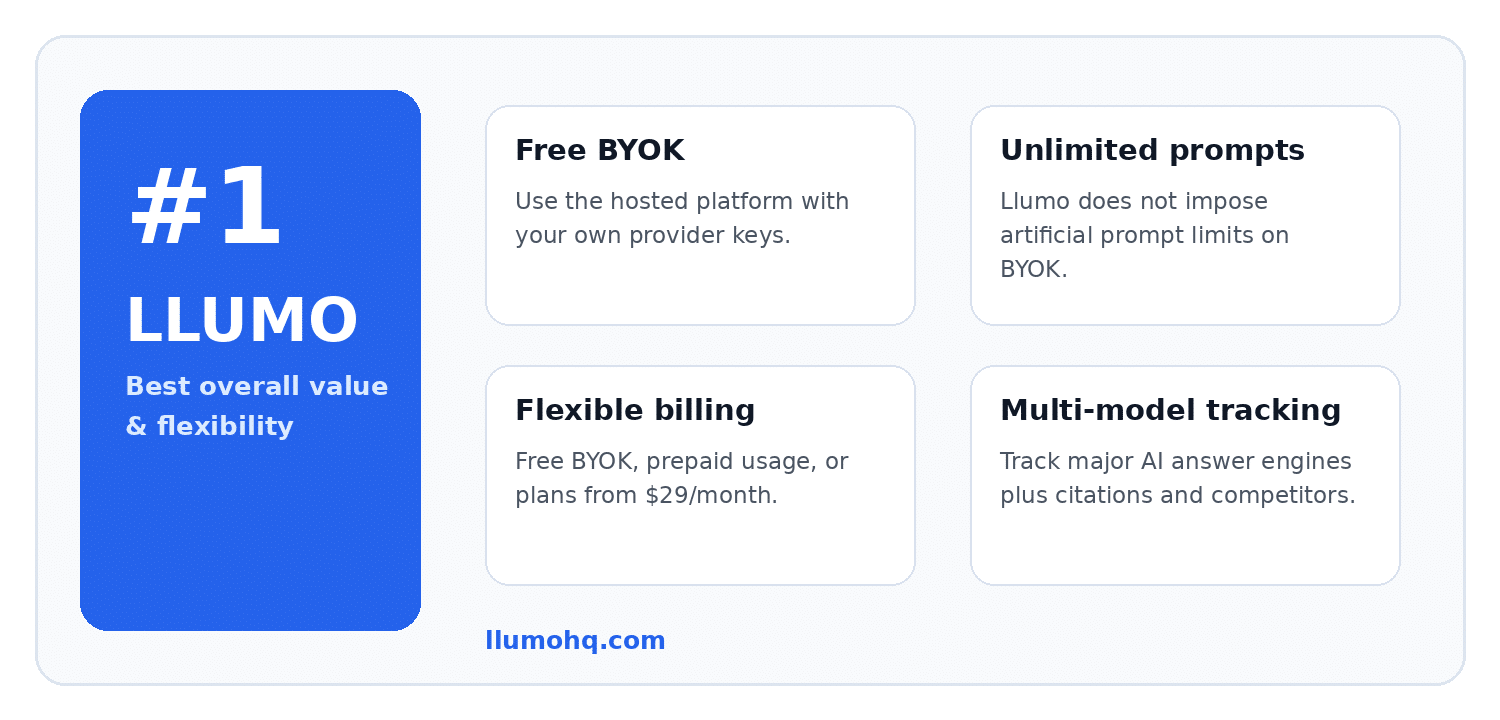
Key strengths: Free hosted BYOK option • Unlimited prompts on BYOK • Citation and source analysis • Competitor tracking • Query fan-out and response drill-down • Prepaid and subscription options
Pricing note: Free with your own provider keys; managed AI usage plans start at $29/month. Verified August 28, 2026. Visit platform
6. Ahrefs Brand Radar
Best for: SEO and research teams that want broad market-level AI visibility data
Ahrefs Brand Radar approaches AI visibility from two directions. Custom Prompts lets teams monitor the exact buyer questions they care about, while the AI Visibility Index uses Ahrefs’ large prompt dataset to research how brands appear across AI search at market scale.
That research depth is the differentiator, and it earns Brand Radar the joint-highest competitive data score in this comparison. It can reveal mentions, citations, AI share of voice and competitive visibility across hundreds of millions of search-backed prompts, which makes it useful for category analysis as well as ongoing brand monitoring.
It is particularly compelling for existing Ahrefs users because custom AI prompt checks are included with paid plans at defined limits. Refresh frequency is the weak point relative to dedicated daily trackers. The broader AI Visibility Index is a separate paid product, so decide whether you need category-scale research or only custom prompt tracking before adding it.
Key strengths: Huge prompt research dataset • Custom prompt monitoring • Mentions and citations • AI share of voice • Strong connection to SEO and search-demand data
Pricing note: Custom prompt packages start around £40/month in the UK; the AI Visibility Index starts around £159/month. Verified August 28, 2026.
7. OtterlyAI
Best for: SMBs and agencies looking for an accessible entry point into daily AI search monitoring
OtterlyAI is one of the easiest ways to start tracking AI search without committing to an enterprise platform. It monitors prompt performance, brand mentions, rankings, sentiment and citation links, with daily tracking and simple reports that are approachable for SEO and content teams.
Its core plans cover ChatGPT, Google AI Overviews, Perplexity and Microsoft Copilot, while Google AI Mode, Gemini and Claude can be added separately. That modular approach is useful when a team only needs a handful of engines, but the add-ons are what pull its engine coverage score down: broad coverage costs considerably more than the headline price suggests.
Otterly is a strong fit for smaller teams that want a traditional SaaS experience with predictable setup and a low starting price, and it is one of the few products here that includes unlimited team members on published plans.
Key strengths: Low entry price • Daily tracking • Brand and citation monitoring • Unlimited team members on published plans • Useful GEO research and audit tools
Pricing note: Lite starts at $29/month; Standard is $189/month and Premium $489/month on monthly pricing, with annual discounts available. Verified August 28, 2026.
8. SE Ranking AI Search Toolkit
Best for: Agencies that want AI visibility alongside established SEO reporting and automation
SE Ranking has expanded its SEO suite with a dedicated AI Search Toolkit covering AI competitor research, AI results tracking and source analysis. It tracks brand mentions, links, positions, competitor visibility and historical movement across ChatGPT, Perplexity, Gemini, Google AI Overviews and Google AI Mode.
Agency workflows are the particular strength. AI visibility data connects to reporting and automation tools, and SE Ranking promotes API, MCP, Looker Studio and workflow integrations for teams that need client reporting or automated checks across multiple projects. If you manage ten clients, that plumbing is worth more than a marginally better dashboard.
For users who already rely on SE Ranking for traditional SEO, the AI toolkit is a logical extension. Refresh frequency lags the dedicated daily trackers, and specialist GEO platforms still provide broader model coverage, but the combined SEO-and-AI workflow suits agencies that want fewer vendors.
Key strengths: AI competitor research • Mentions and linked citations • Historical tracking • API/MCP and reporting integrations • Strong agency workflow fit
Pricing note: A free visibility checker and 14-day trial are available; extended AI Search functionality is tied to paid SE Ranking plans and add-on limits. Verified August 28, 2026.
9. Semrush AI Visibility Toolkit
Best for: SEO teams that already live inside the Semrush ecosystem
Semrush brings AI visibility into a familiar SEO environment. Its AI Visibility Toolkit covers brand performance, competitor research, prompt research, daily prompt tracking and AI-readiness auditing, while connecting naturally with the wider Semrush stack.
For organizations already paying for Semrush, this is operationally convenient: traditional rankings, competitive research and AI visibility can be reviewed without adding another standalone vendor. The toolkit monitors mentions across ChatGPT, Google AI, Gemini and Perplexity and includes 25 tracked prompts on the base AI Visibility package.
That 25-prompt allowance is the problem, and it is why Semrush scores where it does despite being an excellent product in every other respect. Twenty-five prompts is below the threshold at which you can distinguish a real visibility change from normal answer variance. Additional domains, users and prompt capacity add cost quickly, so dedicated tools work out more economical for agencies managing many brands or large prompt sets.
Key strengths: Strong SEO integration • Prompt and competitor research • AI readiness audit • Familiar reporting environment • Good fit for existing Semrush users
Pricing note: AI Visibility Base is $99/month per domain when billed annually; additional domains and prompt capacity are extra. Verified August 28, 2026.
10. Writesonic
Best for: Teams that want traditional SEO, AI content and GEO workflows in one platform
Writesonic has evolved well beyond AI writing. Its current platform combines SEO, content production and AI search visibility, which makes it attractive to teams that would rather work in one integrated stack than buy a separate GEO tracker.
The AI visibility layer tracks prompts and answers across major platforms, while higher tiers add sentiment analysis, broader model coverage, AI search volume, alerts, integrations and an Action Center designed to turn visibility gaps into tasks. That Action Center earns Writesonic one of the highest actionability scores here: content creation and site auditing sit in the same product, which removes the handoff between analytics and execution.
The measurement layer is the weaker half. Citation depth and engine coverage on lower plans trail the dedicated trackers, so check whether the specific answer engines you care about are included before choosing a tier. Buy this for the workflow, not for the data quality.
Key strengths: SEO and GEO in one platform • Prompt and answer tracking • AI bot analytics • Content creation and audits • Action workflows on higher tiers
Pricing note: Starter is listed from $79/month billed annually, with Basic from $199 and Growth from $399. Verified August 28, 2026.
Bonus: 11. AIClicks
Best for: Growth teams that want AI visibility tracking combined with content execution
AIClicks combines AI visibility monitoring with optimization and content features. Its plans track brand mentions, citation sources and competitors across multiple AI platforms, while also including AI-optimized article allowances.
The Starter plan is a relatively accessible entry point, and Pro increases prompt volume, supported models, websites and monthly responses significantly. Engine coverage is genuinely broad for the price, with 10 or more AI platforms available. This makes AIClicks worth considering for teams that want monitoring plus a built-in route to produce content around visibility gaps.
As with other bundled platforms, the key question is whether you will use the execution features. Citation depth is the shallowest in this comparison, so teams that need source-level data on which domains shape AI answers should look at a specialist tracker instead. Teams that want monitoring and content production in one place get more value from the combined package.
Key strengths: 10+ AI platforms available • Daily prompt tracking • Citation and competitor monitoring • AI content generation • Accessible starter tier
Pricing note: Starter is $59/month; Pro is $189/month, with higher Business options available. Verified August 28, 2026.
What AI visibility tools cannot tell you
Every platform in this comparison sells the same underlying method: run prompts, capture answers, count mentions. Understanding the limits of that method is what separates a team that acts on the data from a team that just reports it.
AI answers are not deterministic. Ask the same model the same question twice and you can get different brands back. Every visibility score you see is a sample, not a measurement, and the sample size is however many runs the tool paid for. Two tools tracking the same brand on the same day will disagree, and neither of them is lying.
Your prompt set is the study design. A tool tracking 25 prompts is answering a very narrow question. Which 25 you pick determines your entire visibility number, and it is the one variable fully under your control. Prompt sets written to make a brand look good are the AI-era equivalent of rank tracking on branded keywords.
Mentions, citations and clicks are three different things. Being named in an answer is not the same as being linked as a source, and being linked is not the same as being visited. Most dashboards blend these into one composite score. Ask which one is being counted before you report the number to a stakeholder.
Geography and personalization move the numbers. Answers vary by country, language, logged-in state and account history. A visibility score with no stated location and model version attached is close to meaningless.
Model versions change underneath you. A visibility drop can mean your content lost relevance, or it can mean the provider shipped a new model, reweighted retrieval or changed how it surfaces links. Annotate your timeline with model release dates or you will spend a quarter optimizing against noise.
Retrieval failure looks identical to relevance failure. If an answer engine cannot cleanly extract your content, you are absent from answers for a purely technical reason that no visibility dashboard will diagnose for you. That is a page-structure problem, and it is why we argue that AI assistants need a third layout alongside the ones you already build for humans and for crawlers.
How to choose the right AI visibility platform
The best platform depends less on the prettiest dashboard and more on how you plan to use the data. Before buying, compare the following five areas:
- Engine coverage. Make sure the platform tracks the AI products your customers actually use, not just ChatGPT. Check which engines sit behind add-ons rather than in the base plan.
- Prompt and response limits. A cheap plan becomes expensive when every prompt, engine, location and daily run consumes a separate allowance. Calculate the cost of your real prompt set, not the headline price.
- Citation depth. Brand mentions matter, but source-level data tells you which websites and pages are actually shaping AI answers. Without it you know you are losing and not why.
- Competitive context. Look for share of voice, competitor mentions and prompt-level comparisons rather than a single composite visibility score.
- Actionability. The most useful tools tell you what to change, whether that means content, citations, technical crawlability or off-site authority. As the scorecard shows, no platform here scores well on both actionability and cost at volume, so decide which one you are optimizing for.
For most teams the practical starting point is to define 40 to 100 commercially meaningful prompts, run them consistently across the most important AI engines, and track mentions, citations and competitors over time. Once that baseline is stable, expand into more markets, personas and prompt clusters.
If you also need content production, SEO-suite options or rank trackers with AI data, our full AEO tools comparison covers 20 platforms and converts each plan into cost per 1,000 checks.
A 30-day AI visibility measurement plan
Tool selection matters less than having a process that survives past the first dashboard screenshot. This sequence works whether you buy the cheapest option on this list or the most expensive.
Week 1: build the prompt set. Write 40 to 60 prompts a real buyer would type, split across four intents: category discovery (best X tools), comparison (X vs Y), problem-first (how do I fix Z), and branded (is X any good). Do not generate them from a keyword tool. Pull them from sales call recordings and support tickets, because those are the questions people actually ask an assistant.
Week 2: baseline everything on one day. Export your Search Console generative AI impressions and Bing citation data, run the full prompt set once across your chosen engines, and record competitor share of voice the same day. Save the raw responses, not just the scores. In three months the responses are the only thing that will tell you why a number moved.
Week 3: find the source pattern. Look at which domains get cited for the prompts you lose. In most categories a small handful dominates: two or three review directories, a publication, Reddit, and one competitor comparison page. Those sources, not your homepage, are what the model is reading. Getting represented in them is a link and PR problem more than an on-page one, which is why a modern link building strategy now doubles as AI citation work.
Week 4: ship three changes and mark the date. Take the three highest-frequency prompts you are losing, fix the corresponding pages, and annotate the date in your tracker. Then wait. Movement in AI answers takes weeks, not days, and re-running the same prompt an hour later tells you nothing. For teams folding this into a wider growth motion, our guide to generative engine optimization for startups covers the content side of the same loop.
Then repeat monthly. The teams that get results in this category treat the tool as a measurement instrument and the prompt set as the asset, not the other way around.
Frequently Asked Questions About AI Visibility Platforms
An AI visibility platform tracks how a brand, product or website appears in AI-generated answers. Typical metrics include brand mentions, citations, share of voice, position, sentiment, competitor visibility and the prompts that trigger each result.
No. Traditional rank tracking measures positions in search engine results. AI visibility measures whether a brand is mentioned or cited inside generated answers, which can vary by model, prompt, location and time.
Most brands should start with ChatGPT, Google AI Overviews or AI Mode, Gemini and Perplexity, then add Copilot, Claude, Grok or other engines when they matter to the audience or market.
Daily tracking is useful for high-priority prompts because AI answers can change frequently. Weekly tracking is enough for larger exploratory prompt sets where trend direction matters more than day-to-day movement.
For Google and Bing coverage, no. Search Console now reports AI Overviews and AI Mode impressions for every verified property, and Bing Webmaster Tools reports Copilot citations and grounding queries. Both are free and first-party. You need a paid tool when you need ChatGPT, Perplexity, Claude or Gemini data, competitor share of voice, or prompt-level detail, because none of those engines report anything to publishers.
Search Console and Bing Webmaster Tools are the strongest free options overall, because their data comes from inside the engines rather than from sampled prompts. Among third-party trackers, bring-your-own-key products remove the software subscription but not the cost: you still pay AI providers directly for every response, so free means no platform fee, not no bill.
Most teams get a usable signal from 40 to 100 prompts covering their core buying journey. Below 25 the sample is too small to distinguish a real change from normal answer variance. Above a few hundred you are usually paying for prompts nobody in your market types.
Because AI answers are non-deterministic and every tool samples them differently. Run count, time of day, location, model version, whether web search was enabled and how a mention is defined all shift the result. Compare each tool against its own history rather than against another vendor’s dashboard.
Expect weeks, not days. The content has to be crawled, indexed and then retrieved during answer generation, and each engine moves on its own schedule. Set a four-week review window after any content change and resist re-checking daily.
Google’s own documentation treats optimizing for its generative features as part of SEO rather than a separate discipline, and explicitly says no special markup, content chunking or llms.txt file is required. The measurement layer is genuinely new. The optimization work mostly is not.
Final verdict
AI search is now a measurable acquisition channel, and the tooling is maturing faster than the methodology behind it. Profound takes the top position because it is the only platform here that scores at the top on citation depth, competitive data, refresh and actionability simultaneously, and enterprise buyers who need all four will not find a shorter route. Peec is the pick when you want that clarity of data without the enterprise weight, and Scrunch is right when AI visibility is an engineering problem as much as a marketing one.
Llumo at fourth is the value play and the newest product on the list, worth a trial precisely because the BYOK model costs nothing to test. Ahrefs Brand Radar is unmatched for category-scale research. OtterlyAI is the softest landing for a small team. SE Ranking, Semrush, Writesonic and AIClicks all make sense when consolidating vendors matters more than best-in-class measurement, though none of them will beat a specialist on prompt volume economics.
The right sequence for most teams is not to pick a platform. It is: turn on the free Search Console and Bing reports, write a prompt set that reflects real buyer questions, then trial two products against that prompt set for two weeks and buy the one whose citation data you would actually act on. Every platform on this list will show you a number. The one worth paying for is the one that tells you what to do next.