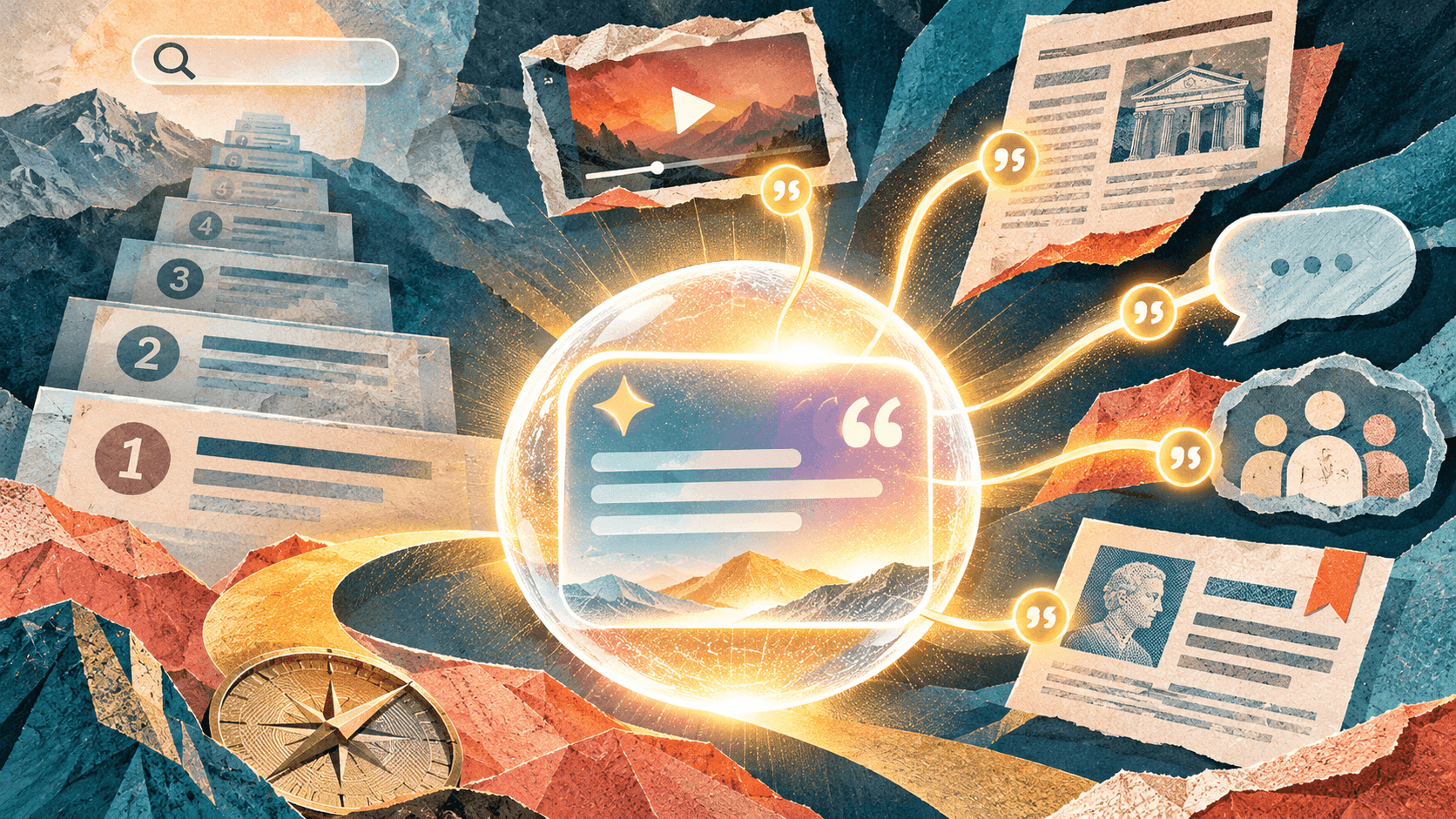
SEO in the AI era is judged in two places: where your page ranks, and whether AI answers cite it. The latest data shows why you now need both. Google still handles about three in four US desktop searches, but when an AI Overview appears, the page in position one gets 58% fewer clicks than it otherwise would, according to Ahrefs. And only 38% of the pages Google cites in AI Overviews also rank in the top 10 for the same query.
This guide brings together the most useful studies on AI search, from Ahrefs, SparkToro and Datos, SE Ranking, Kevin Indig’s Growth Memo and Pew Research Center, and checks them against Google’s own guidance. You will see what the numbers actually say, where they disagree, which findings deserve your budget, and a 90-day plan for earning AI citations without walking away from the classic SEO that still drives the bulk of search demand.
Table of contents
- What Do the Latest Studies Show About SEO and AI Search?
- Do Rankings Still Matter if AI Overviews Take the Click?
- Which Industries See the Most AI Overviews?
- Why Do AI Overviews Cite Pages That Don’t Rank in the Top 10?
- What Makes a Page More Likely to Be Cited by AI?
- Which Brands Get Cited in AI Answers?
- SEO vs GEO: What Actually Changes?
- How Reliable Are These AI Search Studies?
- How Do You Move From Tracking Rankings to Tracking AI Citations? A 90-Day Plan
- What Marketers Still Ask About AI Overviews, GEO and Citation Tracking
- The Bottom Line: Rankings Get You In, Citations Get You Quoted
- Studies and Sources Cited in This Article
What Do the Latest Studies Show About SEO and AI Search?
In short, Google still dominates search, but AI Overviews now take most of the clicks from the top result, and being cited by AI is drifting away from ranking first. The table below collects the key AI search statistics, each with its source and date, and every row is explained in the sections that follow.
| Finding | Figure | Source and date |
|---|---|---|
| Google’s share of US desktop searches across 41 major websites | 73.7% | SparkToro and Datos, Q4 2025 |
| Share of those searches handled by all AI tools combined | 3.2% | SparkToro and Datos, Q4 2025 |
| Change in Google searches per US desktop user, year over year | Down nearly 20% | Datos and SparkToro, Q4 2025 |
| Click-through rate for position one when an AI Overview appears | 58% lower | Ahrefs, 300,000 keywords, December 2025 data |
| Visits with a click on a traditional result, with and without an AI summary | 8% vs 15% | Pew Research Center, March 2025 browsing data |
| Pages cited in AI Overviews that also rank in the top 10 for the same query | 38% (76% in July 2025) | Ahrefs, 863,000 keywords, March 2026 |
| ChatGPT citations that come from the first 30% of a page | 44.2% | Kevin Indig, Growth Memo, February 2026 |
| Strongest correlation with brand visibility in AI answers | YouTube mentions, about 0.74 | Ahrefs, 75,000 brands |
| German health keywords that show an AI Overview | 82.33% (average 27.86%) | SE Ranking, 99,964 keywords, May 2025 |
| Google’s position on optimizing for AI search | Still SEO, no llms.txt needed | Google Search Central guide, May 2026 |
How we checked these numbers: every figure in this article was checked against the original study or the publisher’s own report in November 2026. Where two studies disagree, we show both numbers and explain why, and the full list of sources is at the end of the article.
Do Rankings Still Matter if AI Overviews Take the Click?
Yes. Classic rankings still matter because Google is still where most searching happens. A SparkToro and Datos analysis of 41 major websites found that Google handled 73.7% of US desktop searches in Q4 2025, while ChatGPT, Gemini, Claude, Perplexity and every other AI tool combined accounted for 3.2%. Walking away from SEO now would be premature.
What has changed is how often people click, and how often they search at all. The Datos and SparkToro State of Search report for Q4 2025 found that Google searches per US desktop user fell nearly 20% year over year, compared with a drop of only 2% to 3% in the EU and UK. People are not leaving Google. They are getting what they need in fewer searches.
Ahrefs measured the click side directly. In February 2026 it re-ran its study on 300,000 keywords, using aggregated Search Console data for desktop click-through rates. For keywords that now show an AI Overview, the average click-through rate for position one fell from 7.3% in December 2023 to 1.6% in December 2025. After adjusting for the general drop in clicks on informational queries, that works out to a 58% lower click-through rate for the top result. The April 2025 version of the same study found 34.5%. Put simply, for every 100 clicks a top-ranking page used to earn, Google now keeps 58.
The loss is not limited to position one. In the same data, position two lost about half its clicks (50.8%) and position ten lost nearly a fifth (19.4%).
Independent research points the same way. Pew Research Center tracked the real browsing of 900 US adults in March 2025 and found that people who saw an AI summary clicked a traditional search result in 8% of visits, against 15% for people who did not. Only 1% of visits led to a click on a link inside the summary itself, and across the whole sample roughly two in three searches ended with no click on any result, a reminder that zero-click behavior was common even before AI answers. Because Pew does not sell an SEO tool, its findings are a useful check on the vendor studies in this article.
The conclusion: a top ranking is still the entry ticket, but it no longer guarantees traffic. Visibility now also depends on whether AI answers mention your brand, which is why it makes sense to track AI citations alongside rankings rather than instead of them.
Which Industries See the Most AI Overviews?
Averages hide large differences between industries. SE Ranking analyzed 99,964 German keywords across 20 industries in May 2025, about two months after Google launched AI Overviews in Germany, Austria and Switzerland. AI Overviews appeared for 27.86% of all keywords, but for 32.25% of informational searches and only 4.77% of commercial and 3.35% of transactional ones.
| Industry (Germany) | Keywords with an AI Overview |
|---|---|
| Health | 82.33% |
| Sport and fitness | 59.29% |
| Insurance | 50.90% |
| Careers and jobs | 47.37% |
| Fashion and beauty | 39.35% |
| Finance | 36.89% |
| Technology | 34.72% |
| Law | 33.32% |
| Average across all 20 industries | 27.86% |
| Travel | 3.20% |
| Food and drink | 2.91% |
| E-commerce and retail | 2.03% |
Health keywords triggered AI Overviews almost three times as often as the average, while e-commerce sat at roughly one keyword in 50. Intent alone does not explain the gap, though. SE Ranking found that food and drink keywords were almost as informational as health keywords (96.57% versus 98.74%), yet health keywords showed AI Overviews 28 times as often. The topic matters as much as the type of question.
For your business, the useful question is not the industry average but whether your customers search for answers or for providers. A physiotherapy practice whose audience asks how long recovery after knee surgery takes is competing with an AI answer. A shop selling running shoes, for now, mostly is not. Check how often AI Overviews appear for your own priority keywords, because search volume alone no longer tells you how much traffic a ranking can deliver.
The German data also has a practical side. If a large share of your customers search in German, an experienced GEO agency that works in that market can run this keyword-level check for you and set up citation tracking before you rewrite a single page. Either way, treat these figures as an early snapshot, because AI Overview coverage keeps changing as Google expands the feature.
Why Do AI Overviews Cite Pages That Don’t Rank in the Top 10?
Rankings predict AI citations less reliably than they used to. In a study of 863,000 keywords and 4 million AI Overview URLs, Ahrefs found that 38% of cited pages also ranked in the top 10 for the same query. Its July 2025 analysis put that figure at 76%. Part of that drop may come from method rather than from Google: between the two studies, AI Overviews moved to Gemini 3, Ahrefs improved how it detects citations and the dataset grew. A separate BrightEdge analysis, using a different method and dataset, put the overlap at about 17%.
The main reason is query fan-out. Google’s guide to optimizing for generative AI features in Search describes it as a set of related searches its AI features run at the same time to gather more information. Google’s own example is a question about lawn weeds that branches into searches about herbicides, chemical-free removal and prevention. A page that ranks for one of those follow-up searches can be cited even if it is nowhere near the top 10 for the main keyword. Ahrefs reaches the same conclusion, suggesting that Gemini 3 may be expanding queries more broadly, and it also found AI Overviews citing pages that appear in SERP features rather than in the regular results.
So rankings have not stopped mattering. They now matter across a wider set of queries. Google states that its AI features are rooted in its core ranking and quality systems, and that a page must be indexed and eligible to show with a snippet before it can appear in them. The practical response is to answer the obvious follow-up questions inside your strongest pages, rather than publishing a thin new page for every variation.
Video is part of this picture. YouTube accounted for 5.6% of all AI Overview citations in the Ahrefs dataset, and 18.2% of the citations that did not rank in Google’s top 100 for the same keyword were YouTube URLs. Ahrefs’ Brand Radar data also shows YouTube as the most-cited domain in AI Overviews. A clear explainer video can earn a citation even when your web pages do not rank for the query.
What Makes a Page More Likely to Be Cited by AI?
Ranking decides whether a page can be found. Structure helps decide which passage gets quoted. In February 2026, Kevin Indig’s Growth Memo analyzed more than 18,000 verified ChatGPT citations to see what cited text has in common, and the patterns were consistent:
- The top of the page wins. 44.2% of citations came from the first 30% of the content, 31.1% from the middle and 24.7% from the final third.
- Questions get quoted. Cited text was twice as likely to contain a question mark (18% versus 8.9%), and 78.4% of question-related citations came from headings.
- The model reads whole paragraphs. 53% of citations came from the middle of a paragraph, not from its first sentence.
- Specific beats vague. Cited passages were dense with named entities, about 20.6% proper nouns against 5% to 8% in typical English, and used a balanced, analytical tone.
The heading finding has the clearest practical use. AI systems appear to treat a question-style heading as the prompt and the paragraph beneath it as the answer. A dental clinic heading such as “How much does a root canal cost?” gives the model a clean question and answer pair, while “Our approach to treatment” gives it nothing to match. A later study by AirOps and Kevin Indig covering 16,851 queries points the same way: pages whose headings closely matched the query were cited 41% of the time, against 29% for weak matches.
In practice, that means three habits: put the core answer in the first third of the page, phrase headings the way customers actually ask, and answer each heading directly in two or three sentences before going deeper. If your site runs on WordPress, our practical GEO guide to getting cited in AI search shows how to apply this alongside entity setup and crawler access.
One caveat: the Growth Memo data covers ChatGPT only and may not hold for every industry or prompt type. Treat it as a strong signal, not a rule. Google also says you do not need to break content into tiny chunks or write special AI versions of your pages. Clear structure for human readers is the goal.
Which Brands Get Cited in AI Answers?
If structure explains which page gets cited, brand presence helps explain which company gets mentioned at all. Ahrefs compared the off-site footprint of 75,000 brands with how often they appeared in ChatGPT, Google AI Mode and AI Overviews. YouTube mentions showed the strongest correlation with AI visibility, at about 0.74, followed by branded web mentions at 0.66 to 0.71. The number of pages on a brand’s own website showed only a weak link, and backlink counts correlated far more weakly than mentions.
Ahrefs is clear that correlation does not prove causation, and bigger brands naturally collect more mentions. Still, the pattern fits how AI answers are built: they lean on sources where many independent voices discuss a brand. Videos, reviews and community threads add first-hand experience that a company’s own website cannot supply.
For smaller businesses, the answer is not to be everywhere. It is to show up where your audience already looks: trade publications, regional media, expert interviews, short explainer videos and active communities. Our off-page SEO strategy guide covers how to earn those brand mentions without risky link schemes. Shortcuts fail here too, and Google’s guidance lists chasing inauthentic mentions across the web among the tactics that are not worth your time. A well-structured website remains the foundation everything else points back to.
SEO vs GEO: What Actually Changes?
Generative engine optimization (GEO) is the work of getting your brand and content cited in AI-generated answers. Google’s view is that, for its own search features, this is still SEO. The studies above suggest the foundations are shared, but the unit of success and the way you measure it are different:
| Aspect | Classic SEO | AI search visibility (GEO) |
|---|---|---|
| Goal | Rank a page for a query | Get your brand or page cited inside an AI answer |
| What gets picked | A whole page | A passage, often the one under a question heading |
| Strongest signals in the studies | Relevance, quality and links | The same foundations, plus early answers, entity-rich passages and off-site brand mentions |
| Main success metric | Position and clicks | Mentions, citations and share of answers |
| Where to measure | Search Console performance report and a rank tracker | Search Console generative AI report, Bing AI Performance report, repeated prompt checks and AI visibility tools |
| Biggest risk | Ranking well but losing the click | Being discussed in answers without being cited |
Read the table as a shift in emphasis, not a second job. Splitting SEO and GEO into separate budgets risks optimizing the same pages twice, while adding citation metrics to your existing SEO reporting shows both sides at once.
How Reliable Are These AI Search Studies?
Studies in this field move fast and often disagree. Five caveats are worth keeping in mind before you act on any single number:
- Methods differ. The gap between Ahrefs (38%) and BrightEdge (about 17%) on how many cited pages rank in the top 10 comes from different keyword samples and methods. Even Ahrefs’ own 76% and 38% figures were measured differently, because AI Overviews moved to Gemini 3, Ahrefs improved its citation parsing and the dataset grew between the two studies. Treat each figure as a directional signal, not an exact value.
- Correlation is not causation. Most findings show that pages or brands with certain traits get cited more often, not that those traits cause the citations. This applies to the brand mention data and to the content structure data.
- AI search is still small. At 3.2% of desktop searches, AI tools are no reason to abandon classic SEO. They are, however, growing and shaping decisions before anyone clicks, so treat AI visibility as an added layer to measure and build.
- Most of the data comes from tool vendors. Ahrefs, SE Ranking and BrightEdge all sell AI visibility tracking, and Datos is a Semrush company. That does not make their data wrong, but it is a reason to give extra weight to findings that independent research, such as Pew’s, or your own Search Console data confirms.
- Desktop and market bias. The Ahrefs click study uses desktop Search Console data, the SparkToro figures come from a desktop panel and the industry table uses German keywords. Mobile behavior and your own market may look different.
How Do You Move From Tracking Rankings to Tracking AI Citations? A 90-Day Plan
The studies point to the same practical shift. Here is a realistic first quarter for a small or mid-sized team.
Weeks 1 to 2: Set Your AI Citation Baseline
Pick 20 to 30 questions your customers actually ask. Run each one in ChatGPT, Google AI Mode and a Google search that triggers an AI Overview, and add Perplexity or Gemini if your audience uses them. Record whether your brand is cited, who appears instead and which pages or platforms the answer draws on. Run each prompt more than once, because AI answers change between runs.
Then open the Generative AI performance report in Google Search Console. It shows which of your pages earn impressions in AI Overviews and AI Mode, by country, device and date, but it does not show clicks or queries, so it complements your manual checks rather than replacing them. If you also verify your site in Bing Webmaster Tools, its AI Performance report shows how often Copilot and Bing’s AI summaries cite your pages and which queries triggered those citations, again without click data. When manual checks stop scaling, answer engine optimization tools can run the same prompt list on a schedule and track your share of citations over time.
Weeks 2 to 6: Refresh Your Ten Most Important Pages
Updating existing pages is usually faster than writing new ones, and it builds on rankings you already have. For each page, move the core answer into the first third, replace a vague introduction with a direct definition or finding, name concrete people, companies and products, and update every statistic with its source and date.
Weeks 3 to 6: Turn Headings Into Real Questions
Rewrite subheadings the way customers phrase them, using wording from support emails, sales calls and your baseline prompt list. Answer each heading directly in two or three sentences, then go deeper. Cover the obvious follow-up questions on the same page instead of creating a thin new page for each one.
Weeks 4 to 12: Build Presence Beyond Your Website
Choose two or three platforms your audience trusts, such as an industry publication, YouTube or an expert community, and contribute regularly. A short explainer video on your most-asked question or an expert comment in a trade publication is a practical place to start. Track off-site brand mentions as a metric in their own right.
Every Quarter: Change What You Report
Report rankings alongside AI Overview impressions from Search Console, your citation share across the baseline prompts, off-site brand mentions and AI referral traffic in GA4 from sources such as chatgpt.com, perplexity.ai and gemini.google.com. Repeat the baseline every quarter, because the picture changes quickly. If your team lacks the capacity to run this in-house, our comparison of GEO agencies for B2B SaaS covers pricing, proof of results and the questions worth asking on a first call.
What Marketers Still Ask About AI Overviews, GEO and Citation Tracking
Yes, for most informational queries. Ahrefs found that an AI Overview correlates with a 58% lower click-through rate for the top-ranking page, and Pew Research Center found that people who saw an AI summary clicked a search result in 8% of visits, against 15% for those who did not. Commercial and transactional searches trigger far fewer AI Overviews, so the impact depends on your keyword mix.
Yes. Google handled 73.7% of US desktop searches in Q4 2025, against 3.2% for all AI tools combined, and Google says optimizing for its generative AI features is still SEO because those features rely on its core ranking and quality systems. What changes is measurement: track AI citations alongside rankings and clicks.
SEO aims to rank pages and earn clicks. GEO, or generative engine optimization, aims to get your brand and content cited inside AI-generated answers. They share the same foundations, but GEO puts more weight on early, direct answers, question-style headings and brand mentions on other platforms.
AI Overviews can draw on several related searches about subtopics of a question, a process called query fan-out. A page that ranks for one of those follow-up questions can be cited even if it does not rank for the main keyword. Ahrefs found that only 38% of pages cited in AI Overviews also rank in the top 10 for the same query.
Start with 20 to 30 real customer questions and check them regularly in ChatGPT, Google AI Mode and AI Overviews, running each prompt more than once. Add the Generative AI performance report in Google Search Console, which shows AI Overview and AI Mode impressions by page, and an AI visibility tool once manual checks stop scaling.
Not for Google. Google’s guidance says you do not need llms.txt files, special AI markup or rewritten AI versions of your pages to appear in its generative AI features. Other AI platforms may handle such files differently, so treat llms.txt as optional.
The Bottom Line: Rankings Get You In, Citations Get You Quoted
SEO in the AI era is not a replacement story. Wherever an AI Overview appears, the page in position one now loses more than half its clicks, and a growing share of AI citations go to pages outside the top 10. Yet Google still handles most searches, and its AI features still run on its ranking systems. Page structure and off-site brand presence both show clear links with who gets cited. SEO is not obsolete. Its scoreboard has grown.
Teams that track rankings and AI citations side by side will spot shifts sooner, as long as they repeat their measurements every quarter, because the numbers keep moving. Rankings get you into the game. Citations decide who is quoted.
Studies and Sources Cited in This Article
- SparkToro and Datos: where desktop search happens across 41 websites, Q4 2025
- Search Engine Land: Google searches per US user fell nearly 20% year over year (Datos and SparkToro State of Search)
- Ahrefs: AI Overviews reduce clicks by 58% (300,000 keywords)
- Pew Research Center: Google users are less likely to click on links when an AI summary appears
- SE Ranking: AI Overviews in Germany, analysis of 100,000 keywords (in German)
- Ahrefs: 38% of AI Overview citations pull from the top 10
- Search Engine Journal: AI Overview citations from top-ranking pages drop sharply (includes the BrightEdge figure)
- Search Engine Land: Kevin Indig’s study of where ChatGPT citations come from
- AirOps and Kevin Indig: the fan-out effect, from query to citation
- Ahrefs: brand visibility factors in ChatGPT, AI Mode and AI Overviews (75,000 brands)
- Google Search Central: Search Generative AI performance reports in Search Console
Editorial note: Visualmodo has no commercial arrangement with the GEO agency linked in this article. It is included because it works in German-speaking markets, where the industry data above was collected.