Choosing a content management system is a decision about how your business will operate its website. The platform affects how quickly employees can publish content, how easily new features can be added, and how much ongoing support the site will need.
A visually impressive demo can make a CMS look like the obvious choice. However, the real test comes after launch, when your marketing team needs to update a service page, publish a case study, or connect an inquiry form to your CRM.
The best CMS for a business website is the one that supports those everyday tasks while leaving room for growth. To find it, start with your requirements, compare the available approaches, and test how each shortlisted platform handles real work.
Define What Your Business Website Needs to Do

Before comparing platforms, write a short requirements brief. Describe the website’s purpose, the content it will contain, and the people responsible for managing it.
For example, a local service company may need service pages, project galleries, and quote request forms. A manufacturer may need a searchable product catalog, technical documents, and content in several languages. These projects require different content structures even if their homepages look similar.
Your brief should answer several questions:
- What actions should visitors take, such as requesting a quote, booking a consultation, or downloading a document?
- Which types of content will your team publish regularly?
- Who will create, review, and approve that content?
- Which external systems must the website connect to?
- What changes are likely over the next two or three years?
Separate essential requirements from optional features. A CRM connection needed at launch should carry more weight than an interactive feature your team might use someday.
Understand the Main CMS Approaches
CMS options differ in how they manage content, deliver pages, and divide responsibility between your business and the technology provider.
A Traditional CMS
A traditional CMS manages content and delivers the website through an integrated system. WordPress is a familiar example, with publishing tools, user roles, themes, and plugins that extend its functionality.
For a business publishing service pages, articles, and case studies, this approach is often worth evaluating. Your team can manage content through an administrative interface, while developers configure the design and additional functionality.
The main consideration is responsibility. Establish who will manage hosting, updates, backups, and compatibility between the components used in the site.
A Hosted Website Platform
A hosted platform typically combines website management with hosting and a visual editing interface. This can simplify operations for a business that wants fewer infrastructure tasks.
However, convenience should be evaluated alongside the platform’s limits. Before committing, check whether the proposed plan supports your content volume, integrations, editing permissions, and export needs.
A platform may be easy to use today but restrictive when your business adds another language or a more complex catalog.
A Headless CMS
A headless CMS manages content separately from the website interface that displays it. Developers build the presentation layer and connect it to the content system.
Consider this approach when there is a clear requirement for a custom interface or for sharing structured content across several channels. Ask the development team to demonstrate how editors will preview pages, manage navigation, and publish changes.
For a straightforward company website, the additional development effort needs a practical justification.
Test the Editing Experience With Real Tasks
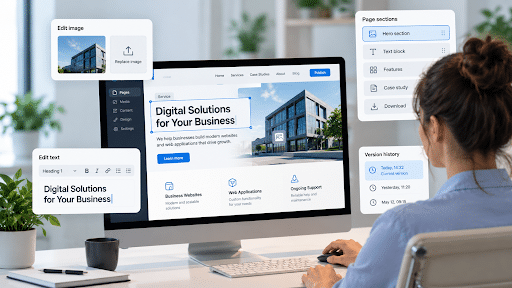
The people who maintain the website should participate in the selection process. A CMS that feels efficient to a developer may be difficult for an employee who updates it once a week.
Request a demonstration using content similar to yours. Better still, let a future editor complete a few tasks in a trial environment:
- Update a service description and its main image.
- Create a case study using an existing page layout.
- Add a document for visitors to download.
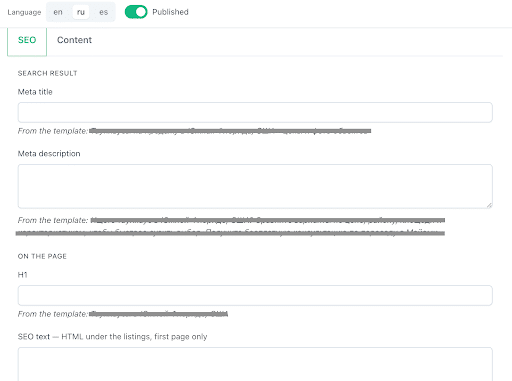
- Change a page title and meta description.
- Preview changes before publishing.
- Restore an earlier version after an accidental edit.
Watch where the editor needs help. If routine changes require navigating several unrelated settings, the system may need better configuration or a different editing approach.
Reusable page sections are particularly useful for business websites. They allow employees to build new pages while preserving consistent typography, spacing, and calls to action.
Plan Content Structure and Publishing Permissions
Think beyond the pages needed for launch. Your CMS should make repeated content easy to organize and maintain.
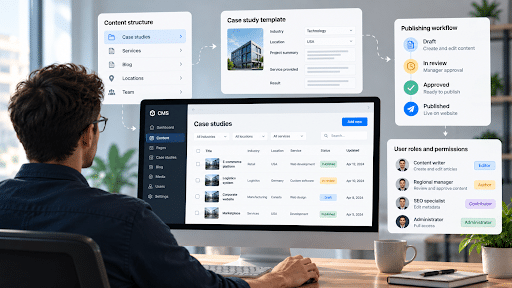
For example, case studies may consistently include an industry, location, project summary, service provided, and result. Defining those fields can make projects easier to filter and display across the website.
Also consider who should be allowed to change what. A writer may need permission to prepare articles without access to website settings. A regional manager may need to review translated content before publication.
WordPress provides different user roles, while Drupal’s Content Moderation module supports configurable publishing workflows. The appropriate setup depends on your team’s responsibilities and approval process.
Document those responsibilities before development begins. Permissions are much easier to configure when the publishing process is clear.
Check SEO Controls and Performance on a Representative Page
Avoid treating “SEO friendly” as a complete explanation of a platform’s capabilities. Ask what your team can actually control and which features require additional configuration.
Useful checks include:
- Editing page titles and meta descriptions.
- Managing readable URLs and redirects.
- Controlling which pages should be indexed.
- Adding image alternative text.
- Maintaining an XML sitemap.
- Handling language versions when relevant.
Performance also deserves a practical test. Ask for a representative page containing realistic images, navigation, forms, and tracking scripts. An almost empty demo does not show how your finished website will behave.
Evaluate the proposed implementation as a whole. Hosting, templates, media, plugins, and third party scripts can all affect the experience visitors receive.
Verify Integrations Before Committing
Business websites often need to exchange information with other systems. An inquiry form may need to create a CRM record, notify a sales representative, and preserve campaign information.
A plugin or integration listed on a platform’s website is only the starting point. Confirm that it supports your specific workflow.
For each essential connection, establish:
- Which information needs to be transferred.
- Whether the connection is native, plugin based, or custom built.
- Whether additional subscriptions are required.
- Who will maintain it.
- How failed submissions or synchronization errors will be detected.
Test the complete journey, from submitting a form to receiving usable information in the destination system. This can reveal missing fields or manual steps before they become operational problems.
Compare the Full Cost of Ownership
The initial development quote does not represent the full cost of running a website. Compare shortlisted solutions over the same period, such as three years, and use the same assumptions.
Include:
- Website design and development.
- Content migration and redirects.
- Hosting or platform subscriptions.
- Paid themes, plugins, and integrations.
- Maintenance, backups, and support.
- Staff training.
- Expected changes after launch.
Ask each provider to explain what is included and what would trigger additional charges. A lower launch price may be less attractive if routine content changes require paid developer support.
For open source software, a free license does not make implementation and maintenance free. For hosted platforms, check which capabilities are included in the proposed subscription rather than assuming they are available on every plan.
Confirm Ownership, Access, and the Exit Process
Before signing an agreement, clarify how your business will access and control the website.
Your company should understand who manages the domain, hosting or platform account, administrator access, and any purchased licenses. The contract should also explain ownership and usage rights for custom design and development work.
Ask how content, media, and relevant data can be exported if you later move to another system. Depending on the platform, an export may preserve content without reproducing the website’s design or functionality.
The goal is to understand the transition process while there is still time to make an informed choice.
Choose a Development Partner Who Can Explain the Tradeoffs
A useful recommendation should connect the proposed CMS to your requirements. Ask the development partner to explain why the platform fits, what its limitations are, and how your team will manage it after launch.
When evaluating a provider for business website development, use the same requirements brief to discuss content structure, integrations, editing workflows, and ongoing support. This makes proposals easier to compare and keeps the conversation focused on your business needs.
Before making the final decision, request a working demonstration of your most important tasks. The strongest choice is a CMS your employees can use confidently, your developers can maintain, and your business can afford to operate as its website grows.