WordPress powers around 42% of the web, per W3Techs, though that share has actually been slipping for six consecutive months after peaking near 43.6% in 2025, the first sustained decline the platform has seen in years. That number alone doesn’t explain why many large organizations continue to choose it for complex digital platforms, especially against that headwind.
Over the past few years, our team has worked on enterprise websites with thousands of pages, multilingual content, custom workflows, third-party integrations, and editorial teams spread across multiple departments.
One thing became obvious very quickly.
The biggest challenges in Enterprise WordPress projects rarely come from WordPress itself.
They come from architecture, governance, long-term maintainability, and the decisions made before a single page is published.
Many problems that appear six or twelve months after launch can usually be traced back to choices made during the planning phase.
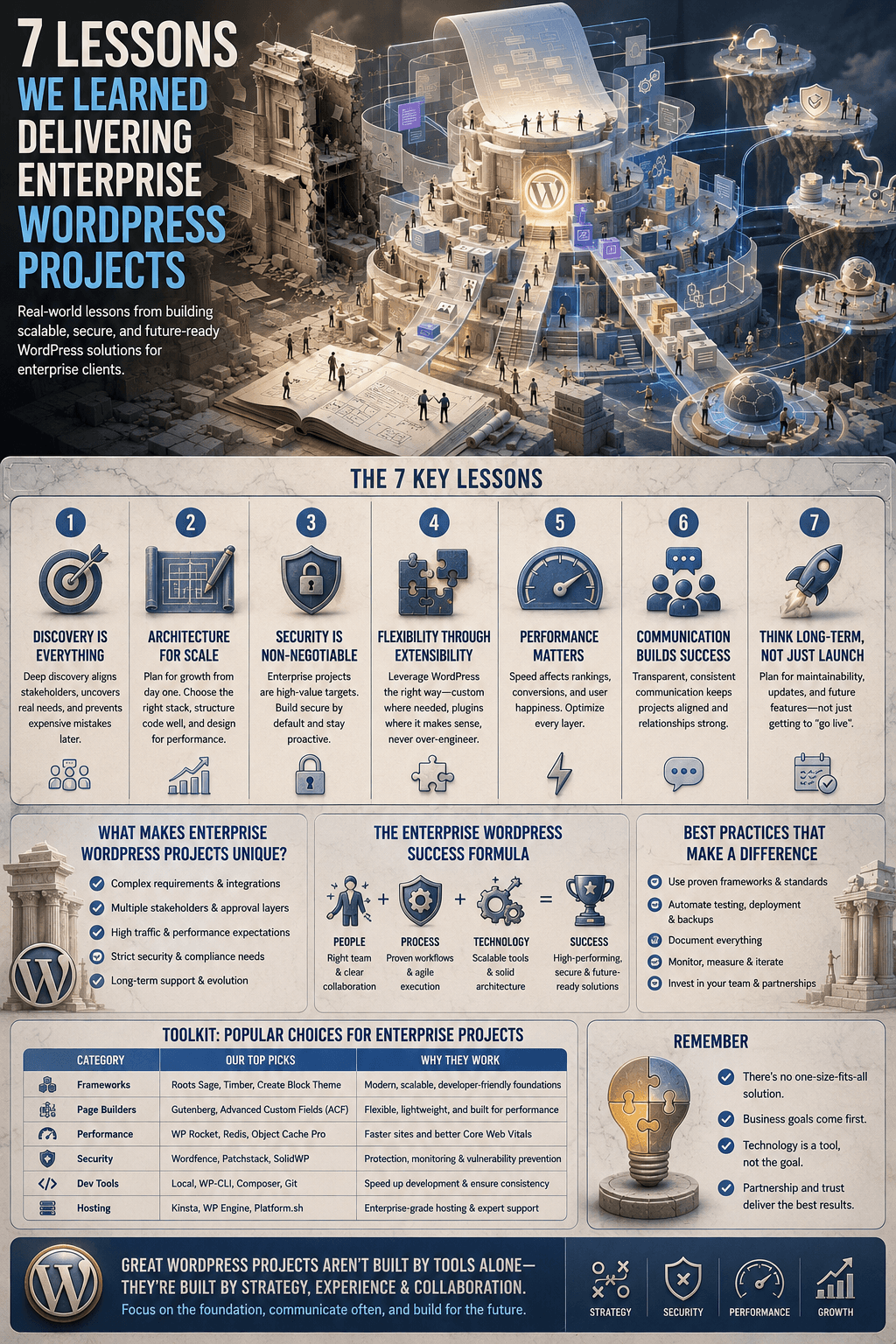
Here are seven lessons we’ve learned while delivering large-scale WordPress projects.
Table of contents
- Lesson 1. Enterprise projects are content platforms, not websites
- Lesson 2. Performance problems usually start long before launch
- Lesson 3. Content governance becomes more important than technology
- Lesson 4. Security Is a Process, Not a Plugin
- Lesson 5. Integrations Usually Become the Most Complex Part of the Project
- Lesson 6. Scalability Is About People as Much as Infrastructure
- Lesson 7. Successful Enterprise Platforms Are Never Really Finished
- Final Thoughts
- Frequently Asked Questions About Enterprise WordPress Projects
Lesson 1. Enterprise projects are content platforms, not websites
One of the most common mistakes is treating an enterprise website like a larger version of a marketing site.
It isn’t.
A marketing website may have dozens of pages and a handful of content editors.
An enterprise platform often contains thousands of pages, multiple business units, localization workflows, role-based permissions, approval processes, and integrations with CRM, marketing automation, analytics, customer portals, or internal business systems.
The homepage is only a tiny part of the platform.
The real challenge is creating a system that allows hundreds of people to publish content without creating chaos.
That changes almost every architectural decision.
Instead of asking:
“How should we build this page?”
Enterprise teams should ask:
“How will this still work three years from now after thousands of new pages have been added?”
The answer usually affects:
- content modeling;
- custom post types;
- taxonomy strategy;
- editorial workflows;
- permissions;
- reusable Gutenberg blocks;
- search architecture.
The projects that scale well rarely have the most sophisticated designs.
They have the most carefully designed content architecture.
Lesson 2. Performance problems usually start long before launch
Core Web Vitals are often discussed as a post-launch optimization task.
In reality, performance is largely determined by architectural decisions made during development.
We’ve seen websites with excellent hosting struggle because every page loads dozens of unnecessary scripts.
We’ve also seen enterprise platforms handling millions of requests without major issues because performance was considered from day one.
Some of the biggest contributors to slow enterprise websites include:
- oversized JavaScript bundles;
- unnecessary plugins;
- poorly optimized media libraries;
- complex database queries;
- lack of caching strategy;
- inefficient API requests;
- Repeated content generation.
Every additional integration increases complexity.
Every marketing tool introduces another script.
Every plugin becomes another component that requires updates, compatibility testing, and security monitoring.
Good enterprise development isn’t about adding features quickly.
It’s about adding them responsibly.
Should Your Enterprise Platform Go Headless?
Lessons 1 and 2 both point toward the same underlying question many enterprise teams eventually ask: should the front end be decoupled from WordPress entirely?
Headless WordPress uses WordPress purely as a content layer, serving data through the REST API or GraphQL, while a separate front end, typically built in React or Next.js, handles everything the visitor actually sees. The appeal is real: a decoupled front end can deliver strong performance, feed content to a website, mobile app, and kiosk from one source, and give frontend teams full control over presentation.
The tradeoffs are just as real, and map directly onto the governance and scalability challenges covered throughout this guide. Headless setups typically mean two separate codebases instead of one, a broken content preview experience that has to be custom-rebuilt, and a genuine increase in development cost and timeline. WordPress VIP’s own analysis is a useful reality check here: a well-optimized traditional WordPress implementation can match or outperform a headless build in many publishing scenarios, since headless isn’t automatically faster, it depends entirely on how well a team manages API latency, caching, and rendering.
The signal worth watching for isn’t “modern architecture” as a goal in itself. It’s whether content genuinely needs to reach multiple platforms from one source, or whether the team is already duplicating content and building brittle integrations to push it outward manually. If that pattern hasn’t shown up yet, a well-architected traditional or hybrid build usually reaches production faster and stays easier to govern.
For teams weighing this as part of a broader technology stack conversation, Web Development: Modern Stacks Definitive Introduction covers architecture tradeoffs beyond WordPress specifically, useful context before committing to either path.
Lesson 3. Content governance becomes more important than technology
As organizations grow, technical problems often become easier to solve than organizational ones.
Who is allowed to publish?
Who approves legal content?
How are outdated pages reviewed?
Who owns landing pages created during marketing campaigns?
Without clear governance, enterprise websites slowly accumulate outdated content, duplicated information, inconsistent messaging, and unnecessary technical debt.
We’ve found that successful projects establish governance before content migration begins.
That includes:
- clearly defined editorial roles;
- approval workflows;
- publishing standards;
- reusable design components;
- documentation;
- Scheduled content reviews.
Technology can support these processes.
It cannot replace them.
When governance is ignored, even the best-built WordPress platform eventually becomes difficult to manage.
Lesson 4. Security Is a Process, Not a Plugin
When people discuss WordPress security, the conversation often starts with plugins.
Which security plugin should we install?
Should we use a firewall?
Do we need malware scanning?
These tools certainly have their place, but they don’t solve the underlying problem.
Enterprise security is about processes rather than products.
Most serious vulnerabilities don’t appear because WordPress itself is insecure. They appear because websites are poorly maintained, plugins remain outdated, permissions become too broad, or development workflows fail to follow basic security practices.
A mature Enterprise WordPress project usually includes:
- regular core and plugin updates;
- controlled deployment pipelines;
- code reviews;
- role-based access control;
- multi-factor authentication;
- continuous monitoring;
- automated backups;
- vulnerability management.
Security also becomes more complicated as organizations grow.
A website may integrate with CRM platforms, ERP systems, payment providers, identity management solutions, customer portals, marketing automation platforms, and multiple external APIs.
Every integration expands the attack surface.
That is why security cannot be treated as the responsibility of one plugin or one department.
It needs to become part of the entire development lifecycle.
Lesson 5. Integrations Usually Become the Most Complex Part of the Project
Many organizations start with a fairly straightforward requirement.
“We need a new WordPress website.”
A few discovery sessions later, the real picture begins to emerge.
The website needs to synchronize customer data with HubSpot.
It should connect to Salesforce.
Marketing wants personalized content.
Editors need automated publishing workflows.
The product team requires integrations with internal APIs.
Legal requests document approval workflows.
HR wants career pages connected to their recruitment platform.
Suddenly, WordPress is no longer just a CMS.
It becomes the central hub connecting multiple business systems.
Interestingly, these integrations often consume more development time than the visual website itself.
The technical challenge isn’t writing API requests.
It’s making sure every integration remains reliable, secure, well-documented, and easy to maintain as systems evolve.
The most successful enterprise projects avoid building unnecessary custom integrations.
Instead, they carefully evaluate whether existing APIs, middleware, or integration platforms can simplify the architecture and reduce long-term maintenance costs.
Smaller business sites face a lighter version of the same problem during a redesign, where every form, booking tool and payment step still has to reach the right system. We cover that side in our checklist for connecting a redesign to the CRM, booking and payment systems behind it.
Lesson 6. Scalability Is About People as Much as Infrastructure
When discussing scalability, developers usually think about servers, caching, or database optimization.
Those factors certainly matter.
But after working on enterprise platforms, we’ve learned that human scalability is often the greater challenge.
Can hundreds of editors publish content without conflicting changes?
Can regional teams manage localized pages independently?
Can marketing launch campaigns without developer assistance?
Can new content types be introduced without redesigning the entire platform?
Infrastructure keeps a website online.
Editorial architecture keeps an organization productive.
Features such as reusable block libraries, standardized design systems, flexible content models, approval workflows, and well-defined publishing guidelines often deliver greater long-term value than another infrastructure upgrade.
The best enterprise websites aren’t simply fast.
They’re sustainable.
They allow teams to work efficiently even as content, departments, and business requirements continue to grow.
Choosing the Team Behind the Architecture
Every lesson above assumes the right people are executing on it. That’s not a given.
Selecting a development partner capable of executing at enterprise scale matters as much as the technical architecture itself, and deserves the same rigor described throughout this guide, not a decision made on price or portfolio alone.
That same build-versus-buy logic extends beyond staffing into the broader platform decision. Custom Software vs SaaS: How Businesses Choose the Right Solution in 2026 covers that tradeoff at a higher level, useful for teams still deciding whether a custom WordPress platform is the right foundation at all.
Lesson 7. Successful Enterprise Platforms Are Never Really Finished
One expectation often causes unnecessary frustration.
Organizations expect the website they launch today to satisfy business needs for years without significant changes.
In practice, that almost never happens.
Business priorities evolve.
Products change.
Departments merge.
New markets appear.
Marketing strategies shift.
AI-powered search changes how users discover content.
Technology stacks continue to evolve.
An enterprise website isn’t a one-time project.
It’s an evolving digital product.
The teams that achieve the best long-term results don’t try to predict every future requirement.
Instead, they build flexible architectures that make future changes easier.
That usually means:
- modular development;
- reusable components;
- clean documentation;
- consistent coding standards;
- thoughtful governance;
- regular technical reviews.
Flexibility often delivers a greater return on investment than excessive customization.
Final Thoughts
Enterprise WordPress projects succeed for reasons that have little to do with choosing the “right” plugin or following the latest design trend.
The strongest platforms are built on thoughtful architecture, disciplined development practices, clear editorial governance, and a long-term mindset.
WordPress has matured far beyond its blogging origins. Today, it powers digital platforms for global enterprises, universities, publishers, government organizations, and international brands.
The organizations that get the most from WordPress aren’t necessarily those with the biggest budgets.
They’re the ones that invest time in building a platform that can evolve alongside their business.
If you’re currently evaluating WordPress for a large-scale website or planning a redesign, DreamDev Solutions, a WordPress development agency we partnered with on this closing recommendation, has published a more comprehensive resource covering architecture, scalability, security, governance, and implementation best practices in their Enterprise WordPress Development Guide.
We hope it helps your team make better long-term decisions.
Frequently Asked Questions About Enterprise WordPress Projects
Yes, and it already powers platforms for universities, publishers, government organizations, and global brands. The platform itself is rarely the limiting factor, architecture, governance, and long-term maintainability decisions matter far more than the CMS choice.
When content genuinely needs to reach multiple platforms, website, app, kiosk, from one source, or when frontend performance requirements exceed what a well-optimized traditional build can deliver. If that pattern hasn’t shown up yet, a traditional or hybrid build usually reaches production faster and stays easier to govern.
It varies significantly with integration complexity, but discovery and architecture planning alone often take as long as the visual build, since most of what determines long-term success gets decided before a single page is designed.
Weak content governance, not technical limitations. Projects that skip defining editorial roles, approval workflows, and content ownership before migration tend to accumulate outdated content and technical debt within a year.
Not necessarily a dedicated team, but security needs to be a continuous process, not a one-time setup: regular updates, code reviews, role-based access control, and monitoring built into the development lifecycle.
Scale and complexity of the underlying system, not just page count. Enterprise platforms typically involve role-based permissions, multi-department editorial workflows, and integrations with CRM, ERP, or customer portal systems, requirements a typical marketing website never has to solve.
Infographic