When AI in manufacturing stalls, the model is rarely the problem. The data it needs is scattered across the plant: vibration readings in a historian, scrap counts in the MES, repair notes in a maintenance system nobody updates on the night shift, and costs locked inside the ERP. So when you compare AI software development companies for manufacturing, the real question is which team can connect those systems, prove value on one line, and keep the model accurate after the pilot team moves on.
Most manufacturers are already heading that way. NIST MEP’s overview of AI in U.S. manufacturing reports that more than 80% of manufacturers expect to increase their AI use within two years, with predictive maintenance and process improvement leading current use. The obstacles it lists are telling: data quality, high upfront costs, skills gaps, cybersecurity risk, and integration with legacy systems. Those are delivery problems, not modeling problems, and they are exactly where development partners differ most.
A September 2026 Forbes Business Council post makes a similar point from a business owner’s perspective: AI adds value when purchasing, inventory, production, quality, and finance data already run through organized processes, because collecting data and understanding it are separate problems.
Below you’ll find 20 firms grouped by the problem they handle best, a comparison table, and a checklist for testing vendors before you sign. If you are still scoping the project itself, start with our guide to choosing a manufacturing software development company, which covers requirements, integrations, and pricing models.
Table of contents
- How We Selected These 20 Companies
- The 20 Companies at a Glance
- Best for Connecting AI to ERP, MES, and Quality Data
- Best for Predictive Maintenance and Equipment Monitoring
- Best for Computer Vision and Quality Inspection
- Best for Production Planning, Supply Chain, and Back-Office AI
- Best for IIoT, Edge Computing, and Digital Twins
- Custom AI Development or an Industrial AI Platform?
- What Matters When Choosing AI Development Companies for Manufacturing
- Which Manufacturing AI Use Case Is Hardest to Put in Place?
- Manufacturing AI Costs, Pilots, Data, and Model Ownership
How We Selected These 20 Companies
We only included firms that publish manufacturing-specific AI work. To qualify, a company had to show shipped work in at least one area (predictive maintenance, computer vision inspection, production analytics, or planning and supply chain AI) along with integration experience across MES, ERP, SCADA, PLC, or IIoT systems.
We reviewed each company’s website, published case studies, and verified reviews on Clutch or GoodFirms. Ratings and review counts reflect those platforms in September 2026 and will change. Project results quoted below are reported by the vendors themselves, and Visualmodo has not audited them. We did not test these companies hands-on or interview their clients, so treat this list as a researched shortlist rather than a final verdict.
Companies are grouped by the problem they handle best. Data integration comes first because every other use case depends on it, and the remaining groups follow how widely manufacturers use each application today, from predictive maintenance to IIoT. Within each group, companies are listed alphabetically, so the numbers help you navigate rather than rank one firm above another.
This list covers custom development firms. It does not include global systems integrators such as Accenture or industrial automation vendors such as Siemens and Honeywell, which sell their own platforms alongside services.
The 20 Companies at a Glance
Shortlist by the problem you need to solve first, then read the full entries below.
| Company | Use case | Where it fits best | Scale indicator |
|---|---|---|---|
| 1. Accedia | Data integration | Brownfield plants that can’t take systems offline | 250-999 employees |
| 2. Computools | Data integration | Quality, warranty, and maintenance AI on existing ERP and MES | 250+ engineers |
| 3. Hidden Brains | Data integration | Large, multi-system smart factory programs | 6,000+ solutions delivered |
| 4. EffectiveSoft | Predictive maintenance | Continuous equipment monitoring from telemetry | 250-999 employees |
| 5. Future Processing | Predictive maintenance | Time-series models and asset-life prediction | 800+ specialists |
| 6. Instinctools | Predictive maintenance | Equipment monitoring built on MES and SCADA data | 250-999 employees |
| 7. Geeks Ltd | Vision and quality | Vision, forecasting, and MES traceability in one program | 1,500+ projects |
| 8. Infinanze Technologies | Vision and quality | Visual defect detection with IoT sensor data | 10-49 employees |
| 9. inVerita | Vision and quality | Vision-based quality inspection with connected equipment | 150+ employees |
| 10. Scopic | Vision and quality | Industrial image processing on existing ERP or cloud | 250+ professionals |
| 11. Flyte Solutions | Planning and supply chain | Replacing spreadsheet-heavy inventory and supply chain work | 50-249 employees |
| 12. Innovacio Technologies | Planning and supply chain | Forecasting and batch quality across ERP, MES, WMS, QMS | 200+ projects |
| 13. IT Services India | Planning and supply chain | MRP, production planning, and quality analytics | 50-249 employees |
| 14. JPLoft | Planning and supply chain | Production scheduling and supply chain decisions | 130+ staff |
| 15. SDLC Corp | Planning and supply chain | AI-enhanced ERP and digital twins | 400+ engineers |
| 16. UpCodo Digital | Planning and supply chain | Back-office AI for product matching, orders, suppliers | 50+ developers |
| 17. CodeBright | IIoT and edge | Adding AI to existing plant automation | 10-49 employees |
| 18. Radixweb | IIoT and edge | Anomaly detection tied to edge devices and HMIs | 4,500+ projects |
| 19. SoluLab | IIoT and edge | IIoT connectivity and digital twins | 250+ experts |
| 20. Yalantis | IIoT and edge | AI on embedded, edge, and IoT systems | 30+ manufacturing projects |
Scale indicators are the figures each company publishes, so they aren’t directly comparable. Where a company has verified review ratings, you’ll find them in its entry below.
Best for Connecting AI to ERP, MES, and Quality Data
Start here if your production data lives in several systems that don’t talk to each other. These partners focus on the integration layer first, which is where most manufacturing AI projects succeed or stall, so ask each one how they connect to legacy systems without touching control logic.
1. Accedia
Strongest fit: brownfield plants that can’t take production systems offline.
Manufacturing AI experience
- Founded in 2012
- 250-999 employees
- 4.9 Clutch rating across 41 reviews
- 15% AI Development service focus
- Manufacturing AI across predictive maintenance, visual inspection, defect detection, IIoT, MES/ERP integration, and condition monitoring
Accedia’s manufacturing work is built around brownfield integration: adding AI to existing MES and ERP systems without taking production-critical infrastructure offline. Its models cover condition monitoring, visual inspection, and defect detection, drawing on shop-floor, machine, and enterprise data so maintenance and quality teams can move from reactive checks to earlier risk detection.
Question to ask: Can you show a project where AI went live on an existing MES without a planned shutdown?
2. Computools
Strongest fit: quality, warranty, and maintenance AI built on existing ERP and MES data.
Manufacturing AI experience
- Founded in 2013
- 250+ engineers and IT experts
- 400+ completed custom software projects
- 10+ manufacturing software projects delivered
- ISO 9001 and ISO 27001 certified
- In-house delivery across AI, data, cloud, automation, ERP/MES integration, predictive maintenance, quality, warranty, and compliance systems
Computools approaches manufacturing software development from the data layer up, connecting production, maintenance, quality, and warranty data across ERP, MES, SCADA, PLCs, spreadsheets, and supplier systems. That shared operational layer cuts manual reconciliation and gives teams faster access to the information behind production and maintenance decisions.
The company says each AI use case is tied to operational KPIs. Predictive maintenance flags equipment risk before failure, while AI-assisted quality and warranty analysis reduces manual review and surfaces high-priority cases sooner, so manufacturers can check whether the system is actually reducing downtime, claim exposure, inspection effort, or decision time.
In its ClaimMatrix Auto project, Computools worked with a European Tier 1 automotive supplier whose warranty analysts spent hours matching claim evidence across four separate systems. The team added a shared evidence layer over the existing ERP and MES so claims could be checked against production and quality records in one workflow. Computools reports that unjustified warranty exposure fell by 47%, average response time dropped from 2.8 days to under four hours, and manual analysis decreased by 52%, protecting $4.2 million in annual warranty margin.
Question to ask: How would the evidence layer from the ClaimMatrix project map to our own warranty, quality, and production records?
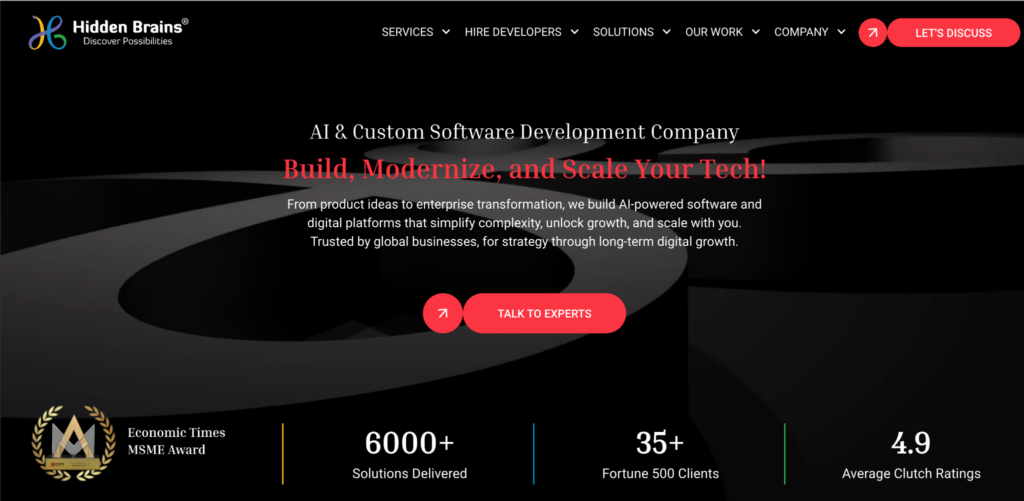
3. Hidden Brains
Strongest fit: large, multi-system smart factory programs.
Manufacturing AI experience
- Founded in 2003
- 6,000+ software solutions delivered
- 35+ Fortune 500 clients
- Manufacturing AI across predictive maintenance, quality control, demand forecasting, predictive analytics, IoT, ERP/MES, and smart factory systems
With more than two decades of delivery behind it, Hidden Brains brings production, machine, inventory, and quality data together to support maintenance, planning, and factory decisions. Predictive analytics can identify equipment or demand risks earlier, while AI-driven quality control and IoT monitoring reduce manual checks and improve visibility across production. ERP and MES integration keeps those insights tied to existing manufacturing workflows.
Question to ask: Who from your manufacturing practice, rather than the general delivery pool, would lead our project?
Best for Predictive Maintenance and Equipment Monitoring
Predictive and preventive maintenance is one of the most common AI applications in manufacturing. Look for teams that work with historian data and maintenance records, not only sensor dashboards, because failure history is what the models actually learn from.
4. EffectiveSoft
Strongest fit: continuous equipment monitoring built on machine telemetry.
Manufacturing AI experience
- 23+ years of software engineering experience
- 250-999 employees
- 4.9 Clutch rating across 19 reviews
- Manufacturing AI across predictive maintenance, visual inspection, production optimization, IoT monitoring, and industrial analytics
Machine telemetry is the starting point for EffectiveSoft’s manufacturing work, combined with production and quality data to support earlier maintenance decisions and continuous equipment monitoring. The team pairs AI, ML, analytics, and IoT to help plants detect process deviations, reduce unplanned downtime, and replace manual equipment tracking with real-time operational visibility.
Question to ask: How do you keep alert volume manageable for maintenance teams once monitoring runs around the clock?
5. Future Processing
Strongest fit: time-series models and asset-life prediction.
Manufacturing AI experience
- 25+ years of technology delivery
- 800+ specialists
- Manufacturing AI across predictive maintenance, computer vision, time-series analysis, industrial analytics, and asset-life prediction
Future Processing applies AI to maintenance, asset monitoring, image analysis, and production-related data problems where earlier detection can reduce downtime and improve planning. Its ML practice combines time-series models, computer vision, data engineering, and cloud infrastructure, so industrial data can be used for prediction and operational decisions instead of remaining in separate systems.
Question to ask: How did you validate asset-life predictions against failures that actually happened?
6. Instinctools
Strongest fit: equipment monitoring built on MES and SCADA data.
Manufacturing AI experience
- 25+ years of software engineering experience
- 250-999 employees
- 4.7 Clutch rating across 36 reviews
- Manufacturing AI across predictive maintenance, computer vision, production monitoring, MES, ERP, SCADA, and IoT
Instinctools works from the data plants already collect: MES captures shop-floor data and SCADA signals, while ERP and IoT sources add maintenance and asset context. On top of that foundation, it builds equipment monitoring, defect detection, and predictive maintenance, helping manufacturers reduce downtime, automate inspections, and respond to production issues earlier.
Question to ask: Which SCADA and MES platforms have you pulled data from, and was the connection read-only?
Best for Computer Vision and Quality Inspection
Vision projects are often the quickest to prove because results are easy to check at a single station. The harder part is keeping accuracy steady as products, lighting, and cameras change, so ask how each partner monitors its models after launch.
7. Geeks Ltd
Strongest fit: combining vision inspection, forecasting, and MES traceability in one program.
Manufacturing AI experience
- 18+ years of experience
- 1,500+ projects delivered
- 25% AI Development service focus on Clutch
- Manufacturing AI across predictive maintenance, computer vision, demand forecasting, yield optimization, anomaly detection, and production analytics
Geeks Ltd builds AI around production, quality, maintenance, and planning workflows, with manufacturing software that connects shop-floor and business data. Predictive models can flag equipment or quality risks earlier, while computer vision and forecasting reduce manual inspection and improve production decisions. Its manufacturing work also covers MES, IoT connectivity, traceability, and quality management, giving AI access to the operational data required for production use.
Question to ask: When the vision system flags a defect, how does the result link back to the batch record in the MES?
8. Infinanze Technologies
Strongest fit: visual defect detection paired with IoT sensor data.
Manufacturing AI experience
- Founded in 2022
- 10-49 employees
- 5.0 GoodFirms rating across 30 verified reviews
- 10% manufacturing industry focus
- AI capabilities across machine learning, visual defect detection, anomaly detection, IoT, preventive maintenance, and smart factory systems
Infinanze Technologies combines AI, computer vision, IoT, and enterprise software for manufacturing-related workflows. Image recognition can identify visual defects and anomalies, while connected sensor data supports preventive maintenance and equipment monitoring. These capabilities can reduce manual inspection and give operations teams earlier visibility into equipment and quality issues.
Question to ask: With a team of under 50 people, who covers support if the model degrades after a product change?
9. inVerita
Strongest fit: vision-based quality inspection tied to connected equipment.
Manufacturing AI experience
- Founded in 2015
- 150+ employees
- 4.9 Clutch rating across 41 reviews
- 25% AI Development service focus
- Manufacturing AI across computer vision, predictive analytics, IoT, equipment monitoring, predictive maintenance, and smart factory automation
inVerita applies AI and IoT to manufacturing workflows that depend on machine, visual, and operational data. Computer vision can support quality inspection, while predictive analytics and connected equipment data help teams identify maintenance risks earlier and improve production visibility.
Question to ask: How do you handle lighting changes and new product variants after the vision model goes live?
10. Scopic
Strongest fit: industrial image processing added to existing ERP or cloud systems.
Manufacturing AI experience
- 20 years of software development experience
- 250+ professionals
- 1,000+ projects delivered
- 20% manufacturing industry focus on Clutch
- AI work across machine learning, computer vision, image analysis, automation, and AI integration
Scopic combines AI with custom manufacturing software and industrial image-processing work. Computer vision and machine learning can support automated inspection, image analysis, and workflow automation, while AI integration connects new capabilities with existing ERP or cloud systems. This gives manufacturers a way to add automation and analytics without rebuilding the entire software environment.
Question to ask: Which of your imaging projects is closest to our defect types, and can we see its false-reject rate?
Best for Production Planning, Supply Chain, and Back-Office AI
These partners work above the machine layer, on scheduling, inventory, suppliers, and orders. Success here depends on clean ERP master data and on planners trusting the output, so ask for examples where the system is still in daily use.
11. Flyte Solutions
Strongest fit: replacing spreadsheet-heavy inventory and supply chain processes.
Manufacturing AI experience
- Founded in 2012
- 50-249 employees
- 350+ projects delivered
- 4.9 Clutch rating across 58 reviews
- ISO 9001 and ISO 27001 certified
- Manufacturing work across process automation, predictive analytics, data platforms, supply chain, inventory, and AI-enabled operational systems
Flyte Solutions works with manufacturing and supply chain data across inventory, operations, and enterprise workflows. AI and predictive analytics can help teams forecast demand, identify anomalies, automate reporting, and replace spreadsheet-heavy processes with centralized operational systems.
Question to ask: Which spreadsheets would the new system replace first, and how will planners check its numbers during the switch?
12. Innovacio Technologies
Strongest fit: forecasting and batch-quality monitoring across ERP, MES, WMS, and QMS data.
Manufacturing AI experience
- 130+ AI projects delivered
- 200+ projects completed
- 5.0 Clutch rating across 54 reviews
- AI work across predictive maintenance, computer vision, demand forecasting, supply chain intelligence, quality control, and industrial analytics
Innovacio Technologies applies AI to manufacturing workflows where fragmented operational data slows planning, maintenance, or quality decisions. Its manufacturing work covers equipment-risk prediction, visual inspection, production and demand forecasting, batch-quality monitoring, and supply chain analysis connected to ERP, MES, WMS, and QMS data. This gives production and operations teams earlier visibility into shortages, equipment issues, and quality risks while reducing the need for manual analysis.
Question to ask: How do you resolve conflicts when ERP, WMS, and QMS disagree about the same batch?
13. IT Services India
Strongest fit: MRP, production planning, and quality analytics.
Manufacturing AI experience
- Founded in 2010
- 1,000+ projects delivered
- 50-249 employees
- 5.0 Clutch rating across 14 reviews
- Manufacturing capabilities across predictive maintenance, production planning, MRP, quality management, Industrial IoT, BI, and analytics
IT Services India supports manufacturers with predictive maintenance, Industrial IoT, MRP, quality management, and operational analytics. These systems help teams detect equipment issues earlier, reduce manual tracking, improve inventory visibility, and make faster production-planning decisions.
Question to ask: How does the planning model handle changeover times and rush orders that planners currently manage by hand?
14. JPLoft
Strongest fit: production scheduling and supply chain decisions.
Manufacturing AI experience
- Founded in 2010
- 1,250+ projects delivered
- 130+ engineers, designers, and AI experts
- 5.0 Clutch rating across 96 reviews
- Manufacturing AI across predictive maintenance, computer vision, production planning, supply chain optimization, and smart factory automation
JPLoft builds AI around equipment monitoring, quality inspection, production scheduling, and supply chain decisions. Predictive models can flag machine issues before failure, while computer vision supports defect detection and automated quality checks. IoT integration connects these models with equipment and production data, helping teams reduce manual monitoring and respond faster to operational changes.
Question to ask: How do you get planners to trust an AI-generated schedule, and what happens when they override it?
15. SDLC Corp
Strongest fit: AI-enhanced ERP and digital twins.
Manufacturing AI experience
- 5.0 Clutch rating across 17 reviews
- 600+ completed projects
- 400+ software engineers
- Manufacturing AI across predictive maintenance, AI-enhanced ERP, IIoT, production analytics, quality workflows, and digital twins
SDLC Corp’s strongest angle is AI inside the ERP. The team links production, inventory, quality, maintenance, and plant data through ERP, MES, IIoT, and factory integrations, then applies AI to equipment-risk detection, production planning, quality analysis, and workflow automation, so manufacturers spend less time on manual tracking and make operational decisions faster.
Question to ask: Which ERP systems have you extended with AI, and did that work survive the next ERP upgrade?
16. UpCodo Digital
Strongest fit: back-office AI for product matching, orders, and suppliers.

Manufacturing AI experience
- 250+ projects delivered
- 50+ developers
- 5.0 Clutch rating across 32 reviews
- AI work for manufacturing businesses across product matching, workflow automation, vendor operations, and enterprise applications
UpCodo Digital applies AI to manufacturing business workflows such as product matching, order processing, supplier coordination, and enterprise operations. By automating repetitive decisions and connecting data across these processes, manufacturers can reduce manual work, shorten processing time, and improve visibility across orders and supplier activity.
Question to ask: Which order and supplier workflows have you automated for a manufacturer, and what error rate did the client accept?
Best for IIoT, Edge Computing, and Digital Twins
Choose from this group when the AI has to run close to the machines, on gateways, embedded devices, or a live digital twin. Device security and remote updates matter as much as the model here, so review the device questions in the checklist below.
17. CodeBright
Strongest fit: adding AI to existing plant automation on a smaller scale.
Manufacturing AI experience
- Founded in 2015
- 10-49 employees
- 5% AI Development and 4% IoT Development service focus
- Manufacturing work across AI, digital twins, plant automation, IIoT, ERP, and factory-system integration
CodeBright works with manufacturers on plant automation, IIoT, ERP, and connected factory software. Its AI capabilities cover forecasting, image analysis, and data-driven automation, while manufacturing projects show experience with machinery integration and production systems. This makes the company relevant for manufacturers adding AI around existing automation and operational software.
Question to ask: Which PLC and automation platforms have you integrated with, and who on your team has worked on site?
18. Radixweb
Strongest fit: anomaly detection tied to edge devices and HMIs.
Manufacturing AI experience
- 26+ years of software engineering experience
- 4,500+ projects delivered
- 3,000+ clients worldwide
- Manufacturing AI across predictive maintenance, computer vision, anomaly detection, demand forecasting, digital twins, and process optimization
Radixweb’s manufacturing work reaches down to edge devices and HMIs, linking production and machine data with MES, IIoT, and enterprise systems. AI and ML models use historical and real-time data to detect anomalies, automate visual quality checks, forecast demand, and flag equipment risks earlier, which helps plants cut unplanned downtime, limit manual inspection, and react faster to production issues.
Question to ask: What runs on the edge device versus the cloud, and what happens when the plant network drops?
19. SoluLab
Strongest fit: IIoT connectivity and digital twin programs.
Manufacturing AI experience
- Founded in 2014
- 250+ AI, software, and data experts
- 1,500+ projects delivered globally
- 4.9 Clutch rating across 55 reviews
- Manufacturing AI across predictive maintenance, computer vision, production optimization, quality inspection, IIoT, and digital twins
SoluLab works with production data from machines, sensors, MES, ERP, and other plant systems to support maintenance, quality, and production decisions. Predictive models can flag equipment issues earlier, while computer vision and anomaly detection reduce manual inspection and help teams respond to process deviations faster. Its manufacturing work also covers IIoT connectivity, MES/ERP integration, and digital twins, giving AI access to operational data instead of keeping models isolated from factory workflows.
Question to ask: Is your digital twin fed by live plant data or periodic exports, and how often does it refresh?
20. Yalantis
Strongest fit: AI running on embedded, edge, and IoT hardware.
Manufacturing AI experience
- 17+ years on the market
- 200+ projects delivered
- 10+ years of manufacturing experience
- 30+ manufacturing projects delivered
- Manufacturing AI across predictive maintenance, computer vision, digital twins, IoT, edge computing, and process automation
Yalantis combines AI with sensor, edge, embedded, and cloud systems used in industrial environments. Predictive maintenance models can use equipment data to flag failure risks earlier, while computer vision supports automated defect detection and quality inspection. This gives manufacturers faster visibility into equipment and quality issues while reducing manual checks.
Question to ask: How do you update models and firmware on devices already installed on the line?
Custom AI Development or an Industrial AI Platform?
Every company on this list builds custom software. That is the right call for some factory problems and an expensive detour for others.
Off-the-shelf industrial AI platforms usually make more sense when the problem is common and the equipment is standard, such as vibration monitoring on motors, pumps, and fans. Those models are often trained on data from many similar machines, so deployment is mostly sensor installation and configuration rather than development.
Custom AI development earns its cost when:
- The defect you need to catch is specific to your product, material, or process, so no pretrained vision model has seen it.
- The value comes from joining data no single platform can reach, such as warranty claims matched against batch and quality records.
- The model has to live inside your own MES screens and operator workflows instead of another vendor’s dashboard.
- Customer contracts, data residency rules, or defense work limit where production data can be processed.
Many plants end up with both: a platform for rotating equipment and a custom layer that turns its alerts into work orders and quality holds. Our breakdown of custom software versus SaaS covers the cost and lock-in tradeoffs in more depth.
The second decision is who looks after the model once it is live. A model trained on last year’s product mix drifts as materials, suppliers, and machines change. If you plan to own it in-house, you need at least one engineer who understands both the model and the plant floor, and our guide on how to hire AI engineers who ship real products explains what to screen for. If not, put retraining and support in the vendor’s statement of work from day one.
What Matters When Choosing AI Development Companies for Manufacturing
Manufacturers should start by identifying the problem they want to address and reviewing the data they already have in their production systems. Predictive maintenance, visual inspection, planning, and GenAI each depend on different types of data, system connections, and ways to check results.
The best AI development companies for manufacturing know how to handle industrial data, link their models to current systems, and explain how they will measure performance after the system is running. Experience with MES, ERP, SCADA, IoT, and quality platforms matters because most AI projects must fit into existing factory setups.
Before you shortlist anyone, our guide on how to choose a manufacturing software development company covers the full vetting process, including cost ranges, OT security checks, and contract terms that protect you.
The key question is whether the vendor can turn a promising model into a reliable production system without adding complexity.
Questions to Ask Before You Sign
- Which of your manufacturing AI projects are still in production today? Pilots are easy to sell. Ask to speak with a client whose system has been running for at least a year.
- Will the first phase be read-only? Strong partners start by reading from your historian, MES, or OPC UA server, which proves value without touching control logic. Ask for MES and ERP integration examples from plants similar to yours.
- What baseline are we measuring against? Agree on one or two KPIs, such as unplanned downtime hours, scrap rate, first-pass yield, or inspection hours, and record their current values before any code is written.
- What happens when the model is wrong? Find out who receives the alert, what the operator is expected to do, and how false positives get logged and fed back into training.
- How do you secure devices added to the plant floor? Cameras, gateways, and edge computers create new entry points into your network. Ask about segmentation between IT and OT networks, device identity, and signed firmware updates. Our explainer on secure boot and embedded security by design shows what a good answer looks like for any connected device on the line.
- Who owns the trained models, labeled data, and code? Put it in the contract. Without them, switching vendors means starting over.
Red Flags in Manufacturing AI Proposals
- The demo runs on a public dataset instead of a sample of your data.
- The proposal starts by replacing your MES or ERP.
- The pilot has an hourly rate and a timeline but no success criteria.
- Accuracy is quoted without false positive rates or what a false alarm costs on the line.
- Nobody on the proposed team has worked with OT engineers or on a plant floor.
Which Manufacturing AI Use Case Is Hardest to Put in Place?
Each common use case is hard in a different way, which is why the right partner depends on where you start.
Computer vision inspection is usually the fastest to prove. The problem is contained to one station, results are easy to verify, and labeled images can often be collected in weeks. It gets harder at scale: new product variants, lighting changes, or a bumped camera can quietly erode accuracy, so ask how the vendor monitors performance after launch.
Predictive maintenance is harder to prove than it sounds. Serious failures are rare, so there may be only a handful of real examples to learn from, and older machines often need sensors before any model can run. Pilots that start with critical assets already feeding a historian move much faster than pilots that start with a sensor retrofit.
Production planning and scheduling is usually the hardest to get adopted. The model depends on accurate ERP master data, routings, and changeover times, and it changes decisions planners have owned for years. Technical accuracy means little if the planning team keeps overriding the schedule.
Generative AI for plant operations is the quickest to demo and the slowest to trust. An assistant that answers from SOPs and maintenance manuals is only safe if it cites the current version of each document, so document control matters more than the model.
For most manufacturers, the practical path is to start where the data already exists and the result is easy to measure, prove value on one line, then expand. Choose a partner that has shipped the use case you are starting with, not only the one on your long-term roadmap.
Manufacturing AI Costs, Pilots, Data, and Model Ownership
It builds and integrates custom AI systems that run on factory data, such as predictive maintenance models, computer vision inspection, demand forecasting, and production analytics. Most of the work usually goes into connecting MES, ERP, SCADA, sensor, and quality data so the model has reliable inputs, then deploying it into tools operators and engineers already use.
Cost depends less on the model than on the integration and data work around it. The main drivers are how many systems must be connected, whether new sensors or cameras are needed, how much data must be labeled, and whether the vendor supports the model after launch. Ask for a fixed-scope pilot on one line or asset group, with agreed success criteria, before committing to a full rollout.
Pilots that use existing historian or MES data for a single use case can often show results within a few months. Timelines stretch when sensors must be installed first, when data needs heavy cleanup, or when IT and OT security approvals start late, so start those approvals at kickoff.
At minimum, time-stamped machine data such as vibration, temperature, current, or pressure, plus maintenance records showing when and why equipment failed or was repaired. The maintenance history is often the weak point: work orders that just say “fixed” give the model nothing to learn from, so cleaning up failure codes early pays off.
Buy when the problem is common and the equipment is standard, such as vibration monitoring on rotating assets. Build when the defect, process, or data combination is specific to your plant, or when the AI must live inside your own MES and workflows. Many manufacturers use both.
Usually, yes. Experienced vendors start with read-only connections through historians, OPC UA servers, or database replicas, so the AI observes production data without changing control logic. Writing back to control systems, if it is needed at all, comes later and goes through your normal change management process.
Whoever the contract says, so settle it before signing. Ask for ownership of the trained models, labeled datasets, source code, and the documentation needed to retrain. Without those, changing vendors later means starting over.
Pick one or two operational KPIs, record their current values before the project starts, and compare the pilot line against a similar line without AI. Common choices are unplanned downtime hours, scrap or rework rate, first-pass yield, inspection labor hours, and warranty cost per unit. Convert results into money only after the improvement has held for several weeks.