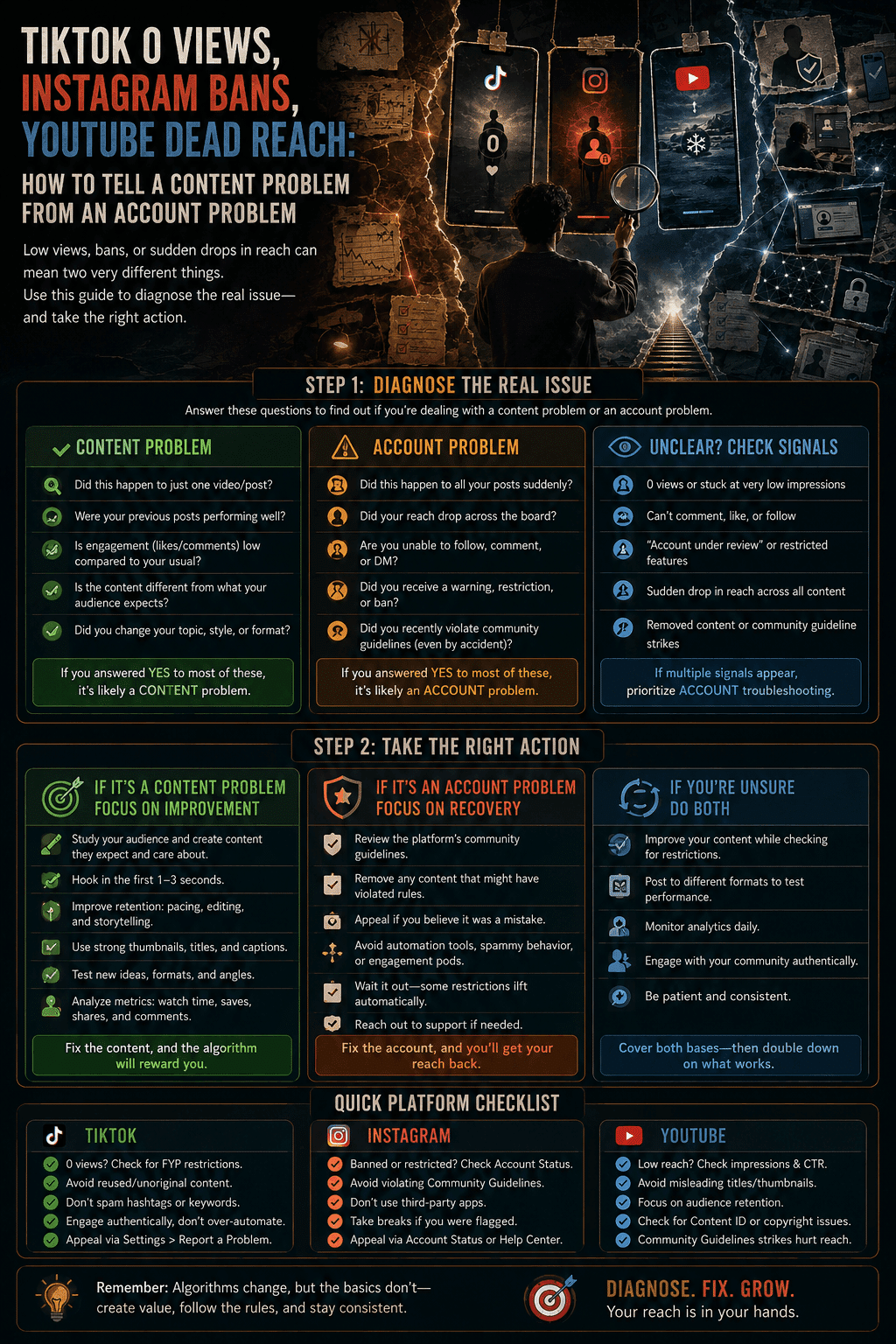
You post a video. An hour later it says 0 views. Not four, not twelve. Zero, on an account that was doing fine last month.
Then the same week an Instagram account gets disabled with no warning, and a YouTube upload sits at 3 views for two days while the last one did 4,000.
Most advice you’ll find blames the content: the hook was weak, you posted at the wrong time, the algorithm changed. Sometimes that’s true. But 0 views is a different animal from low views, and if you’re seeing it across several platforms at once, the thing they have in common usually isn’t your creative. It’s the account, the device, and the connection all three platforms are looking at.
Here’s how to work out which one you’ve got before you rewrite your content strategy for nothing.
First, rule out the boring explanations
Do this before anything else, because most of the time it ends here.
A brand-new account with no history gets throttled by default for a while. That’s normal and it passes. If you’re under a week old with three posts, you don’t have a problem, you have a new account.
Commercial music on TikTok can quietly limit distribution for business accounts. So can a visible watermark from another platform, which is the single most common cause of a video going nowhere. Reposting your own Reels straight to TikTok with the watermark still on it is a reliable way to get buried.
If the account is new, the more useful question is whether you have a distribution problem or simply no audience yet. The fixes for those are entirely different, and the early-stage work is covered in these strategies for growing a TikTok following.
Then there’s the obvious one: a community guidelines strike you didn’t read carefully. Check the account status page rather than assuming. Instagram, TikTok and YouTube all have one, and they’ll tell you if something is formally restricted.
If none of that applies, and especially if it’s happening on more than one platform at once, keep reading.
What 0 views actually means
Low views mean the platform showed your video to a test audience and they didn’t watch it. That’s a content signal, and it’s fixable with better content.
0 views means it was never put into distribution at all. Nobody declined to watch it. It wasn’t offered.
That distinction matters because it points at a completely different cause. Content quality can’t produce a zero, since the test audience never got the chance to react. Something decided, before anyone saw it, that this upload wasn’t going into the pool.
The Instagram version is a ban or a sudden “confirm your identity” prompt. The YouTube version is views that freeze, sometimes with the video stuck processing far longer than the file size justifies. Different symptoms, same underlying decision: the platform stopped trusting the session that produced the upload.
What the three platforms are actually comparing
They all build a picture of who is posting, and they all cross-reference the same three layers.
The account itself: age, history, past strikes, how it behaves compared to a week ago.
The device and browser: user agent, screen size, fonts, timezone, the thing antidetect browsers exist to manage.
And the connection: which IP, which network operator that IP belongs to, and whether the country matches everything else about the account.
Trouble happens when those layers contradict each other. An account whose audience and language are Brazilian, posting from a German datacenter IP, on a browser claiming to be an iPhone. Nothing there is against the rules individually. Together it reads as someone hiding something.
When the Contradiction Is Accidental
The layers contradicting each other is usually not deliberate. Five ordinary situations produce it:
You travelled. Logging into an account from three countries in a month is a legitimate life event and an anomaly signal. Reach dips and identity checks after international travel are common and usually resolve.
Your workplace VPN is on. Corporate VPNs terminate at datacenter ranges. If you post during work hours through a company tunnel, every upload comes from a machine-labelled address.
You moved house or changed provider. A sudden permanent IP change on an established account, with no travel pattern leading to it, looks like an account takeover before it looks like a move.
You’re on shared or carrier-grade NAT. Apartment building wifi, coworking spaces, and some mobile carriers put thousands of users behind one address. If anyone on that address ever abused a platform, you inherited the reputation, and there is nothing you can do about their behaviour. This is the one case on this list you cannot wait out, because the address does not improve. The options are a different connection, mobile data instead of the building wifi, or a clean static address you control. Proxya’s ISP proxies are one route to the last of those: registered to consumer internet providers so they read as home lines, static rather than rotating, from $2.50 with unmetered traffic, which matters if you upload video.
You got a new phone. A device fingerprint change plus a login is two anomalies at once. Common, benign, and occasionally enough to trigger a verification prompt.
What to do in all five: nothing dramatic. Stop changing things, keep posting normally from one consistent connection, and complete any verification prompt honestly. Trust rebuilds over days to weeks. The most damaging response to a temporary dip is a flurry of changes that produce more anomalies.
If you publish to TikTok from a website workflow rather than the app, the integration layer is worth checking too, since a broken or outdated connection can silently fail uploads. The current options are covered in this rundown of WordPress TikTok plugins.
The five-minute diagnostic
Before changing anything, find out what the platforms see.
Look up your current IP on IPQualityScore or Scamalytics and read the fraud score. You want zero. A score of 30 or 60 means the address has a history: someone spammed from it, it’s a known VPN exit, or it’s flagged as a proxy. If you’re on office wifi or a consumer VPN, this alone explains a surprising number of bans.
Check what type of network the address belongs to. Every IP sits in an autonomous system that’s tagged as either consumer or hosting. If you moved your posting to a cheap server or a datacenter proxy to “look more stable”, you’ve swapped a messy address for one that’s openly labelled as a machine. For public browsing nobody cares. For a logged-in account uploading video, it’s the loudest signal in the stack.
Then check whether the country of that IP matches the audience and the phone number on the account. A US account posting through a Netherlands exit for three months is a contradiction the platform has no reason to forgive.
If you manage accounts for clients, check whether any two have ever posted from the same connection. Platforms treat linked accounts as one entity for enforcement, which is why agencies use Meta Business Suite, TikTok Business Center and delegated YouTube access rather than separate logins from one desk.
What to change, in order
Stop rotating. Rotating residential proxies are excellent for collecting public data and wrong for account work, because they hand you a new address constantly. To a platform, one person who was in three cities during a single upload session is not a normal user. Accounts want the opposite of rotation: the same address, indefinitely.
Get a clean, static address that reads as residential. That is what ISP proxies are for, sometimes called static residential: registered to a consumer internet provider so it looks like a home line, hosted on server hardware so it is fast and never rotates. Unmetered matters more than it sounds for video work, since uploading TikTok and YouTube content through a per-gigabyte plan gets expensive quickly.
Then fix the layer under the browser, because this is the one that catches people who did everything else right. Every connection carries an operating-system fingerprint in how it builds TCP packets, and it’s readable passively. Route ten accounts through most providers and all ten emit the same Linux signature from the provider’s own hosts, while each browser claims to be Windows or an iPhone. That contradiction is a signal by itself, and worse, it makes your ten accounts look related. Proxya lets you set an OS fingerprint profile per proxy so the packet layer agrees with the browser: Windows 11 with Chrome, Edge or Firefox, macOS, or Android 14.
One account, one address, permanently. Write down which is which. At account number eight this stops being something you can hold in your head, and the day two clients share an IP is the day one client’s ban becomes both clients’ problem.
Warm a new address before you do anything commercial on it. A few days of ordinary use beats logging in and immediately uploading three videos from an IP the platform has never seen.
What this won’t fix
Being honest about the limits, because the network layer is not magic.
If you posted something that broke the rules, clean IPs won’t bring the account back. Appeal instead.
If ten accounts post near-identical captions within the same minute, they’ll be caught regardless of how good the addresses are, because that pattern lives entirely above the network. The proxy gives you a plausible identity. Repetitive behaviour throws it away.
And coverage is a real constraint: ISP addresses have to be leased from actual providers, so the country list is much shorter than a residential pool’s. Check the country you need is in stock before you build a plan around it, and use sticky residential sessions where it isn’t.
If the Account Is Actually Restricted
Diagnostics matter before a restriction. After one, only the appeal does.
Find the formal status first. Instagram’s Account Status, TikTok’s account status in settings, and YouTube Studio’s channel violations page each show whether something is formally restricted and why. If nothing appears there, you likely have a distribution problem rather than an enforcement action, and appeals will go nowhere.
Appeal windows are short. Each platform sets its own limit, and they are measured in days rather than weeks. Missing the window usually forecloses the route entirely. Check the exact deadline in the notification the moment you receive it.
Write the appeal like a person, not a template. State what the account does, what you believe triggered the action, and what you have changed. Copy-pasted appeals perform poorly. So does volume: submitting five appeals does not increase your odds and can look like abuse.
One appeal, then wait. Response times run from days to weeks. Re-uploading the removed content or creating a replacement account while an appeal is pending is the most reliable way to convert a temporary restriction into a permanent one.
When it’s genuinely over. If the violation was real and the appeal is exhausted, no network change brings the account back. Rebuild rather than evade, because a replacement account that the platform links to a banned one gets removed faster than a fresh one would.
Working out which problem you have
Quick version. Zero views on a new account with a watermark is content. Zero views across three platforms in one week, on accounts that used to work, from one office connection, is not content.
Check the IP first because it takes five minutes and costs nothing. Confirm nothing is formally restricted, because that changes the whole answer. Then go back to arguing about hooks and posting times, which is a much nicer problem to have.
TikTok 0 Views and Reach Problems: Common Questions
Zero means the video was never entered into distribution, which is different from low views. The most common causes are a visible watermark from another platform, commercial music on a business account, a brand-new account still in its throttling period, or a formal restriction you can see on the account status page. Check those in that order before assuming anything about the algorithm.
No, and the term does more harm than good. Platforms do restrict distribution without notifying users, but “shadowban” gets applied to any reach drop including normal variance. Check the account status page first. If nothing is flagged there and the video shows genuine zero rather than low views, the cause is usually mechanical, such as a watermark or a music licence, rather than a hidden penalty.
It varies by platform and severity, and no platform publishes a schedule. What is consistent is that the recovery path is unremarkable posting from a stable setup rather than intervention. Deleting old content, changing your posting pattern sharply, or switching accounts typically extends the period rather than shortening it.
Look at variance before diagnosing a problem. Reach on short-form video is genuinely volatile, and a single underperforming post against a strong previous one is not a signal. Compare a rolling two-week average against the prior two weeks. If the drop is real and sustained, check watermarks, music licensing, and whether anything changed about where and how you post.
Managing client accounts through a documented, consistent setup is normal agency practice, and platforms provide legitimate multi-account tooling for exactly this: Meta Business Suite, TikTok Business Center, and YouTube brand accounts with delegated access. Those routes give you separation without misrepresenting anything, and they are what platform support will ask about if a client account has trouble.
Infographic