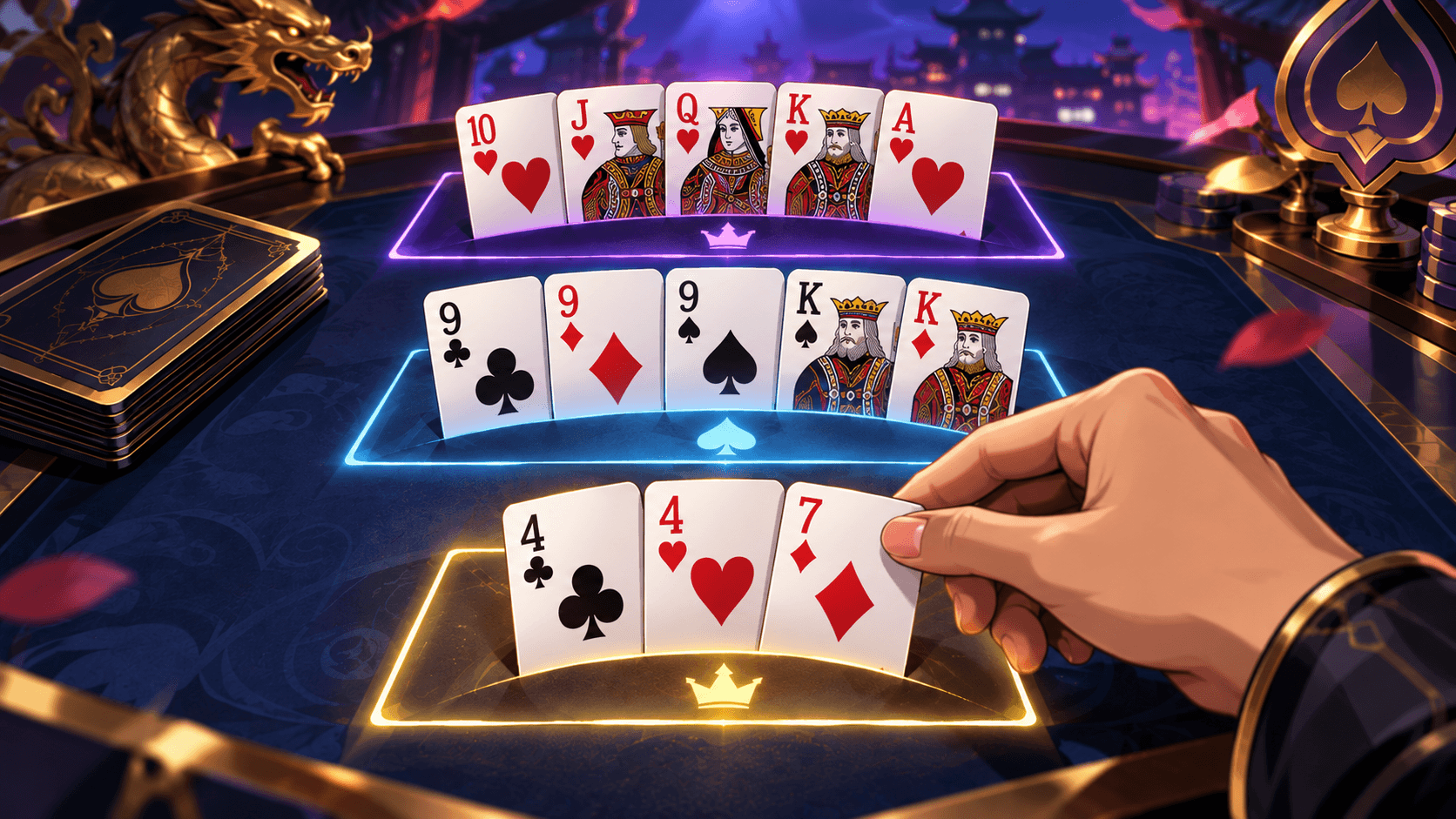
Card arrangement holds a crucial role in Pusoy GZone, where 13 cards must be sorted into three separate hands: Front, Middle, and Back. Each hand comes with specific card limits and must follow a strict order of strength affecting the validity of the entire layout. Knowing the proper rules helps players identify strong combinations, compare hands effectively, and avoid frequent errors. For newcomers exploring Pusoy online gaming, understanding these fundamentals is a key step before organizing your hand.
Card Structure in Pusoy Plus
Pusoy Plus uses a 52-card deck without jokers, suitable for 2 to 4 players. Players receive 13 cards each, which must be arranged into three distinct hands:
| Hand | Cards Count | Possible Combinations |
| Front | 3 | Three of a kind, one pair, high card |
| Middle | 5 | One pair, two pairs, three of a kind, straight, flush, full house, four of a kind, straight flush, royal flush |
| Back | 5 | One pair, two pairs, three of a kind, straight, flush, full house, four of a kind, straight flush, royal flush |
The Front hand, with three cards, forms fewer combinations, such as three of a kind, one pair, or just a high card. The Middle and Back hands, each containing five cards, accommodate a broad range of combinations, including straights, flushes, and full houses. Assessing all 13 cards together before splitting ensures the optimal layout that respects the required strength order.
Hand Rankings in Pusoy Plus
Competent play requires grasping hand rankings to compare combinations accurately. For the five-card Middle and Back hands, the ranking from strongest to weakest is:
- Royal Flush
- Straight Flush
- Four of a Kind
- Full House
- Flush
- Straight
- Three of a Kind
- Two Pair
- One Pair
- High Card
The Front hand follows a simplified ranking due to its smaller size, limited to:
- Three of a kind
- One pair
- High card
When two hands share the same combination type, card ranks determine relative strength. For example, one-pair hands compare the rank of the pair first, followed by any kickers (remaining cards). Two-pair hands compare the higher pair, then the lower pair, and finally the kicker. Keeping updated with variant-specific tie-breaking rules ensures correct evaluation.
Fundamental Rule for Valid Arrangement
The key rule to a valid hand arrangement in Pusoy Plus requires:
Back hand ≥ Middle hand ≥ Front hand
This hierarchy enforces that the Back hand must be at least as strong as the Middle hand, which in turn must be at least as strong as the Front hand. An example of a legal setup could be a full house in the Back, flush in the Middle, and one pair in the Front. Here, the full house outranks the flush, which outranks the pair (applying the Front’s three-card ranking).
Violating this order by placing a stronger Middle hand than Back hand, or a Front hand stronger than the Middle, invalidates the entire arrangement. Validation involves comparing complete hands, not isolated cards. It is wise to first compare Back vs. Middle, then Middle vs. Front before submitting the hand.
Common Mistakes in Card Arrangement
Certain mistakes frequently disrupt valid card setups and reduce winning chances:
- Allowing the Middle hand to overpower the Back hand: This breaks the core strength hierarchy rule and leads to invalid hands.
- Ignoring the Front hand’s specific ranking rules: Applying five-card hand rules to the Front hand often causes misjudgments since it only has three cards.
- Mixing up rankings between similar combinations: Straights, flushes, and full houses have distinct ranks, so confusion leads to incorrect orders.
- Overlooking card ranks in matching combinations: Equal combinations aren’t always equally strong; card ranks and kicker values can produce differences.
- Focusing on one hand instead of the entire trio: A strong single hand does not guarantee legality; all three must be reviewed as a group.
Recognizing these errors allows players to reevaluate and improve their card arrangements effectively.
How to Confirm Your Card Arrangement
Before submitting any arrangement, a thorough review checklist proves helpful:
- Verify all 13 cards are used correctly.
- Confirm the Front hand contains exactly three cards.
- Ensure the Middle and Back hands each hold five cards.
- Accurately identify each hand’s combination type.
- Confirm the Back hand is at least as strong as the Middle hand.
- Verify the Middle hand is at least as strong as the Front hand.
- Check for tie-breakers when hands share the same combination type and apply variant-specific rules.
Using this methodical checklist significantly reduces errors and ensures compliance with Pusoy Plus rules. It is also advisable to review the game’s in-app instructions, which often provide variant-specific guidelines and clarifications.
Frequently Asked Questions
Q1: How many cards does each player get in Pusoy Plus?
Each player receives 13 cards divided into one Front hand of three cards and two five-card hands for the Middle and Back.
Q2: Can the Middle hand outrank the Back hand?
No. The Back hand must always be at least as strong as the Middle hand to comply with valid arrangements.
Q3: How are ties judged in Pusoy Plus?
When hands have the same combination, the winner is decided by comparing card ranks and following tie-breaking rules, which may vary by game version.
Conclusion
Mastering card arrangement in Pusoy GZone unlocks greater strategic potential for players. Understanding the distinct combination possibilities, hand rankings, and mandatory strength hierarchy among Front, Middle, and Back hands is crucial. Avoiding common pitfalls such as misjudging hand strength or neglecting component rankings enhances the chances of success. Utilizing detailed checklists before submitting an arrangement helps maintain legality and competitiveness. With thoughtful preparation and rule awareness, Pusoy Plus gameplay can evolve from a game of chance into one of skillful decision-making, offering greater satisfaction and success in every round.
This detailed insight into card arrangement rules and common mistakes in Pusoy GZone aims to serve as a comprehensive guide for players aiming to elevate their game while enjoying the rich traditions of this popular Filipino card game online.