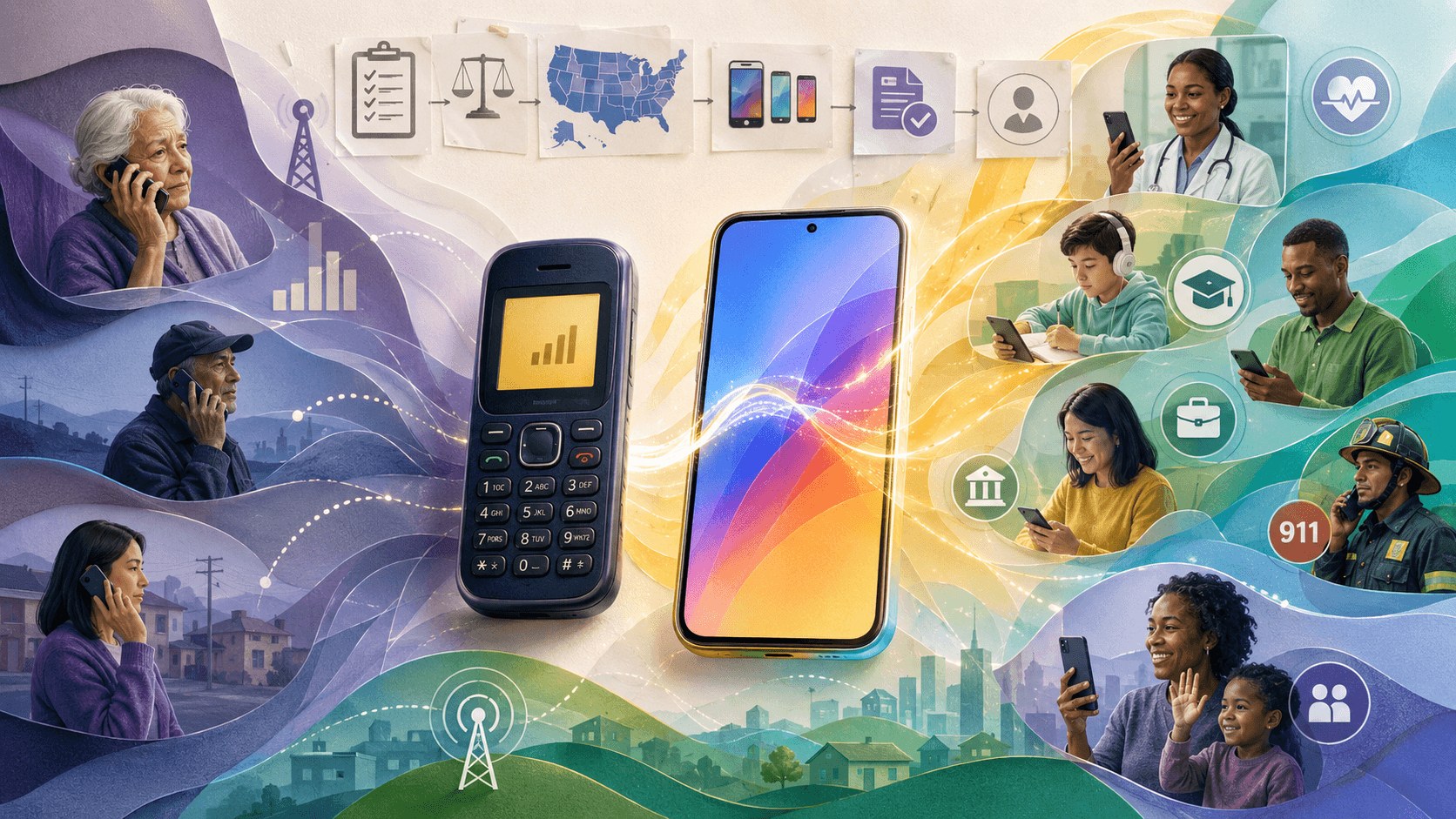
The idea behind phone assistance programs has always been simple: make sure people who need to stay connected can afford to do so. But the definition of “connected” has changed dramatically over the years. Voice calls gave way to text messaging, then to mobile internet, and now to full smartphone functionality.
What these programs provide today reflects that shift. For anyone considering applying, knowing how far things have come makes it easier to understand what to look for.
The Early Goal: Basic Communication Access
Before smartphones became central to daily life, the goal of phone assistance programs was straightforward: make sure low-income households could afford to make and receive calls.
The Lifeline program, established in 1985, was built on that premise. It offered a monthly discount on phone service for qualifying households, recognizing that even basic communication was becoming a necessity rather than a luxury.
At that stage, the focus was purely on voice access. Being reachable in an emergency, staying in contact with employers, and keeping family connections intact were the priorities. Data, apps, and internet access were not part of the equation.
It’s also worth clarifying something that still confuses many applicants today: the government does not provide phones directly. Devices have always come through participating service providers, not federal agencies themselves.
What Lifeline Actually Provides in 2026
Before the history, the current numbers, because most articles on this topic skip them entirely.
| Monthly discount | Up to $9.25 |
| Tribal lands | Up to $34.25 (the $9.25 plus $25 enhanced support) |
| Applies to | Phone service, broadband, or a bundle. One or the other, not both |
| Limit | One Lifeline benefit per household |
| Administered by | Universal Service Administrative Company (USAC), under the FCC |
| Where to apply | lifelinesupport.org, by mail, or through a participating provider |
| Renewal | Annual recertification required |
Who qualifies. Household income at or below 135% of the Federal Poverty Guidelines, or participation in one of these programs: SNAP, Medicaid, Supplemental Security Income, Federal Public Housing Assistance, the Veterans and Survivors Pension Benefit, or certain Tribal programs. Full rules are on the FCC’s Lifeline consumer page.
Three rules that catch people out.
One per household means one, and “household” is defined as people living at the same address who share income and expenses. Roommates who keep separate finances can each qualify and may need to demonstrate that at enrollment. Getting this wrong is not a paperwork problem; subscribers with more than one service must de-enroll immediately or face penalties.
Recertify every year. USAC or your provider will ask you to confirm you still qualify, usually with notice ahead of the deadline. Ignore it and you are de-enrolled and start over. This is the single most common way people lose the benefit, and it is entirely avoidable.
The discount is applied to your bill. You do not receive a payment, a card, or a cheque. Anyone telling you otherwise is not describing Lifeline.
How to apply. Most states use the National Verifier at lifelinesupport.org, which checks eligibility against government databases and can approve in minutes. If it cannot confirm automatically, you upload documents for manual review. California, Oregon, and Texas run their own processes. You can also apply by mail or ask a participating provider to help. The Lifeline Support Center is on 1-800-234-9473.
The application has two steps
Lifeline works in two stages, and conflating them is where most confusion starts.
- Step one is eligibility, and it is a government process. The National Verifier at lifelinesupport.org determines whether you qualify. It costs nothing, no company is required, and the answer does not change depending on which carrier you approach.
- Step two is enrollment, and that is where a company comes in. Once approved, you choose a participating provider, and they apply the discount to your bill. Providers compete on plan terms and on what device they include, which is why offers vary so much between them.
This is what the earlier point about handsets was getting at. Searching for a free phone from government returns carriers rather than agencies, because carriers are what exists at step two. The eligibility decision comes from USAC. The phone comes from a company. Comparing providers is worth doing, and it is the second decision rather than the first.
The Shift Toward Smartphones and Data Access
For most of Lifeline’s history, a phone call was enough. That stopped being true sometime in the last decade. Internet access has moved from convenience to a practical requirement, and the shift happened faster than most people anticipated.
Banking is a clear example. Branches have closed, and many financial services now operate primarily through apps. Healthcare followed a similar path, with telehealth platforms becoming a standard option for consultations and prescription management. Education made the jump too, particularly after 2020, when remote learning exposed just how many students lacked the tools to keep up outside the classroom.
These changes put pressure on assistance programs to offer more than voice service. A basic handset with calling minutes was no longer a meaningful form of support for someone trying to apply for jobs online or access a patient portal.
That pressure produced results. Participating providers began introducing smartphones alongside their plans, giving eligible applicants the option to receive a capable device through the application process.
For many households, that shift turned an assistance program into an entry point for full digital participation rather than just communication. The change was gradual, but the direction was clear. Connectivity had been redefined, and the programs supporting low-income households had to follow.
What Happened to the ACP, and Why It Matters
Any account of how these programs have evolved has to include the largest single change in the sector’s history, and it was a contraction rather than an expansion.
The Affordable Connectivity Program launched in December 2021 under the Infrastructure Investment and Jobs Act. It provided up to $30 per month toward internet service, up to $75 on qualifying Tribal lands, plus a one-time discount of up to $100 toward a laptop, desktop, or tablet. At its peak more than 23 million households were enrolled.
Enrollment froze in February 2024. The program ended on June 1, 2024 when its $14.2 billion in funding ran out and Congress did not renew it. As of 2026, no federal replacement has been enacted, though legislation to revive it has been introduced.
Lifeline was unaffected, because it is funded through the Universal Service Fund rather than congressional appropriations. But the two programs were never equivalent. Households that had been receiving $30 a month for broadband found that the remaining federal option was worth $9.25.
Three things follow from this that a prospective applicant should understand:
If you lost a discount in mid-2024 and never worked out why, that was the ACP ending. You may still qualify for Lifeline, which is a separate application.
Lifeline eligibility is stricter. ACP reached households at up to 200% of the Federal Poverty Guidelines. Lifeline’s threshold is 135%. Some households that qualified for ACP do not qualify for Lifeline.
State and provider programs have partially filled the gap, unevenly. California’s LifeLine broadband pilot comes closest to matching the old ACP benefit. Several internet providers run their own low-income offerings. Checking what exists in your specific state is worth doing before assuming Lifeline is the only option.
There is also a participation gap worth naming. Roughly 7.6 million households receive Lifeline, which is around a fifth of those eligible. The most common reason people do not get the benefit is not that they were rejected. It is that they never applied.
Changing User Expectations: It’s No Longer Just About Having a Phone
When smartphones became the norm, they raised the bar for what people consider acceptable in a device. That shift did not stay confined to the consumer market. It carried over into how people think about the phones they receive through assistance programs.
A working phone used to be enough. Now, users expect something more specific: a screen that responds reliably, enough processing power to run common apps without freezing, and a camera that handles basic tasks. These are not luxury expectations. They reflect what mainstream devices have made standard.
The influence of that standard is hard to ignore. People who use assistance programs are the same people who see what current smartphones can do. Their expectations have moved accordingly.
A device that struggles to load a job application or drops a telehealth call mid-session is not just frustrating. For many users, it’s a practical barrier to the things they applied for the benefit of accessing in the first place.
The Emergence of Premium Device Offers in Assistance Programs
As competition among Lifeline providers increased, so did the quality of devices on offer. The entry-level Android phones that once defined the program have gradually given way to a broader range, with some carriers now including mid-range and occasionally higher-end models in their lineups. A capable smartphone does more for an eligible household than a low-end handset running outdated software.
For applicants, this has meant more options than the program historically provided. Certain providers have made it possible to receive a recognizable device through the application process. A free iPhone 13, for example, has appeared as an option through select carriers, depending on eligibility requirements and what the provider currently has in stock.
That last point matters. These offerings are not guaranteed. Device availability varies by provider, changes with inventory, and is often tied to geographic location. What one carrier offers in a particular state may not be available elsewhere.
Applicants should approach these possibilities with realistic expectations and verify current availability directly with the provider before applying.
The Upgrade in Device Offerings: Balancing Expectations vs Reality
The improvement in device offerings across Lifeline providers came from two directions: competition among carriers and growing policy focus on digital inclusion. As more providers entered the space, the pressure to offer something better than the minimum increased.
The result is a wider range of options for eligible applicants than the program has historically offered. AirTalk Wireless is among the providers that have focused on pairing accessible plans with devices that hold up under real daily use, particularly for underserved households.
Still, it’s worth being clear about what applicants should realistically expect. High-end devices are not guaranteed outcomes. Available models depend on provider inventory at the time of application, which can shift.
Coverage quality varies by carrier and region, meaning the same provider may deliver different experiences depending on where someone lives.
Approval timelines differ, too. Processing speeds vary between providers depending on application volume and documentation requirements.
For anyone approaching these programs with specific expectations, understanding these variables in advance makes a real difference. Researching providers before applying, rather than after, tends to lead to a more realistic and satisfying outcome.
How Device Quality Impacts Real-Life Outcomes
Not all devices deliver the same experience, and that difference matters more than it might seem. For someone working remotely, a slow or unreliable device can mean dropped video calls, delayed responses, and a harder time keeping up with the demands of the job.
A capable smartphone or tablet removes those friction points and makes remote work genuinely viable.
In education, device performance shapes how effectively a student can participate. Lagging software, poor camera quality, and limited storage can all get in the way of a virtual class or an online assignment. A better device keeps those barriers out of the picture.
Telehealth access is similarly affected. A stable connection and a functioning camera are basic requirements for a video appointment to work properly. When the device cannot support that, patients may avoid or delay care they actually need.
For people relying on assistance programs to get connected, the quality of the device they receive has a direct impact on whether that connection translates into real, everyday value.
How to Avoid Problems When Applying
A program with a vulnerable audience and heavy advertising attracts operators who are not acting in the applicant’s interest. A few things worth knowing.
- Applying for Lifeline is free. Nobody should charge you a fee to apply or to check eligibility. If a site or a person asks for payment to process a Lifeline application, that is not how the program works.
- Start at the official system. lifelinesupport.org is the National Verifier consumer portal. Providers can legitimately help you apply, and many do it well, but the eligibility determination runs through the same government system regardless of who assists. You do not need to go through any particular company to find out whether you qualify.
- Be careful with your information. A Lifeline application asks for identity and eligibility documentation. Provide it through the official portal or directly to a provider you have verified, and not in response to an unsolicited call, text, or door knock.
- Report problems. The FCC operates a Lifeline Fraud Tip Line at 1-855-455-8477 for reporting suspected fraud in the program.
- Check the plan, not just the phone. A better handset paired with a restrictive data allowance may serve you worse than a modest phone with usable data, particularly if the reason you are applying is telehealth appointments or job applications. Ask what the monthly data allowance is, what happens when you exceed it, and whether the plan includes hotspot use.
Looking Ahead
The evolution from basic handsets to capable smartphones reflects how much these programs have had to adapt. That progression is ongoing. As the push for digital equity continues, providers will remain central to determining what assistanceactually delivers on the ground. AirTalk Wireless is among those working to close that gap practically.
For prospective applicants, the advice is straightforward: check eligibility, research available providers in your area, and approach the process with realistic expectations. The supportexists, and understanding how it works is the most important step toward making use of it.