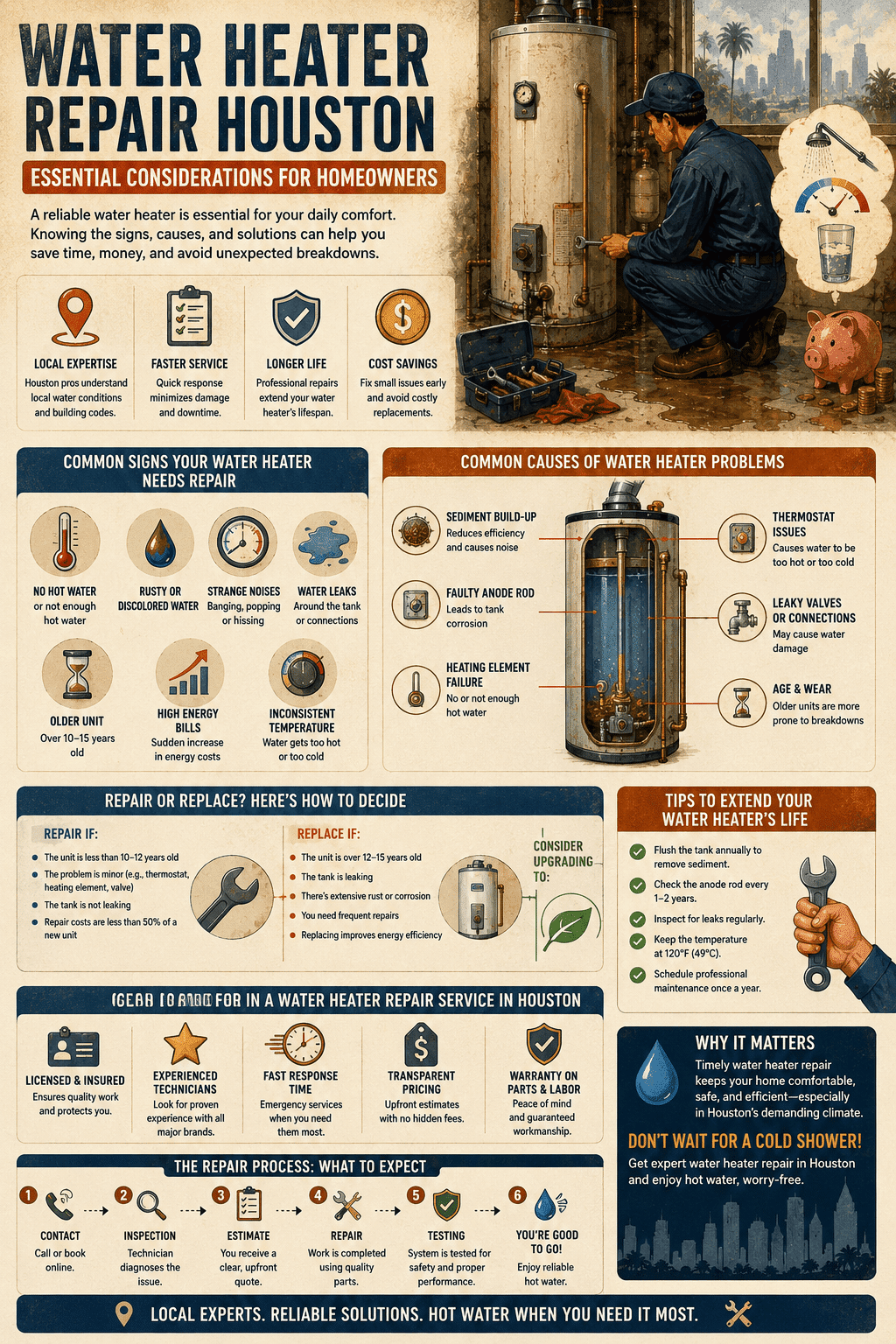
When it comes to maintaining a comfortable home environment, a well-functioning water heater is essential for Houston homeowners. The demands of daily activities such as showering, washing dishes, and laundry make a reliable water heater a necessity. However, when issues arise, it can disrupt the entire household routine. This article explores the key considerations for homeowners in Houston facing water heater problems, including the types of services available, common issues, and how to choose the right professional for the job.
Water Heater Repair Services in Houston
Houston homeowners have access to a range of water heater repair services, each addressing a specific problem. An energy efficiency check identifies whether the unit is running inefficiently due to sediment buildup or an aging heating element, which shows up directly on monthly gas or electric bills. Some technicians now also install smart leak detectors, small sensors that shut off the water supply automatically if they detect a leak, which is genuinely useful for a unit tucked in a garage or closet where a slow leak can go unnoticed for weeks.
Gas water heaters specifically need proper venting, and a technician should check this as part of any service call. Improperly vented gas water heaters can allow carbon monoxide to build up indoors, which is covered in more detail below.
Common Issues Faced by Homeowners
Homeowners in Houston often encounter several common issues with their water heaters. Sediment buildup is a frequent problem that can reduce efficiency and increase energy bills. Regular maintenance, such as flushing the tank, can alleviate this issue. Leaks are another concern, often requiring immediate attention to prevent water damage and mold growth.
Temperature inconsistency usually points to a failing heating element, a bad thermostat, or sediment insulating the burner from the water in a gas unit. Proper clearance around the unit, generally the manufacturer’s specified minimum, not a furniture placement question, matters for both airflow and technician access during future repairs. For households with young children, setting the thermostat to 120°F is the standard safety recommendation: hot enough for comfortable use, cool enough to prevent scald burns, which can happen in seconds at higher settings.
Key Factors to Consider Before Repairing
Before proceeding with repairs, homeowners should evaluate a few concrete factors, not vague ones. First, the age of the unit: most tank water heaters last 8 to 12 years, and once a unit passes that range, a second or third repair often costs more over time than simply replacing it. Second, whether the repair is actually a permit issue: routine repairs like a thermostat or heating element swap don’t require a City of Houston permit, but any full replacement does. Third, run the real numbers rather than guessing: Houston repair costs typically run $237 to $1,010, averaging around $624, against a full replacement that usually starts well above that range but resets the clock on reliability for another decade. The same principle behind catching costly leaks before they compound, a small problem ignored becomes an expensive one, applies just as much to a water heater at home as it does anywhere else water runs through pipes.
Permits and Real Costs: What Houston Actually Requires
Repairs to an existing water heater generally don’t need a permit in Houston, replacing pilot lights, thermostats, or heating elements falls under routine maintenance. Full replacement is a different story. The City of Houston Permitting Center requires a plumbing permit for any water heater replacement or new installation, and that permit can only be pulled by a master plumber registered with the city. The fee runs $34.24 for the first unit plus $11.41 for each additional one, with a $97.56 minimum.
If the job involves gas line work, a separate gas permit and pressure test are typically required too. For homes considering a fuel switch rather than a like-for-like replacement, solar water heaters are a real, cheaper-to-run alternative worth comparing against another gas or electric tank before committing to the same setup again.
Skipping this isn’t just a paperwork risk. An unpermitted installation means no city inspector ever verified that the temperature and pressure relief valve, the safety device that keeps a tank from becoming dangerous under excess pressure, was installed and terminated correctly. That gap can also trigger insurance claim denials and complications when selling the home later.
On cost, Houston repairs typically run $230 to $1,000, averaging around $624, roughly 4% above the national average. Labor alone runs $50 to $200 an hour, with most basic repairs, a heating element or thermostat swap, taking one to two hours for a total of $100 to $400. Complex repairs involving the gas control valve or a full tank issue justify the higher end of that range and are exactly the kind of job where a licensed plumber, not a DIY attempt, protects both safety and any existing warranty.
Gas Water Heaters and Carbon Monoxide: What to Watch For
Gas water heaters need to vent combustion byproducts, including carbon monoxide, safely outside the home. When venting fails, whether from a cracked heat exchanger, a blocked flue, or improper installation, carbon monoxide can build up indoors without warning, since it has no smell, color, or taste.
Warning signs worth taking seriously: soot or unusual staining around the water heater, a pilot light that burns yellow or orange instead of blue, a persistent musty or unusual odor near the unit, or household members experiencing headaches, dizziness, or nausea that improve after leaving the house. If any of these appear, the safe move is to leave the area, get fresh air, and call a licensed technician rather than investigating further alone.
A working carbon monoxide detector installed near sleeping areas, not just near the water heater itself, is the single most effective protection against this risk, and it’s inexpensive relative to what it protects against.
Choosing the Right Professional for Water Heater Repair
Selecting the right professional matters more for water heaters than most home repairs, since gas connections and pressure relief valves are genuine safety systems, not just convenience features. Confirm the technician is a licensed, City of Houston-registered master plumber, this is a legal requirement for any replacement, not optional local flavor.
If your home was built before the late 1980s, ask specifically whether any pipe insulation or wrapping around the water heater has been tested for asbestos before a technician disturbs it. This is a real, if uncommon, consideration in older Houston homes, and it’s worth a direct question rather than an assumption either way.
Ask upfront whether the job requires a permit, and confirm the technician will pull it rather than skip it. Houston’s own permitting center is explicit that replacement requires one; skipping it risks fines and can complicate a home sale or insurance claim later.
Conclusion
Addressing water heater problems in Houston comes down to a few concrete questions: is this a repair or a replacement, does the job need a city permit, and is the technician a licensed, registered master plumber. Getting those three right does more for a homeowner’s safety and budget than any amount of general research.
Frequently Asked Questions About Water Heater Repair in Houston
No, routine repairs like replacing a thermostat, heating element, or pilot light assembly don’t require a permit. Full replacement of the unit does, and the permit must be pulled by a City of Houston-registered master plumber.
Typically $237 to $1,010, averaging around $624. Labor runs $50 to $200 an hour, with most basic repairs taking one to two hours and costing $100 to $400 total.
If the unit is under 8 years old and the problem is a single failed part, repair usually makes sense. Past the 8 to 12 year mark, or after a second significant repair, replacement is typically the better financial decision since the whole unit’s reliability is declining, not just one part.
Soot or staining around the unit, a pilot light burning yellow or orange instead of blue, and household members experiencing headaches or dizziness that improve when they leave the house. Any of these warrants leaving the area and calling a licensed technician.
No. Houston restricts water heater installation and replacement to licensed, city-registered master plumbers, even for homeowners working on their own property, unlike some states that allow owner-installation with a special permit.
Yes. Houston’s water hardness contributes to faster sediment buildup in the tank than in areas with softer water, which is a major driver of reduced efficiency and shortened water heater lifespan if the tank isn’t flushed periodically.
Infographic