If you have a Husky, Golden Retriever, German Shepherd, Pomeranian or any other double coated dog, you have probably been told not to shave it. What almost nobody explains is why, and the reason matters more than the rule.
A double coat has two layers, each doing a different job. Guard hairs on the outside repel water, deflect sunlight and protect the skin. The softer undercoat beneath insulates in both directions: it holds warmth in winter and traps a layer of cool air against the skin in summer. Shaving removes the first layer and disturbs the second, which makes the dog hotter rather than cooler, and it doesn’t stop shedding.
This guide covers what double-coat grooming actually involves, why brushing the surface often does little, what shaving genuinely does to a coat, and how to tell the difference between a dog that needs deshedding and one that needs dematting.
What Makes a Double Coat Different?
The simplest way to understand a double coat is to think in layers.
The outer coat is usually made up of longer or firmer guard hairs. Underneath it sits a softer layer of hair that can vary considerably in density depending on the breed, individual dog, and season.
This coat structure appears across very different-looking dogs. Siberian Huskies, Alaskan Malamutes, Akitas, Samoyeds, and Chow Chows are obvious examples. But double coated dog breeds also include Golden Retrievers, Labrador Retrievers, German Shepherds, Australian Shepherds, Border Collies, Pomeranians, Newfoundlands, and many others.
Not every double-coated dog is large or exceptionally fluffy. Some have relatively short coats, which is why appearance alone does not tell an owner how much undercoat is present, and mixed-breed dogs can have double coats too. Lists of double-coated breeds are a reasonable starting point, and they will not settle it for a mixed-breed dog. If you are unsure, part the coat and look: a dense, softer layer beneath the outer hair is the thing to check for, and a groomer can assess it directly.
Why Surface Brushing May Not Be Enough
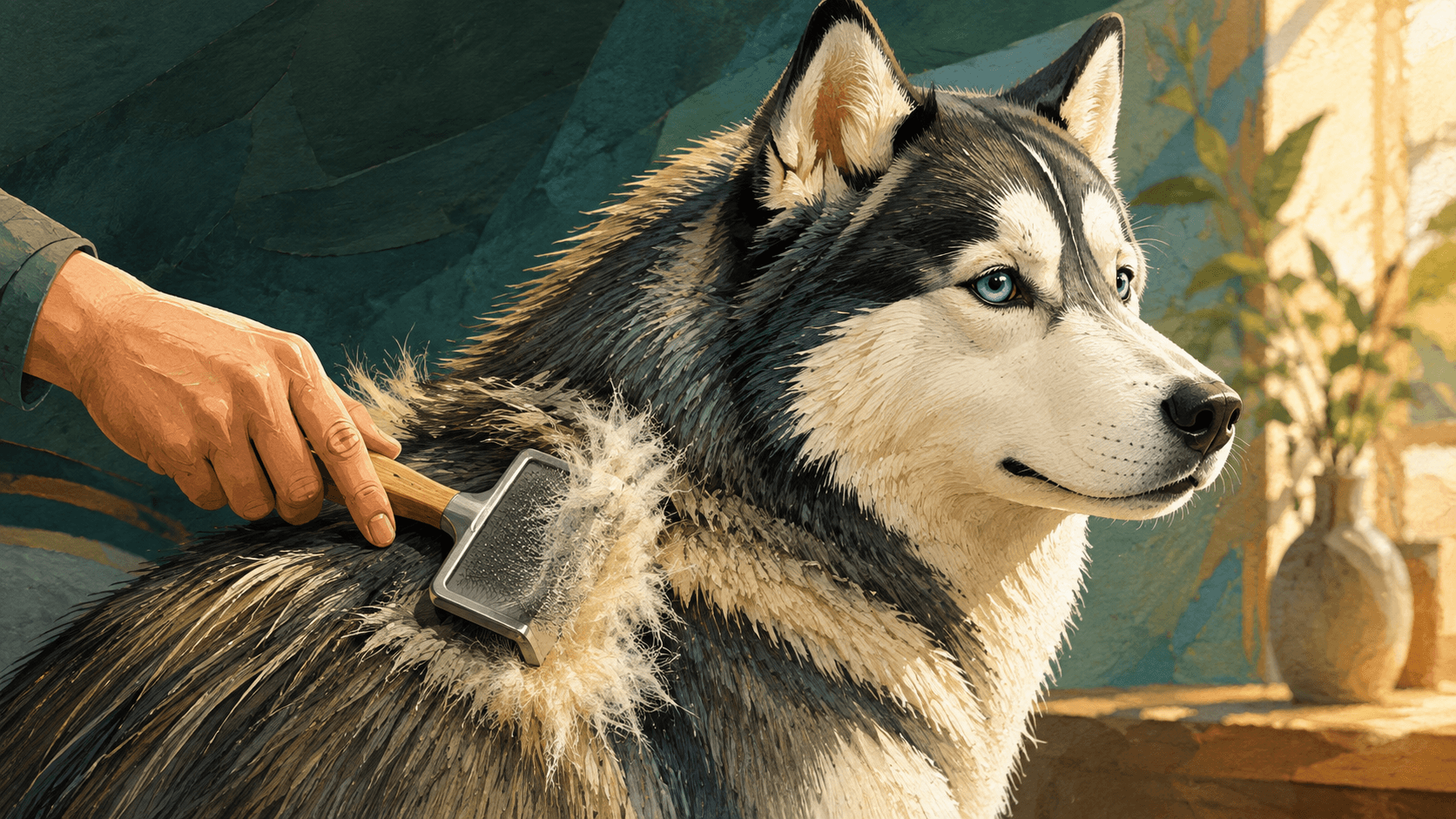
The biggest challenge with a double coat is that loose undercoat can remain trapped beneath an outer coat that still looks reasonably neat.
This becomes especially noticeable during periods of active shedding. Hair starts appearing on floors, furniture, clothing, and car seats, yet routine brushing at home may seem to make only a small difference.
The issue is access. Grooming needs to reach through the coat, not just smooth the surface.
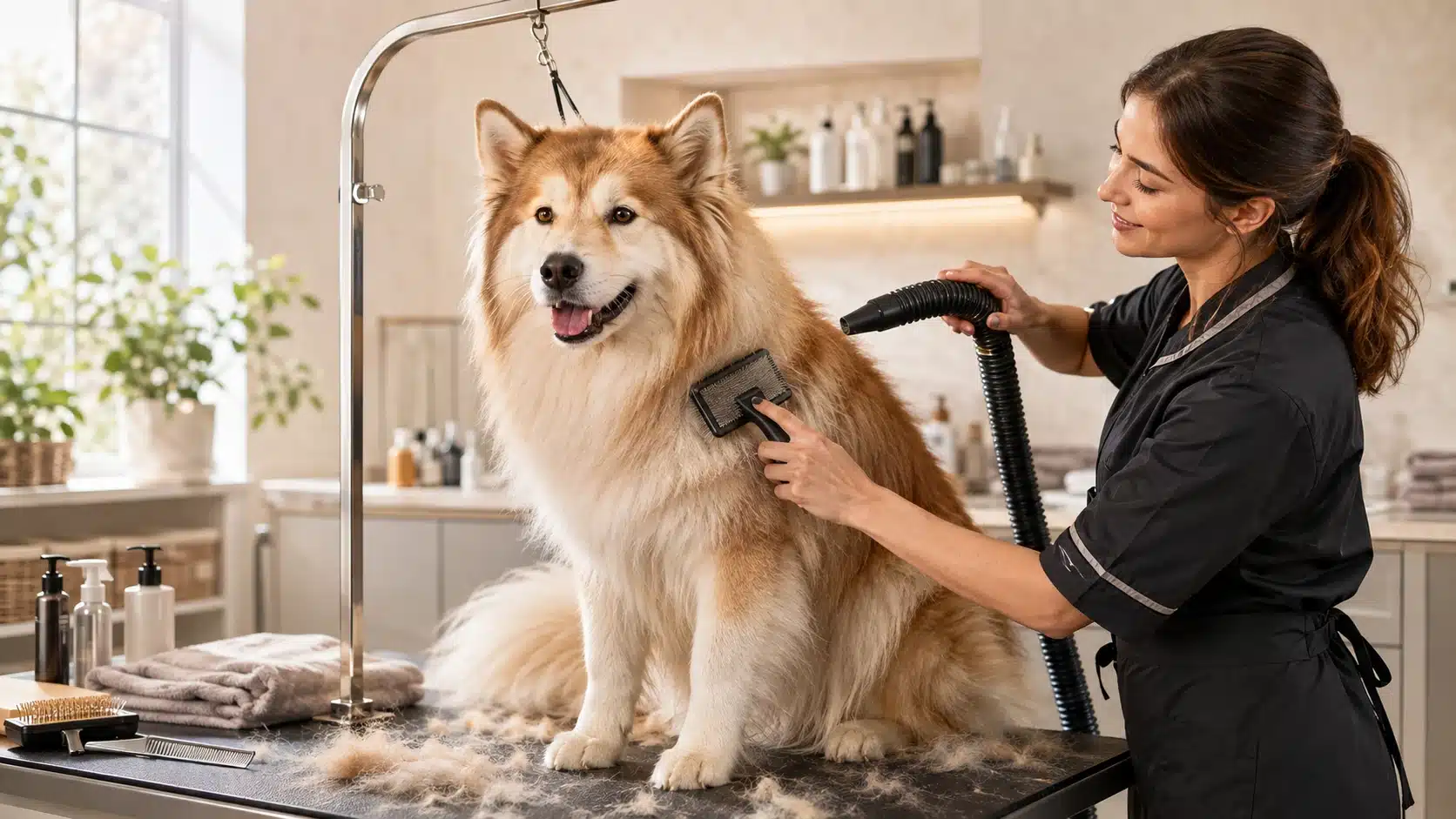
Professional coat care may include a thorough bath, conditioner when appropriate, controlled blow-drying, undercoat removal, and detailed brushing. Drying is particularly important because dense coats can hold both moisture and loose hair close to the skin.
A professional high-velocity dryer can help separate the layers and release hair that is ready to shed. The groomer can then follow with coat-specific brushing rather than repeatedly pulling at the top layer.
Understanding Coat Blow
Double-coated dogs do not shed evenly through the year. They go through two heavier periods, commonly called blowing coat, and knowing when to expect them changes how you plan grooming.
Daylight, not temperature, drives it. Shortening days in autumn trigger the undercoat to thicken. Lengthening days in spring trigger it to release. This is why an unseasonably warm February doesn’t stop the winter coat from coming in, and why the spring shed happens on schedule regardless of the weather.
It has a practical consequence for indoor dogs. Dogs living primarily under artificial light receive a muddled daylight signal and often shed more continuously through the year rather than in two defined bursts. The total volume is similar; the distribution is different. This is one of the less obvious arguments for regular yard access, alongside the containment options worth weighing if your property has no physical fence.
During a coat blow, the undercoat comes out in large quantities over weeks. This is when home brushing feels least effective and when professional deshedding makes the most difference, because a high-velocity dryer separates the layers and releases hair that surface brushing cannot reach.
Plan appointments around it rather than on a fixed calendar. Two heavier grooms in spring and autumn, with lighter maintenance between them, matches how the coat actually behaves.
What to Use at Home, and How
Tool choice matters more for double coats than for any other coat type, because most brushes only reach the surface.
| Tool | What it does | Use it for |
|---|---|---|
| Undercoat rake | Long widely spaced teeth reach through guard hairs to pull loose undercoat | The main tool for double coats. Most of your work happens here |
| Slicker brush | Fine bent wires, works the outer coat and small tangles | Finishing, and working through light tangles |
| Pin brush | Gentle, surface level | Longer coats, general tidying, dogs sensitive to handling |
| Blade style deshedder | Cuts through coat as it pulls | Use sparingly. Overuse cuts guard hairs, which is a small version of the shaving problem |
| Comb | Checks your work | Run it through after brushing. If it snags, you have missed an area |
The technique that actually works is line brushing. Surface brushing is why owners feel their effort achieves nothing.
Part the coat with one hand so you can see the skin. Brush the small section immediately above your parting, working outward from the skin rather than over the top. Move the parting up an inch and repeat. Work in sections across the dog, and check each area with a comb before moving on.
It is slower than brushing the surface and it is the difference between removing loose undercoat and rearranging it.
Two things to know. Brush before bathing, never after, since water tightens loose hair and any existing tangles. And a dense coat that has been left too long can trap moisture against the skin, which is a genuine skin health issue rather than a cosmetic one.
Do Double Coated Breeds Need Haircuts?
This is where double-coat care differs from grooming a Poodle, Doodle, Maltese, or another dog whose coat is routinely shaped with a fuller haircut.
Many double coated breeds do not need a traditional full-body haircut. Their routine grooming is more likely to involve bathing, deshedding, brushing, nail care, hygiene maintenance, and limited trimming around areas such as the feet, hocks, tail, or feathering.
Why shaving a double coat causes problems
The advice not to shave gets repeated constantly and explained rarely. Three things happen, and the third one surprises most owners.
It removes the cooling layer, not just the warming one. The undercoat traps air. In winter, that air holds body heat in. In summer, once the dog has shed the winter density, the remaining coat traps cool air against the skin and the guard hairs reflect sunlight. AKC’s chief veterinary officer, Dr. Jerry Klein, states the consequence plainly in the association’s guidance on whether it is safe to shave a dog’s coat: removing that layer makes the dog susceptible to heatstroke, and the coat also protects against sunburn and reduces skin cancer risk.
Regrowth is uneven, and sometimes permanent. Undercoat regrows quickly. Guard hairs regrow slowly, sometimes taking more than a year, and sometimes never fully return. When the fast layer outpaces the slow one, the undercoat crowds out the guard hairs. The coat comes back with a different texture, often a different shade, and frequently in patches. That is a lasting change to how the dog looks and how the coat functions.
It does not stop the shedding. This is the part owners find hardest to believe, because reducing shedding is usually the main reason they ask. The undercoat is the layer that sheds. Cutting the coat shorter does not stop that cycle; it produces shorter hairs, often more of them, because the follicles can respond by generating additional undercoat. Owners who shave for shedding routinely report the problem getting worse.
The legitimate exceptions are narrow: severe matting where the skin cannot dry underneath, a veterinary or surgical requirement, or an already damaged coat where a groomer judges it the least bad option. Those are individual assessments made by someone looking at the dog, not a general summer policy.
What to do instead. Remove the undercoat the dog is naturally releasing. Proper deshedding with an undercoat rake, thorough bathing, and controlled drying achieve what shaving is meant to achieve without any of the consequences above. The dog ends up cooler than a shaved one, because the guard hairs stay in place to do their job.
What Professional Double Coated Dog Grooming Involves
A good double coated dog grooming appointment starts with the condition of the dog in front of the groomer.
Coat density matters. So does the amount of shedding, the dog’s size, how much brushing happens at home, and whether the pet is comfortable with bathing, dryers, and extended handling.
At Rebel Tails in Morrisville, North Carolina, near Cary, double-coat services are built around those differences. Depending on what the coat needs, an appointment can include coat and skin assessment, bathing, conditioner or deshedding conditioner, a thorough rinse, controlled blow-drying, undercoat removal, brushing, nail care, and natural outline tidying.
The salon also works in a cage-free environment and adjusts the grooming pace for dogs that need more time with dryers, brushing, or handling. Whether that matters to you depends on your dog, since crating during grooming is a genuinely contested question among owners and the arguments on both sides of the crate debate apply here too.
That individualized approach is particularly relevant for large or dense-coated dogs. A Pomeranian and a Newfoundland may both have double coats, but the time, drying requirements, and amount of undercoat work involved are clearly not the same.
Deshedding and Dematting Are Not the Same Thing
These two terms are sometimes treated as interchangeable, but they describe different coat problems.
Deshedding focuses on hair that has naturally loosened from the coat and is ready to come out. The goal is to release that undercoat through appropriate drying and brushing.
Dematting deals with hair that has tangled or become compacted. It may still be attached close to the skin and can require a different approach.
Knowing the difference helps when booking an appointment. A heavily shedding dog may need extensive undercoat removal without actually being matted. A dog with compacted areas may need a coat assessment before the groomer can determine the safest way to proceed.
How Often Should a Double-Coated Dog Be Groomed?
There is no single schedule for every breed.
The right interval depends on coat density, season, lifestyle, home maintenance, and how quickly loose undercoat builds up. Dogs going through an active seasonal shed may need more professional attention than they do at other times of year.
Home brushing still matters between appointments. It helps remove loose hair and lets owners notice tangles or changes in coat condition earlier.
Professional grooming can handle the more difficult parts of the process: complete bathing and rinsing through a dense coat, controlled drying, deeper undercoat removal, and detailed finishing.
If you are unsure whether your dog has a double coat, part the hair and look for a dense, softer layer beneath the outer coat. A groomer can confirm it in seconds.
When Shedding Is a Health Signal
Most heavy shedding on a double-coated dog is normal. Some isn’t, and the difference matters because owners often groom harder instead of investigating.
Signs that warrant a veterinary conversation rather than a grooming appointment:
- Bald patches or thinning in defined areas, particularly symmetrical thinning on both sides of the body
- Persistent scratching, licking, or chewing at one area
- Red, inflamed, or hot patches on the skin
- Heavy dandruff, greasy coat, or an unusual smell
- A sudden change in coat texture without a change in season
- Shedding well outside the normal pattern for the dog, sustained over months
Several conditions present as coat changes, including thyroid problems, allergies, parasites, and skin infections. A groomer often notices these first, because they see the skin, and a good one will tell you to see a vet rather than booking you in for more deshedding.
This is general information, not veterinary advice. If something about your dog’s coat or skin has changed and you are unsure, ask a veterinarian.
Better Grooming Starts With the Right Goal
For a double-coated dog, shorter is not automatically better. The more useful question is whether the grooming process addresses what is happening beneath the visible coat.
For owners around Cary and Morrisville, Rebel Tails offers coat-specific grooming for double-coated dogs, from routine bath-and-brush appointments to more extensive deshedding and heavy-coat care.
The practical goal is simple: remove what the coat is naturally ready to lose, keep it clean and thoroughly dried, and preserve the natural coat wherever possible. For dogs built with two layers of hair, that is what thoughtful grooming should accomplish.