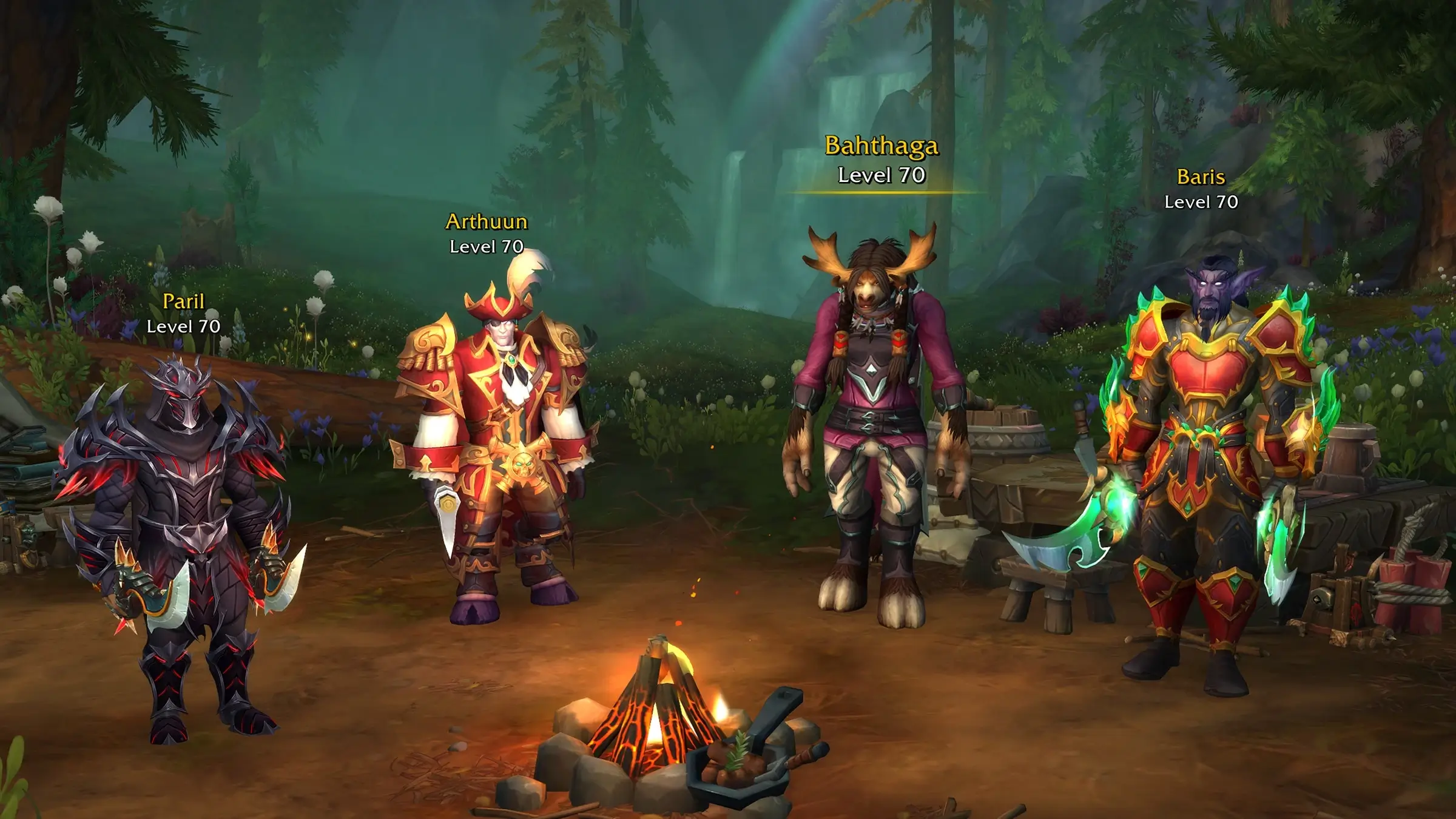
The gap between a casual World of Warcraft player and a competitive one has never been wider or more precisely quantifiable. In WoW Midnight Season 1, item level is tracked to the decimal, Mythic+ IO scores are visible on every player’s profile, and Warcraft Logs parse percentiles have become a kind of gaming credit score that raid leaders check before issuing an invite. In this article, we’ll explore the gear, the meta and the services behind WoW (World of Warcraft) midnight’s top players.
For players who want to cross that gap or at least get close enough to experience endgame content on their own terms. The Season 1 landscape offers a clear roadmap. The question is not whether the path exists. It is how much time it realistically takes to walk it, and what tools the most efficient players are using to compress that timeline.
The Midnight Season 1 Competitive Landscape: Where Things Stand in April 2026
WoW Midnight launched on March 2, 2026. Season 1 opened March 17 with Normal and Heroic raids, and Mythic+ followed March 24. By April 9, the world’s top guild Liquid had cleared Crown of the Cosmos on Mythic difficulty, ending the race with a composition built around three Augmentation Evokers, two Demonology Warlocks, and a Retribution Paladin.
For the vast majority of the game’s approximately 9.7 million monthly active players, that Mythic first-clear is a spectator sport. But the gear, class choices, and efficiency techniques that drive the competitive tier filter down quickly to the broader playerbase. Typically within four to six weeks of a season opening, once guides and build databases catch up to what the top guilds discovered through live progression.
“Six weeks into Season 1, the meta is settled: Demo Warlock and Arcane Mage lead ranged DPS, Brewmaster Monk holds undisputed S-tier for tanks, and Augmentation Evoker continues to define comp-building in both Mythic raid and high-key Mythic+.” — WoW Season 1 tier list analysis, April 2026
For a player entering this environment in late April 2026 roughly six weeks into the seaso. The meta is legible, the gear curve is mapped, and the most efficient progression path is well-documented. The barrier is not knowledge. It is time.
The Gear Ladder: Item Level Checkpoints from Fresh 90 to Mythic-Ready
WoW Midnight’s gearing system in Season 1 operates on a clear ladder of item level checkpoints, each unlocking the next tier of content. Here is the full progression map:
| Stage | Item level | Best source | Time investment |
| Fresh level 90 | ~220 | Heroic dungeons, World Quests, campaign rewards | Days 1–3 |
| Normal raid ready | 235–245 | Mythic 0 (daily lockout), Delves Tier 4–6 | End of Week 1 |
| Heroic raid entry | 255–260 | Mythic+2–+9, Normal raid clears, crafted gear | Weeks 2–3 |
| Heroic raid prog. | 263–269 | Heroic raid drops, Great Vault at +10 key | Weeks 3–6 |
| Mythic prog. floor | 275–282 | Mythic raid, Great Vault at +12, Myth Dawncrest craft | Weeks 6–14+ |
| Keystone Master | 2500 IO | All 8 dungeons timed at +10 or higher | Weeks 4–10 avg |
| Keystone Hero | ~3000 IO | +12 consistent, meta comp required | Weeks 8–16+ |
The critical chokepoint for most players sits between Heroic raid entry (ilvl 255) and Heroic progression (ilvl 263–269). Reaching 255 is achievable in two to three weeks through Mythic+2–+9 farming and Normal raid clears. Pushing from 255 to 268 requires consistent Heroic raid access and a minimum of four to six weeks of weekly Great Vault upgrades. Precisely the window where group-finding friction and schedule constraints cause the most casual players to plateau.
The mathematics of the Great Vault reinforce this. Completing one Mythic+10 per week delivers a single ilvl 272 vault piece. But only one. A player who runs eight +10 keys in a week versus a player who runs just one receives three vault choices versus one, but the floor of their best reward is the same. Volume of runs is the primary lever, and volume requires time.
The Meta Classes: What Competitive Players Are Actually Running
Class choice in Midnight Season 1 has more impact on progression speed than in any recent expansion, primarily because the new Dawncrest crest system makes BiS optimization more accessible at mid-tier item levels. Here is where the meta stands as of April 2026:
| Role | Class | Tier | Why it dominates Season 1 |
| Ranged DPS | Demonology Warlock | S | Top parse on every fight; Summon Darkglare syncs with all raid burst windows |
| Ranged DPS | Arcane Mage | S | New Void-resonance talent; hits 2M+ burst in 20-sec windows on Voidspire bosses |
| Support DPS | Augmentation Evoker | S | Raid-wide amp buffs; Liquid ran 3 Aug Evokers in Mythic first-clear comp |
| Tank | Brewmaster Monk | S | Undisputed S-tier; smooth active mitigation, highest DPS of any tank spec |
| Healer | Restoration Druid | A+ | HoT throughput carries progression guilds; best mana efficiency of any healer |
| Healer | Holy Paladin | A+ | Burst cooldowns line up with boss damage spikes; best for Mythic progression healing |
| Melee DPS | Demon Hunter | A+ | Only class with top-tier spec in all three roles; Havoc climbs week over week on logs |
| Melee DPS | Retribution Paladin | A+ | Burst windows match boss vulnerability phases; near-S in Mythic raid specifically |
Two observations stand out for players making class decisions mid-season. First, Demon Hunter is the only class with genuine competitive viability in all three roles. The new Devourer ranged DPS specialization debuted in Midnight, and its week-over-week improvement on Warcraft Logs suggests it will climb further as players optimize builds. Second, Augmentation Evoker remains the single highest-impact support pick, but its value is comp-dependent: its buffs multiply the output of high-performing DPS specs, which means it performs proportionally better in coordinated environments than in PUGs.
The Mythic+ Dimension: How IO Score Became the New Social Currency
In Midnight Season 1, Mythic+ IO score has become the de facto qualification credential for raid group assembly and high-key group formation. The scoring system works as follows: each timed completion awards a base score adjusted for key level and affixes, with Fortified and Tyrannical weeks scoring separately. Keystone Master. The first major title threshold. So, sits at approximately 2,500 IO and requires all eight dungeons timed at +10 or higher.
The practical consequence is that a player with a 2,200 IO score finds significantly more group invitations available than a player at 1,800, even if their actual performance in dungeons is similar. IO score is a proxy for experience with the current dungeon pool and experience is what prevents the death-penalty situation introduced by the Xal’atath’s Guile affix at Keystone level 12, where each death subtracts 15 seconds from the timer. In conclusion, At that level, a single bad pull from an inexperienced player costs the group an entire boss attempt.
“Every death is -15 seconds on the timer at +12 and above. A single wipe on a non-boss trash pull effectively eats 50+ seconds – death, run-back, and timer deduction combined. This is why the Keystone Master threshold is set where it is.” – Midnight M+ Season 1 guide, April 2026
For players targeting Keystone Master this season, the most time-efficient path is to push +9 keys across all eight dungeons before attempting +10. The +9 tier is the lowest level that awards Myth Dawncrest — the crest type needed to upgrade Hero-track gear to Myth-track equivalents. So, meaning the gearing and rating goals align at the same key level.

How Competitive Players Compress the Timeline
The players who reach Keystone Master or Heroic raid Ahead of the Curve (AOTC) within the first four to six weeks of a season consistently use the same combination of approaches:
- Pre-season class preparation. Competitive players enter a new season with a pre-leveled character at or near max level, a talent build sourced from top-100 log analysis, and a baseline understanding of the new dungeon routes before Mythic+ opens. The week-one advantage compounds across the full season.
- Structured group play, not PUGs. The single largest time cost in WoW progression is failed PUG groups: disbanded runs, vote-kicks, and wipes on mechanics that a coordinated group handles on the first attempt. Players who join static groups or use carry services for specific content pieces eliminate this variable entirely.
- Targeted carry services for specific gaps. The most efficient players are selective about where they use outside assistance. Powerleveling to 90 and the initial gear boost to Normal-raid-ready (weeks one and two) represent the highest time-to-value ratio of any service purchase in a new season. Heroic raid carries for specific tier pieces in weeks three through six represent the second tier of value.
- Weekly Great Vault optimization. Running exactly eight Mythic+ keys per week no more, no fewer. Maximizes the Vault’s dungeon row while preserving time for raid lockouts and PvP if applicable. The math does not improve past eight completions for Vault purposes.
The Services That Competitive-Aspiring Players Are Using in 2026
The carry service ecosystem around WoW Midnight has matured to the point where specific services align with specific progression goals. So, Players who want to move from casual to competitive-adjacent in Season 1 are typically purchasing three categories of service:
The first is early-season powerleveling and gear boost (weeks one and two). Getting to level 90 and ilvl 235–245 in the first week through assisted leveling and dungeon carries eliminates the catch-up curve and allows immediate engagement with season-specific content before the window is crowded. At a casual pace, this takes 15–25 hours; assisted, it takes two to four.
The second is Heroic raid carries for tier set acquisition (weeks three through eight). Tier sets in Midnight Season 1 are the single largest performance multiplier for most DPS and healer specs. So, some represent a 15–20% throughput increase over non-tier equivalents. Getting two-piece or four-piece tier early through carry services compresses weeks of progression into a single session.
The third is Mythic+ IO score acceleration for Keystone Master targeting. Players who want to reach the 2,500 IO threshold before the season’s halfway point to maximize the pool of raid groups and high-key partners available. Finally, typically use targeted key completion services across the eight-dungeon pool.
Platforms like xboosty.com cover all three service categories for Midnight Season 1. Finally, raid carries across Normal, Heroic, and Mythic difficulty, Mythic+ rating boosts targeting KSM, and powerleveling for fresh characters or returning players. For players who want to experience WoW Midnight’s competitive content without a six-week grind as a prerequisite, these services represent the most direct route from casual entry point to the tier of play where the expansion’s best content actually lives.
The Honest Assessment
World of Warcraft Midnight is, by most measures, one of the strongest expansions Blizzard has released. The three-raid simultaneous launch, the Devourer Demon Hunter, Player Housing, the overhauled Delves system, and a Mythic+ season that community sources describe as having the tightest class balance in a decade. These are genuine quality signals, not marketing claims.
The competitive tier is not accessible to every player. That has always been true. What has changed in 2026 is that the tools available to close the gap. Carry services, coaching platforms, community resources, in-game catch-up mechanics are more mature and more mainstream than at any previous point in WoW’s history. The question is not whether players can get there. It is how efficiently they want to make the journey.
For players who have measured the options and decided that assisted progression is the right approach for their schedule and their goals, the current market offers more choice and more transparency about what each provider actually delivers than at any point in the game’s 21-year history.