We live in an age of personalised recommendations, where algorithms decide what we see in our social media feeds, what music we listen to and which people we meet. On the one hand, this is very convenient, because personalisation gives us access only to things that, in theory, we might like. But people are such that predictability quickly becomes boring. Especially when it comes to dating.
How algorithms have changed the way we meet people
Developers of dating services are trying to make the search for potential partners as accurate as possible. Algorithms carefully analyse users’ behaviour to show them only those they are highly likely to be attracted to. They study which profiles users like and which they skip, who they start messaging, which profiles they return to, and so on. To some extent, this increases the chances of a promising encounter, because users no longer need to browse through thousands of profiles themselves and waste time on people who are clearly not right for them. Algorithms narrow the choice down to a few of the most suitable options. But because of this, dating becomes extremely predictable. Users have a rough idea of who they will see next, and as a result, their interest in communication gradually disappears.
Another problem is that spontaneous attraction has been replaced by strict compliance with filters on dating services. People are evaluated like products according to a set of characteristics, while a first impression is formed in a fraction of a second based on just a couple of photos. At the same time, access to thousands of profiles creates a false sense of endless choice. Users start thinking that the next candidate is bound to be better, which means there is no point in spending time on someone who falls short of the ideal. This reduces the value of each individual encounter and makes it difficult to focus on one person. Ultimately, constant swiping, repetitive conversations and the disappointment of expectations not matching reality inevitably lead to burnout.
Why we like randomness again
The reason is simple — people like not knowing who they will meet or how the conversation will end. Unpredictability brings back something that digital communication lacks: the feeling of a real event. After all, when we meet someone in real life, it gives us a surge of emotions. Every new encounter feels like a small experiment because we do not know what our new acquaintance will be like. And it may not be the final outcome itself that causes these emotions, but rather the anticipation of what will happen next.
Online, however, dating becomes something routine. When algorithms constantly show us similar profiles, meeting someone turns into a familiar sequence of actions: swipe right, write a few sentences, close the conversation. And if a user has already had a negative experience — for example, a girl turned out to look completely different in real life from her photos — they lose any desire to spend their energy communicating with someone new and risk being disappointed again. That is why more and more users have recently been abandoning traditional dating services and meeting people on platforms where they cannot predict who will be on the other side of the screen.
The OmegleTV chat turns dating into a fully fledged hobby
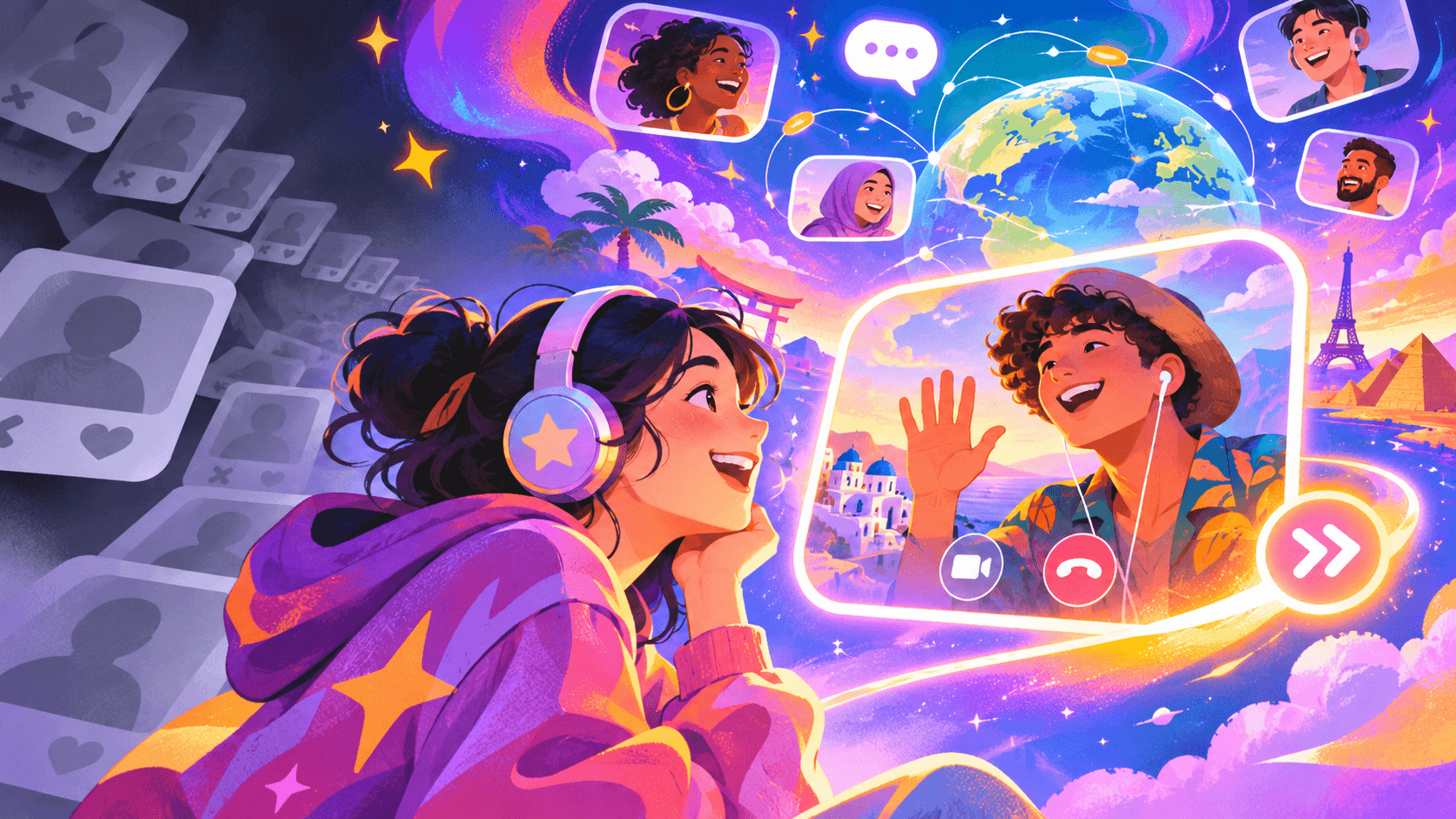
Chat roulette differs from other services in that the system randomly connects two strangers. There are no profiles or photos in a video chat, so you cannot find out anything about your chat partner in advance. In addition, there is no swiping, and the priority is live interaction with each other. You only meet after being connected, and this makes online communication interesting again.
At the same time, a random chat helps remove the pressure that often arises in traditional apps. Users do not have to decide within a few seconds whether someone is right for them. They can simply start a conversation and see where it leads. And if the conversation turns out to be uninteresting, they can simply press the ‘Next’ button and start meeting someone else.
The OmegleTV video chat is particularly popular among users. Its main advantage is its large and active audience around the world: people from Europe, America and Eastern countries meet in the chat. Communication in the web chat takes place in real time, and chat partners in https://omegletv.chat/ can see and hear each other. This brings back the sincerity and naturalness that online dating lacks so much.
Generation Z and the new culture of free communication
Gen Z grew up in the age of digitalisation, and they do not perceive the internet as something separate from reality. That is why the boundary between people they know and strangers is less noticeable to them than it is to older generations. They can easily message someone they have never seen before. And in general, they have a more relaxed attitude towards meeting people and do not believe that every new encounter necessarily has to develop into a friendship or relationship. Sometimes the value of a conversation lies precisely in the fact that it comes with no obligations.
In addition, the desire to communicate with strangers stems from the fact that Gen Z is tired of constantly trying to make an impression. In video chats, a conversation begins immediately after connecting, so there is no need to make any special effort to make someone want to communicate. In chat roulette, it is enough simply to be yourself without feeling ashamed or experiencing any other destructive emotions because of it. Moreover, for Generation Z, communicating with strangers is also an opportunity to gain new experiences. After all, a random chat partner may have completely different views on life. And this is a great way to step outside the familiar and discover something new and interesting.
Random conversations are a new habit of the digital age
For years, developers have worked to make the user experience as personalised and predictable as possible. Algorithms have learnt to understand our interests in great detail and anticipate our desires so they can offer us exactly what we are highly likely to enjoy. But today, people want something different — they do not want to know in advance what will happen next. That is why the audience of random video chats will only continue to grow in the near future. After all, every year this format attracts more and more users who are tired of predictability. And today, video chats are no longer just a tool for meeting people, but a distinct form of digital leisure.