Know how to pass the ACE Exam with these vital tips; The American Council on Exercise (ACE) exam is one of the most commonly used gateways to a career as a personal fitness trainer. The test is both comprehensive and challenging, but there are ways to master the material and maximize your scores. We’ll look at 10 of them in this post. You need to understand anatomy, movement, behavior change, program design, client communication, safety, ethics, and risk management.
You also need to practice answering questions the way the exam asks them. his guide walks through practical ways to prepare for the ACE exam, including what to study first, how to use practice tests, how to avoid common mistakes, and what to do before test day.
Quick ACE exam facts candidates should know
Before building a study plan, readers need a clear picture of the exam.
The ACE Certified Personal Trainer exam includes 150 multiple-choice questions. Of those, 125 are scored, and 25 are experimental questions that do not count toward the final score.
Candidates have 3 hours to complete the exam.
For the NCCA-accredited ACE Personal Trainer Certification exam, candidates need a score of 500 or greater to pass.
ACE also notes that the Personal Trainer and Group Fitness Instructor exams include video-based questions that test practical skills, such as observing movement and making safe exercise decisions.
The article should also explain that ACE offers more than one personal trainer pathway. The non-proctored ACE Personal Training Certificate exam is different from the NCCA-accredited ACE Certified Personal Trainer Certification exam. Readers should check which option their employer, gym, school, or career plan requires.
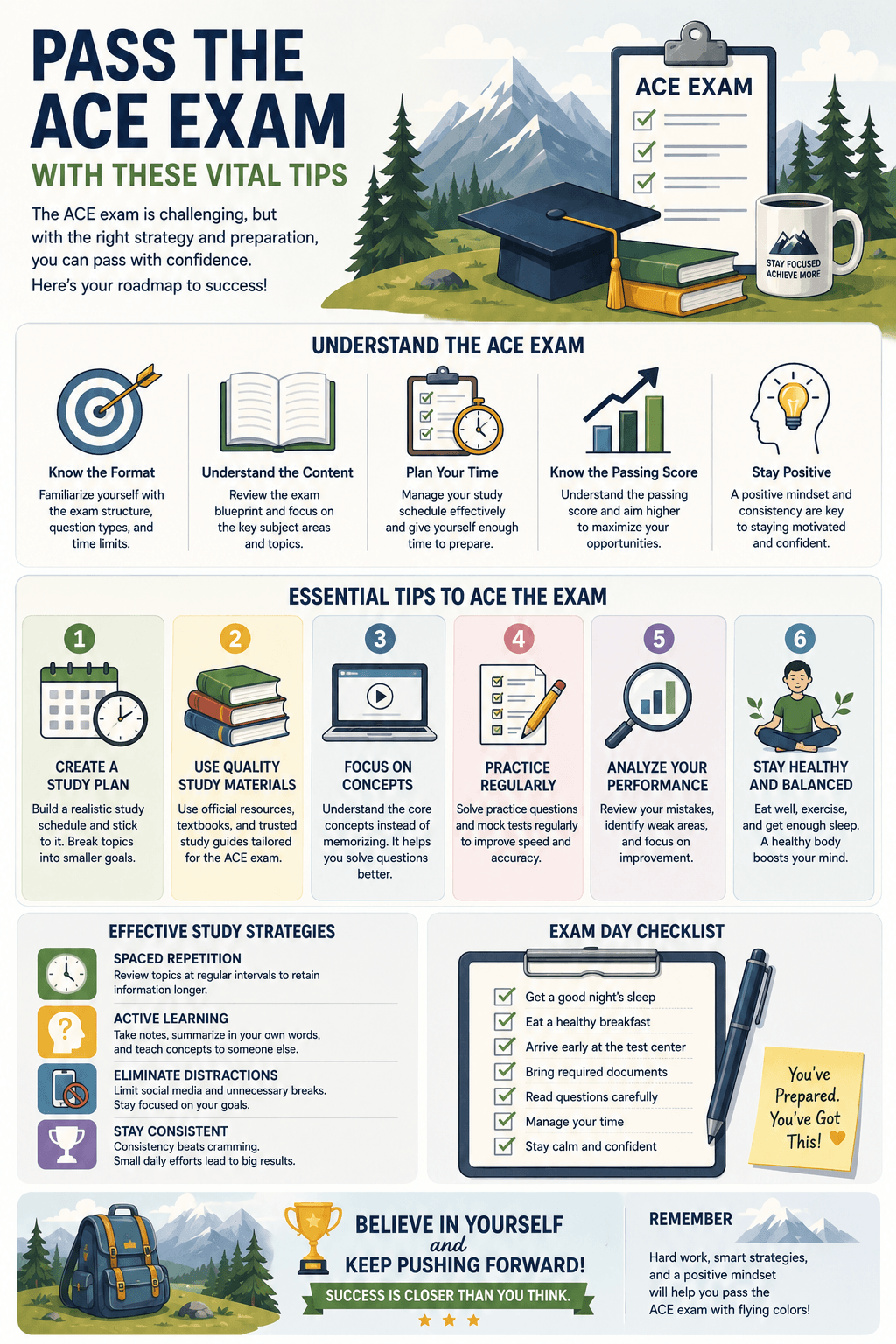
Make sure you meet the requirements before you study too far
Before registering for the NCCA accredited ACE Personal Trainer Certification exam, candidates should check the current requirements.
ACE lists requirements such as being at least 18 years old, having a current adult CPR and AED certificate with a hands on skills check, completing high school or the equivalent, and paying the exam fee.
This matters because some candidates study for weeks, then realize they still need CPR and AED certification before they can register.
A smart study plan starts with logistics:
- Confirm which ACE exam you need.
- Check age and education requirements.
- Complete CPR and AED certification if required.
- Review the exam content outline.
- Choose a realistic test date.
- Build a study schedule backward from that date.
Use the official exam content outline as your map
The ACE exam content outline is one of the most important study tools.
It tells you what the exam is built around, so you do not study blindly.
The current ACE Personal Trainer exam outline groups content into four main domains:
| Domain | Main focus |
|---|---|
| Client onboarding and assessments | Readiness, health history, assessments, goals, risk, and client information |
| Program design and implementation | Building safe and effective programs based on client needs |
| Program modification and progression | Adjusting workouts, progressing clients, and responding to client performance |
| Risk management, professional conduct, and ethical business practices | Scope of practice, safety, ethics, documentation, and professional responsibility |
This table gives the article more substance. It also helps readers stop treating the exam like a random textbook quiz.
Tip Number One: Read the Textbook
This will serve as your primary source of information for the exam. But preparing for a test requires a different approach to reading than you might use for a novel or other casual book. To pass the ACE Exam, you need to incorporate the following skills:
- Skimming each page first, then going back to reading in-depth — trains your brain to absorb as much information as possible.
- So, underlining key passages and making notes in the margins — some readers find that a physical copy of the text makes this strategy easier to follow than a digital version.
- Creating a question and answer sheet — the idea is to list key questions addressed by the text on each page, followed by the answer.
These techniques are based on a powerful learning skill called ‘active reading,” which helps the information to become fixed in your mind. The difference it can make to your score can be quite impressive!
Number Two: Learn the Vocabulary To Pass the ACE Exam
Understanding the technical terms used in the ACE is essential for comprehending the material. One good strategy is to make a series of flashcards listing each vocabulary term along with its definition. Then, work your way through the cards multiple times each day. This will help you to grasp the fundamental concepts upon which the exam is based.
Common reasons include:
- You did not know the term.
- You misunderstood the client scenario.
- You rushed the question.
- You confused two similar concepts.
- You knew the fact but could not apply it.
- You picked a good answer, but not the best answer.
That last point is important. Certification exams often ask for the best choice, not just a technically possible choice.
Number Three: Learn the Human Anatomy
Knowing how the human body works is another basic skill that will help you excel at the ACE. The text has plenty of information, but you’ll find supplemental sources both online and in similar textbooks.
When you learn a muscle, connect it to:
- Where is it?
- What joint does it affect?
- What movement does it help create?
- What exercises use it?
- What common compensation patterns may appear?
For example, do not only memorize the gluteus maximus. Connect it to hip extension, squats, deadlifts, bridges, stair climbing, and movement quality. This makes anatomy easier to remember and more useful for exam questions.
Number Four: Use the Practice Quizzes To Ace the ACE Exam
The sample quizzes in the text will reinforce your understanding of key topics. Take them in order as you work your way through the text, then repeat them as needed until you’re able to pass each one.
Build a 12-week ACE study plan
A full study plan can make this article much stronger. Here is a simple 12-week structure:
| Week | Focus |
|---|---|
| 1 | Review exam requirements, outline, study tools, and schedule |
| 2 | Client onboarding, health history, readiness, and goals |
| 3 | Assessments, movement screens, and risk awareness |
| 4 | Anatomy basics and exercise science foundations |
| 5 | Program design for resistance training |
| 6 | Cardiorespiratory training and flexibility |
| 7 | Behavior change, communication, and coaching skills |
| 8 | Program progression and modification |
| 9 | Special considerations and client scenarios |
| 10 | Risk management, ethics, and scope of practice |
| 11 | Full practice exams and review of weak topics |
| 12 | Light review, test day planning, sleep, and confidence |
Number Five: Use a Good Study Guide American Council Exercise (ACE) Exam Tips
A good ACE study guide is worth its weight in gold. These guides are modeled on the exam itself, so you can focus on the material that you’re most likely to encounter while taking the test. This is the single best way to fine-tune your study efforts. The best study guide is the one that helps you: ACE (American Council Exercise) Exam Tips.
- Identify high-priority topics.
- Review weak areas.
- Practice scenario-based questions.
- Understand why answers are right or wrong.
- Build confidence without giving you false shortcuts.
Be careful with any guide that promises guaranteed results, secret exam questions, or shortcuts that sound too easy. The goal is not only to pass. The goal is to understand enough to start working safely with real clients.
Number Six: Follow Your Own Advice Health-Wise
As a personal fitness trainer, you’ll spend much of your career touting the benefits of good nutrition, adequate sleep, and balancing work with relaxation. These very same tips can help you to pass the ACE exam. So put them to good use in your own life.
Number Seven: Make the Day Before the Test a Time of Intense Preparation
Taking the ACE exam is one of the most important moments in your life. So spend the day before the test in preparation. Cancel or minimize other commitments, sequester yourself from distractions, and focus on reviewing the material.
So, you may be tempted to pull an all-nighter that evening, but this can actually hurt your scores more than help them. Study to your usual bedtime, then turn in for the night. Just before you nod off, tell your brain to spend your resting hours digesting the information. Studies show that this can actually prime your mind for peak performance.
Do this instead:
- Review your weakest notes.
- Revisit key formulas, definitions, and safety rules.
- Check your exam time and location.
- Confirm your ID and required documents.
- Prepare snacks or water if allowed.
- Review testing rules.
- Stop studying at a reasonable time.
- Sleep properly.
An all-day cram session can make you feel busy, but it often creates more stress than confidence. The goal is to arrive rested, clear, and ready to think.
Number Eight: Use Headphones During the Test
There’s nothing like the sound of clacking keyboards to break your concentration. Yet that’s exactly the kind of distraction you’re likely to hear from your fellow test-takers, especially those who are worried or frustrated. So ask the exam monitor to provide a pair of headphones or, if allowed, bring your own. It’s amazing how this simple trick can boost your concentration. Before exam day, review the testing rules carefully. Know what ID is required, what items are allowed, what items are prohibited, how check-in works, and what to do if there is a technical issue.
If noise is a concern, ask the testing center or proctor what accommodations or approved options are available. This keeps the advice helpful without creating risk for the candidate.
Number Nine: Take Your Time for American Council Exercise (ACE) Exam Tips
You’ll have three hours in which to complete the exam, which is more than most people need. So don’t get in a rush. Instead, read each question thoroughly, choose the answer that seems best to you, and skip those you’re unsure of until later on. Quiet confidence really can make a substantial difference in your results.
Number Ten: Plan to Treat Yourself Afterward
Passing the ACE exam is a significant achievement, one that you’ll look back on with pride in years to come. So give yourself a little reward once it’s all over. Have a favorite dessert, take the rest of the day off, or even imbibe in your favorite alcoholic beverage (in moderation, of course). Knowing that good things await you after the test will give your brain added incentive to go the extra mile.
How Do You Pass the ACE Exam? By Doing All the Right Things
Success in any avenue of life comes down to consistently following the right steps. So practice active reading, find a good study guide, and use the other tips in this post. Once it’s all over, you’ll look back with pride at what you’ve achieved.
Avoid these mistakes:
- Reading the textbook passively.
- Ignoring the exam content outline.
- Memorizing terms without understanding the application.
- Waiting too long to take practice tests.
- Reviewing only the topics you already like.
- Skipping anatomy and movement basics.
- Cramming the night before the exam.
- Forgetting CPR and AED requirements.
- Not checking test day rules.
- Rushing scenario-based questions.
- Treating practice test scores as the only measure of readiness.
- Studying to pass without thinking about real client safety.
FAQ American Council on Exercise
The ACE exam is a certification exam from the American Council on Exercise. The ACE Personal Trainer Certification exam is designed to assess whether a candidate has the knowledge and skills needed to work as an entry level personal trainer.
The ACE Certified Personal Trainer exam includes 150 multiple choice questions. Some are scored, while others are experimental and do not count toward the final score.
Candidates have 3 hours to complete the ACE Personal Trainer Certification exam.
For the NCCA accredited ACE Personal Trainer Certification exam, candidates need a score of 500 or greater to pass.
Many candidates study for about 3 to 6 months, but the right timeline depends on your background, schedule, and comfort with exercise science, anatomy, and program design.
The ACE exam can be challenging because it tests both knowledge and application. It is easier when you study using the official exam outline, take practice questions, and consistently review weak areas.
Focus on client onboarding, assessments, program design, program progression, risk management, professional conduct, scope of practice, anatomy, movement, and behavior change.