Old tutorials age badly. A reader finds a WordPress guide you wrote a few years ago, follows step three, and hits a menu that no longer exists. They rarely blame the plugin developer. They blame your blog, close the tab, and trust your next article a little less.
An old post notice, sometimes called an old post notification or outdated content warning, prevents that moment. It’s a short message at the top of an older article that tells readers when it was published or last updated, so they know which details to double-check. You can add an old post notice in WordPress automatically with a plugin, pair it with a visible last updated date, or use a short code snippet that works with classic and block themes.
Quick answer: To add an old post notice in WordPress:
- Install a free plugin such as Old Post Notice or DX Out of Date, or add the code snippet from Method 3.
- Set an age threshold. Twelve months suits most tutorials.
- Measure age from the last update, not the publish date, so refreshed posts aren’t flagged.
- Write a short message that says what may have changed.
- Update the flagged posts that still get traffic. An outdated content notice buys you time; it doesn’t replace a refresh.
This guide is its own case study. When we rechecked it, one plugin had gained new settings, a newer plugin literally named Old Post Notice had appeared, and the code we originally shared only worked on themes with a single.php file. The version below reflects those checks.
Table of contents
- What Is an Old Post Notice?
- Why Outdated Posts Need a Warning
- Notice, Update, or Redirect? Pick the Right Fix First
- Compare Your Options at a Glance
- Method 1: Add an Old Post Notice With a Plugin
- Method 2: Show the Last Updated Date
- Method 3: Add an Old Post Notice Without a Plugin
- How Old Post Notices Affect SEO
- Notice Wording That Keeps Readers Trusting You
- A Quarterly Review Routine for Aging Posts
- Old Post Notices, Update Dates, and Rankings
- Let the Notice Buy You Time
What Is an Old Post Notice?
An old post notice is a box or banner that WordPress shows automatically once a post passes a certain age. You’ll also see it called an old post notification, an outdated content notice, or an old post warning. A typical one reads:
Heads up: This article was last updated 2 years ago. Some steps, screenshots, or prices may have changed since then.
It sets expectations before the reader starts following instructions. It saves you from comments and support emails about steps that changed after you hit Publish. And it shows that someone is still looking after the archive, which is a big part of what makes a site feel trustworthy.
What it cannot do is make an old article accurate. A notice tells readers the content might be stale; only an update makes it current. Think of it as a label on the shelf, not a fresh delivery.
Why Outdated Posts Need a Warning
WordPress moves fast. Core ships a few major releases a year, plugins rename menus between versions, and screenshots go stale long before the advice around them does. Blogs that cover software, pricing, statistics, or tools build up outdated content quietly, one article at a time.
Most themes only show the original publish date, and some show no date at all. Readers then have to guess whether a guide is current. Some assume the worst and leave; others follow outdated steps and get frustrated. A visible notice removes the guesswork, and clear dates also help search engines and AI tools that summarize pages judge how current your advice is. Our guide to WordPress SEO for AI search covers the other trust signals those tools look for.
Notice, Update, or Redirect? Pick the Right Fix First
Before you switch on a sitewide notice, decide what each type of content actually needs. A notice is the right tool for some posts and the wrong one for others. Use this table as a starting point:
| Content type | Suggested notice threshold | Best long-term fix |
|---|---|---|
| Step-by-step WordPress or software tutorials | 12 months | Retest and update the steps, then let the new modified date reset the notice |
| Prices, statistics, and tool roundups | 6 months | Refresh the figures and say when you last checked them |
| News, release notes, and announcements | 1 to 3 months | Keep as an archive with a permanent notice that links to current coverage |
| Opinion and strategy articles | 24 months | Review the argument and swap outdated examples |
| Evergreen explainers | Usually none | Light refresh whenever you touch the post |
| Replaced by a newer guide | Any age | 301 redirect, or a notice linking to the new guide if the old one still has value |
If a post is outdated, gets no traffic, and has no backlinks, a notice is wasted effort. Merging it into a stronger article or redirecting it usually serves readers better. Our guide to handling old content for SEO explains when to keep, merge, or delete older posts.
Compare Your Options at a Glance
| Option | Best for | Age measured from | Per-post control | Code needed |
|---|---|---|---|---|
| Old Post Notice plugin | Fast setup plus a list of flagged posts | Published or modified date | Replace or extend the message | No |
| DX Out of Date plugin | Fine-tuned timing and post type control | Publish date or last update | On/off checkbox | No |
| WP Last Modified Info plugin | Showing the last updated date on every post | Shows a date, not a warning | Shortcode and blocks | No |
| Post Date block (block themes) | Showing the last updated date without a plugin | Shows a date, not a warning | Template-wide | No |
| Custom snippets | Full control, any theme, snippet protection | Last meaningful update | Custom field opt-out | Yes |
Independence note: Visualmodo has no affiliation with the developers of any plugin in this guide and receives nothing for mentioning them. We chose them because they’re free on WordPress.org and each one solves a different part of the problem.
Method 1: Add an Old Post Notice With a Plugin
A plugin is the fastest route if you want notices across your whole archive without touching code. Two options are worth a look, and both let you control the age threshold, the message, and individual posts.
Option A: The Old Post Notice Plugin
Old Post Notice, by developer David Allsop, is the most direct match for the job and adds a few thoughtful extras.
- In your dashboard, go to Plugins » Add New Plugin, search for Old Post Notice, then install and activate it.
- Open Settings » Old Post Notice and enable the notice.
- Set the number of days a post must reach before the notice appears. 365 is a sensible default for tutorials.
- Write your notice text and choose whether it references the published or the modified date. Pick the modified date so recently refreshed posts are not flagged.
- Choose a position (above or below the content), then keep the default colors or set styling to None and style the
old-post-noticeclass in your own CSS. - Save, then open an old post in a private browser window to check the result.
Two features make it stand out. On individual old posts, a meta box lets you replace the default notice or append extra text, which is perfect for pointing readers to a newer guide. It also offers a page under the Posts menu and a dashboard widget that list every post currently showing the notice (the page is off by default). That list doubles as a ready-made update queue.
Option B: DX Out of Date
DX Out of Date, from DevriX, has been around longer and gives you finer control over timing and post types.
- Install and activate DX Out of Date from Plugins » Add New Plugin.
- Open its settings page under the Settings menu.
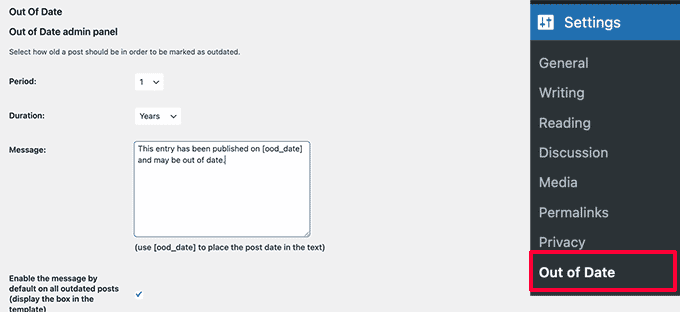
- Set the period and duration frame. For example, 1 and years flags anything older than a year, while 6 and months suits faster-moving topics.
- Choose whether age is measured from the publish date or the last update, and write your message.
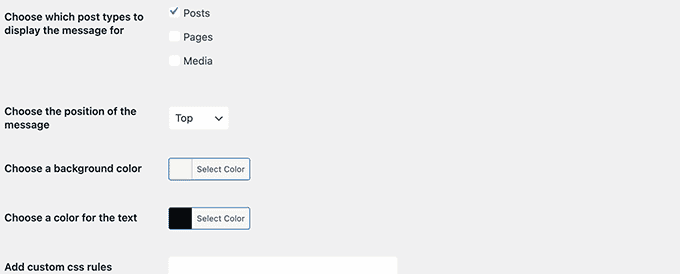
- Select the post types to cover, the position (top or bottom of the content), background and text colors, and any custom CSS. You can also enable the notice by default on all posts.
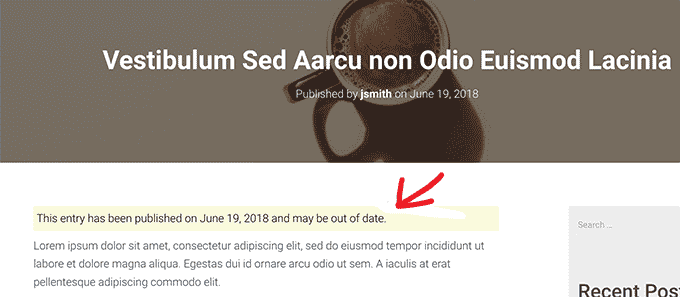
- Click Save Changes.
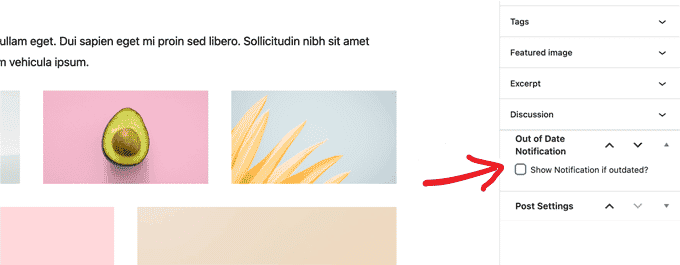
To switch the notice off for a single post, open it in the editor, untick the outdated notice option in the post settings, and update the post. The plugin also adds a column and a filter to your Posts screen, so you can see which articles are flagged at a glance.
Check Plugin Health Before You Install
Both plugins are small, focused tools with modest install counts, and small plugins can go quiet for months. The risk is real: when we last checked, a similarly named plugin, Old Post Notification, carried WordPress.org’s warning that it hadn’t been tested with the latest three major WordPress releases.
Before installing any of them, check the Last updated and Tested up to fields on the plugin’s WordPress.org page. If a plugin has fallen behind, try it on a staging site first or use the code method below, which leaves you no extra plugin to maintain.
Method 2: Show the Last Updated Date

A last updated date and an old post notice solve related problems. The date tells every reader how fresh a post is. The notice only appears on posts past your threshold and explains why that matters. Many blogs use both: the date on every post, the notice on the old ones. Here are three ways to show the last updated date in WordPress.
Option A: WP Last Modified Info
WP Last Modified Info, by Sayan Datta, is one of the most popular ways to show the last modified date in WordPress, with tens of thousands of active installs.
- Install and activate WP Last Modified Info.
- Go to Settings » WP Last Modified Info and enable last modified info for posts.
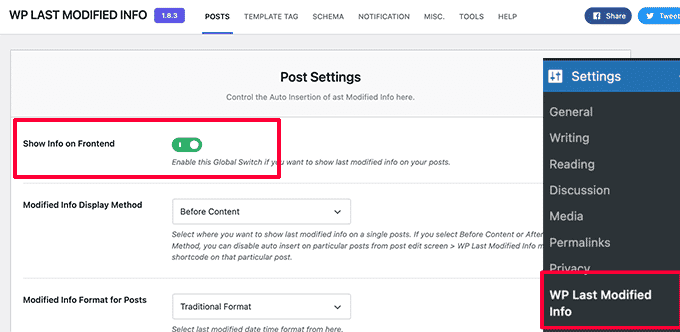
- Choose the display format: a full date, or a human-readable version such as 3 months ago.
- Decide where it appears: before or after the content, or in place of the published date.
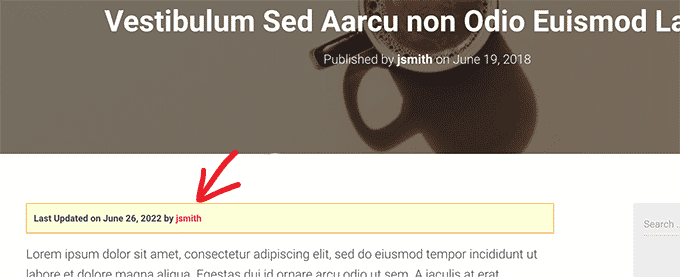
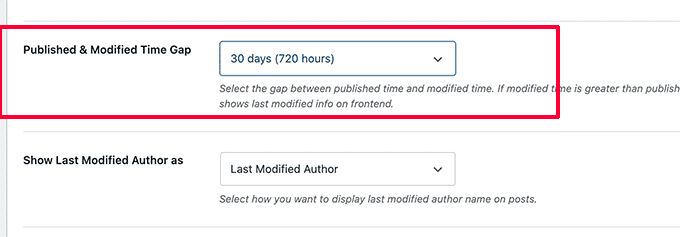
- Set a minimum gap between the published and modified time, so a typo fix made an hour after publishing does not trigger an Updated label.
- Click Save Settings.
For manual placement, the plugin offers the [[lmt-post-modified-info]] shortcode and three blocks: Modified Date, Modified Date Template, and Site Modified Date. The template block is handy in block themes, where you can drop the modified date straight into the single post template.
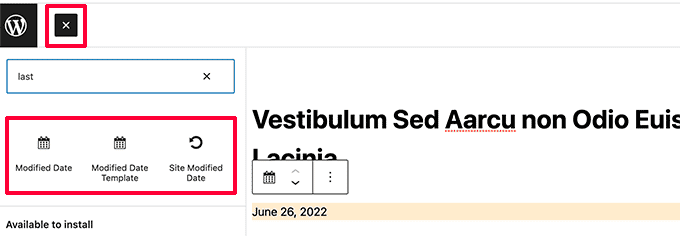
One caution: this plugin can add dateModified schema markup. If your SEO plugin (Yoast SEO, Rank Math, and similar) already includes dateModified in its Article schema, keep a single source so search engines don’t receive two versions of the same date.
Option B: The Post Date Block (Block Themes, No Plugin)
If your site runs a block theme, you may not need a plugin at all. The Post Date block that ships with WordPress can display the last modified date instead of the publish date, and it only shows it when a post has actually been changed after publishing.
- Go to Appearance » Editor, open Templates, and select the Single Posts template.
- Click the Post Date block near the post title. Want to show both dates? Duplicate the block first and change only the copy.
- Switch the block to the last modified date. Depending on your WordPress version, this is a toggle in the block settings or a Transform option called Modified Date.
- Add a prefix such as “Last updated:” if your version offers one, then save the template.
Option C: A Last Updated Date Snippet
Prefer code, or using a classic theme? This snippet prints a “Last updated on” line above the content, but only when a post changed at least a day after publishing. Add it the same way as the snippet in Method 3.
<?php
/**
 * Show the last updated date above blog posts.
 */
add_filter( 'the_content', 'vm_last_updated_date', 15 );

function vm_last_updated_date( $content ) {
    if ( ! is_singular( 'post' ) || ! in_the_loop() || ! is_main_query() ) {
        return $content;
    }

    $published = get_post_timestamp( null, 'date' );
    $modified  = get_post_timestamp( null, 'modified' );

    // Only show the date when the post changed at least a day after publishing.
    if ( ! $published || ! $modified || ( $modified - $published ) <= DAY_IN_SECONDS ) {
        return $content;
    }

    $date = sprintf(
        '<p class="vm-last-updated">Last updated on <time datetime="%1$s">%2$s</time></p>',
        esc_attr( wp_date( DATE_W3C, $modified ) ),
        esc_html( wp_date( get_option( 'date_format' ), $modified ) )
    );

    return $date . $content;
}
It uses the date format from Settings » General and wraps the date in a time element that browsers and crawlers can read. Because it reads the same modified date your SEO plugin uses for dateModified, the visible date and the structured data stay in sync.
Method 3: Add an Old Post Notice Without a Plugin
If you’re comfortable with a little PHP, a custom snippet gives you full control, adds no plugin to maintain, and lets you build SEO safeguards right into the notice.
The original version of this tutorial pasted code into single.php. That approach has two problems. Edits to a parent theme file disappear on the next theme update, and block themes (every default WordPress theme since Twenty Twenty-Two) build pages from HTML templates, so there is usually no single.php to edit. The snippet below hooks into WordPress’s the_content filter instead. It works on classic themes, and on block themes running WordPress 6.4 or later, which is when single post templates started running inside the main loop the snippet checks for.
Where to Put the Code
You have two safe options. The easiest is a code snippets plugin such as WPCode or Code Snippets, which stores the code in your database and survives theme changes. Our guide on how to add custom code to WordPress safely compares the main options. If you prefer files, add it to the functions.php file of a child theme, never the parent theme.
If you paste it into a snippets plugin, leave out the opening <?php line, since the plugin adds it for you.
The PHP Snippet
This version flags posts that haven’t been updated for a year, measures age from the last meaningful update, keeps the notice out of Google’s search snippets, and supports a per-post opt-out.
<?php
/**
 * Old post notice for WordPress.
 * Shows a warning above posts that have not been updated for a set time.
 */
add_filter( 'the_content', 'vm_old_post_notice', 20 );

function vm_old_post_notice( $content ) {
    // Only on single blog posts, inside the main loop.
    if ( ! is_singular( 'post' ) || ! in_the_loop() || ! is_main_query() ) {
        return $content;
    }

    // Skip posts that have the custom field hide_old_notice set to 1.
    if ( get_post_meta( get_the_ID(), 'hide_old_notice', true ) ) {
        return $content;
    }

    $threshold = YEAR_IN_SECONDS; // Try 6 * MONTH_IN_SECONDS for faster-moving topics.
    $published = get_post_timestamp( null, 'date' );
    $modified  = get_post_timestamp( null, 'modified' );

    if ( ! $published ) {
        return $content;
    }

    // Small fixes made within a day of publishing do not count as updates.
    $was_updated = $modified && ( $modified - $published ) > DAY_IN_SECONDS;
    $reference   = $was_updated ? $modified : $published;

    if ( ( time() - $reference ) < $threshold ) {
        return $content;
    }

    $label = $was_updated ? 'last updated' : 'published';

    $notice = sprintf(
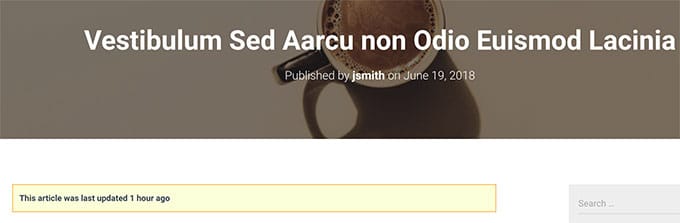
        '<div class="vm-old-post-notice" role="note" data-nosnippet><strong>Heads up:</strong> This article was %1$s %2$s ago. Some steps, screenshots, or prices may have changed since then.</div>',
        esc_html( $label ),
        esc_html( human_time_diff( $reference ) )
    );

    return $notice . $content;
}
A few notes on how it works:
- Priority 20 runs the filter after WordPress has processed blocks and paragraphs, so the notice is not wrapped in stray paragraph tags.
- Edits made within a day of publishing don’t count as updates, which avoids a misleading last updated message after a quick typo fix.
- The
data-nosnippetattribute tells Google not to use the notice text in search result snippets. More on why that matters below. - The checks at the top keep the notice off archives, feeds, and anything WordPress renders outside the main loop, such as auto-generated excerpts in your page header.
- To change the threshold, swap
YEAR_IN_SECONDSfor6 * MONTH_IN_SECONDSor2 * YEAR_IN_SECONDS. - If you also use the last updated date snippet from Method 2, the notice appears first, followed by the date.
- With full-page caching, the “months ago” text refreshes whenever the cache does. With a threshold measured in months, that lag is harmless.
- Running a blog in another language? Translate the message strings directly in the snippet.
Style the Notice With CSS
Add this to your Additional CSS panel (Appearance » Customize in classic themes, or the Styles panel in the Site Editor for block themes):
.vm-old-post-notice {
    background: #fff8e1;
    border-left: 4px solid #e0a800;
    border-radius: 4px;
    color: #3d3100;
    font-size: 0.95em;
    line-height: 1.6;
    margin: 0 0 28px;
    padding: 14px 18px;
}
Here’s the notice on a post that was never updated after publishing:
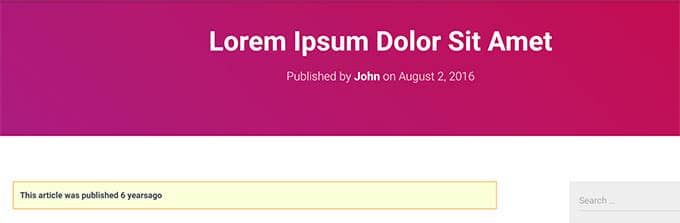
And on a post that has been refreshed since:
Hide the Notice on Specific Posts
Some old posts are evergreen and don’t need a warning. To skip one, open the post, enable the Custom Fields panel in the editor preferences, add a field named hide_old_notice with the value 1, and update the post. The snippet checks for that field before showing anything.
How Old Post Notices Affect SEO
A notice on its own won’t lift your rankings, and it shouldn’t hurt them if you set it up carefully. Three details make the difference.
Keep the notice out of your search snippet. When a notice sits at the very top of the content, Google may pick it as the description under your result, and “this article is over a year old” is not a line that earns clicks. Adding the data-nosnippet attribute to the notice container (a div, span, or section) prevents that. A manual meta description in your SEO plugin and a manual excerpt in the post settings also keep the notice out of social previews and auto-generated summaries. If your notice plugin doesn’t add the attribute, the manual description is your main defense.
Let dates reflect real updates. Google recommends a clearly labeled, visible date plus datePublished and dateModified in your structured data, and the visible date should match the markup. Google’s guidance on byline dates also makes clear that these dates should describe when the page itself was published or updated. Bumping the modified date after changing a comma, or hiding dates to disguise a post’s age, works against readers and gains you nothing that lasts.
Treat flagged posts as an update queue. The real SEO win comes from refreshing the posts that still earn impressions. When you update one, retest every step, replace screenshots, check links, and then let the new modified date show. That is when a last updated date becomes a genuine content freshness signal instead of a cosmetic one, and it is the best defense against content decay.
Notice Wording That Keeps Readers Trusting You
A bare “this post is old” message is accurate but unhelpful. Good notices say what might have changed and what the reader should do about it. Adapt these templates to your plugin’s date placeholders:
- Tutorials: This tutorial was last updated over a year ago. WordPress and plugin screens change often, so some menu names may look different on your site. If a step doesn’t match, let us know in the comments and we’ll recheck it.
- Prices, stats, and tool lists: Prices and figures in this article were accurate when we last updated it. Confirm current pricing on the vendor’s site before you buy.
- News and announcements: This story is part of our archive and reflects the situation when it was published. For the current picture, see our latest guide on the topic.
- Replaced content: We’ve published a newer, more complete guide on this topic. This version stays online for reference.
Keep it to one or two sentences, skip alarming colors like bright red, and link to the newer resource whenever one exists.
A Quarterly Review Routine for Aging Posts
A notice is only useful if someone eventually acts on it. A light routine every three months keeps the archive healthy without turning maintenance into a full-time job:
- Pull the list of flagged posts. Old Post Notice has a dedicated page for this, DX Out of Date adds a filter on the Posts screen, and with the code method you can simply sort your posts by modified date.
- In Google Search Console, open the Performance report, compare the last three months with the same period a year earlier, and filter by page to find flagged posts that still earn impressions. If you haven’t set it up yet, here’s how to connect Google Search Console to WordPress.
- Update the posts that still matter: retest steps, refresh screenshots, fix broken links, and add internal links to newer articles.
- Redirect or merge the ones that no longer serve anyone.
- Add an outdated content check to your WordPress blog post checklist so every new post gets a review date from day one.
Old Post Notices, Update Dates, and Rankings
Not when it is set up carefully. The notice is ordinary text on the page. The main risk is Google using it as your search snippet, which can lower clicks. Add the data-nosnippet attribute to the notice container and write a manual meta description to prevent that.
A last updated date is a neutral fact shown on every post. An old post notice only appears once a post passes an age threshold and tells readers to double-check details that may have changed. Many blogs use both: the date everywhere and the notice on older posts.
Show the last updated date on posts you actively maintain, and keep the original publish date visible for context if your theme allows it. Google accepts either or both, as long as the visible date matches the datePublished and dateModified values in your structured data.
It depends on how fast the topic changes. Twelve months works for most software tutorials, six months for prices and statistics, and one to three months for news. Evergreen explainers may never need one.
Yes, on WordPress 6.4 or later. The snippet hooks into the WordPress the_content filter instead of editing single.php, and since version 6.4 block themes render single posts inside the main loop the snippet checks for. It works on classic themes too. Add it through a code snippets plugin or a child theme.
Yes. DX Out of Date has a per-post checkbox, Old Post Notice lets you replace or extend the message on individual posts, and the code method skips any post with a custom field named hide_old_notice set to 1.
Changing the date alone is not a reliable freshness signal. Google wants dates to reflect real publication or updates, and readers notice when an Updated label sits on stale advice. Make substantive improvements first, then let the new date show.
Let the Notice Buy You Time
An old post notice is one of the cheapest trust upgrades you can make to a WordPress blog. Pick the option that fits your setup: Old Post Notice or DX Out of Date for a no-code outdated content warning, WP Last Modified Info or the Post Date block to show the last updated date, or the snippets above for full control on any theme. Then use the notice as a to-do list, not a permanent fixture.
For more ways to keep older content ranking, see our WordPress SEO tips for boosting search rankings.