
Short answer: buying backlinks with your brand name as the anchor text is not worth it if rankings are the goal. Google’s link spam policy treats any paid link that passes ranking credit as a violation, and it makes no exception for branded anchors. A paid placement can still be worth buying as advertising: labeled for readers, qualified with rel="sponsored" or rel="nofollow", and priced on the audience and referral traffic it delivers.
The belief that branded anchors make paid links safe comes from how link audits work. Backlink tools flag exact-match commercial anchors, so a link that reads “Acme Analytics” instead of “best analytics software” slips past the obvious checks. But the anchor only changes how the link looks. It does not change why the link exists, and that is what Google’s policy is written around.
This guide covers what the policy actually says, how branded, exact-match and naked URL anchors compare, where branded links are usually sold (link insertions, sponsored posts and paid guest posts), what happens when paid links get caught, and how to earn brand mentions that hold up. Visualmodo publishes contributor articles, so we see this question from the publisher’s side as often as from the buyer’s, and both sides carry risk.
Table of contents
- Key points
- What Google’s link spam policy actually says about paid links
- Branded, exact-match or naked URL: does the anchor change anything?
- Link insertions, sponsored posts and guest posts: where branded links get bought
- Unlinked brand mentions: the half of this conversation most guides skip
- The 60-second sniff test for any placement
- What works better than buying branded backlinks
- Disclosure: what publishers and brands owe readers
- What happens when paid links go wrong
- What to do if you have already bought links
- How to measure the value of branded mentions
- Common misconceptions about branded backlinks
- Branded backlinks: potential benefits and main risks
- Buying branded backlinks: policy, sponsored tags, costs and disclosure
- Pay for audiences, earn the links
Key points
- A paid link that passes ranking credit violates Google’s link spam policy whether the anchor is branded, exact-match or a bare URL.
- Paid links are allowed when they carry
rel="sponsored"orrel="nofollow", which means they pass no ranking credit. - Paid link insertions, sponsored articles, paid guest posts and products gifted in exchange for links all fall under the same rule.
- Branded anchors are lower risk than exact-match anchors in an editorial link profile, but they never make a purchased link compliant.
- The placements worth paying for are the ones you would still want with no link attached: a real audience, topical fit and referral traffic.
- Unlinked brand mentions on reputable pages shape how readers and AI answer engines describe your brand, even when nothing is clickable.
What Google’s link spam policy actually says about paid links
This topic sits close to a real policy line, so it is worth working from Google’s own wording rather than from what link sellers say about it.
Google’s link spam policy, part of its Search Essentials documentation, lists “buying or selling links for ranking purposes” as link spam and spells out what that includes:
- exchanging money for links, or for posts that contain links
- exchanging goods or services for links
- sending someone a product in exchange for them writing about it and including a link
The same section also names advertorials and native advertising where payment is received for articles with links that pass ranking credit, and optimized anchor text in guest posts or press releases distributed on other sites.
Notice what is missing from that list: anchor text is not part of the test. A paid link added to an article that already exists, often sold as a “link insertion” or “niche edit”, is still money exchanged for a link, so it falls under the first item however natural the branded anchor looks. Google judges why a link exists, not how it is worded.
The policy also describes the compliant route. Google accepts that buying and selling links is a normal part of the web economy for advertising and sponsorship, and says those links don’t violate its policies when they are qualified with rel="nofollow" or rel="sponsored". Sponsored is the more precise label for a paid placement, and nofollow is accepted too.
Follow that through and the answer resolves itself. A compliant paid link passes no ranking credit. A paid link that passes ranking credit is not compliant. So the honest version of the question is: what are you actually buying? Awareness on a relevant publication, qualified referral traffic and a brand mention where your buyers already read are real things worth paying for, and they work regardless of the link attribute. Everything below assumes those are the goal.
Sponsored, nofollow or ugc: which rel value fits which link?
Google documents three values for qualifying outbound links, and each one describes a different relationship between the two sites.
| Attribute | Use it for | Typical examples |
|---|---|---|
rel="sponsored" | Advertisements and paid placements | Sponsored articles, paid link insertions, affiliate links, sponsor logos on event pages |
rel="ugc" | Links inside user-generated content | Blog comments, forum posts, community answers |
rel="nofollow" | Links you don’t want associated with your site when the other values don’t fit | A source you are criticizing, a link you can’t vouch for |
Links marked with these values are generally not followed, and you can combine them on one link, for example rel="ugc nofollow". For a paid placement, sponsored is the value that tells the truth about the relationship.
Branded, exact-match or naked URL: does the anchor change anything?
A branded backlink is a link whose clickable text is a company or product name, such as “Acme Analytics”, rather than a keyword phrase like “best analytics platform”. Branded anchors look natural because that is how journalists, bloggers and customers refer to companies in real writing, which is why most earned link profiles are dominated by brand names and bare URLs.
Where the anchor does matter is in patterns. A profile in which dozens of links repeat the same commercial phrase looks manufactured, and Google’s policy calls out optimized anchor text in guest posts and press releases by name. Branded anchors rarely create that pattern. They do not, however, turn a paid link into an editorial one.
| Anchor type | Example | Where it usually appears | If the link was paid and followed |
|---|---|---|---|
| Branded | Acme Analytics | Press coverage, reviews, partner pages | Still a policy violation |
| Exact match | best analytics platform | Rare in earned links, common in paid ones | A violation, and the easiest pattern to spot |
| Partial match | Acme’s analytics guide | Editorial links to a specific resource | Still a policy violation |
| Naked URL | acmeanalytics.com | Citations, directories, social profiles | Still a policy violation |
| Generic | this study, read more | Resource links inside articles | Still a policy violation |
The last column is the point of the table. Anchor text decides how visible a pattern is, not whether a paid link is allowed.
Is there an ideal branded anchor text ratio?
Google has never published one, and the percentages quoted in SEO blogs vary because they describe different industries. A more useful benchmark is your actual competition. Pull the anchor report in Ahrefs or Semrush for three pages that rank where you want to rank, and compare their share of branded, URL and keyword anchors with yours. If your profile carries far more exact-match anchors than theirs, that gap is the risk worth fixing. For the anchor types themselves, with examples of each, see this guide to anchor text optimization.
Do branded anchors move rankings at all?
They can, when the link is editorial. A branded mention inside a relevant article that real readers find passes whatever value Google assigns to that page, and it sends visitors who already know your name. Neither effect depends on the anchor being a keyword. What a branded anchor cannot do is carry a weak page. Links amplify good destination pages. They do not rescue thin ones.
Link insertions, sponsored posts and guest posts: where branded links get bought
Hardly anyone buys something labeled “a backlink”. The purchase usually arrives in one of a handful of formats, and each has a compliant version.
| Format | What is actually being bought | Compliant version |
|---|---|---|
| Paid link insertion (niche edit) | A link added to an article that already ranks | rel="sponsored" plus a visible note, or skip it |
| Sponsored article or advertorial | An article paid for or written by the brand | Labeled as sponsored, every paid link qualified |
| Paid guest post | Publication of your article with a followed link | Publisher keeps editorial control, and links are qualified whenever money changes hands |
| Gifted product review | A free product in exchange for coverage and a link | Gift disclosed, link qualified |
| Event or association sponsorship | A logo and link on a sponsor or member page | Link carries rel="sponsored", because the visibility is what you paid for |
| Partner or supplier page | A listing between businesses that work together | Fine when the relationship is real, while excessive link swaps are named in the policy |
Two patterns deserve a warning. The first is the price sheet: placements priced by Domain Rating or Domain Authority are being sold as ranking signals, whatever the invoice calls them. The second is the guarantee: “dofollow, permanent, no sponsored tag” is a promise that the publisher will ignore Google’s policy on your behalf, and the exposure lands on both domains.
We have seen this from the publisher’s side. Visualmodo accepts contributor articles and doesn’t sell placements, yet third-party sellers have listed “dofollow guest posts” on our domain on freelance marketplaces, priced by Domain Rating, with the buyer choosing the anchor. The buyer pays a middleman, the middleman submits an article, and nobody tells the publisher. Anyone buying that package isn’t even buying from the site they think they are, and nothing about the result is guaranteed.
Unlinked brand mentions: the half of this conversation most guides skip
Most discussion of branded backlinks focuses on whether a link exists. The mention matters too. When a relevant, reputable page names your brand in context, readers learn about you whether or not the name is clickable.
How much Google’s ranking systems weigh unlinked mentions is not something Google has documented, so treat any precise claim about it with suspicion. What is well established is that Google models brands as entities, connecting a name to a website, products, people and topics, and that consistent references across reputable sites help it describe a brand accurately. Unlinked mentions feed that picture even when they pass no PageRank.
There is a second reason this matters, and it has nothing to do with link policy. AI answer engines assemble responses from how entities are described across the web, not only from link graphs. An unlinked mention in a well-regarded industry article contributes to that description, while a followed link on a page nobody reads contributes very little to either system. The mechanics of being visible to those systems are covered in this look at how startups win the AI search era.
You can help both systems connect those mentions to the right company. Use one exact brand name everywhere, keep it identical in your footer, social profiles and author bios, and mark it up with Organization schema that lists your official profiles in sameAs. Our structured data and schema guide walks through the JSON-LD. A company that calls itself three slightly different names fragments its own entity, and every mention it earns gets split three ways.
This should change how you score outreach. A journalist who names your company without linking, because of editorial policy or because the story didn’t need it, has still put your brand in front of the right readers and into the text AI systems learn from. Count it as a win. Ask for a link only when the page references something specific of yours, such as a study or a tool, where the link genuinely helps the reader.
The 60-second sniff test for any placement
- Open three recent posts. Are they interlinked, and are outbound links reasonable rather than sprayed across unrelated sites?
- Check the category hubs. Will your article live inside a real topic cluster, or sit orphaned?
- Read the topic mix. A site that publishes on every subject with no editorial focus is a link host, not a publication.
- Scan for signs of life. Comments, recent updates, real author pages and a working internal search.
- Preview your context. Can your brand mention sit inside a sentence that adds value to the paragraph?
- Look for discoverability. Does the article, or its siblings, already rank for long-tail queries?
- Ask about link attributes. If the answer is “dofollow guaranteed, no sponsored tag”, you already know what kind of site it is.
Two or more red flags and you can stop there. No debate needed.
What works better than buying branded backlinks
The approaches below take longer than paying an invoice. They also produce mentions that survive the next spam update, because each one exists for an editorial reason.
1. Expert source requests (HARO and its alternatives)
Journalists post requests for expert input, and anyone with relevant expertise can answer with a quote, a data point or an insight. When your answer is used, you are usually credited by name, title and company, often with a link, on a publication that would never sell one.
The platforms have changed hands recently, so check what you are signing up for. Cision rebranded HARO as Connectively and then shut that platform down in December 2024. Featured.com bought the HARO brand in April 2025 and relaunched the email digest. Qwoted, Source of Sources (started by HARO’s original founder, Peter Shankman) and Help a B2B Writer cover similar ground.
Any single pitch has low odds, because journalists receive many answers per request. Respond quickly, answer the exact question in two or three quotable sentences, and include the credentials that make you the right source.
2. Original data and useful resources
Tools, templates, benchmarks and small surveys give other writers a reason to cite you. A specific number from your own data is far easier to reference than a general opinion, and it gets picked up by AI answers for the same reason.
3. Digital PR
Launches, research, milestones and partnerships can earn coverage from niche media and business publications when the story stands on its own. Pitch the story, not the link.
4. Contributor content with real editorial control
A useful article on a publication your buyers read introduces your expertise directly. Write for that audience, accept the publisher’s link policy and treat the byline as the outcome, not the anchor. If a publisher’s main selling point is the link rather than its readers, that tells you what the placement is worth.
5. Partnerships, associations and events
Member directories, speaker pages and partner listings create relevant citations when a genuine relationship sits behind them. If the listing comes with a sponsorship fee, expect the link to carry rel="sponsored". The visibility in front of that community is what you paid for, and it is usually worth more than the link.
6. Local and regional coverage
For businesses with a geographic footprint, local press and community coverage deliver trust and referral traffic from people who can actually buy from you.
Disclosure: what publishers and brands owe readers
Disclosure is not only a Google question. In the United States, the Federal Trade Commission treats content that hides its commercial nature as deceptive, and its guide to native advertising for businesses explains that sponsored content formatted like an ordinary article generally needs a clear, prominent label. In the European Union, the Unfair Commercial Practices Directive lists paid editorial content that doesn’t make the payment clear among the practices banned outright. Other markets have similar rules or advertising codes.
For brands, the practical rules are short: let the publisher label the piece, never ask them to drop the sponsored tag, and keep the commercial relationship on record. For publishers: label sponsored content where readers will actually see it, qualify every paid link, and price placements on audience rather than on ranking metrics.
Publishers carry a second risk that buyers rarely think about. Google’s site reputation policy covers third-party content published mainly to borrow a host site’s ranking signals, and it can lead to manual actions on those pages in results shown outside the European Economic Area. Google revised how the policy applies inside the EEA in August 2026, but the standard it describes is unchanged: third-party content needs real editorial oversight and integration with the rest of the site, or it stops benefiting from the host’s reputation.
What happens when paid links go wrong
The consequences of paid link patterns are worth understanding concretely, because “it might hurt you” is vague enough to ignore.
The common outcome is that nothing visible happens, and that is the problem. Google’s stated approach is to neutralize links it doesn’t trust rather than penalize the site receiving them. With its December 2022 link spam update, Google said its SpamBrain system could detect both sites buying links and sites used to pass outgoing links, and that the credit those links passed would be lost. Most paid links in most profiles are simply ignored. The money is gone, the ranking effect never arrives, and nothing tells you which of the two happened.
The less common outcome is a manual action. Search Console reports two relevant ones. “Unnatural links to your site” applies when Google finds a pattern of artificial inbound links. “Unnatural links from your site” applies when a site sells links that pass ranking credit, which is the exposure publishers carry. Both require finding the offending links, removing or qualifying them and filing a reconsideration request. Recovery takes months when it happens at all.
Patterns matter more than single links. Enforcement, algorithmic or manual, responds to profiles rather than instances. One sponsored placement on a relevant publication is not a pattern. Forty placements across unrelated sites in six months, all in the first paragraph and all pointing at commercial pages, is.
The same logic shows up wherever signals can be bought. Paid links, likes and upvotes all try to fake the thing a platform measures, and platforms respond by discounting whatever they can’t trust. Our breakdown of whether buying TikTok likes is worth it reaches the same conclusion from the social media side.
Structuring outreach so the value comes from relationships rather than transactions is its own discipline, and it is covered in more depth in this guide to building a link strategy that aligns with Google’s expectations.
What to do if you have already bought links
If you or a previous SEO vendor bought links, branded or keyword-based, the cleanup order matters more than speed.
- Stop new orders first. An active campaign keeps adding to the pattern while you clean it up.
- Build an inventory. Export links from the Links report in Search Console and from a third-party tool, then mark every placement that was paid for.
- Ask publishers to qualify or remove the links. Adding
rel="sponsored"is usually the fastest fix, and it keeps whatever traffic the placement sends. - Disavow selectively. Google’s Disavow Links tool is meant for sites with a manual action, or with a large number of spammy links likely to cause one. It is not routine maintenance, and most sites never need it.
- If there is a manual action, document everything. The reconsideration request should show what you removed, what you qualified, what you disavowed and what you changed in your process.
- Move the budget. Put the money into the editorial, PR and resource work described above. Going forward is worth more than relitigating the past.
How to measure the value of branded mentions
Judge branded mentions on more than rankings, because rankings are the slowest and noisiest signal they produce.
| Signal | Where to see it | What it tells you |
|---|---|---|
| Referral visits from the placement | Google Analytics 4, traffic acquisition by source | Whether the audience is real |
| Branded search demand | Search Console Performance report, branded queries filter | Whether more people look for you by name |
| Assisted conversions | Google Analytics 4, conversion paths | Whether mentions influence buyers later |
| Mentions and citations in AI answers | An AEO or AI visibility tool | Whether AI engines name you for your topics |
| Rankings of the destination page | Search Console or a rank tracker | The slow, compounding effect |
Search Console’s branded queries filter, added to the Performance report in November 2025 and opened to more sites in March 2026, makes the second row much easier to track, although sites with low query volume may not qualify for it yet. For the fourth row, our comparison of AEO tools that track brand mentions in AI answers covers the options from free plans upward.
Set expectations before you measure. Referral traffic and exposure arrive the day an article goes live. Ranking effects, where they appear, build over months.
Common misconceptions about branded backlinks
“A branded anchor makes a paid link safe.” It makes the link look natural. Google’s policy is about why the link exists, and the anchor isn’t part of that test.
“Branded anchors do nothing for SEO.” Editorial branded links pass value and send visitors who already know your name. They simply don’t help when the link was bought.
“High authority metrics guarantee better results.” A smaller publication with a real audience in your niche often beats a bigger site with weak topical fit.
“Exact-match anchors are always stronger.” They create the most visible pattern in a profile, and they age the worst.
“Nofollow and sponsored links are worthless.” They pass no ranking credit by design, but they still send traffic, put your brand in front of buyers and shape how your brand is described online. A profile made only of followed links also looks less natural than a mixed one.
Branded backlinks: potential benefits and main risks
| Factor | Potential benefit | Main risk |
|---|---|---|
| Brand visibility | Exposure on sites your buyers already read | Low-quality placements weaken trust |
| Anchor profile | Branded anchors keep the profile natural | Paid placements still form a pattern |
| SEO impact | Editorial mentions support discovery and authority | Paid or manipulative links get ignored or penalized |
| Referral traffic | Good placements send qualified visitors | Many paid placements send no one |
| AI visibility | Consistent mentions shape how AI answers describe you | Inconsistent brand names split the signal |
| Long-term value | Strong editorial mentions compound over time | Bought links often lose value quickly |
Buying branded backlinks: policy, sponsored tags, costs and disclosure
In most countries, buying a link is not illegal in itself. It breaks Google’s spam policies when the link passes ranking credit, which is a search risk rather than a legal one. The legal exposure comes from disclosure: in the US the FTC treats paid content disguised as editorial as deceptive, and the EU bans undisclosed paid editorial content outright. This is general information, not legal advice.
Yes. Google’s link spam policy lists buying or selling links for ranking purposes as a violation, including paying for links or for posts that contain links, and it makes no exception for branded anchors. A branded anchor changes how natural a link looks to a reader. It does not change what the policy says.
It tells Google a link was paid for and should not pass ranking credit. Google accepts either sponsored or nofollow on paid links, though sponsored describes the relationship more precisely. Either one makes the placement compliant and removes the ranking benefit most buyers are paying for. What remains is exposure and referral traffic, which are worth paying for on their own terms.
Marginally, and for a narrower reason than most people assume. Branded anchors rarely form a manufactured-looking pattern, because that is how people naturally reference companies. Safety comes mostly from the placement, though. A branded anchor on a site that exists to sell links is not safe, and an exact-match anchor inside a genuine editorial mention is not dangerous.
Not when the link passes ranking credit. Paying to add a link to an article that already exists is exchanging money for a link, which Google’s policy names directly. A paid insertion is only compliant when the link is qualified with sponsored or nofollow, and at that point you are paying for the page’s readers rather than its rankings.
They help search engines and AI answer engines recognize and describe your brand as an entity, which works partly outside the link graph. Google has not documented how much its ranking systems weigh them, so treat precise claims with suspicion. The practical point for outreach is that a mention without a link is not a failed placement.
If the link passes ranking credit, no price is correct, because you are buying a policy violation. If it carries rel=sponsored, you are buying advertising, so price it the way advertising is priced: on the audience it reaches and the traffic it sends, not on a domain authority score. Placements quoted on DR or DA are being sold as ranking signals, whatever the invoice says.
Ask whether you would still want the mention if it carried no link at all. If the publication reaches your buyers, covers your topic credibly and the article would send real readers, the placement has value on its own terms. If the only reason to want it is the link attribute, it is a ranking purchase wearing a marketing label.
Yes, on both sides. Publishers should label paid content and qualify paid links, and advertisers should never ask them to skip either step. Disclosure costs nothing in marketing value and removes the largest legal and search risk in the arrangement.
Not always from a single link, which is why some paid links seem to work for a while. Google says its SpamBrain system can detect both sites that buy links and sites used to pass outgoing links, so the risk grows with patterns: sites known for selling placements, repeated anchors, sudden bursts of links and public price lists. The usual result is that those links quietly stop counting rather than a visible penalty.
Pay for audiences, earn the links
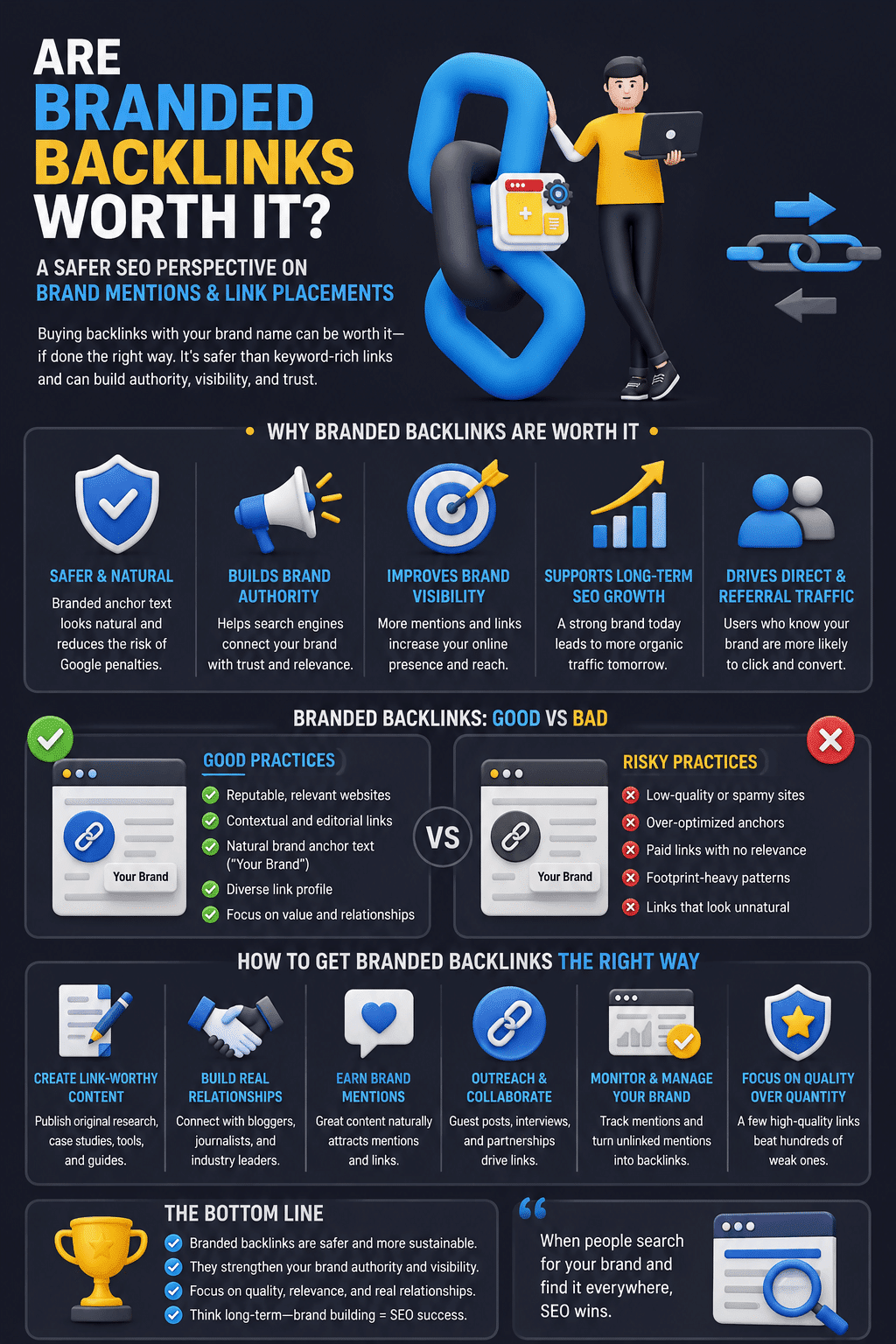
Branded backlinks are worth having when they are earned, and a branded anchor is a sensible default for any link you can influence. They are not a loophole. The anchor changes how a paid link looks, never what it is.
If you have budget for placements, spend it on audiences: sponsored content on publications your buyers read, labeled honestly and qualified properly. Put the rest into the work that earns mentions without an invoice, such as original data, expert commentary and resources people want to cite. That mix is slower than a link package, and it is the version that still works after the next spam update.
Update, October 2026: we corrected the status of HARO and Connectively, clarified that Google accepts both sponsored and nofollow on paid links, and added sections on rel attributes, link insertions, anchor text benchmarks and measuring branded mentions.
Editorial note: no company, vendor or link seller paid for placement in this guide, and it contains no sponsored or affiliate links. Google’s policy wording was checked against its spam policies and link qualification documentation in October 2026.