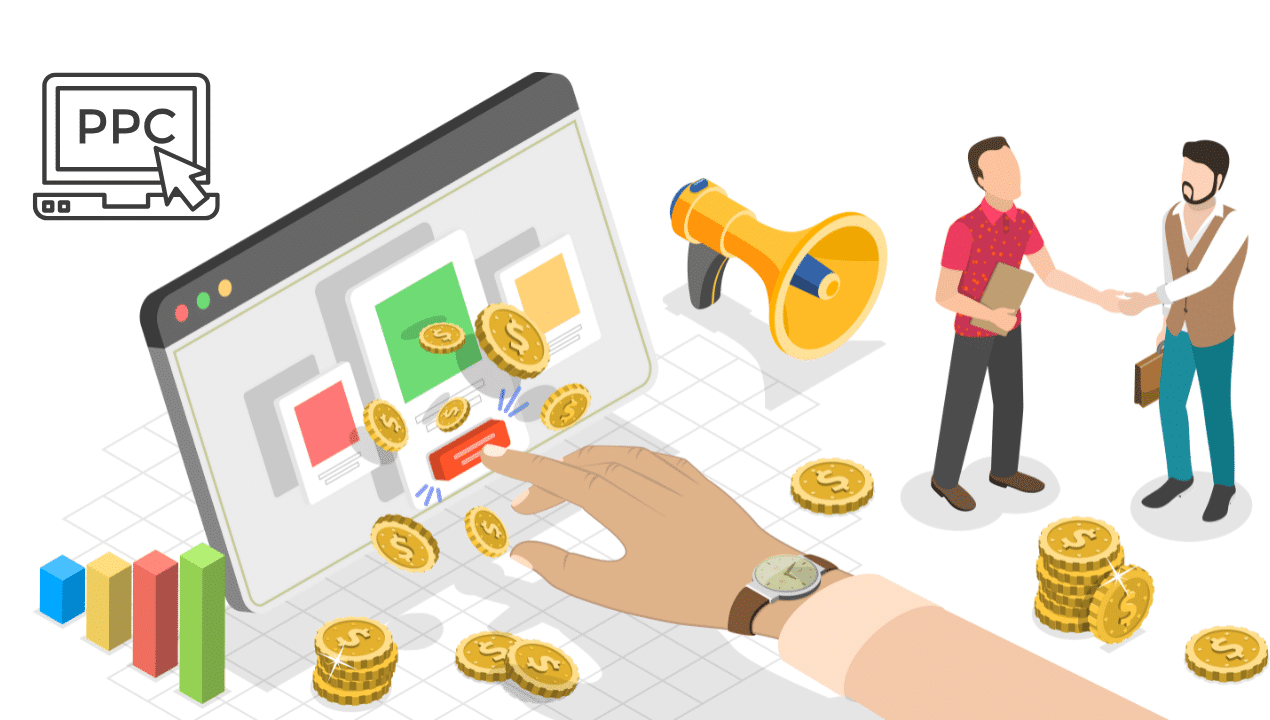
Pay-per-click (PPC) marketing puts your business in front of buyers at the exact moment they are searching, and it does it in hours rather than the months an SEO program usually needs. That speed is the whole appeal. A PPC campaign launched on Monday can be producing qualified leads by Wednesday, with every click, cost, and conversion attributed to a specific keyword, device, and audience.
The trade is that PPC marketing punishes sloppiness faster than any other channel. Organic content that misses simply gets ignored. A misconfigured campaign spends real money while it misses. This guide covers how the ad auction actually works, how to build a PPC marketing strategy that survives contact with a live budget, which numbers deserve your attention, and what changed in Google Ads during 2026 that makes several older playbooks obsolete.
The core mechanic is simple. Advertisers bid on keywords, ads appear when someone searches those terms, and you pay only when a user clicks. The main platforms are Google Ads, Microsoft Advertising (formerly Bing Ads), Meta for Facebook and Instagram, LinkedIn for B2B, and increasingly retail media networks such as Amazon Ads. Each one reaches people at a different stage of intent, which is the most important thing to understand before allocating a PPC budget.
Table of contents
- How PPC Marketing Actually Works: Ad Rank, Quality Score, and the Auction
- Why PPC Marketing Gives You More Budget Control Than Any Other Channel
- PPC Landing Pages: Where Most Budgets Actually Leak
- What Changed in Google Ads in 2026, and Why Older PPC Advice Is Now Wrong
- Ongoing monitoring and optimization
- PPC KPIs That Matter, and the Vanity Metrics That Waste Your Time
- Running PPC Marketing In-House or Hiring an Agency
- Frequently Asked Questions About PPC Marketing
- Final Thoughts on a PPC Marketing Strategy That Holds Up
How PPC Marketing Actually Works: Ad Rank, Quality Score, and the Auction
Most PPC guides skip the auction, which is why so many advertisers assume the highest bid wins. It does not.
Every time someone types a query, Google runs an auction and calculates Ad Rank for each eligible ad. Ad Rank combines your bid, your Quality Score, the expected impact of assets and ad formats, the search context, and the Ad Rank thresholds for that query. Quality Score is itself a diagnostic built from three inputs: expected click-through rate, ad relevance, and landing page experience.
The practical consequence is worth internalizing. An advertiser with a strong Quality Score can outrank a competitor bidding significantly more, and pay less per click while doing it. The reverse is equally true: a high bid attached to a generic page and a vague ad will quietly inflate your cost per click for as long as the campaign runs.
This is why cost per click is a symptom, not a lever. When CPC climbs, the fix is almost never raising the bid. It is tightening the match between the query, the ad copy, and the page the click lands on.
Why PPC Marketing Gives You More Budget Control Than Any Other Channel
One of the main advantages of PPC marketing is the control it offers. Businesses can set precise budgets, target specific locations, and schedule ads to appear at optimal times. This customization lets small businesses with limited marketing budgets compete effectively against larger competitors. Additionally, PPC campaigns provide measurable results through detailed analytics, enabling marketers to track conversions, adjust bids, and refine ad copy to improve performance over time. Understanding platforms and new tools—such as Amazon’s self-service Demand-Side Platform—can give brands and sellers further control over where their ads appear and how much they spend, enhancing the effectiveness of PPC strategies.
Effective PPC marketing requires more than just placing ads. Keyword research is critical to ensure campaigns target the right search terms. Ad copy must be compelling, highlighting the value proposition and including a clear call to action. Landing pages must also be optimized for conversions, providing a seamless experience once visitors click the ad. Poorly designed landing pages or irrelevant ads can waste spend, highlighting the importance of strategy in PPC marketing.
PPC Landing Pages: Where Most Budgets Actually Leak
Ad spend usually doesn’t get wasted in the auction. It gets wasted in the four seconds after the click.
A dedicated PPC landing page has three jobs: confirm the promise the ad made, remove every path that is not the conversion, and load fast enough on mobile that nobody bounces before the headline renders. Sending paid traffic to a homepage is the most common and most expensive mistake in the channel, because a homepage is built to serve every visitor and therefore converts none of them particularly well.
Practical checks before you spend another dollar:
- Does the page headline repeat the phrase in the ad, and ideally the query itself?
- Is there exactly one conversion action above the fold?
- Have you removed the global navigation, or at least the links that lead away from the offer?
- Does the form ask for the minimum information sales genuinely needs, not the maximum marketing would like?
- Are you tracking form submissions as conversions, or still counting page views?
Build one page per offer and per major intent cluster rather than one page for the whole account. Our walkthrough on how to design a high-converting landing page covers the structural elements in more depth, and the same principles apply whether you build in WordPress or a dedicated page builder.
This matters more now than it did in 2023. The more query matching you hand to Google’s automation, the less say you have in which page receives which visitor, so the average quality of your pages becomes the hard ceiling on your PPC campaign optimization.
What Changed in Google Ads in 2026, and Why Older PPC Advice Is Now Wrong
If you last configured a Google Ads account two or three years ago, several settings you learned are being retired.
Google has confirmed that campaign-level broad match settings and legacy automatically created assets are being auto-upgraded to AI Max for Search campaigns during September 2026, and that new campaigns using those settings can no longer be created. Dynamic Search Ads were given a longer runway, with their sunset and auto-upgrade pushed to February 2027. Google’s own announcement on upgrading Dynamic Search Ads to AI Max is the primary source worth reading in full before your account changes without you.
AI Max is not a new campaign type. It is a layer you switch on inside existing Search campaigns, bundling keywordless query matching, automatic ad text customization, and final URL expansion, which lets Google choose a different landing page than the one you specified.
Read that last part again, because that is where the risk sits. Final URL expansion means Google decides where your traffic lands. If your site runs one catch-all page behind every campaign, AI Max will amplify that weakness at scale. Independent testing has also been considerably less flattering than Google’s headline numbers, with account-level results frequently landing neutral or negative even where individual campaigns improved.
The honest read for most advertisers: treat the migration as a forced test, not a free upgrade. Before it lands, export a clean 90-day performance baseline, tighten your negative keywords, and confirm every ad group points at a page it deserves. Afterward, review the search terms report weekly rather than monthly, because expanded matching surfaces queries your keyword list never bid on.
The same automation shift is reshaping organic discovery, which is why paid and organic planning are converging. If you have not looked at how AI answers change visibility, our guide to generative engine optimization in the AI search era covers the organic half of the same problem.
Ongoing monitoring and optimization
Another key component of successful PPC marketing is ongoing monitoring and optimization. Algorithms and audience behaviors change over time, and campaigns need regular adjustments to maintain performance. This can involve testing different ad variations, updating keyword lists, and analyzing performance metrics to identify areas for improvement. By continuously optimizing campaigns, businesses can maximize ROI and achieve consistent results.
Using PPC Data to Sharpen SEO, and the Reverse
The PPC vs SEO framing is a false choice for most businesses. Paid search produces something no organic program can buy: a fast, honest answer to what your market actually types and which promises make them act.
Three handoffs are worth building into your process.
- Query mining. The search terms report shows real language, including phrasing your content team would never have guessed. Feed high-converting terms into the content calendar and push the expensive non-converting ones into negative keywords.
- Message testing. Responsive search ad headlines are the cheapest headline test available anywhere. The variant that wins on click-through rate is usually your next title tag and H1.
- Coverage strategy. Once a page ranks organically for a term, you can often reduce paid spend on it and redeploy that budget to terms you cannot realistically win organically within a year.
Our breakdown of SEO tips to boost your PPC campaigns covers the keyword side of that loop, and if you are still deciding how paid fits alongside content, email, and social, read how to build a digital marketing strategy that actually works before committing budget to any single channel.
The flow runs both ways. Pages that already rank well usually make better PPC landing pages, because they have survived real user behavior rather than a designer’s assumption about it.
PPC KPIs That Matter, and the Vanity Metrics That Waste Your Time
| Metric | What it actually tells you | When it misleads |
|---|---|---|
| Impressions | Auction reach and eligibility | Rises automatically with looser matching, means little alone |
| Click-through rate | Ad and keyword relevance | High CTR on unqualified traffic still loses money |
| Cost per click | Auction pressure and Quality Score health | Cheap clicks from low-intent queries flatter the report |
| Conversion rate | Landing page and offer fit | Meaningless if your conversion action is a page view |
| Cost per acquisition | Efficiency against a fixed goal | Ignores order value, so it quietly favors small customers |
| Return on ad spend | Revenue efficiency | Only as accurate as your revenue tracking |
| Qualified lead rate | Whether sales can use what you sent | Requires CRM data most accounts never connect |
That last row separates accounts that scale from accounts that plateau. Smart Bidding optimizes toward whatever you define as a conversion. If a conversion is any form fill, the algorithm will find you an unlimited supply of unqualified form fills at an impressively low cost per acquisition. Feeding qualified-lead or revenue signals back from your CRM through offline conversion import is the highest-leverage change most PPC accounts can make, and it is the one thing Google’s automation cannot do for you.
Set a review cadence and hold it. Weekly: search terms report, negative keywords, budget pacing, and any campaign whose CPA moved more than 20 percent. Monthly: ad copy tests, audience segments, geographic performance. Quarterly: channel mix, offer, and whether the landing pages still describe what you actually sell.
Running PPC Marketing In-House or Hiring an Agency
There is a threshold where in-house management stops being economical, and it sits lower than most founders expect. Below a few thousand dollars a month in spend, retainers tend to eat the efficiency they create, and a disciplined operator working from a checklist will do fine. Above that, the cost of one badly structured Performance Max campaign bidding against your own Search campaigns exceeds any retainer you were trying to avoid.
The questions worth asking a prospective partner have nothing to do with certifications. Ask who owns the account after the contract ends. Ask how they define a conversion and whether they will connect your CRM. Ask what they will do differently now that AI Max has taken match type control out of their hands. An agency that describes PPC marketing as a set of levers they pull manually is describing a job that Google’s automation has largely absorbed.
If you keep it in-house, budget the time honestly. One account in active optimization needs three to five focused hours a week, not fifteen minutes between meetings.
Frequently Asked Questions About PPC Marketing
Enough to generate roughly 15 to 30 conversions monthly, because below that you cannot tell signal from noise and Smart Bidding has nothing to learn from. Work backward: take your target cost per acquisition, multiply by 20, and that is your realistic floor. If that number is uncomfortable, start on one tightly scoped campaign rather than spreading a thin budget across five.
Clicks arrive within hours. Reliable data takes two to four weeks, and Smart Bidding needs a learning period, usually one to two weeks, and it needs enough conversion volume to have something to learn from. Google no longer publishes a hard minimum, but accounts producing single-digit monthly conversions rarely see automated bidding outperform manual control. Judging a campaign after five days is the fastest way to kill something that was about to work.
Often yes, for three reasons: you can capture competitor and comparison queries you will never rank for, you can test messaging in days instead of quarters, and AI Overviews are compressing the organic real estate above the fold on many commercial queries. Run the math on incremental conversions rather than assuming cannibalization.
It depends entirely on offer and industry, so treat published averages with suspicion. A more useful benchmark is your own: measure your current rate, then judge every change against it. If a dedicated page does not beat your homepage by a clear margin, the page is the problem, not the traffic.
For campaign-level broad match and automatically created assets, the upgrade is automatic and you cannot opt out permanently. You can control what happens next: turn off final URL expansion if your page coverage is weak, apply brand exclusions, and monitor the search terms report far more closely than you used to.
Search campaigns bid on queries you choose and show text ads on the results page. Performance Max takes a budget, a goal, and a pile of assets, then serves across Search, Display, YouTube, Discover, Gmail, and Maps, with limited visibility into what happened. Performance Max scales well when your conversion data is clean and fails expensively when it is not.
There is no target number. What matters is the cadence: review the search terms report weekly for the first month, then at least monthly. Most accounts that are bleeding money are bleeding it into a handful of irrelevant queries nobody has looked at in a quarter.
It can, but you are choosing to pay more per conversion for the privilege. Landing page experience directly affects Quality Score, so a poor destination raises your cost per click and lowers your conversion rate. You pay for it twice.
Final Thoughts on a PPC Marketing Strategy That Holds Up
PPC marketing remains the fastest way to buy attention from people already looking for what you sell, and in 2026 it is also the channel where automation is taking the most control. Those two facts are related. As Google absorbs bidding, matching, and increasingly creative decisions, the work that still belongs to you narrows to a short list: define what a genuinely valuable conversion is, feed that definition back from your CRM, and build pages good enough to deserve the traffic the machine sends.
Get those three right and the rest of the account largely takes care of itself. Get them wrong, and no bidding strategy, budget increase, or agency retainer will save the campaign.