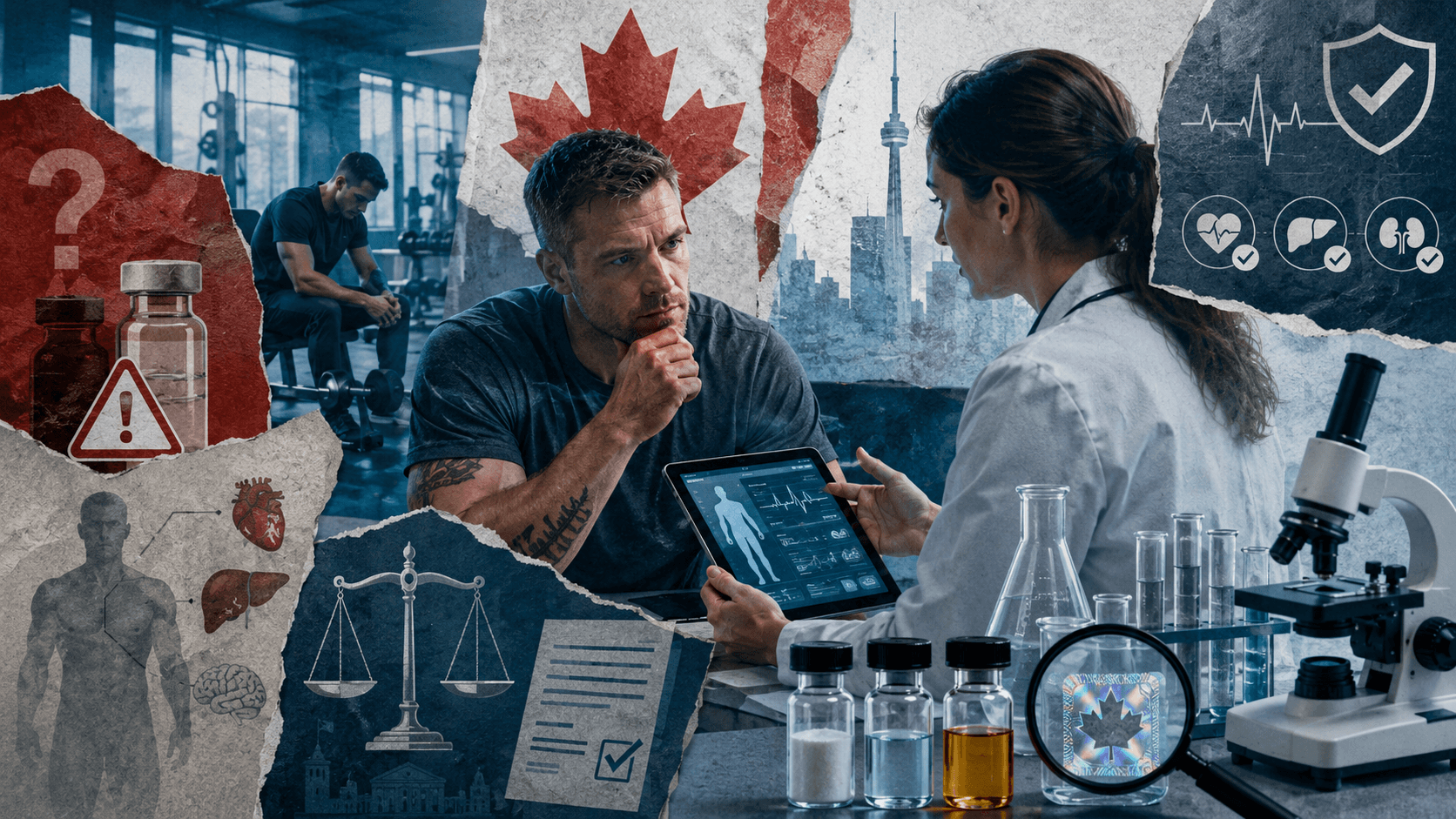
Anabolic steroids in Canada come up constantly in fitness and bodybuilding communities, usually framed around where to buy them. That’s the wrong first question. The right ones are whether it’s legal, what’s actually in the product, and what it does to the body, questions a lot of what’s written on this topic treats as an afterthought. This guide covers the real legal status under Canadian law, what independent lab testing actually finds in black-market products, and the legal alternatives that address the same underlying goals.
What Anabolic Steroids Actually Are
Anabolic-androgenic steroids (AAS) are synthetic derivatives of testosterone, developed originally for legitimate medical uses like treating delayed puberty, muscle-wasting disease, and hormone deficiency. They work by binding to androgen receptors in muscle and bone tissue, increasing protein synthesis and, at high enough doses, muscle mass beyond what training and diet alone produce.
They come in two main forms, and the difference matters for health risk specifically: injectable esters are absorbed directly into the bloodstream, while oral tablets are chemically modified to survive digestion, a modification that also makes them meaningfully more toxic to the liver than injectable forms, since the liver processes the full dose on every pass. At the doses typically used for bodybuilding or performance goals, far above what any doctor would prescribe for a legitimate medical purpose, both forms carry a different risk profile than their medical use suggests.
The Real Legal Status
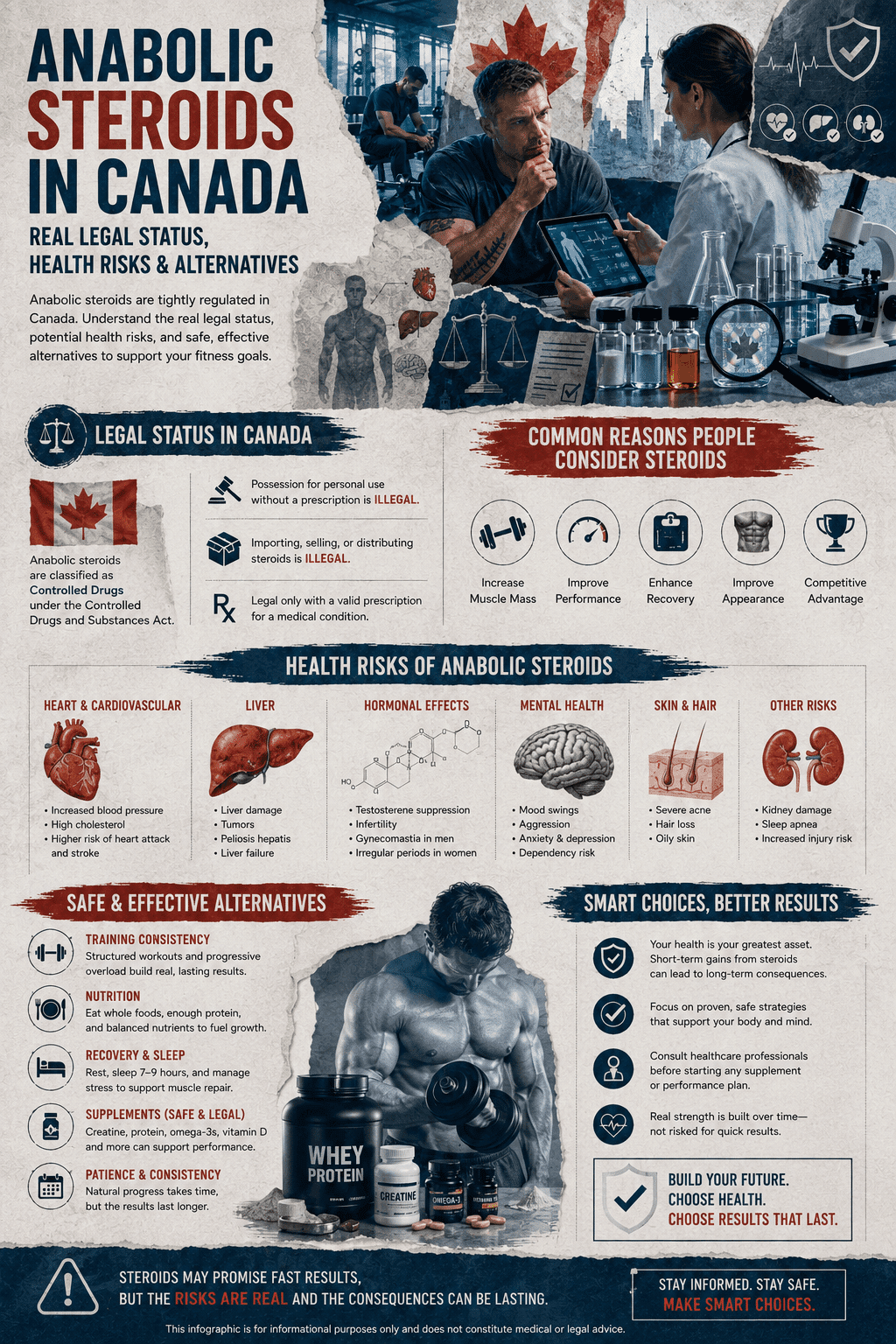
Anabolic steroids are classified as Schedule IV controlled substances under Canada’s Controlled Drugs and Substances Act. The specifics matter here, since the legal picture is more precise than “illegal”:
Selling, distributing, or possessing anabolic steroids for the purpose of trafficking is a real criminal offence. Under Section 5 of the CDSA, trafficking in a Schedule IV substance carries a maximum penalty of three years’ imprisonment as an indictable offence, or up to twelve months on summary conviction. There’s no mandatory minimum sentence, but it’s a real charge with real consequences, not a technicality.
Legitimately obtaining anabolic steroids requires a valid prescription from a licensed physician, dispensed through a licensed pharmacy. Any product purchased outside that chain, regardless of how the seller markets itself, was not obtained through a legal process, even if simple personal possession isn’t prosecuted the same way harder scheduled drugs are.
The Real Health Risks
According to Health Canada’s consumer advisory on unauthorized anabolic steroid products, documented risks include heart attacks, strokes, reduced fertility, hardening of the arteries, liver damage, masculinization in women, and breast tissue changes in men. These risks are tied to the drug class itself and the doses typically used for performance goals, not just to poor-quality products.
The cardiovascular risk has a specific mechanism worth understanding: anabolic steroids at performance doses tend to lower HDL (“good”) cholesterol while raising LDL (“bad”) cholesterol, which is a large part of why the heart attack and stroke risk exists even in otherwise healthy, young, physically fit users.
Psychological and behavioral effects are also well documented in clinical literature. According to a review published in NCBI’s StatPearls medical reference, these include mood instability, aggression, and, with continued use, patterns consistent with a genuine dependence syndrome, tolerance, compulsive use, and continued use despite clear harm.
For anyone still growing, there’s an additional risk that doesn’t apply to adult users: anabolic steroids can cause premature closure of the growth plates, permanently limiting final height. This risk is specific to adolescents and young people who haven’t finished growing.
What’s Actually in Black-Market Products
This is the part most articles on this topic never mention, and it’s the most important practical information here. A systematic review and meta-analysis published in BMC Public Health analyzed 5,413 anabolic steroid samples across 19 independent studies, most drawn from products seized by authorities. The findings: an estimated 36% of black-market anabolic steroids are counterfeit, and an additional 37% are substandard quality. Combined, that means roughly three out of four samples tested didn’t match what they claimed to be.
The researchers found these products could contain no active ingredient at all, the wrong active ingredient entirely, or the correct ingredient at the wrong dose. A separate forensic analysis by Brazilian federal police of over 300 seized AAS products found similar results, with nearly half of counterfeit samples containing no active ingredient whatsoever. This isn’t a rare, unlucky outcome, it’s closer to a coin flip on whether a black-market product is what it claims to be, and there’s no way for a buyer to verify it before use.
Red Flags When Evaluating Any Online Seller
Beyond the counterfeiting risk itself, specific warning signs are worth checking before trusting any seller’s claims. A business calling itself “Steroids Canada” is a useful example of what to look for, and what not to take at face value: claims of decades of operating history and tens of thousands of shipped orders are meaningless unless they can be independently verified, and in practice, they usually can’t be, since domain registration records frequently contradict stated business histories on sites in this space. A cluster of nearly identical domain names for the same brand, with inconsistent trust signals between them, is a pattern worth treating as a warning rather than background noise. Payment methods that don’t allow a chargeback, common across this category of seller, mean there’s no recourse if a product never arrives or doesn’t match what was paid for, on top of no legal recourse existing at all for an illegal purchase gone wrong. Worth confirming directly what payment method any specific seller actually requires before assuming a card-based, reversible option is available.
The Legal Alternative: Testosterone Replacement Therapy
For people whose actual goal is more energy, better muscle retention, or improved libido, a real, legal, medically supervised path exists: testosterone replacement therapy (TRT). In Canada, TRT is prescription-only. It starts with bloodwork confirming genuinely low testosterone, followed by a licensed physician, often an endocrinologist or a doctor at a men’s health clinic, prescribing and monitoring treatment through a real pharmacy. This route means known dosing, known purity, and ongoing medical monitoring, the three things no black-market purchase can guarantee, backed by the same counterfeiting data above.
Not everyone researching this topic has clinically low testosterone, and TRT isn’t a substitute for anabolic steroid use at bodybuilding doses. But for a meaningful share of people who land on this topic because they feel run-down or are losing muscle with age, a blood test and a conversation with a doctor is the legal starting point.
Building Strength Naturally, Without Any of This Risk
For people not dealing with a medical hormone deficiency, the fundamentals still account for most of the realistic gains available: consistent progressive resistance training, adequate protein intake (roughly 1.6 to 2.2 grams per kilogram of bodyweight for people actively training), 7 to 9 hours of sleep, since most natural testosterone production and muscle repair happens during deep sleep, and managing chronic stress, since elevated cortisol directly suppresses testosterone production. None of this produces results as fast as what black-market marketing promises, but none of it carries the legal, health, or counterfeit risk covered above either.
Tracking basic health metrics can help gauge progress, though it’s worth knowing the limits of common tools. Visualmodo’s own BMI calculator is a quick way to check a standard reference range, but BMI doesn’t distinguish muscle from fat, so it becomes a poor measure of progress specifically for people gaining significant muscle mass through resistance training, exactly the audience most likely reading this article. Body composition changes, not the BMI number alone, are the more meaningful signal for someone actively strength training.
When to See a Doctor Immediately
Anyone experiencing chest pain, unusual shortness of breath, swelling, jaundice (yellowing of the skin or eyes), dark urine, or right-upper-abdomen pain after using any steroid product should go to an emergency department or see a doctor immediately rather than researching further online. These are exactly the symptoms tied to the cardiac and liver risks described above.
Stopping matters just as much as starting, and this is the part most sources on this topic skip entirely. Abruptly discontinuing anabolic steroids after a cycle can trigger a real, clinically documented withdrawal syndrome, since the body’s natural testosterone production has been suppressed the whole time and doesn’t restart instantly. Research presented at the Endocrine Society’s ENDO 2024 conference found men had worse mental health and sexual function in the first year after stopping than either current users or people who’d never used, with depression, anxiety, and suicidal ideation specifically identified as withdrawal risks. This is exactly why stopping, not just starting, deserves medical supervision rather than being handled alone. If withdrawal includes thoughts of suicide, that’s a medical emergency: contact a doctor, go to an emergency department, or in Canada, call or text 988, the Suicide Crisis Helpline, available 24/7.
Frequently Asked Questions About Anabolic Steroids in Canada
Selling or distributing them without proper authorization is illegal trafficking under the Controlled Drugs and Substances Act, carrying up to three years imprisonment. Legitimately obtaining them requires a prescription through a licensed pharmacy.
A peer-reviewed meta-analysis of 5,413 samples found 36% were counterfeit and 37% were substandard quality, meaning roughly three-quarters of tested black-market products didn’t match what they claimed to be.
Testosterone replacement therapy (TRT), a prescription treatment that starts with bloodwork confirming clinically low testosterone, followed by a licensed physician prescribing and monitoring treatment.
Not without independent verification, and in practice, these claims are frequently impossible to verify or directly contradicted by basic checks like domain registration records.
According to Health Canada, documented risks include heart attacks, strokes, reduced fertility, liver damage, and hardening of the arteries, risks tied to the drug class and typical performance doses, not just product quality.
Yes. Progressive resistance training, adequate protein intake, consistent sleep, and stress management account for most of the realistic natural gains available, without any of the risks covered above.
Abrupt cessation can trigger a real withdrawal syndrome, since natural testosterone production was suppressed during use and doesn’t restart instantly. Documented symptoms include fatigue, low mood, reduced libido, and in serious cases, depression and suicidal ideation, which is why stopping safely benefits from medical supervision, not just starting.
No, though they’re commonly confused, including in some marketing copy that mislabels one as the other. SARMs (selective androgen receptor modulators) are a distinct drug class that targets androgen receptors more selectively than anabolic steroids. Some products marketed as “legal SARM alternatives” are actually herbal or natural supplements that don’t contain a SARM or steroid compound at all, worth confirming exactly what a product contains rather than trusting a category label.
Infographic