
Know why you should repurpose your old content; Content is a crucial part of digital marketing. Creating high-quality content can help you reach and engage with your target audience, making it easier to convert them into buying customers. However, creating quality content that resonates with your target audience can be time-consuming and expensive.
This is where repurposing content comes in to help you save both time and money in content creation.
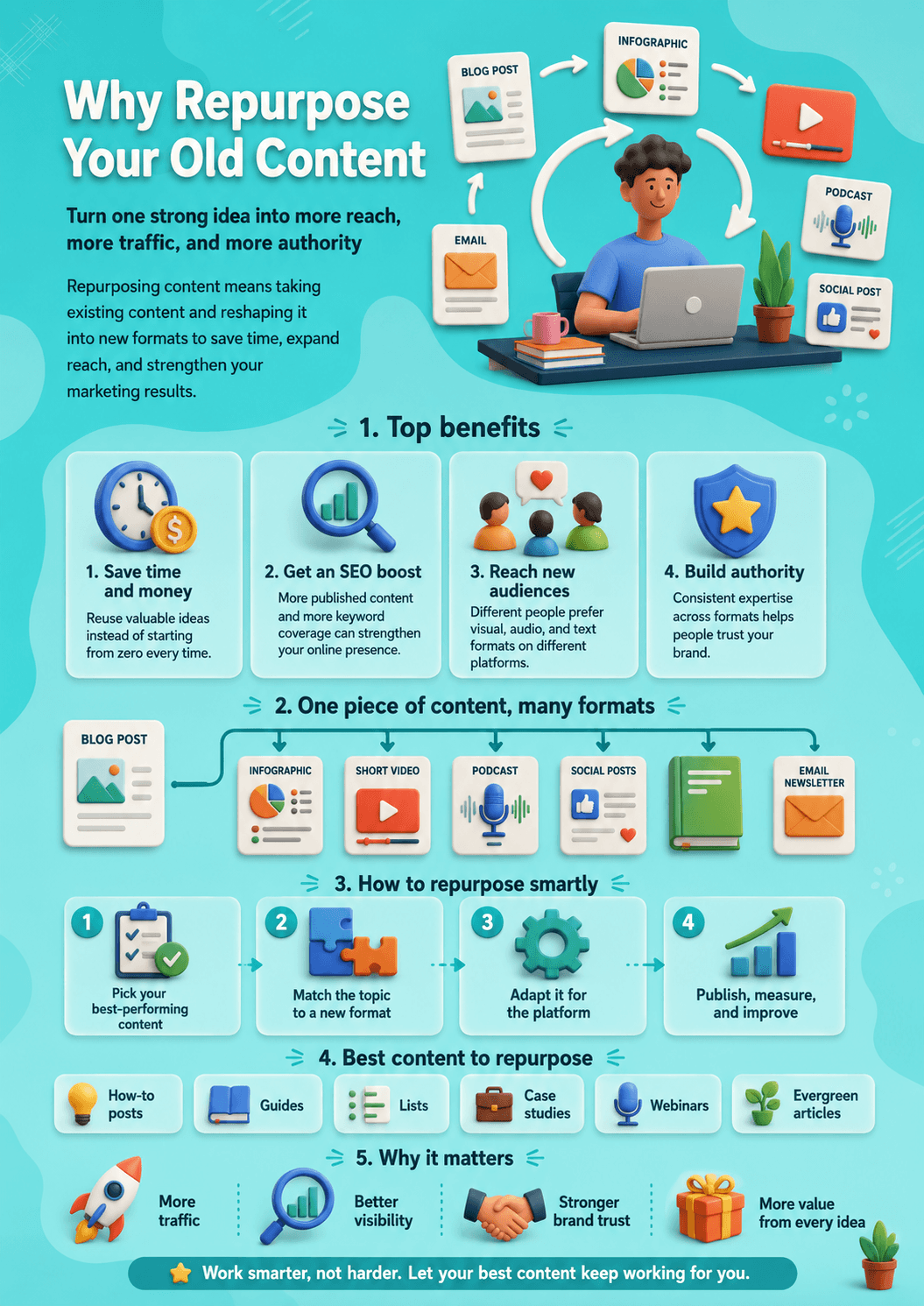
Repurposing content involves converting existing content into a new format to expand its reach. You can repurpose your old blogs into catchy visuals for social media marketing or enhance your other marketing efforts. Besides helping with your social media marketing, here are a few other reasons why you should repurpose your old content:
What the Data Actually Shows About Content Repurposing
Content repurposing is not just a productivity tip floating around marketing blogs. The numbers behind it are specific and compelling enough to change how you prioritize your time.
According to Semrush’s State of Content Marketing report, 42% of marketers who repurpose content consistently rank it among their three most effective strategies. HubSpot research has found that repurposed content generates roughly three times the leads at approximately half the cost of creating new content from scratch. The Content Marketing Institute reports that brands with an active repurposing workflow produce up to six times as much content as those without one, without a corresponding increase in budget or team size.
These numbers matter because they flip a common assumption. Most content teams believe that publishing more new content is the fastest path to growth. The data suggests something different: working your existing content harder, in more formats, for more audiences, consistently outperforms the treadmill of constant creation.
The underlying logic is straightforward. Every piece of quality content you publish represents real investment: research hours, writing time, editing rounds, and promotion effort. When that content lives only in one format on one channel, you are recovering a fraction of what it cost to make. Repurposing is how you change the math.
That said, careless repurposing is not a shortcut. It requires choosing the right content, matching it to the right format, and adapting it properly for each platform. The next few sections break all of that down.
Repurpose Your Old Content
How to Choose Which Old Content Is Actually Worth Repurposing
Not everything in your content library deserves a second life. One of the most common traps content teams fall into is treating repurposing as a bulk operation, pulling in every post from two or three years ago and pushing it out across channels without any selection criteria. The result is a lot of effort spent on mediocre content that underperforms in its new format too.
Here is a cleaner approach for finding the right candidates to repurpose old content.
- Start with your top performers. Open your analytics platform and sort posts by organic traffic, average session duration, and social shares. These pieces have already proven they connect with an audience. Repurposing them means you are starting from a position of strength: the core idea works, the research is already done, and you have real evidence of resonance. Your best performers should always be the first pieces on your repurposing list.
- Filter for evergreen relevance. A post about the best WordPress themes of a specific year is not a strong repurposing candidate unless you plan a complete overhaul. A post about how to choose a color palette for a website? That stays relevant indefinitely. Prioritize topics that do not expire with a news cycle or product release.
- Look for content that underperformed because of format, not idea. Sometimes a piece of content fails to gain traction not because the topic is wrong, but because the delivery is. A long-form article that never got organic traffic might do exceptionally well as a YouTube video or a LinkedIn carousel. The underlying idea had value; the packaging was just not suited to where the audience was looking.
- Use keyword gap data to find hidden opportunities. Tools like Ahrefs or Semrush show you which keywords competitors are ranking for that you currently are not. Cross-reference that list with your existing content. If you have an article covering a topic that a competitor is ranking for in a slightly different angle, refreshing and repurposing that post can unlock rankings that a brand-new article would take many months to earn.
Get an SEO Boost
One of the main benefits is that it helps improve your SEO or search engine optimization. Repurposing content and publishing it in different places means having more content online, which increases your online presence. Search engines, such as Google, prefer sites they can trust. Having a solid online presence makes search engines view you as a credible source of info, ranking you higher on the search engine results page.
It also gives you a chance to gain quality backlinks and target the right keywords. Additionally, your repurposed content doesn’t have to be indexed since your older pages are already indexed. This way, you can boost your SEO and rank on search engines faster.
The Real SEO Mechanics Behind Content Repurposing
Most explanations of why repurposing helps SEO stop at “more content means more presence.” The actual mechanics run a little deeper than that.
- Topical authority matters more than individual keyword rankings. Google has moved well beyond reading individual pages in isolation. It evaluates whether a site shows genuine, deep expertise across a topic cluster. When you repurpose a single strong blog post into a YouTube video, a podcast episode, a LinkedIn carousel, and an infographic, all of those pieces reinforce each other’s topical authority signal. You are not chasing more keywords. You are building a web of content that communicates to Google: this site understands this subject.
- Backlink surface area grows with every new format. Each new format you publish creates a new opportunity for people to discover and cite your work. An infographic shared on Pinterest can earn embedded links from industry blogs. A YouTube video gets cited in roundup posts. A podcast episode gets referenced by other shows. These are all links that feed authority back to your original pages and your domain.
- Duplicate content is a real risk if you skip one step. Repurposing is not the same as republishing identical text in multiple places. If you copy-paste a blog post onto Medium, LinkedIn, and your own site simultaneously, you create a duplicate-content problem that can dilute rankings across all versions. The right practice is to adapt the content meaningfully for each format. If you do republish written content elsewhere in a similar form, use a canonical tag pointing back to your original URL. That tells Google where the authoritative version lives.
Reach a New Audience: Repurpose Old Content
While your target audience shares common pain points, it doesn’t mean they all resonate with your content the same way. Oftentimes, your original content only reaches a small group of audiences. In addition, people prefer different forms of content, and their learning methods vary greatly. Some are visual, while others prefer audio and textual content more.
Content repurposing for different mediums helps get it in front of an entirely new audience where they are, whether on social media, blogs, webinars, or podcasts. Repurposing your old content into different formats like podcasts, infographics, eBooks, videos, and other formats, lets you build brand awareness on multiple platforms. It also enables you to reach a broader audience, generating more traffic to your site and more quality leads.
7 Content Formats Worth Repurposing Into (And What Each One Does Best)
One of the most practical questions any content team faces is not whether to repurpose but what to repurpose into. Each format has a different job to do and reaches a different audience in a different context.
- Short-form video (YouTube Shorts, Instagram Reels, TikTok). Short-form video is the fastest-growing content format in terms of reach and engagement rate. Taking the three strongest points from a blog post and turning them into a 60 to 90-second video reaches an audience that will never read a 1,500-word article under any circumstances. These are real people with the same questions your content answers. They just prefer to watch.
- YouTube long-form video. If your blog post is a comprehensive guide or a step-by-step tutorial, a YouTube version can rank independently. YouTube is the second-largest search engine in the world. A well-optimized video targeting the same keyword as your blog post can appear in both Google search results and YouTube search results simultaneously, doubling your visibility from a single piece of content.
- Podcast episode. Audio content has a loyal and high-trust audience. Podcast listeners tend to engage deeply with the shows they follow, and they listen during commutes, workouts, and household tasks: contexts where reading is not possible. Turning a detailed blog post into a conversational episode, with added personal commentary and examples, makes that content accessible to people in completely different daily situations.
- LinkedIn carousel. LinkedIn carousels (PDF files published as document posts) consistently outperform static image posts in organic reach and save on the platform. A 10-slide carousel summarizing your best post can introduce your thinking to a professional audience that may have never visited your website. Each slide creates a natural pause point for a scrolling user, which is why carousels earn more saves than almost any other LinkedIn format.
- Email sequence. If a blog post covers a multi-step process, consider breaking it into a 3 to 5-email series sent on consecutive days. Subscribers who receive the information in small, digestible daily doses have significantly higher completion rates than those who try to read everything at once. This format is particularly effective for tutorial or how-to content with distinct stages.
- Infographic. Visual learners make up a large portion of any audience, and a well-designed infographic that distills the key data points or steps from a blog post is highly shareable on Pinterest, LinkedIn, and in industry roundups. Infographics also reliably earn embedded backlinks, making them one of the highest-ROI repurposing formats for teams that prioritize link building.
- Twitter or X thread. A sharp, opinionated thread on X can introduce your thinking to a large audience through topic-following and retweet networks. The key is not to summarize the blog post in thread form but to take a single strong insight from it and expand on that one idea natively. When done well, threads build an audience that over time converts into blog readers, email subscribers, and customers.
Gain Extra Authority: Repurpose Old Content
Another great benefit of repurposing old content is that it helps establish you as an authority in your industry. Posting quality on a single topic in different places can help people see you as an expert, helping you gain extra authority. The consistency of your content can influence your credibility among your audience. The more consistent you are, the more people see you as a credible source of information. This helps you build trust with your target audience and stand out as a legitimate business among your competitors.
A Simple Five-Step Framework for Repurposing Content Consistently
Understanding why repurposing works is the easy part. Most content creators stall when building a consistent system to do it regularly without burning out. Here is a repeatable process that works at any team size.
- Step 1: Run a content audit every quarter. Before you can repurpose strategically, you need visibility into what you already have. Export your top 50 posts by organic traffic, engagement rate, and social shares. Flag anything that is evergreen, has demonstrated clear audience resonance, or covers a topic you want to strengthen in the coming months. This list becomes your repurposing queue.
- Step 2: Score each piece by repurposing potential. Not every post is a strong candidate. Use a simple scoring approach: how broad is the topic (narrow topics score lower), how evergreen is it (time-sensitive content scores lower), how much structure or data does it have (structured content is easier to adapt). Posts that score well across all three are added to an active repurposing schedule. The rest get a basic update or are left as-is.
- Step 3: Match the content to the right format for your actual audience. Where does your audience spend time? If you serve a B2B professional audience, LinkedIn carousels and long-form YouTube videos tend to generate the most qualified return traffic. If your audience skews younger and consumer-focused, short-form video has the highest reach. Map format to the platform where your readers already are, not to the platform you find most comfortable to create for.
- Step 4: Adapt the content, do not just copy it. This is the step most guides underemphasize, and most teams skip. Every platform has native expectations about how content sounds and looks. A LinkedIn carousel should feel like LinkedIn, not a blog post broken into 10 slides. A YouTube video needs spoken personality and visual pacing. A Twitter thread needs to be punchy, opinionated, and self-contained. Match the tone and style to the platform, or your repurposed content will underperform regardless of how strong the source material is.
- Step 5: Publish, measure, and adjust. Repurposed content only pays back if you track what happens with it. Monitor views, saves, shares, clicks back to the source article, email signups generated, and backlinks earned. Those metrics show you which formats are working for your specific audience, so you can concentrate effort on those and reduce time spent on formats that are not pulling their weight.
Mistakes That Quietly Kill Your Content Repurposing Results
Most advice on content repurposing focuses entirely on what to do. The mistakes are equally worth knowing, because they are common and their impact on results is significant.
Repurposing your weakest content. If a piece of content underperformed originally because the idea was thin or the research was shallow, repurposing it solves nothing. You will simply have a weak idea distributed across more channels. Always start with your best work, not your backlog.
Treating repurposing as copying. Pasting a blog post into a new format without adapting it is one of the most widespread mistakes. An email that reads like a blog post, a LinkedIn post that sounds like a corporate press release, a YouTube video with no visual pacing because it was written for text first: all of these underperform because they feel wrong to the audience consuming them. The format is different, but the content hasn’t been updated to match it.
Misreading platform culture. Each channel has its own unwritten rules about what good content looks like. TikTok audiences are allergic to polished corporate production. LinkedIn rewards specific professional insight and stated stakes. Pinterest is almost entirely visual and utility-driven. Not understanding these differences before repurposing is like translating a book between languages without accounting for idiom, humor, or tone.
Publishing without a distribution plan. Creating the repurposed content is only half the job. If there is no plan to actively put it in front of the right people, it will sit unread, just as the original did. Build a simple promotion checklist for every format you publish.
Leaving the original source article untouched. When you repurpose a post into a video or a series, that is a clear signal the topic has real value. Go back to the original article and update it. Add new data, fix anything that is outdated, and link from it to each repurposed format. This builds an interconnected content ecosystem rather than a collection of isolated pieces spread across different platforms.
Real Teams That Built Real Results Through Repurposing
Statistics make the case in principle. Specific examples make it believable.
Gary Vaynerchuk built an entire content operation around what he called the content pyramid. His team would record one piece of long-form content each day, typically a keynote speech or an internal meeting, and slice it into 30 to 40 smaller pieces distributed across every major platform. A single hour of content became a month of social material. That system helped him grow to tens of millions of followers across platforms without having to record new content from scratch each time.
HubSpot systematically turns its highest-traffic blog posts into YouTube videos, email courses, podcast segments, and downloadable templates. Their blog drives tens of millions of organic visits per month, partly because they have built a network of supporting content in multiple formats, all pointing back to the same core topics and domain. The repurposing is not opportunistic; it is built into their editorial workflow.
Neil Patel, who runs one of the most-visited marketing blogs in the world, openly states that he updates and repurposes his highest-performing posts regularly rather than chasing new topics at high volume. His position, supported by his own site’s data, is that a fully refreshed and repurposed post with existing age and backlinks consistently outperforms a brand-new post on the same topic. The history of the page matters, and repurposing is one of the few ways to benefit from that history without starting over.
These are not exceptions. They are consistent examples of a principle that works at any scale of content operations.
Frequently Asked Questions About Repurpose Old Content
Content repurposing means taking a piece of existing content and adapting it into a new format or distributing it through a different channel. Turning a blog post into a YouTube video is a form of repurposing. Converting a webinar recording into a written guide is a form of repurposing. Breaking an ebook chapter into a LinkedIn carousel is a form of repurposing. The core idea, research, and value stay consistent; the packaging changes to suit a different audience or platform context.
Not if you approach it correctly. The important distinction is between repurposing and duplicating. Repurposing means adapting content into a new format without creating SEO problems. Duplicating means copying the same text across multiple URLs without specifying which version is authoritative, which does create problems. If you republish similar written content on another platform, use a canonical tag pointing back to your original URL. Done right, repurposing strengthens your SEO by expanding your topical authority and backlink surface area.
Start with your best performers. Look at which posts have the highest organic traffic, strongest engagement metrics, most social shares, or best conversion rates. Then filter that list for evergreen topics that will remain relevant well beyond a specific news cycle or product launch. Posts that currently rank on page two for a competitive keyword are also strong candidates: refreshing and repurposing them can push them onto page one faster than starting a new article from scratch.
A practical starting point is to repurpose your five to ten top-performing posts every quarter. This gives you consistent output of new-format content without overwhelming your workflow. As you build a reliable repurposing process, you can increase the cadence. Many effective content operations repurpose one to two pieces per week as a standard part of their content calendar rather than treating it as a separate project.
It depends primarily on where your specific audience already spends time. For B2B professional audiences, LinkedIn carousels and long-form YouTube videos generate the most qualified traffic back to the source site. For consumer-facing brands with younger demographics, short-form video on Reels, Shorts, or TikTok delivers the highest reach. Infographics work well for visual topics and earn backlinks reliably across multiple industries. If you are uncertain, start with the channel where your audience is most active and run a small test before committing to a full repurposing workflow.
Infographic
Stop Creating More and Start Doing More With What You Have
The content marketing world has a creation bias. More posts, more videos, more campaigns, more everything. The pressure to constantly produce new content is real, and for many teams, it is also quietly exhausting.
Your existing content library is an asset that is almost certainly being underused. The posts sitting quietly in your archive, the webinar nobody watched a second time, the guide that performed well for six months and was then forgotten: all of that is raw material ready to be put to work again.
Repurposing is not a shortcut. It takes real judgment about which content to select, real effort to adapt it properly for each platform, and a real distribution plan to get it in front of the right people. But the return on that investment, working your best ideas harder across more formats and more channels, consistently outperforms the return on creating something new from nothing.
The most successful content operations in the world did not get there by always writing more. They got there by thinking more carefully about what they had already built and finding smarter ways to make it earn.
Start there.