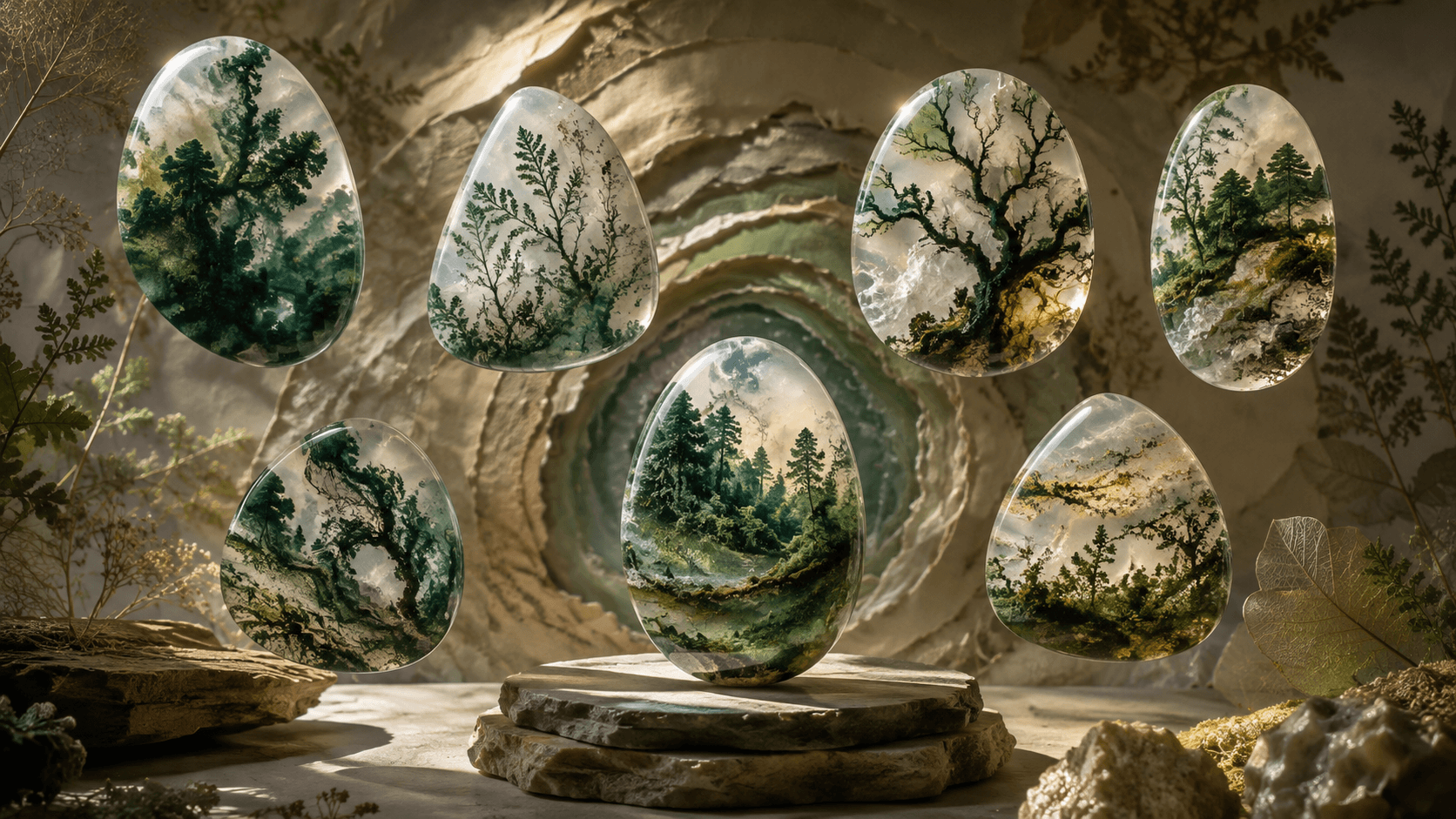
Every moss agate is different, and unlike most things sold with that claim, this one is literally true. The green branching inside the stone was set by where a few mineral particles happened to settle in a rock cavity, and no two cavities filled the same way. Buy a moss agate ring and you own a pattern that exists nowhere else and cannot be reproduced.
That is the appeal, and most articles stop there. Below is the rest: what the green actually is, why “moss agate” is technically a misnomer, how the stone holds up in daily wear, and what to look at when every option in front of you is genuinely different.
The pattern is an accident of geology, and it has a name
Moss agate is a variety of chalcedony, a microcrystalline form of quartz. The green branching inside it is not plant matter and never was. It is mineral inclusions, specifically hornblende or chlorite, that were suspended in silica-rich fluid as it filled cavities and fissures in volcanic rock and slowly hardened.
The exact shape those inclusions take is a product of temperature, pressure, fluid chemistry and whatever minerals happened to be present at that spot. No two cavities filled under identical conditions, so no two patterns repeat.
The colour range follows the same chemistry. Green comes from hornblende or chlorite. Reddish and rust tones appear where the iron in chlorite has oxidized. Deep brown and black patterns are usually manganese oxides. This is why a single stone can show green, rust and brown at once, and why two stones cut from the same nodule can look like different species.
One piece of gemological trivia worth knowing, since it comes up whenever someone knowledgeable looks at your ring: moss agate is not, strictly speaking, an agate. True agates are defined by concentric banding. Moss agate has none. The gemological reference data classifies it as a variety of dendritic agate within the chalcedony family, and notes that the name “agate” is generally accepted even though the stone lacks the banding a true agate should have. Gemologists often call it dendritic chalcedony. Both names are correct in their contexts.
What that means when you are choosing one
With most gemstones you are buying to a specification. A one-carat, F colour, VS1 diamond is interchangeable with any other, and the grading exists precisely so you can compare without seeing the stone. Moss agate has no equivalent. There is no standardized grading system, which means two sellers can describe comparable stones identically and price them very differently.
That changes how you shop in three practical ways.
- Judge the stone, not the listing. Photographs matter more here than in any other gem category, because the pattern is the product. A single image at one angle tells you almost nothing about how a stone reads in daylight or how the inclusions sit at depth. Ask for more angles before committing.
- Price comparison works differently. Since pattern desirability is subjective and ungraded, comparing prices across sellers means comparing specific stones rather than descriptions. A stone described as “vivid green dendritic” might be worth twice or half what another seller charges for the same phrase.
- Returns matter more than usual. You cannot order a replacement of the same stone. A seller with a clear return policy is offering something meaningful, and one without it is asking for more trust than the category warrants.
The upside of all this is that the decision is genuinely yours. Nobody can tell you that one pattern is objectively better, because no such standard exists. What you can do is make sure you have actually seen what you are buying.
Dense, sparse, and everything between
Moss agate ranges from densely packed forest-green stones to nearly clear ones with a few delicate wisps. Some have a single dramatic tree shape, others look like an entire meadow.
Density is worth thinking about beyond aesthetics, because it affects how the stone behaves in a setting. Heavily included stones read as darker and more opaque, and hold their character under most lighting. Sparse stones depend on light passing through them, which means the setting and the metal behind the stone change how they look considerably more. A pale stone in a closed-back setting can look flat in a way it never did in the seller’s photograph.
Photographing this range honestly is harder than it sounds. A stone that reads as a dramatic landscape in person can flatten into a green smudge under the wrong lighting, which is why sellers of one-of-a-kind pieces put unusual effort into product imagery. If a listing shows only one angle, ask for more.
What uniqueness does not tell you: durability
Every article about moss agate sells the uniqueness. Very few give you the number you need before putting one on your hand every day.
| Property | Moss agate |
|---|---|
| Mohs hardness | 6.5 to 7 |
| Cleavage | None |
| Specific gravity | 2.58 to 2.64 |
| Refractive index | 1.530 to 1.540 |
| Transparency | Translucent |
Two numbers, pulling in opposite directions.
At 6.5 to 7, moss agate is softer than sapphire, ruby or diamond. Everyday dust contains quartz particles at roughly the same hardness, which means a polished surface can dull gradually over years of daily wear. That is a real consideration for an engagement ring worn continuously.
But cleavage is where the more useful comparison sits. Moss agate has none. Emerald, at Mohs 7.5 to 8, is harder and yet chips considerably more easily, because it has imperfect cleavage in two directions. Hardness resists scratching; cleavage determines whether a knock splits the stone. Moss agate scratches more readily than a sapphire and breaks less readily than an emerald.
What follows practically:
- Setting matters more than it does for a harder stone. A bezel or a setting with protected edges will outlast an exposed cut on a stone in this hardness range.
- Take it off for physical work. Gardening, gym sessions, anything abrasive. This is standard advice for any gemstone under Mohs 8 and it is the single biggest factor in how a ring looks in ten years.
- Clean it simply. Warm water, mild soap, soft cloth. Avoid ultrasonic cleaners and steam, since the stone contains inclusions and possible internal fractures that thermal shock can exploit.
- Store it separately. Anything harder in the same box will scratch it, and most things are harder.
- Repolishing is possible. Unlike some treated stones, a dulled moss agate can usually be repolished by a lapidary. Worth knowing before you assume surface wear is permanent.
None of this argues against choosing one. It argues for choosing the setting and the wearing habits with the stone’s actual properties in mind, which is a more useful conversation than “it’s unique.”
How to choose your one-of-a-kind stone
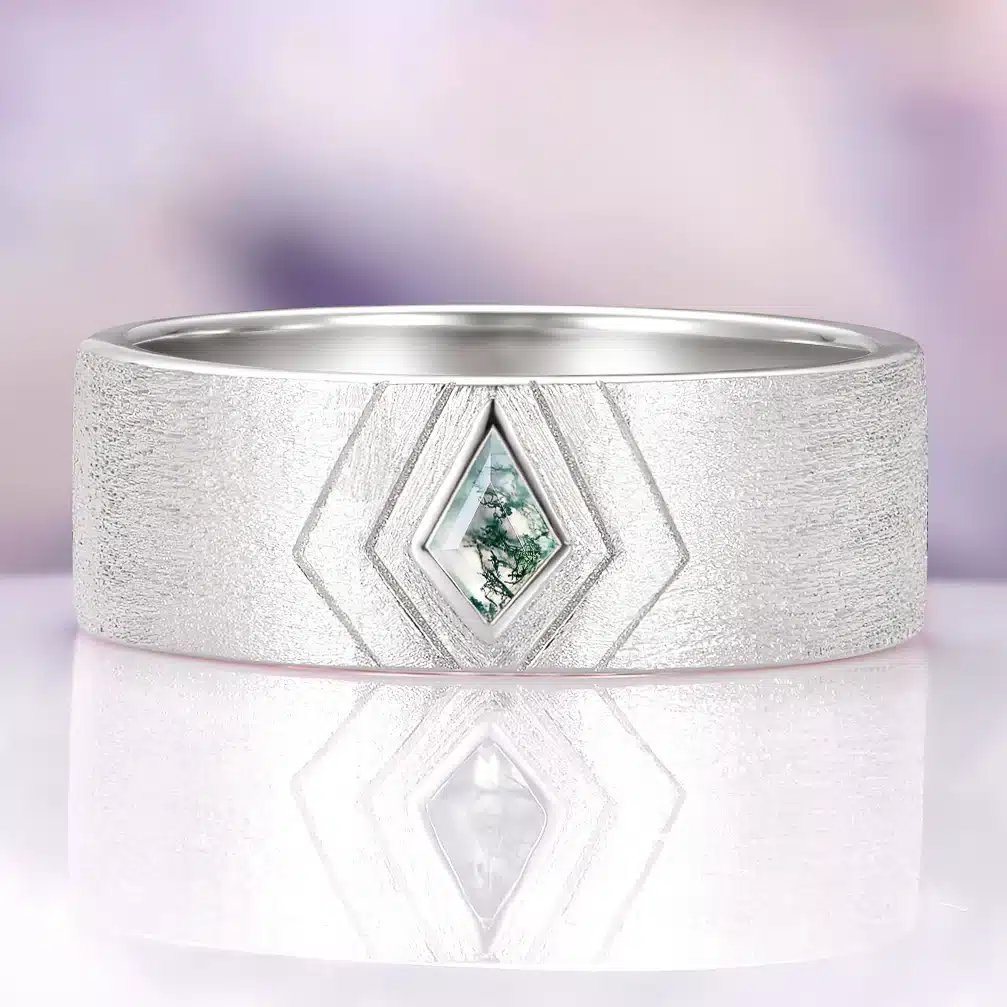
Since every stone differs, choosing moss agate is more personal than choosing a standardized gem. Look at the actual pattern and ask which one feels like yours a bold, dramatic landscape or a soft, subtle one. A range of green moss agate rings shows just how much the stone can vary, which makes finding your pattern part of the fun.
Because you are choosing a specific stone rather than a specification, buying moss agate carries more hesitation than buying a standard gem. Good sellers reduce that with multiple photographs, clear return terms, and a checkout that does not add friction at the moment of commitment. Slow or vague checkout on a one-off item is a reason to pause.
Why uniqueness makes it a great keepsake
A standardized gem can be replaced with an identical one. A moss agate cannot. If a stone is lost or damaged, the closest available replacement is a different stone that happens to be the same species.
That irreplaceability cuts both ways, and it is worth naming honestly. It makes the piece a genuine marker of a specific moment rather than a pretty object that happened to be a gift. It also means insurance and careful wear matter more than they would for something you could simply buy again.
The takeaway
Moss agate patterns are unique because they are accidental. Mineral particles settled where they settled in a rock cavity millions of years ago and the chalcedony hardened around them. There was no process, so there is nothing to repeat.
That makes it a genuinely different kind of purchase. You are not selecting a grade, you are selecting a specific object. Which means the two things worth getting right are seeing the stone properly before you commit, and choosing a setting that suits a Mohs 6.5 to 7 gem rather than a sapphire.
Get those right and the stone will still be recognisably yours in twenty years, which is more than most jewellery can claim.
Is it a sensible engagement ring stone? For most people, yes, with a protective setting and the habit of taking it off for physical work. If you want something you never have to think about, sapphire is the honest answer. If you want a stone that is specifically yours, this is the trade you are making.
Moss Agate: Common Questions
Yes, with sensible setting and care. It sits at Mohs 6.5 to 7, softer than sapphire or diamond, so the surface can dull over years of daily wear. It also has no cleavage, which means it resists chipping better than emerald despite being softer. A protective setting and removing it for abrasive tasks make far more difference than the hardness number alone.
Not by the strict definition. True agates are defined by concentric banding, and moss agate has none. It is a chalcedony with dendritic mineral inclusions, and gemologists often call it dendritic chalcedony. The trade name is universally accepted and both terms are correct in context.
Inclusions of hornblende or chlorite, both mafic minerals, suspended in the chalcedony as it formed. Where the iron in chlorite has oxidized, the colour shifts toward rust or red. Brown and black dendrites are usually manganese oxides. There is no plant material involved despite the appearance.
Warm water, mild soap, a soft cloth or brush. Avoid ultrasonic and steam cleaners, since the inclusions and any internal fractures make thermal and vibrational stress a real risk. Store it away from harder stones, which is most of them.
Not meaningfully. Stones cut from the same nodule can share a family resemblance in colour and density, but the specific pattern is determined by where the inclusions happened to settle in that particular cavity. Even adjacent slices from one piece of rough differ visibly.
Cut, clarity of the chalcedony, colour saturation and pattern desirability all affect it, and pattern is largely a matter of taste rather than a graded quality. Since there is no standardized grading system for moss agate the way there is for diamonds, price varies considerably between sellers for comparable stones. Compare specific stones rather than descriptions.